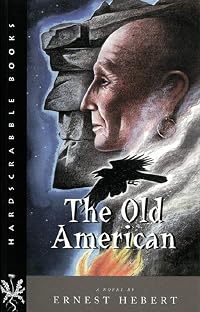
The Old American: A Novel (Hardscrabble Books)
by Ernest Hebert
On This Page
Description
A long-awaited new novel set in the period of the French and Indian Wars brings a new dimension to the region's historyTags
Recommendations







































Member Reviews
This is a fictionalize version of a real-life adventure of Nathan Blake, a settler in colonial America in 1786. He was captured by an Iroquois war party and kept as a prisoner. Ten years later, he was ransomed by his wife. Not much else is known of his captivity except that Nathan said his ten years with the Indians were the happiest period of his life.
Intrigued with this true story, Ernest Hebert, a professor at Dartmouth, well versed in early American history, wrote a historical novel in which he described, from an expert's point of view, the Indians and the pioneers. Hebert describes how the Indians lived, what they were like, and shows their truly human side. He fictionalized the Iroquois captor, whom Hebert names "Caucus-Meteor," a show more son of King Philip (a real historical figure) and portrayed Caucus-Meteor as "king of the remnants of King Philip's tribe." In those days, the Indians, rather than the pioneers, were called Americans. Hebert refers to Caucus-Meteor as "The Old American." The novel is more about Caucus-Meteor than about Nathan Blake. Caucus-Meteor is the main character.
This fascinating novel ends with a description of a stone that marks where Nathan was captured. The stone's caption reads: “Site of first log house built by Nathan Blake 1736. He was captured by the Indians and taken to Canada in 1746. Ransomed by his wife Elizabeth Graves in 1749. Six generations of the Blake family lived on this spot.” show less
Intrigued with this true story, Ernest Hebert, a professor at Dartmouth, well versed in early American history, wrote a historical novel in which he described, from an expert's point of view, the Indians and the pioneers. Hebert describes how the Indians lived, what they were like, and shows their truly human side. He fictionalized the Iroquois captor, whom Hebert names "Caucus-Meteor," a show more son of King Philip (a real historical figure) and portrayed Caucus-Meteor as "king of the remnants of King Philip's tribe." In those days, the Indians, rather than the pioneers, were called Americans. Hebert refers to Caucus-Meteor as "The Old American." The novel is more about Caucus-Meteor than about Nathan Blake. Caucus-Meteor is the main character.
This fascinating novel ends with a description of a stone that marks where Nathan was captured. The stone's caption reads: “Site of first log house built by Nathan Blake 1736. He was captured by the Indians and taken to Canada in 1746. Ransomed by his wife Elizabeth Graves in 1749. Six generations of the Blake family lived on this spot.” show less
Unique persona of native narrator makes this a mind-expanding story.
Ratings
Members
- Recently Added By
Author Information

Awards and Honors
Classifications
Statistics
- Members
- 63
- Popularity
- 494,310
- Reviews
- 2
- Rating
- (4.09)
- Languages
- English
- Media
- Paper, Ebook
- ISBNs
- 4
- ASINs
- 2