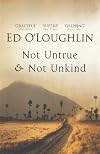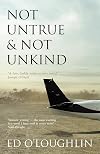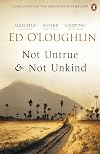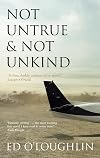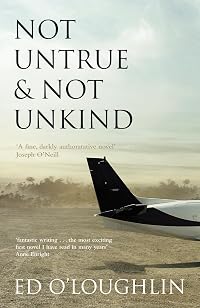
Not Untrue and Not Unkind
by Ed O'Loughlin
On This Page
Description
In Dublin, a newspaper editor called Cartwright is found dead. One of his colleagues, Owen Simmons, discovers a dossier on Cartwright's desk containing a photograph that brings him back to a dusty road in Africa and to a woman he once loved. Not Untrue & Not Unkind is Owen's story, a gripping tale of friendship, rivalry, and betrayal among a group of journalists and photographers covering Africa's wars. It is an astonishingly powerful and accomplished debut that immediately establishes Ed show more O'Loughlin as a mature master of the novel form. show lessTags
Recommendations







Member Reviews
Not Untrue & Not Unkind
Ed O’ Loughlin
It’s a first novel from an Irish journalist who spent time reporting from African war zones. The main character could be the author himself, now back from a traumatic experience in Africa and working at a desk job for a Dublin newspaper. One of his colleagues, Cartwright, commits suicide. Owen finds him - along with photographs that trigger flashbacks to Africa.
The flashbacks were a bit disjointed, and I went back over the Dublin sections at the end and read them in sequence to get a better flow. On the whole though, the book is very skillfully plotted, with clever touches. For example, Owen and his journalist friends hear about another reporter who has written a book called ‘Not Untrue & Not show more Unkind’. They totally rubbish it – the guy was never really there, and hasn’t a clue what he’s on about etc. In a weird example of life imitating art, I found a journalists’ blog on the net dismissing Ed Mc Loughlin’s book for much of the same reasons as in the novel.
The human suffering in Africa is described in a very detached way. I think the author was maybe looking for contrast with some of the more voyeuristic and manipulative news coverage. ‘Getting the story’ is not always the main motive, and the journalists sometimes carry out heroic actions for non-heroic, more human reasons. In Owen’s case he was driven on by love and jealousy - with fatal consequences.
This book made me look at journalists through new eyes, and gave me some understanding of how the whole media circus uses and abuses them too. In an ironic moment two of the journalists buy kitsch Princess Diana t – shirts saying ‘Anyway, we owe it to her memory. It was us who killed her.’ One of them is wearing the t-shirt in a car ambush resulting in death and injury.
The book has a slow pace, and the reader sometimes feels a bit like a journalist hanging round waiting for something to happen. When it does, there’s a real sting in the tail. I’d be interested in reading more from this author. show less
Ed O’ Loughlin
It’s a first novel from an Irish journalist who spent time reporting from African war zones. The main character could be the author himself, now back from a traumatic experience in Africa and working at a desk job for a Dublin newspaper. One of his colleagues, Cartwright, commits suicide. Owen finds him - along with photographs that trigger flashbacks to Africa.
The flashbacks were a bit disjointed, and I went back over the Dublin sections at the end and read them in sequence to get a better flow. On the whole though, the book is very skillfully plotted, with clever touches. For example, Owen and his journalist friends hear about another reporter who has written a book called ‘Not Untrue & Not show more Unkind’. They totally rubbish it – the guy was never really there, and hasn’t a clue what he’s on about etc. In a weird example of life imitating art, I found a journalists’ blog on the net dismissing Ed Mc Loughlin’s book for much of the same reasons as in the novel.
The human suffering in Africa is described in a very detached way. I think the author was maybe looking for contrast with some of the more voyeuristic and manipulative news coverage. ‘Getting the story’ is not always the main motive, and the journalists sometimes carry out heroic actions for non-heroic, more human reasons. In Owen’s case he was driven on by love and jealousy - with fatal consequences.
This book made me look at journalists through new eyes, and gave me some understanding of how the whole media circus uses and abuses them too. In an ironic moment two of the journalists buy kitsch Princess Diana t – shirts saying ‘Anyway, we owe it to her memory. It was us who killed her.’ One of them is wearing the t-shirt in a car ambush resulting in death and injury.
The book has a slow pace, and the reader sometimes feels a bit like a journalist hanging round waiting for something to happen. When it does, there’s a real sting in the tail. I’d be interested in reading more from this author. show less
Owen Simmons is a writer and copy editor for a major international newspaper, who is selected to become an editor after the sudden death of Cartwright, a colleague and nemesis. In preparation for his new position, and a degree of curiosity about the man he is replacing, he reviews Cartwright’s folder. In it he finds a magazine photo that he had taken ten years earlier, when he worked as a freelance journalist in some of the most dangerous places in Africa. In the photograph are several of his former colleagues, most of whom he hasn’t seen or spoken to in years. As he remembers his time in Africa, we learn more about these colleagues, and about the dangers they faced, the petty squabbles and competitions they have with each other, show more and the stressors that make their lives both exhilarating and mundane. A slightly older female journalist becomes a valued confidant and lover, as well.
O’Loughlin, who worked as a reporter in Africa for The Irish Times, gives us a stark and unsentimental look into the lives of foreign journalists in war-torn countries. Simmons and his colleagues are cynical and unlikable characters, which made this book a bit of a challenge to read, as I skimmed over the last 100 pages. The book discusses the townspeople, government officials and military leaders only tangentially, in keeping with its focus on the journalists. Because I gained a greater insight into and appreciation of these journalists, and the hardships they face, I would recommend this book primarily for those interested in an inside look into the lives of foreign journalists. show less
O’Loughlin, who worked as a reporter in Africa for The Irish Times, gives us a stark and unsentimental look into the lives of foreign journalists in war-torn countries. Simmons and his colleagues are cynical and unlikable characters, which made this book a bit of a challenge to read, as I skimmed over the last 100 pages. The book discusses the townspeople, government officials and military leaders only tangentially, in keeping with its focus on the journalists. Because I gained a greater insight into and appreciation of these journalists, and the hardships they face, I would recommend this book primarily for those interested in an inside look into the lives of foreign journalists. show less
Cynical and world-weary journalists covering conflicts in Africa, and juggling love and sex and addiction to the adrenalin? thrill? pressure? Ed O'Loughlin is writing about what he knows, and the verisimilitude shines through. Although not all of us know that much about Africa, so I was quite lost at times.
I usually don't mind being thrown in the deep end with my fiction, but this one did need a few signposts (it's not until 2/3s of the way through that I found out which decade it was set in). And the jumping about in time just confused me (hang on, isn't he dead? Oh, not yet?). Nothing wrong with some chapter titles with some *information* in them.
I liked the cynicism of the characters, at the same time as not liking the cynicism of show more the characters. They were amusing with their bitchy comments about foreign aid and the U.N., but at the same time I was appalled - tell me it isn't so!
It was actually a rather good book, but the frustrations just wore me down by the end. show less
I usually don't mind being thrown in the deep end with my fiction, but this one did need a few signposts (it's not until 2/3s of the way through that I found out which decade it was set in). And the jumping about in time just confused me (hang on, isn't he dead? Oh, not yet?). Nothing wrong with some chapter titles with some *information* in them.
I liked the cynicism of the characters, at the same time as not liking the cynicism of show more the characters. They were amusing with their bitchy comments about foreign aid and the U.N., but at the same time I was appalled - tell me it isn't so!
It was actually a rather good book, but the frustrations just wore me down by the end. show less
One of my friends once said, if you have to make an excuse for a movie, it wasn't any good. I find myself doing this with Ed O'Loughlin's debut novel. By chance I happened to read Tony Maniaty's Shooting Balibo a couple of weeks before and I am compelled to compare them. Of the two, I prefer Shooting Balibo if you're looking for an account of a journalist reporting from a war-torn foreign country. I get that, in order to report dispassionately or objectively, one must distance oneself from the subject to a degree. However Ed O'Loughlin's main character Owen was so busy appearing cool that I was hard-pressed caring for him at all. My enormous ignorance of Africa and its ever changing political landscape also made me want to reach for an show more atlas/wikipaedia to try to follow what on earth was going on. Perhaps this was intentional on the author's behalf but it just left me confused and frustrated. I wanted to gun for one of the characters but they were all so damaged, cynical or thin that it was an effort to finish the book. show less
Owen Simmons is selected to take over after the death of his editor, Cartwright. As he begins to go through Cartwright's folders, he discovers a photo of Owen's friends and colleagues taken during his time in Africa as a correspondent during the 1990s. As he studies the photo, it takes him back to those days, reopening wounds that he'd rather not remember, some of which, in fact, he's mentally disengaged from. In Not Untrue and Not Unkind we follow events of Simmons' past in Africa as he reflects backwards in time, interspersed with events of the present.
But the story isn't really about events per se in Africa, although Simmons was there (for example, at the end of the Rwandan genocide in the Congo) when things were really still very show more hot; rather, it's about the relationship among a group of journalists in Simmons' circle. These people are not glitzy media stars but professional and freelance reporters and photographers out there to scoop the next story. For the most part, these people tend to be callous and shallow, often living and working in emotional disconnect from their surroundings. There is always an undercurrent of tension among the group with feelings often left unspoken and thus not dealt with, especially with Simmons, who can't seem to admit his feelings even to himself and who sometimes has trouble trying to make sense of things. On the whole, they're not likable characters that you can actually warm up to at any point in the story.
The author saves any kind of emotional high note until the end, so you really do have to read through the entire story to make sense of it all. It's slow going until you get there, but well worth the read. I was surprised to discover that Not Untrue and Not Unkind was his first novel because for the most part, the writing is not something you'd expect from a debut.
I recommend it with a few cautions: it's very slow, and you're not going to get any real insights into the whys of the horrors or atrocities of the wars in Africa even though some of the scenes are a bit stomach churning; it's also character, rather than action driven, and the slow pace may also be a turnoff for some readers. Overall, though, I liked it and thought it well worth the time I put into it. show less
But the story isn't really about events per se in Africa, although Simmons was there (for example, at the end of the Rwandan genocide in the Congo) when things were really still very show more hot; rather, it's about the relationship among a group of journalists in Simmons' circle. These people are not glitzy media stars but professional and freelance reporters and photographers out there to scoop the next story. For the most part, these people tend to be callous and shallow, often living and working in emotional disconnect from their surroundings. There is always an undercurrent of tension among the group with feelings often left unspoken and thus not dealt with, especially with Simmons, who can't seem to admit his feelings even to himself and who sometimes has trouble trying to make sense of things. On the whole, they're not likable characters that you can actually warm up to at any point in the story.
The author saves any kind of emotional high note until the end, so you really do have to read through the entire story to make sense of it all. It's slow going until you get there, but well worth the read. I was surprised to discover that Not Untrue and Not Unkind was his first novel because for the most part, the writing is not something you'd expect from a debut.
I recommend it with a few cautions: it's very slow, and you're not going to get any real insights into the whys of the horrors or atrocities of the wars in Africa even though some of the scenes are a bit stomach churning; it's also character, rather than action driven, and the slow pace may also be a turnoff for some readers. Overall, though, I liked it and thought it well worth the time I put into it. show less
A good book that could have been a great one. The author writes whereof he knows - but his writing suffers from his journalistic background. It doesn't help that the narrator is a self-centered douche-bag.
A great book- very well written! Whilst a better knowledge of recent African history/politics and conflicts would have added to my understanding, its lack did not take away from my enjoyment.
The writing stands out as some of the finest new writing I've had the pleasure to read.
The writing stands out as some of the finest new writing I've had the pleasure to read.
Members
- Recently Added By
Lists

Booker Prize
491 works; 62 members

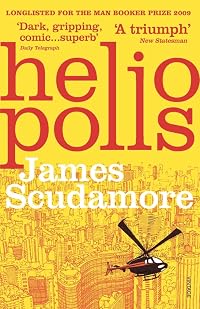
Man Booker Prize Longlist 2009
13 works; 2 members
Author Information
6+ Works 288 Members
Awards and Honors
Common Knowledge
- Dedication
- To Nuala
- First words
- Ten years ago, I became a hero, and when I came home my old paper took me on again.
- Last words
- (Click to show. Warning: May contain spoilers.)There could be anything at all in that camera, until I open it up, and learn differently.
- Blurbers
- Hope, Christopher; O'Neill, Joseph; Enright, Anne
Classifications
Statistics
- Members
- 102
- Popularity
- 317,182
- Reviews
- 9
- Rating
- (3.27)
- Languages
- English
- Media
- Paper, Audiobook, Ebook
- ISBNs
- 18
- ASINs
- 3