
On This Page
Description
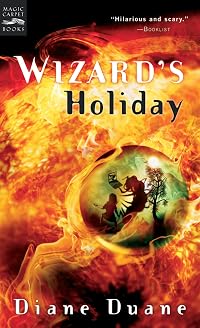
While Nita's sister and her dad host three young alien wizards, teenage wizards Nita and Kit travel halfway across the galaxy as part of an exchange program and find themselves again caught up in the dark doings of their nemesis, the Lone Power.Tags
Recommendations
















Member Reviews
While I enjoyed reading this book, I had some very mixed feelings about one of the two main plots in it. I also got a bit confused by some of the details.
The main idea of the story is that Nita and Kit end up partaking in what was explained to be a sort of wizard exchange program; wizards visit other cultures, and in return, their home is used to house exchange wizards from other planets. However, the math of it didn't make any sense to me. I figured Nita and Kit would go to a home where one or two wizards had left, while an exchange wizard would be housed in each of their homes. What actually happened was that three exchange wizards stayed at Nita's house (none at Kit's), and no one on the entire planet Nita and Kit visited left to be show more an exchange wizard. The math of the whole process felt sloppy and illogical to me, though admittedly, I've never done a cultural exchange program in real life, so I don't know if it's as neat and logical as I expected it to be or not.
Now, the at-home story about the three exchange wizards that stay at Nita's house with Dairine made sense to me and was enjoyable. I liked reading about the different aliens' physiologies and perceptions of Earth; in fact, I would have enjoyed seeing even more of this, as reading about Earth from an alien perspective is a favored trope of mine. However, I didn't much like Nita and Kit's plot line, at all. They are assigned to this tropical paradise of a planet; unlike humans and most other species, the people of this planet actually rejected the Lone Power during their Choice, leading to complete peace, long life, and a lingering presence of spirits after death. The whole planet felt ideal to me, exactly as I wish Earth could be, but Nita kept feeling this nagging sense that something wasn't right, and that idea that some nameless thing was wrong with what could be considered perfection was really the only thing that pushed the plot forward in the first place (and pretty late into the book, I might add). In the end, they run into the Lone Power (shocked, aren't you?) and It tells them that the Choice these people made stunted their ability to evolve, which It makes out to be much more important than the eternal happiness that they are effectively lounging in. Now, for some reason, Nita and Kit actually agree and immediately begin trying to convince the wizard they're staying with that her people need to give up world peace and long life so that they can stop stagnating (what evolution actually needs to occur when you've already accomplished world peace and long life is beyond me). In the end, it turned out that the evolution that needed to occur was dying and leaving the planet permanently (like we do IRL), and the second that the wizard responsible for this planet accepted this and renounced their Choice, everyone on the entire planet died instantly. What's worse, this was considered a good thing, and Nita and Kit went home feeling accomplished. How messed up is that?
Now, maybe Diane Duane has more religious leanings than I was aware of (with the heavy science influence of her books, I wouldn't have expected that), but as an agnostic who believes there's no way of knowing what will happen after death, it sickens me to think that anyone would believe so strongly in a happy afterlife that they would willingly let themselves die to reach it. These people were capable of living thousands of years in a beautiful and violence-free world and effectively living on a different version of their planet permanently after they "died," as well. They even had proof that their spirits would exist after they died because the dead could still speak to the living to some extent. Yet every single person on the entire planet agreed within what I read to be the span of a few minutes that they would rather give up all that to die and see what's out there. Never in a million years would I have agreed with that decision, but there was next to no dissent whatsoever. And what's worse, this completely undermined everything the series seemed to be saying in the earlier books. The Lone Power is known to be so horrible because it created death and its broader manifestation, entropy, and because it corrupted most civilizations in existence with this poisonous touch. So how can Nita and Kit possibly encourage this death and corruption, especially when not a single soul seemed unhappy with the way things were in this perfect society? It Duane intended to paint the world as a happy-on-the-surface-but-secretly-torture situation, she failed miserably. And Nita also lost her mother a few books back; how she could encourage the death of a whole species without once questioning anything about her decision, I'll never understand.
Anyway, here's hoping the next book is more consistent with the values of the originals. show less
The main idea of the story is that Nita and Kit end up partaking in what was explained to be a sort of wizard exchange program; wizards visit other cultures, and in return, their home is used to house exchange wizards from other planets. However, the math of it didn't make any sense to me. I figured Nita and Kit would go to a home where one or two wizards had left, while an exchange wizard would be housed in each of their homes. What actually happened was that three exchange wizards stayed at Nita's house (none at Kit's), and no one on the entire planet Nita and Kit visited left to be show more an exchange wizard. The math of the whole process felt sloppy and illogical to me, though admittedly, I've never done a cultural exchange program in real life, so I don't know if it's as neat and logical as I expected it to be or not.
Now, the at-home story about the three exchange wizards that stay at Nita's house with Dairine made sense to me and was enjoyable. I liked reading about the different aliens' physiologies and perceptions of Earth; in fact, I would have enjoyed seeing even more of this, as reading about Earth from an alien perspective is a favored trope of mine. However, I didn't much like Nita and Kit's plot line, at all. They are assigned to this tropical paradise of a planet; unlike humans and most other species, the people of this planet actually rejected the Lone Power during their Choice, leading to complete peace, long life, and a lingering presence of spirits after death. The whole planet felt ideal to me, exactly as I wish Earth could be, but Nita kept feeling this nagging sense that something wasn't right, and that idea that some nameless thing was wrong with what could be considered perfection was really the only thing that pushed the plot forward in the first place (and pretty late into the book, I might add). In the end, they run into the Lone Power (shocked, aren't you?) and It tells them that the Choice these people made stunted their ability to evolve, which It makes out to be much more important than the eternal happiness that they are effectively lounging in. Now, for some reason, Nita and Kit actually agree and immediately begin trying to convince the wizard they're staying with that her people need to give up world peace and long life so that they can stop stagnating (what evolution actually needs to occur when you've already accomplished world peace and long life is beyond me). In the end, it turned out that the evolution that needed to occur was dying and leaving the planet permanently (like we do IRL), and the second that the wizard responsible for this planet accepted this and renounced their Choice, everyone on the entire planet died instantly. What's worse, this was considered a good thing, and Nita and Kit went home feeling accomplished. How messed up is that?
Now, maybe Diane Duane has more religious leanings than I was aware of (with the heavy science influence of her books, I wouldn't have expected that), but as an agnostic who believes there's no way of knowing what will happen after death, it sickens me to think that anyone would believe so strongly in a happy afterlife that they would willingly let themselves die to reach it. These people were capable of living thousands of years in a beautiful and violence-free world and effectively living on a different version of their planet permanently after they "died," as well. They even had proof that their spirits would exist after they died because the dead could still speak to the living to some extent. Yet every single person on the entire planet agreed within what I read to be the span of a few minutes that they would rather give up all that to die and see what's out there. Never in a million years would I have agreed with that decision, but there was next to no dissent whatsoever. And what's worse, this completely undermined everything the series seemed to be saying in the earlier books. The Lone Power is known to be so horrible because it created death and its broader manifestation, entropy, and because it corrupted most civilizations in existence with this poisonous touch. So how can Nita and Kit possibly encourage this death and corruption, especially when not a single soul seemed unhappy with the way things were in this perfect society? It Duane intended to paint the world as a happy-on-the-surface-but-secretly-torture situation, she failed miserably. And Nita also lost her mother a few books back; how she could encourage the death of a whole species without once questioning anything about her decision, I'll never understand.
Anyway, here's hoping the next book is more consistent with the values of the originals. show less
This has to be my favorite of the Young Wizards series, although others come close. The premise, the story, the characters, the places; everything Duane did fantastically in her other books gets stepped up a notch.
While Kit and Nita's journey was strange and eye-opening (and seeing the depths of the Lone One's ambiguous deviousness was fun--especially as a girl this time!) But it has to be admitted; it was the events with the foreign exchange wizards back on Earth that stole the show.
I like watching Dairine's character grow, especially as I thought she was being neglected ever since "A Wizard Abroad". This book gave her a huge chance to do that. But really, we can talk character development all we want. But taking a Christmas tree, a show more giant purple centipede, and a holier-than-thou alien prince to the mall? It does not get better than this. Filif and Sker'ret were a lot of fun, but I think Roshaun was the best newcomer-character. I loved the dynamic between him and Dairine...it was built at just the right pace.
And the climax was breathtaking. Be prepared for cliffhangers galore. show less
While Kit and Nita's journey was strange and eye-opening (and seeing the depths of the Lone One's ambiguous deviousness was fun--especially as a girl this time!) But it has to be admitted; it was the events with the foreign exchange wizards back on Earth that stole the show.
I like watching Dairine's character grow, especially as I thought she was being neglected ever since "A Wizard Abroad". This book gave her a huge chance to do that. But really, we can talk character development all we want. But taking a Christmas tree, a show more giant purple centipede, and a holier-than-thou alien prince to the mall? It does not get better than this. Filif and Sker'ret were a lot of fun, but I think Roshaun was the best newcomer-character. I loved the dynamic between him and Dairine...it was built at just the right pace.
And the climax was breathtaking. Be prepared for cliffhangers galore. show less
In the grand tradition of Star Trek films, the best Young Wizards books are always the even-numbered ones. Except Wizard's Holiday, which bucks that trend by being one of the very best books in the series - even if it is something of an in-between book.
When we open this book, Nita has been going all-out pretty much ever since she became a wizard, and is still reeling from the death of her mother and the changes in her life around that loss. But in Wizard's Holiday, she gets a vacation - a real vacation, to sit on the beach and get sunburnt and read and relax. For free and clear, courtesy of the Powers that Be, as part of a wizarding exchange program.
Of course, the One's work is everywhere, and a wizard's holiday always involves some show more wizard's work in it, somewhere.
Meanwhile, Dairine is left at home with her father to handle the foreign wizards hosted at their house in exchange, a delightfully mismatched group of wonderfully non-humanoid young people, each with his own problems back home -- and a crisis shows up on Earth as well, a chance for Dairine's guests to have a wizard's holiday as well.
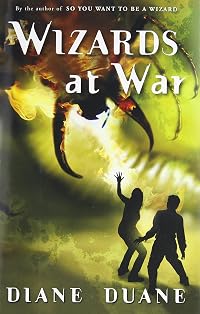
This is a much more low-tension book than most of the series, and most books of its type; though the climax is as high-stakes as ever, most of the book is about exploring and making friends and learning about yourself - the fun parts of being a wizard, and something that too easily gets lost in stories that simply chronicle one crisis after another. In some respects it serves as a calm before the storm that's coming in the next books, Wizards at War (and it has much more in the way of a direct lead-in to that next book than most of the YW volumes, though it's not quite a cliffhanger). But it's also a chance to see how the young wizards react to wizardly problems when they *aren't* under direct pressure - a much different kind of test.
I do have a few issues with the structure here - the start is slow (espeically for someone who already knows all about wizardry); the switching between Nita and Dairine with barely-connected storylines on two different planets can be fragmenting and confusing, especially with lots of new characters being introduced quickly; and in some respects the endings come off as rushed. But the general high quality of the writing and the characters and story is up to Duane's usual standard and this is simply a lovely book. show less
When we open this book, Nita has been going all-out pretty much ever since she became a wizard, and is still reeling from the death of her mother and the changes in her life around that loss. But in Wizard's Holiday, she gets a vacation - a real vacation, to sit on the beach and get sunburnt and read and relax. For free and clear, courtesy of the Powers that Be, as part of a wizarding exchange program.
Of course, the One's work is everywhere, and a wizard's holiday always involves some show more wizard's work in it, somewhere.
Meanwhile, Dairine is left at home with her father to handle the foreign wizards hosted at their house in exchange, a delightfully mismatched group of wonderfully non-humanoid young people, each with his own problems back home -- and a crisis shows up on Earth as well, a chance for Dairine's guests to have a wizard's holiday as well.
This is a much more low-tension book than most of the series, and most books of its type; though the climax is as high-stakes as ever, most of the book is about exploring and making friends and learning about yourself - the fun parts of being a wizard, and something that too easily gets lost in stories that simply chronicle one crisis after another. In some respects it serves as a calm before the storm that's coming in the next books, Wizards at War (and it has much more in the way of a direct lead-in to that next book than most of the YW volumes, though it's not quite a cliffhanger). But it's also a chance to see how the young wizards react to wizardly problems when they *aren't* under direct pressure - a much different kind of test.
I do have a few issues with the structure here - the start is slow (espeically for someone who already knows all about wizardry); the switching between Nita and Dairine with barely-connected storylines on two different planets can be fragmenting and confusing, especially with lots of new characters being introduced quickly; and in some respects the endings come off as rushed. But the general high quality of the writing and the characters and story is up to Duane's usual standard and this is simply a lovely book. show less
This is book seven in Diane Duane's Young Wizards series, which features teenage wizards helping to keep the Earth and the universe in good working order. In this one, our heroes Nita and Kit participate in a sort of wizardly exchange student program, which sends them to a paradisaical alien planet for two weeks while an assorted trio of aliens moves into Nita's house with her dad and her sister.
I remembered really enjoying at least the first few books in this series, but at some point I lost interest or just stalled out for some reason, and it had been many, many years since I read book six. The good news is that it was easy enough to fall right back into the series, and not the least bit confusing, even if I'd forgotten a lot of the show more specific details of what had happened before. And this installment did make me remember what I liked about it in the first place, including the way the magic is informed by real science and the sense that the characters inhabit a big, wide, wonderful universe. I'm less sure how I feel about the pseudo-Christian metaphysics behind it all, but it is at least interesting, and it's wrapped up in an appealingly life-affirming philosophy.
Unfortunately, most of this particular volume just wasn't particularly interesting, as it takes almost 3/4 of the book before any semblance of a plot develops. That's nearly 300 pages of lying around on beaches and introducing aliens to the joys of the American shopping mall, and it's pleasant enough, even rather charming, but not terribly engaging, to the extent that every time I put the book down, I had to mentally poke myself to make myself pick it up again. And once the plot does get going, some parts of it work better than others. I was never able to get too worked up about the Earth-bound side of the story, as there was very little suspense about how it was going to come out. The stuff on the alien planet was quite a bit more interesting, if only because it gave me a lot of classic Star Trek vibes, but both parts felt like they wrapped up entirely too abruptly.
Mind you, it's very possible that if I hadn't left the better part of a decade between the previous volume and this one, the lack of action in most of it might have felt more like a welcome breather -- a holiday, even -- between more intense stories. It's also very possible that if I were 12 or so, and thus much more firmly in the intended audience, rather than the jaded, seen-it-all adult that I am, pure sense of wonder might have carried me happily through the slower parts.
I'm not remotely sure, now, whether I'm going to end my attempt to return to this series here or carry on with the rest of it at some point. show less
I remembered really enjoying at least the first few books in this series, but at some point I lost interest or just stalled out for some reason, and it had been many, many years since I read book six. The good news is that it was easy enough to fall right back into the series, and not the least bit confusing, even if I'd forgotten a lot of the show more specific details of what had happened before. And this installment did make me remember what I liked about it in the first place, including the way the magic is informed by real science and the sense that the characters inhabit a big, wide, wonderful universe. I'm less sure how I feel about the pseudo-Christian metaphysics behind it all, but it is at least interesting, and it's wrapped up in an appealingly life-affirming philosophy.
Unfortunately, most of this particular volume just wasn't particularly interesting, as it takes almost 3/4 of the book before any semblance of a plot develops. That's nearly 300 pages of lying around on beaches and introducing aliens to the joys of the American shopping mall, and it's pleasant enough, even rather charming, but not terribly engaging, to the extent that every time I put the book down, I had to mentally poke myself to make myself pick it up again. And once the plot does get going, some parts of it work better than others. I was never able to get too worked up about the Earth-bound side of the story, as there was very little suspense about how it was going to come out. The stuff on the alien planet was quite a bit more interesting, if only because it gave me a lot of classic Star Trek vibes, but both parts felt like they wrapped up entirely too abruptly.
Mind you, it's very possible that if I hadn't left the better part of a decade between the previous volume and this one, the lack of action in most of it might have felt more like a welcome breather -- a holiday, even -- between more intense stories. It's also very possible that if I were 12 or so, and thus much more firmly in the intended audience, rather than the jaded, seen-it-all adult that I am, pure sense of wonder might have carried me happily through the slower parts.
I'm not remotely sure, now, whether I'm going to end my attempt to return to this series here or carry on with the rest of it at some point. show less
I read this back when it came out, but remembered very little of it. Reading a retrospective of the series (at online SFF magazine Strange Horizons) made me want to catch up on the last few entries, and this was suggested as a good point to step back in and catch up.
Dairine, wanting to get away from the tense atmosphere that still hangs in the Callahan household after the events of The Wizard's Dilemma, signs herself and Nita up for an exchange program that would send them halfway across the universe... without telling Nita, their father, or any local wizardly authority. She ends up grounded but encourages Nita to go and take Kit with her, the allowance for the transit already having been approved.
Nita and Kit end up on Alaalu, a huge, show more beautiful world so calm and peaceful that only one wizard is needed for the entire planet... a world still caught up in the consequences of the Alaalids' long-ago Choice. Dairine and her father end up with three wizardly houseguests- centipede-like Sker'ret, burdened with his parent's expectations for the future; exuberant sentient tree Filif; and the standoffish, arrogant alien prince Roshaun.
This one takes a while to get going, with a leisurely but enjoyable first half (maybe as much as first two thirds) split between Nita and Kit traveling to and settling in on Alaalu and Dairine trying to manage her guests' personalities (especially clashing with Roshaun, who is too like Dairine herself for her comfort) and handle a sudden crisis that her guests just might be in exactly the right place at the right time to handle.
My one quibble is that it seemed like there was very little in the way of denouement- I especially would have liked to have seen more wrap-up on the Dairine side. It seems like the next book might pick up very shortly after (if not immediately after) this one, though, so that may be less of a problem if the books are read close together. show less
Dairine, wanting to get away from the tense atmosphere that still hangs in the Callahan household after the events of The Wizard's Dilemma, signs herself and Nita up for an exchange program that would send them halfway across the universe... without telling Nita, their father, or any local wizardly authority. She ends up grounded but encourages Nita to go and take Kit with her, the allowance for the transit already having been approved.
Nita and Kit end up on Alaalu, a huge, show more beautiful world so calm and peaceful that only one wizard is needed for the entire planet... a world still caught up in the consequences of the Alaalids' long-ago Choice. Dairine and her father end up with three wizardly houseguests- centipede-like Sker'ret, burdened with his parent's expectations for the future; exuberant sentient tree Filif; and the standoffish, arrogant alien prince Roshaun.
This one takes a while to get going, with a leisurely but enjoyable first half (maybe as much as first two thirds) split between Nita and Kit traveling to and settling in on Alaalu and Dairine trying to manage her guests' personalities (especially clashing with Roshaun, who is too like Dairine herself for her comfort) and handle a sudden crisis that her guests just might be in exactly the right place at the right time to handle.
My one quibble is that it seemed like there was very little in the way of denouement- I especially would have liked to have seen more wrap-up on the Dairine side. It seems like the next book might pick up very shortly after (if not immediately after) this one, though, so that may be less of a problem if the books are read close together. show less
The Wizard's Holiday is a fun book. Because of all the stress and issues in the previous couple of books, Dairine decides to sign herself and her sister up for a sort of wizardly student exchange program during spring break. She gets in trouble for signing them up without asking anyone first, so instead of her and Nita going, Nita and Kit go, while Dairine stays home to help her dad deal with the exchange wizards that come to stay at her house. Hijinks ensue...and some saving the world, too.
Great book. I don't think there's much difference (a few bits, but not much - Nita's dad's cellphone, for one) between this and the original edition. The funny thing is that I remember scenes throughout the book, including the end, which makes me think I read it all - but I must have skimmed in some fashion, because I don't remember some very important scenes and concepts. There's some really deep thinking here - much less grimness and sorrow than the last couple books, but (as usual for a Duane) new concepts about the way the universe is organized, and the characters' parts to play in the universe. Little things like why the Stationmaster was rude, or what the keks were actually doing, have wider resonances throughout the book and into show more later books (I'm pretty sure). This is supposed to be a vacation for the wizards - it turns out to be not so much of one, more just another errantry (though they do get _some_ time to relax). It is, however, a nice vacation for the readers. While the stakes continue to be high, there's much less of the doom and gloom of the last few books; the one point where the Lone One is gloating doesn't last long, for a change. Loopholes - speaking of resonances, that one resonates from the very first book (among others). Two different storylines, with Kit and Nita in one and Dairine in the other, along with other wizards in both lines. The siblings don't interact at all, though (which is probably a good thing for both of them - speaking of holidays). Fun, and makes me want to read the next one soon. show less
Members
- Recently Added By
Lists

Travel from real to fantasy world -- children's/young adult fiction
125 works; 11 members

Books Read in 2014
2,343 works; 89 members
Author Information

135+ Works 35,868 Members
Author Diane Duane was born in New York City on May 18, 1952, and grew up in Roosevelt, Long Island. She is an American science fiction and fantasy author. Duane studied nursing in college and became a psychiatric nurse. She began writing full time in 1980 and has published numerous novels, including several with her husband, Peter Morwood. She show more also writes screenplays, served as senior writer for the BBC-TV education series "Science Challenge," and writes scripts for CD-ROM computer games. Her "Young Wizards" series won a special commendation in the Anne Spencer Lindbergh Prize in Children's Literature, 2003. She currently lives in County Wicklow, Ireland. (Bowker Author Biography) show less

Diane Duane is a LibraryThing Author, an author who lists their personal library on LibraryThing.
Some Editions
Series


Work Relationships
Common Knowledge
- Canonical title
- Wizard's Holiday
- Original publication date
- 2003-10-01
- People/Characters
- Dairine Callahan; Harold Edward Callahan; Nita Callahan; Filif; the Lone One; Ponch (show all 14); Quelt; Carmela Rodriguez; Kit Rodriguez; Roshaun; Sker'ret; Spot [Dairine Callahan's companion]; Tom Swale; Urruah
- Important places
- Alaalu; the Crossings; Hempstead, New York, USA; Nassau County, New York, USA; New York, USA; New York, New York, USA (show all 9); USA; Wellakh; Long Island, New York, USA
- Epigraph
- Unending stairs reach up the mountain above you,
And you keep climbing, while the welcoming voices
Cheer you along. They make the long climb easier,
Though the gift you’re bringing may to you seem small.
Don... (show all)’t worry, it’s what they need. For all the cheering,
See how empty the streets are? Take your time,
Make your way upward steadily toward what waits,
Through day’s blind radiance to the city’s pinnacle,
And fall up the last few steps into empty sky…
— hexagram 46, Sheng: “Onward and Upward”
“With me, a change of trouble is as good as a vacation.”
— David Lloyd George (1863-1945)
What, can the Devil speak true?
— William Shakespeare, Macbeth, I, iii - Dedication
- For Virginia Heinlein
…We miss you, Astyanax. - First words
- It was the Friday afternoon before the start of spring break.
- Last words
- (Click to show. Warning: May contain spoilers.)“Uh-oh. Uh-oh. Uh-oh… !”
- Original language
- English
Classifications
- Genres
- Fiction and Literature, Fantasy, Teen, Young Adult
- DDC/MDS
- 813.54 — Literature & rhetoric American literature in English American fiction in English 1900-1999 1945-1999
- LCC
- PZ7 .D84915 .W — Language and Literature Fiction and juvenile belles lettres Fiction and juvenile belles lettres Juvenile belles lettres
- BISAC
Statistics
- Members
- 1,435
- Popularity
- 16,357
- Reviews
- 22
- Rating
- (3.99)
- Languages
- English, German
- Media
- Paper, Audiobook, Ebook
- ISBNs
- 16
- ASINs
- 7