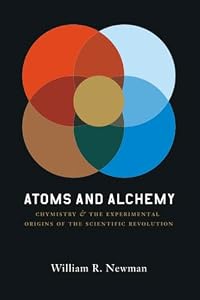
Atoms and Alchemy: Chymistry and the Experimental Origins of the Scientific Revolution
by William R. Newman
On This Page
Description
Since the Enlightenment, alchemy has been viewed as a sort of antiscience, disparaged by many historians as a form of lunacy that impeded the development of rational chemistry. But in Atoms and Alchemy, William R. Newman--a historian widely credited for reviving recent interest in alchemy--exposes the speciousness of these views and challenges widely held beliefs about the origins of the Scientific Revolution. Tracing the alchemical roots of Robert Boyle's famous mechanical philosophy, show more Newman shows that alchemy contributed to the mechanization of nature, a movement that lay at the very heart of scientific discovery. Boyle and his predecessors--figures like the mysterious medieval Geber or the Lutheran professor Daniel Sennert--provided convincing experimental proof that matter is made up of enduring particles at the microlevel. At the same time, Newman argues that alchemists created the operational criterion of an "atomic" element as the last point of analysis, thereby contributing a key feature to the development of later chemistry. Atomsand Alchemy thus provokes a refreshing debate about the origins of modern science and will be welcomed--and deliberated--by all who are interested in the development of scientific theory and practice. show lessTags
Recommendations








Member Reviews
Most discussions of the Scientific Revolution leaves out the impact that Alchemy has had on the development of chemistry, metallurgy, and (in this case) matter theory. Alchemy is portrayed as grounded in myth and mysticism, and therefore could not have influenced serious scientists.
But as Newman points out, Alchemy and Chymistry (a science that many alchemists practiced) actually had a significant influence in the 16th and 17th centuries, and must have had an impact on the scientists working in those periods. Newman uses strong textual evidence throughout his book to show in very specific ways, how Chymistry influenced the development of matter theory, specifically citing the ways in which Robert Boyle's mechanical philosophy was show more influenced by the work of Daniel Sennert. Sennert's use of reduction and experimentation to prove his theories was and especially important influence on Boyle.
This is not a fun book to read. In fact, it reads like a text book and is very dense with information. I was willing to work my way through it, because the subject matter was interesting enough to me. I especially liked seeing the thought processes that these scientists used, which is so foreign now, with our understanding of atoms and molecules.
I would not recommend this to everyone, but those who are interested in the subject matter and willing to put a little effort into their reading may find this an interesting book. show less
But as Newman points out, Alchemy and Chymistry (a science that many alchemists practiced) actually had a significant influence in the 16th and 17th centuries, and must have had an impact on the scientists working in those periods. Newman uses strong textual evidence throughout his book to show in very specific ways, how Chymistry influenced the development of matter theory, specifically citing the ways in which Robert Boyle's mechanical philosophy was show more influenced by the work of Daniel Sennert. Sennert's use of reduction and experimentation to prove his theories was and especially important influence on Boyle.
This is not a fun book to read. In fact, it reads like a text book and is very dense with information. I was willing to work my way through it, because the subject matter was interesting enough to me. I especially liked seeing the thought processes that these scientists used, which is so foreign now, with our understanding of atoms and molecules.
I would not recommend this to everyone, but those who are interested in the subject matter and willing to put a little effort into their reading may find this an interesting book. show less
Ratings
Members
- Recently Added By
Lists

Chemistry
53 works; 3 members
Author Information
9+ Works 324 Members
William R. Newman is professor of history of science at Indiana University
Classifications
Statistics
- Members
- 57
- Popularity
- 536,247
- Reviews
- 1
- Rating
- (3.50)
- Languages
- English
- Media
- Paper, Ebook
- ISBNs
- 4