On This Page
Tags
Recommendations





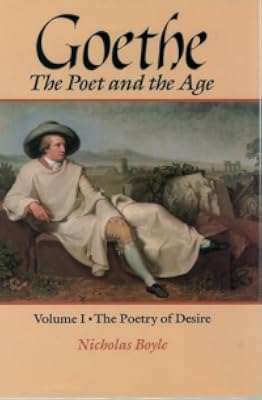





















Member Reviews
This is a tough one to catalog on LT, with so many different editions dividing it in so many different ways. Wikipedia tells me there are four "parts" of five "books" (chapters?) each, but various editions split these across volumes in all sorts of ways. My ebook cuts off halfway through Part 2, and I only read to the end of Part 1.
Goethe's earliest childhood memories included tossing and smashing all his household's new crockery into the street for the thrill of entertaining neighbourhood children - how great is that? Reading the rest of Part One taught me the core of his origins. He demonstrated a genius for learning and curiosity from a young age. He came from a well-to-do household that could afford to educate him with the best show more tutors, and he had some say in which tutors he received. He could study and pick up languages in a snap: German, Italian, French, English, Latin, Greek and Hebrew. He wasn't a man who came from nothing or through hardships; it's a story of someone who applied himself in an ideal environment, amply challenged and rewarded by his betters.
Part One is mostly not too bad to get through (although he basically reviews the entire book of Genesis at one point), but it took the wind out of my sails about continuing when I learned Goethe's biographers consider this an unreliable source. Goethe admitted to inventing or exaggerating events (poetry) from his life (truth) to make a better story out of it. I trust he was at least honest about his influences, since he believed that to be the most important portion of any man's history. Embellished descriptors of other people seems to be the primary complaint. Gretchen possibly never existed, and knowing that is what countered the hook at the end of Part One that otherwise would have kept me going.
Goethe is likened often to Shakespeare in the pantheon of literary figures. I wish the Bard had been able to leave us even this much of a personal history. show less
Goethe's earliest childhood memories included tossing and smashing all his household's new crockery into the street for the thrill of entertaining neighbourhood children - how great is that? Reading the rest of Part One taught me the core of his origins. He demonstrated a genius for learning and curiosity from a young age. He came from a well-to-do household that could afford to educate him with the best show more tutors, and he had some say in which tutors he received. He could study and pick up languages in a snap: German, Italian, French, English, Latin, Greek and Hebrew. He wasn't a man who came from nothing or through hardships; it's a story of someone who applied himself in an ideal environment, amply challenged and rewarded by his betters.
Part One is mostly not too bad to get through (although he basically reviews the entire book of Genesis at one point), but it took the wind out of my sails about continuing when I learned Goethe's biographers consider this an unreliable source. Goethe admitted to inventing or exaggerating events (poetry) from his life (truth) to make a better story out of it. I trust he was at least honest about his influences, since he believed that to be the most important portion of any man's history. Embellished descriptors of other people seems to be the primary complaint. Gretchen possibly never existed, and knowing that is what countered the hook at the end of Part One that otherwise would have kept me going.
Goethe is likened often to Shakespeare in the pantheon of literary figures. I wish the Bard had been able to leave us even this much of a personal history. show less
Members
- Recently Added By
Lists

501 Must-Read Books
529 works; 72 members
Author Information

3,056+ Works 51,638 Members
Johann Wolfgang von Goethe, 1749-1832 Johann Wolfgang von Goethe was born in Frankfurt am Main. He was greatly influenced by his mother, who encouraged his literary aspirations. After troubles at school, he was taught at home and gained an exceptionally wide education. At the age of 16, Goethe began to study law at Leipzig University from 1765 to show more 1768, and he also studied drawing with Adam Oeser. After a period of illness, he resumed his studies in Strasbourg from 1770 to 1771. Goethe practiced law in Frankfurt for two years and in Wetzlar for a year. He contributed to the Frankfurter Gelehrte Anzeigen from 1772 to 1773, and in 1774 he published his first novel, self-revelatory Die Leiden des Jungen Werthers. In 1775 he was welcomed by Duke Karl August into the small court of Weimar, where he worked in several governmental offices. He was a council member and member of the war commission, director of roads and services, and managed the financial affairs of the court. Goethe was released from day-to-day governmental duties to concentrate on writing, although he was still general supervisor for arts and sciences, and director of the court theatres. In the 1790s Goethe contributed to Friedrich von Schiller´s journal Die Horen, published Wilhelm Meister's Apprenticeship, and continued his writings on the ideals of arts and literature in his own journal, Propyläen. The first part of his masterwork, Faust, appeared in 1808, and the second part in 1832. Goethe had worked for most of his life on this drama, and was based on Christopher Marlowe's Faust. From 1791 to 1817, Goethe was the director of the court theatres. He advised Duke Carl August on mining and Jena University, which for a short time attracted the most prominent figures in German philosophy. He edited Kunst and Altertum and Zur Naturwissenschaft. Goethe died in Weimar on March 22, 1832. He and Duke Schiller are buried together, in a mausoleum in the ducal cemetery. (Bowker Author Biography) show less
Series

Classifications
- Genres
- Fiction and Literature, Biography & Memoir
- DDC/MDS
- 831.6 — Literature & rhetoric German & related literatures German poetry 1750–1832 : 18th century; classical period; romantic period
- LCC
- PT2027 .A8 .O8 — Language and Literature German, Dutch and Scandinavian literatures German literature Individual authors or works 1700-ca. 1860/70 Goethe Translations
Statistics
- Members
- 53
- Popularity
- 575,436
- Reviews
- 1
- Rating
- (3.50)
- Languages
- English, French, German
- Media
- Paper
- ISBNs
- 4
- ASINs
- 2