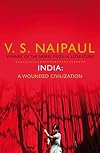
India: A Wounded Civilization
by V. S. Naipaul
On This Page
Description
In 1975, at the height of Indira Gandhi's "Emergency," V. S. Naipaul returned to India, the country his ancestors had left one hundred years earlier. Out of that journey he produced this concise masterpiece: a vibrant, defiantly unsentimental portrait of a society traumatized by centuries of foreign conquest and immured in a mythic vision of its past. Drawing on novels, news reports, political memoirs, and his own encounters with ordinary Indians-from a supercilious prince to an engineer show more constructing housing for Bombay's homeless-Naipaul captures a vast, mysterious, and agonized continent inaccessible to foreigners and barely visible to its own people. He sees both the burgeoning space program and the five thousand volunteers chanting mantras to purify a defiled temple, the feudal village autocrat and the Naxalite revolutionaries who combined Maoist rhetoric with ritual murder. Relentless in its vision, thrilling in the keenness of its prose, India: A Wounded Civilization is a work of astonishing insight and candor. India: A Wounded Civilization is typical Naipaul-brilliantly lucid, terse, with something hardbitten yet resigned in the emotional background. show lessTags
Recommendations












Member Reviews
Having read only two of Naipaul's nonfiction works (the other being A Turn In The South), I would say India: A Wounded Nation is not as detached and is more personally involved in its subject matter. “Modern democratic” India and it's attending politically and socially dominate religion, Hinduism, comes in for a ferocious attack. The frustration shown by the author for his ancestral home, he was Trinidad born and raised, shows a deep caring. Gandhi and Gandhism are not spared in this critique. Some of the matters discussed would now be considered dated but the if and how India would become a democratic society is quite current and pressing.
Quotes : (page 8) “The emphasis is on training men of the region, local men. Because of this show more land that once was a land of great builders, there is now human deficiency. The state of which the region forms part is the one state in the Indian Union that encourages migrants from other states. It needs technicians, artisans; it needs men with simple skills; it needs even hotel waiters. All it has been left with is a peasantry that cannot comprehend the idea of change; like the squatters in the ruins outside the living Vijayanagar temple, slipping in and out of the decayed stone facades like brightly colored insects, screeching and unimportantly active on this afternoon of rain.”
(page 105) “Far away, at Yasnaya Polyana in Russia, Tolstoy, in the last year of his life, said of Gandhi, whose work he followed and with whom he exchanged letters: 'His Hindu nationalism spoils everything.' It was a fair comment. Gandhi had called his South African commune Tolstoy Farm; but Tolstoy saw more clearly than Gandhi's English and Jewish associates in South Africa, fellow seekers after the truth. Gandhi really had little to offer these people. His experiments and discoveries and vows answered his own need as a Hindu, the need constantly to define and fortify the self in the midst of hostility; they were not of universal application.”
(page 108) “The need, then, for individual observation and judgment is reduced; something close to a purely instinctive life becomes possible.
The childlike perception of reality that results does not imply childishness---Gandhi proves the opposite. But it does suggest that Indians are immersed in their experiences in a way that Western people can seldom be. It is less easy for Indians to withdraw and analyze. The difference between the Indian and Western ways of perceiving comes out most clearly in the sex act. Western man can describe the sex act; even at the moment of orgasm he can observe himself. Kakar says that his Indian patients, men and women, do not have this gift, cannot describe the sex act, are capable only of saying, 'It happened.'”
(page 164) “I asked him one day, as we were racing across the desert in his campaign jeep,what it was about Gandhi that he particularly admired. He said without hesitation that he admired Gandhi for going to Buckingham Palace in 1931 in a dhoti; that act 'put the picture of poor India before the world.' As though the world didn't know. But to the old Congressman India's poverty was a very special thing, and I got the impression that, as a Gandhian, he didn't want to see anyone spoiling it. The old man disliked machines; he told me he had heard that the people in the West had begun to turn against them as well, and---though in a famine region, and though asking people for votes--- he strongly disapproved of having piped water and electricity taken to the villages. Piped water and electricity were 'morally bad,' especially for the village women. They would be denied valuable 'exercise' and become 'sluggish,' and their health would suffer. No more fetching 'healthy water from the well'; no more corn-grinding with the old fashioned quern. The good old days were going; everything was being Westernized.” show less
Quotes : (page 8) “The emphasis is on training men of the region, local men. Because of this show more land that once was a land of great builders, there is now human deficiency. The state of which the region forms part is the one state in the Indian Union that encourages migrants from other states. It needs technicians, artisans; it needs men with simple skills; it needs even hotel waiters. All it has been left with is a peasantry that cannot comprehend the idea of change; like the squatters in the ruins outside the living Vijayanagar temple, slipping in and out of the decayed stone facades like brightly colored insects, screeching and unimportantly active on this afternoon of rain.”
(page 105) “Far away, at Yasnaya Polyana in Russia, Tolstoy, in the last year of his life, said of Gandhi, whose work he followed and with whom he exchanged letters: 'His Hindu nationalism spoils everything.' It was a fair comment. Gandhi had called his South African commune Tolstoy Farm; but Tolstoy saw more clearly than Gandhi's English and Jewish associates in South Africa, fellow seekers after the truth. Gandhi really had little to offer these people. His experiments and discoveries and vows answered his own need as a Hindu, the need constantly to define and fortify the self in the midst of hostility; they were not of universal application.”
(page 108) “The need, then, for individual observation and judgment is reduced; something close to a purely instinctive life becomes possible.
The childlike perception of reality that results does not imply childishness---Gandhi proves the opposite. But it does suggest that Indians are immersed in their experiences in a way that Western people can seldom be. It is less easy for Indians to withdraw and analyze. The difference between the Indian and Western ways of perceiving comes out most clearly in the sex act. Western man can describe the sex act; even at the moment of orgasm he can observe himself. Kakar says that his Indian patients, men and women, do not have this gift, cannot describe the sex act, are capable only of saying, 'It happened.'”
(page 164) “I asked him one day, as we were racing across the desert in his campaign jeep,what it was about Gandhi that he particularly admired. He said without hesitation that he admired Gandhi for going to Buckingham Palace in 1931 in a dhoti; that act 'put the picture of poor India before the world.' As though the world didn't know. But to the old Congressman India's poverty was a very special thing, and I got the impression that, as a Gandhian, he didn't want to see anyone spoiling it. The old man disliked machines; he told me he had heard that the people in the West had begun to turn against them as well, and---though in a famine region, and though asking people for votes--- he strongly disapproved of having piped water and electricity taken to the villages. Piped water and electricity were 'morally bad,' especially for the village women. They would be denied valuable 'exercise' and become 'sluggish,' and their health would suffer. No more fetching 'healthy water from the well'; no more corn-grinding with the old fashioned quern. The good old days were going; everything was being Westernized.” show less
Nvidia manufactures big, complicated chips; Vidia N. had one on his shoulder. Actually he had several chips on his shoulders, and made a career out of transmuting them into literature, but the subject of this book is one of his biggest and most complicated: the land of his ancestry, and his shame at it (and, I suspect, his unacknowledged shame at feeling ashamed).
Part travelogue, part literary criticism, part political essay, and all Naipaul, India: A Wounded Civilization accuses its subject of smugness, passivity, incuriousness, false pride, snobbery, laziness, and an inability to adequately define itself as a nation (I'm sure I missed some), finds it guilty on all counts, and sentences it to dismemberment (Naipaul seems to predict the show more dissolution of the country before too long). The travel narrative consists of a few dinner parties, and guided visits to a Bombay slum and a rural irrigation project. It's barely adequate, but Naipaul's gift for observing and analyzing the people he meets is ever in evidence. The book talk focuses on R.K. Narayan (whom he convinced me I'm long overdue to read), the Marathi playwright Vijay Tendulkar, and the novel Samskara (both of which I think I can skip for now). The political essays, written (like the rest of the book) at the time of the Emergency, in the mid-70's, when Indira Ghandi suspended the constitution and effectively implemented a dictatorship, I found dull and hard to understand. There's a scathing takedown of the original Ghandi, based mostly on his autobiography (and what's not in it), and that and Naipaul's visit to an institute of rural technology where intellectuals try and reinvent the bullock cart and the plough were the only parts that made me laugh.
The thing about V.S. Naipaul is, he was such a jerk — pantomime villain territory, really — but his prose is always impeccable, and these two things mean I'll always be happy to pick up something by him for 50 cents from a library book sale, as I did this. show less
Part travelogue, part literary criticism, part political essay, and all Naipaul, India: A Wounded Civilization accuses its subject of smugness, passivity, incuriousness, false pride, snobbery, laziness, and an inability to adequately define itself as a nation (I'm sure I missed some), finds it guilty on all counts, and sentences it to dismemberment (Naipaul seems to predict the show more dissolution of the country before too long). The travel narrative consists of a few dinner parties, and guided visits to a Bombay slum and a rural irrigation project. It's barely adequate, but Naipaul's gift for observing and analyzing the people he meets is ever in evidence. The book talk focuses on R.K. Narayan (whom he convinced me I'm long overdue to read), the Marathi playwright Vijay Tendulkar, and the novel Samskara (both of which I think I can skip for now). The political essays, written (like the rest of the book) at the time of the Emergency, in the mid-70's, when Indira Ghandi suspended the constitution and effectively implemented a dictatorship, I found dull and hard to understand. There's a scathing takedown of the original Ghandi, based mostly on his autobiography (and what's not in it), and that and Naipaul's visit to an institute of rural technology where intellectuals try and reinvent the bullock cart and the plough were the only parts that made me laugh.
The thing about V.S. Naipaul is, he was such a jerk — pantomime villain territory, really — but his prose is always impeccable, and these two things mean I'll always be happy to pick up something by him for 50 cents from a library book sale, as I did this. show less
In his An Area of Darkness V. S. Naipaul had measured the India of 1963 against the nostalgic, imagined India from his childhood days of growing up in the Indian community of Trinidad and – rather unsurprisingly – found it much wanting. Here, in his second book on India, he attempts to take the India of 1976 on its own terms – and the result are not much better, possibly even worse.
India: A Wounded Civilization is a very different book from its predecessor which according to Naipaul’s preface (added for a later edition of the book) was mostly due to the time he was visiting the country – he was asked by several publishers to write book on India during the Emergency – the state of emergency declared by then Prime Minister show more Indira Gandhi in 1975, suspending the constitution and for all practical purposes turning India into a dictatorship – and he accepted, apparently intending a more or less “normal” travel book, mostly based on him interviewing a number of natives. Those, however proved to be singularly uncooperative, and this led to Naipaul selecting a different approach, relying on secondary sources rather than first hand accounts.
Which, is has to be said, was not exactly favourable to the vividness and general colourfulness of this India: A Wounded Civilization – compared to An Area of Darkness, this book is a very dry affair, and humour is largely absent from it. This later book is (at least) as much analysis as observation, (at least) as much essay as it is travel narrative. In his preface to my edition Naipaul claims that there was (albeit only half-consciously) a thesis behind this book, namely that India and Indian culture over the centuries has been shaped by having been conquered several times over. Which seems both fairly obvious and quite trite to me (which conquered country would not bear the traces of that conquest?) – but fortunately, this by no means sums up what in my opinion is, for all its differences to An Area of Darkness another fascinating and highly perceptive exploration of India.
What is true about the claim of India: A Wounded Civilization having a central thesis, in any case, is that what Naipaul chiefly explores this time is not so much India as it presents itself and can be experienced, not so much the empirical India, but India in the way it relates to other cultures, those cultures that came to conquer and placed their indelible stamp on the country and its people. The unexpected thing about this is that Indians not only attempt to reject that foreign influence but that they even deny it, or, even beyond that, that they do not even perceive its existence in the first place even as it shows all around them.
In An Area of Darkness, Naipaul saw the way it held on to traditions and their relics as the essence of Hinduism; in India: A Wounded Civilization his view has shifted (or maybe expanded) somewhat – now, Hinduism appears essentially as a withdrawal to the self, a focusing on what is known and one’s own, and the exclusion of all external influences where they do not directly touch on that self. This Naipaul also makes out as the Indians’ primary defensive mechanism against the repeated conquests of their country, and considering that for all practical purposes this strategy amounts to burying one head in the sand, that is a pretty harsh judgment, making it somewhat understandable why so many people seem to hate this book.
But Naipaul does make a compelling case, drawing on some interesting sources – not just his own travels and newspaper and magazine articles but also Mahatma Gandhi’s autobiography (in a particular brilliant chapter singled out for praise even by many people who otherwise dislike the book) and, most surprisingly, two Indian novels, one by R. K. Narayan, one by a contemporary author. Of course Naipaul does not read those as factual accounts, but rather as a kind of psychogram of the Indian mind; and it makes sense that when it comes down to exploring a people’s worldview and attitudes, the way it does (or, in this case, doesn’t) perceive things, then a novel makes as good source material as any magazine article or non-fiction study, might even surpass them for its more refined sensorium and is condensation of experience into significance.
Of course, it needs someone to be able to actually read and distill that significance from the source material, and Naipaul proves himself to be as masterful in deciphering secondary sources as he is adept in coaxing the essence out of firsthand experiences. It is less surprising that he censures the Indians so heavily for their failure in perception once one realizes just how uncannily perceptive Naipaul himself is, in the way he notices small things, in the way he combines those with other tiny details he has observed, and in the way he draws conclusions from this that are both surprising and compelling, presenting them in a language that is both precise and beautiful and moves along with a delicately articulated rhythm. V. S. Naipaul holds the balance between reporting from his experience and analysing his source materials and combines them into a distinct form, which marks India: A Wounded Civilization not so much as a travel narrative than something which would probably be most aptly called a travel essay.
In the course of my unofficial reading project on India I am planning on read Naipaul’s third book in India next, but seeing how much I have come to enjoy this writer (well, his works, for the man still appears thoroughly unlikable – although I suppose he should be rewarded some bonus points for not trying to conceal it), I will likely end up reading more of his work; in fact I am quite curious to find out what his novels are like. show less
India: A Wounded Civilization is a very different book from its predecessor which according to Naipaul’s preface (added for a later edition of the book) was mostly due to the time he was visiting the country – he was asked by several publishers to write book on India during the Emergency – the state of emergency declared by then Prime Minister show more Indira Gandhi in 1975, suspending the constitution and for all practical purposes turning India into a dictatorship – and he accepted, apparently intending a more or less “normal” travel book, mostly based on him interviewing a number of natives. Those, however proved to be singularly uncooperative, and this led to Naipaul selecting a different approach, relying on secondary sources rather than first hand accounts.
Which, is has to be said, was not exactly favourable to the vividness and general colourfulness of this India: A Wounded Civilization – compared to An Area of Darkness, this book is a very dry affair, and humour is largely absent from it. This later book is (at least) as much analysis as observation, (at least) as much essay as it is travel narrative. In his preface to my edition Naipaul claims that there was (albeit only half-consciously) a thesis behind this book, namely that India and Indian culture over the centuries has been shaped by having been conquered several times over. Which seems both fairly obvious and quite trite to me (which conquered country would not bear the traces of that conquest?) – but fortunately, this by no means sums up what in my opinion is, for all its differences to An Area of Darkness another fascinating and highly perceptive exploration of India.
What is true about the claim of India: A Wounded Civilization having a central thesis, in any case, is that what Naipaul chiefly explores this time is not so much India as it presents itself and can be experienced, not so much the empirical India, but India in the way it relates to other cultures, those cultures that came to conquer and placed their indelible stamp on the country and its people. The unexpected thing about this is that Indians not only attempt to reject that foreign influence but that they even deny it, or, even beyond that, that they do not even perceive its existence in the first place even as it shows all around them.
In An Area of Darkness, Naipaul saw the way it held on to traditions and their relics as the essence of Hinduism; in India: A Wounded Civilization his view has shifted (or maybe expanded) somewhat – now, Hinduism appears essentially as a withdrawal to the self, a focusing on what is known and one’s own, and the exclusion of all external influences where they do not directly touch on that self. This Naipaul also makes out as the Indians’ primary defensive mechanism against the repeated conquests of their country, and considering that for all practical purposes this strategy amounts to burying one head in the sand, that is a pretty harsh judgment, making it somewhat understandable why so many people seem to hate this book.
But Naipaul does make a compelling case, drawing on some interesting sources – not just his own travels and newspaper and magazine articles but also Mahatma Gandhi’s autobiography (in a particular brilliant chapter singled out for praise even by many people who otherwise dislike the book) and, most surprisingly, two Indian novels, one by R. K. Narayan, one by a contemporary author. Of course Naipaul does not read those as factual accounts, but rather as a kind of psychogram of the Indian mind; and it makes sense that when it comes down to exploring a people’s worldview and attitudes, the way it does (or, in this case, doesn’t) perceive things, then a novel makes as good source material as any magazine article or non-fiction study, might even surpass them for its more refined sensorium and is condensation of experience into significance.
Of course, it needs someone to be able to actually read and distill that significance from the source material, and Naipaul proves himself to be as masterful in deciphering secondary sources as he is adept in coaxing the essence out of firsthand experiences. It is less surprising that he censures the Indians so heavily for their failure in perception once one realizes just how uncannily perceptive Naipaul himself is, in the way he notices small things, in the way he combines those with other tiny details he has observed, and in the way he draws conclusions from this that are both surprising and compelling, presenting them in a language that is both precise and beautiful and moves along with a delicately articulated rhythm. V. S. Naipaul holds the balance between reporting from his experience and analysing his source materials and combines them into a distinct form, which marks India: A Wounded Civilization not so much as a travel narrative than something which would probably be most aptly called a travel essay.
In the course of my unofficial reading project on India I am planning on read Naipaul’s third book in India next, but seeing how much I have come to enjoy this writer (well, his works, for the man still appears thoroughly unlikable – although I suppose he should be rewarded some bonus points for not trying to conceal it), I will likely end up reading more of his work; in fact I am quite curious to find out what his novels are like. show less
Less than 200 pages but it is very hard to understand. Usually, Naipaul likes to understand a country through his travels but he was circumscribed on this trip. Hence, much of the analysis was through his reading and interpretation of novels about India, and politicians' actions and words. His point is India's intellectual paucity, a country stagnating in its rituals and caste system. An unpleasant book to read if you are Indian but intriguing for other readers, that is if you are unable to understand it.
I have just finished chapter six of this book. Being somewhat interested in science and technology/research, I connect with this chapter the most. The author speaks about the lack of scientific inclination, the lack of humility that encourages learning and experimentation with due diligence (which is replaced by a nonchalant arrogance behind a veil of age or seniority) and of an "intellectual parasitism" that has hampered India's forays in research and development of new technology. I cannot stop myself making a connect between this and modern India's inclination to manufacturing rather than research and design, the poor management of intellectual property rights and aspects that relate to encouraging innovation and invention and the show more insecurity inventors and researchers face in India. The author rightly points out that most research and development in India is based, even today, on mimicry and/or a sluggish inertia that clings on to archaic design and hapless efforts to increase the functionality of old tools with minimal and/or impractical modifications which sometimes are no longer applicable to the productivity needs modern world. Rightly claimed, hypocrisy and arrogance are rampant in India (especially among the "intellectuals") along with a lack of civic sense and concern for society or collective development. A segmentation of society based on cast, religion and language, though disregarded by the constitution, is hard wired into the thought process of the masses. The book is an eye opener to the underlying psychology that has driven India for most of the past millennium; Naipaul captures its many facets without being stereotypical and provides a truly damning (as Time magazine puts it) account of contemporary India. show less
The great G. K. Chesterton once noted that he had an idea for a novel that he was either “too busy or too lazy" to actualize. The plot concerned a yachtsman who through miscalculation lands in England when he believes he’s discovered a new island in the South Pacific. Despite some beautiful prose, I believe something akin happened to V.S. Naipaul when he traveled to India. Every broken lightbulb or beggar confirms his thesis of a failed people, unsuited for intellectual endeavor and seemingly Naipaul would then go into the shadow of a new hydroelectric dam to scribble these notes. There’s an uncomfortable invective on display. The fact that the visit occurred during the infamous Emergency is the sole consolation. Naipaul predicts show more a smashing of the great Indian nation state, a subsequent creation of small nations. During the mid 1970s many people predicted a number of such collapses as when the Love Canal caught fire, the last chopper left Saigon, the Junta assumes control of Argentina and Larry Mullins Jr. leaves a note in a Dublin rec center seeking band mates.
One should not fault Naipaul for his failures of prognosis. There’s plenty to dislike about Vidia, just don’t be cheap about it. show less
One should not fault Naipaul for his failures of prognosis. There’s plenty to dislike about Vidia, just don’t be cheap about it. show less
Naipaul on India . . . naturally this is full of interest, but it's also true about everybody's quality control being most absent when they're writing about what they most love. This book makes you want to sit down with him and ask "Why couldn't you see the signs of renewal? Was it some kind of insane racial Hindutva freakout against imagined decadence and decay all fascist-styles? Or is the rest of the world wrong, and seeming progress is merely an illusory structure growing out of the same old feudalism of the soul?" He's super good on Gandhi being all about personal purity, though, even if I don't know whether what's needed instead is really that racial sense. And spot on wi that fuckin Vinoba Bhave cunt. I'm watching "The Acid House."
Members
- Recently Added By
Lists

Best Travel Writing - Non-Fiction
110 works; 6 members
Author Information

97+ Works 25,717 Members
Vidiadhar Surajprasad Naipaul was born of Indian ancestry in Chaguanas, Trinidad on August 17, 1932. He was educated at University College, Oxford and lived in Great Britain since 1950. From 1954 to 1956, he edited a radio program on literature for the British Broadcasting Corporation's Caribbean Service. His first novel, The Mystic Masseur, was show more published in 1957. His other novels included A House for Mr. Biswas, A Bend in the River, Guerrillas, and Half a Life. In a Free State won the Booker Prize in 1971. He started writing nonfiction in the 1960s. His first nonfiction book, The Middle Passage, was published in 1962. His other nonfiction works included An Area of Darkness, Among the Believers, Beyond Belief, and A Turn in the South. He was knighted in 1990 and received the Nobel Prize in Literature in 2001. He died on August 11, 2018 at the age of 85. (Bowker Author Biography) show less
Awards and Honors
Distinctions
Notable Lists
Torchlight List (#193)
Series
Belongs to Publisher Series
岩波現代選書 (15)
Common Knowledge
- Original publication date
- 1977
- Important places
- India
Classifications
Statistics
- Members
- 735
- Popularity
- 38,122
- Reviews
- 12
- Rating
- (3.61)
- Languages
- 10 — Danish, Dutch, English, French, German, Hindi, Italian, Japanese, Spanish, Swedish
- Media
- Paper, Audiobook, Ebook
- ISBNs
- 29
- ASINs
- 12