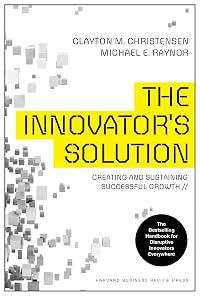
The Innovator's Solution: Creating and Sustaining Successful Growth
by Clayton M. Christensen, Michael E. Raynor
On This Page
Description
Clayton Christensen's bestselling book, The Innovator's Dilemma, introduced the groundbreaking idea of disruptive innovation, revealing how even well-run companies can do everything right and yet still lose market leadership. In The Innovator's Solution, Clayton Christensen and Michael Raynor expand on the idea of disruption, explaining how companies can and should become disruptors themselves. Now with a foreword by innovation expert Scott Anthony, this classic work shows just how timely show more and relevant these ideas continue to be in today's hyper-accelerated business environment and will help anyone trying to transform their business right now. Christensen and Raynor give advice on the business decisions crucial to achieving truly disruptive growth and propose guidelines for developing your own disruptive growth engine. The authors identify the forces that cause managers to make bad decisions as they package and shape new ideas-and offer new frameworks to help create the right conditions, at the right time, for a disruption to succeed. This is a must-listen for all senior managers and business leaders responsible for innovation and growth, as well as for members of their teams. show lessTags
Recommendations
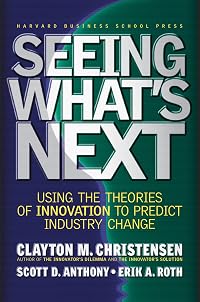
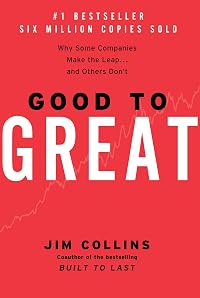
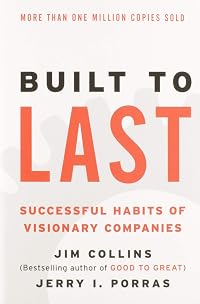

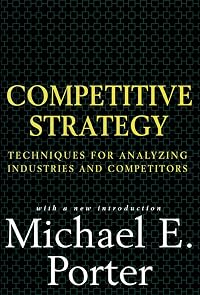




Member Recommendations
Member Reviews
Where The Innovator's Dilemma was about theory, this is about implementation-a recipe for managers looking to lead successful companies. Christensen admirably tackles the complex problem of guiding a company though times of disruption. There's a lot here, but the essence is that if you want to succeed, start with an idea that is somewhat profitable and go after customers who are under-served, either because no product exists that fits their needs, or they're the least profitable segment of an established market. If you want to make a lot of money, you need to have a product that is "not-yet-good-enough" so that your firm can compete on quality and innovation as opposed to cost.
Christensen advises against purely causal management-picking show more executive who have succeeded before or following the latest reorganization fad. He is particularly opposed to 'focusing on our core competencies' as the kind of accounting trick that hollows out a company over the long term. The kind of foresight required to move towards where the market is going rather than where's it been isn't easy to acquire, the insight and flexibility needed to switch strategies in midstream is even harder to find, but Christensen makes a compelling argument that good management is possible. show less
Christensen advises against purely causal management-picking show more executive who have succeeded before or following the latest reorganization fad. He is particularly opposed to 'focusing on our core competencies' as the kind of accounting trick that hollows out a company over the long term. The kind of foresight required to move towards where the market is going rather than where's it been isn't easy to acquire, the insight and flexibility needed to switch strategies in midstream is even harder to find, but Christensen makes a compelling argument that good management is possible. show less
Not your typical shallow marketing book filled with mumbo-jumbo which could be condensed into a few pages.
This no-bullshit book dives deep into the case studies and research to provide great insights thinking about the strategy and execution of it. Few days after finishing it I still find myself thinking about some of the concepts introduced here (e.g. competing with nonconsumption).
I rate it 4 stars because it is not an easy read and listening to the audio version definitely didn't help with that. Will take some time in the future to actually read it.
Here are the main takeaways:
1. Never target an incumbent with a sustaining solution
In almost all cases, an incumbent will win if they are threatened by a sustaining technology. They show more will simply do more of what they’re good at, serving their customers with product improvements. The solution is to enter the market from below. Create a product that is not as good as the incumbents', but is cheaper, easier or more convenient. It’s important to begin with targeting a lower profit margin. Incumbents would rather let a low margin business go and concentrate on high margin growth (flee, not fight).
2. Customers ‘hire’ products to get specific ‘jobs’ done
"Companies that target their products at the circumstances in which customers find themselves, rather than at the customers themselves, are those that can launch predictably successful products."
3. Core competence is a dangerously inward-looking notion
"Core competence, as it is used by many managers, is a dangerously inward-looking notion. Competitiveness is far more about doing what customers value than doing what you think you’re good at. And staying competitive as the basis for competition shifts necessarily requires a willingness and ability to learn new things rather than clinging hopefully to the sources of past glory."
4. Proprietary architectures lead to overshooting what the market needs
An industry is always in a state of flux and never completely one or the other. The trick for senior managers is to build up the instinct for where the market is moving and to move towards it.
"Managers of industry-leading businesses need to watch vigilantly in the right places to spot these trends as they begin because the processes of commoditization and de-commoditization both begin at the periphery, not the core."
5. Use the emergent strategy to develop disruptive innovations
There are two fundamentally different processes for strategy formation: deliberate and emergent. Deliberate is common. It is analytical, rigorous, and formulated after a deep review of factors like market segment sizing, customer needs, competition, projected returns and so on.
Emergent strategy is the cumulative effect of all the day-to-day decisions made to invest and prioritize resources. These decisions are made from middle management and at the individual employee level. You can tell what a company’s strategy is by looking at what comes out of the resource allocation process and not what goes into it. This scenario should dominate when the future is hard to forecast and it is not yet clear which direction the business should take.
6. Appoint people for their ability to learn, not their track record
“It is not as important that managers have succeeded with the problems as it is for them to have wrestled with it and developed the skills and intuition for how to meet the challenge successfully the next time around … Failure and bouncing back from failure can be critical courses in the school of experience.”
7. Be patient for growth and impatient for profit
Launch new-growth businesses regularly, when the core business is in healthy shape. When financial results signal the need to do it, it is probably too late.
As an organization grows, continue to divide up business units so that each unit can launch new ventures and be patient for growth, as they are small enough to benefit from small opportunities (disruptive innovations will start out small).
Minimize the use of profit from the core business to subsidize losses in the new-growth ventures. Be impatient for profit and patient for growth. If a venture is profitable, it remains likely to continue even when the core business is struggling.
8. Launching disruptive businesses can be a repeatable process
1. The best time to invest in growth is when the company is growing.
2. Appoint senior executive to shepherd ideas and resource allocation.
3. Create a team and a process for shaping ideas.
4. Train the troops. Sales, marketing, and engineering, in particular, must be trained to spot disruptive ideas because these individuals are most likely to encounter them and see the opportunities. show less
This no-bullshit book dives deep into the case studies and research to provide great insights thinking about the strategy and execution of it. Few days after finishing it I still find myself thinking about some of the concepts introduced here (e.g. competing with nonconsumption).
I rate it 4 stars because it is not an easy read and listening to the audio version definitely didn't help with that. Will take some time in the future to actually read it.
Here are the main takeaways:
1. Never target an incumbent with a sustaining solution
In almost all cases, an incumbent will win if they are threatened by a sustaining technology. They show more will simply do more of what they’re good at, serving their customers with product improvements. The solution is to enter the market from below. Create a product that is not as good as the incumbents', but is cheaper, easier or more convenient. It’s important to begin with targeting a lower profit margin. Incumbents would rather let a low margin business go and concentrate on high margin growth (flee, not fight).
2. Customers ‘hire’ products to get specific ‘jobs’ done
"Companies that target their products at the circumstances in which customers find themselves, rather than at the customers themselves, are those that can launch predictably successful products."
3. Core competence is a dangerously inward-looking notion
"Core competence, as it is used by many managers, is a dangerously inward-looking notion. Competitiveness is far more about doing what customers value than doing what you think you’re good at. And staying competitive as the basis for competition shifts necessarily requires a willingness and ability to learn new things rather than clinging hopefully to the sources of past glory."
4. Proprietary architectures lead to overshooting what the market needs
An industry is always in a state of flux and never completely one or the other. The trick for senior managers is to build up the instinct for where the market is moving and to move towards it.
"Managers of industry-leading businesses need to watch vigilantly in the right places to spot these trends as they begin because the processes of commoditization and de-commoditization both begin at the periphery, not the core."
5. Use the emergent strategy to develop disruptive innovations
There are two fundamentally different processes for strategy formation: deliberate and emergent. Deliberate is common. It is analytical, rigorous, and formulated after a deep review of factors like market segment sizing, customer needs, competition, projected returns and so on.
Emergent strategy is the cumulative effect of all the day-to-day decisions made to invest and prioritize resources. These decisions are made from middle management and at the individual employee level. You can tell what a company’s strategy is by looking at what comes out of the resource allocation process and not what goes into it. This scenario should dominate when the future is hard to forecast and it is not yet clear which direction the business should take.
6. Appoint people for their ability to learn, not their track record
“It is not as important that managers have succeeded with the problems as it is for them to have wrestled with it and developed the skills and intuition for how to meet the challenge successfully the next time around … Failure and bouncing back from failure can be critical courses in the school of experience.”
7. Be patient for growth and impatient for profit
Launch new-growth businesses regularly, when the core business is in healthy shape. When financial results signal the need to do it, it is probably too late.
As an organization grows, continue to divide up business units so that each unit can launch new ventures and be patient for growth, as they are small enough to benefit from small opportunities (disruptive innovations will start out small).
Minimize the use of profit from the core business to subsidize losses in the new-growth ventures. Be impatient for profit and patient for growth. If a venture is profitable, it remains likely to continue even when the core business is struggling.
8. Launching disruptive businesses can be a repeatable process
1. The best time to invest in growth is when the company is growing.
2. Appoint senior executive to shepherd ideas and resource allocation.
3. Create a team and a process for shaping ideas.
4. Train the troops. Sales, marketing, and engineering, in particular, must be trained to spot disruptive ideas because these individuals are most likely to encounter them and see the opportunities. show less
I have read this book so often that it is falling apart! Seriously, the important discovery was the concept of "jobs to be done" categorizing innovation discovery. I have used this concept to widen my view to experiment with new ideas at my own work (Telecommunications). Mr. Christensen has a company web site with additional information and works in progress.
www.innosight.com
www.innosight.com
I have just been reading Clay Christensen's "The Innovator's Solution" (follow up the "The Innovator's Dilemna"), in which the author makes some telling points.
One of the most interesting is his discussion of how you form a good theory about management. To him, the key is to categorize the observations or phenomena you make correctly and he chides consultants for advising the same soltion that has worked for a few excellent companies (since it is very rare that many companies are in exactly the same circumstances). Unless you have exhausted the circumstances of when and where the solution won't work, you haveb't got a complete theory and can't describe what is truly happening.
Unfortunately, this mistake happens all the time in agencies show more and consultancies. We glibly cite Starbucks, Nike etc. as paragons of great advertising and proscribe them as solutions. But to few of us really understand why things worked when they did (except for thos on the client side or who worked on the business). This is the problem with the whole concept of best practices - best for what when.
Incidentally, Christensen uses a similar argument to take on segmentation in a riff that is similar to previous articles in Nilewide. He criticizes segmentation on attributes (of products or people) because the mathematics involved only look at the correlation between attributes and outcomes. Applying his argument, we need to segment on the circumstances of the job customers want a product to fulfill (emotional, functional, personal) vs focusing on the product or person.
Circumstancial marketing was used by Sony's Akio Morita to drive that company's innovation ro disrupt the market (e.g. Targeting cheap portable radios at teens in the 1960's because any music was better than none). When Morita left, Sony stopped doing this and they haven't really had a disruptive innovation since ( e.g. PSP was a late market entrant vs a first) show less
One of the most interesting is his discussion of how you form a good theory about management. To him, the key is to categorize the observations or phenomena you make correctly and he chides consultants for advising the same soltion that has worked for a few excellent companies (since it is very rare that many companies are in exactly the same circumstances). Unless you have exhausted the circumstances of when and where the solution won't work, you haveb't got a complete theory and can't describe what is truly happening.
Unfortunately, this mistake happens all the time in agencies show more and consultancies. We glibly cite Starbucks, Nike etc. as paragons of great advertising and proscribe them as solutions. But to few of us really understand why things worked when they did (except for thos on the client side or who worked on the business). This is the problem with the whole concept of best practices - best for what when.
Incidentally, Christensen uses a similar argument to take on segmentation in a riff that is similar to previous articles in Nilewide. He criticizes segmentation on attributes (of products or people) because the mathematics involved only look at the correlation between attributes and outcomes. Applying his argument, we need to segment on the circumstances of the job customers want a product to fulfill (emotional, functional, personal) vs focusing on the product or person.
Circumstancial marketing was used by Sony's Akio Morita to drive that company's innovation ro disrupt the market (e.g. Targeting cheap portable radios at teens in the 1960's because any music was better than none). When Morita left, Sony stopped doing this and they haven't really had a disruptive innovation since ( e.g. PSP was a late market entrant vs a first) show less
A very smart and helpful book. I'm giving it 3 stars mostly because the writing is highly redundant and often unnecessarily dense; I wonder if that's the co-author's fault. Regardless, it's solid theory.
This appears to offer significant explanatory power relative to other theories, as well as direct leverage for any firm to consider. Since the underlying factors are generally not quantifiable, it's likely that many relevant firms and leaders will miss it.
A sequel to The Innovator's Dilemma. Previous book explains why successful companies' success factors can also lead them to get disrupted. This book deals with how you can create sustainable growth as a disruptor. You'll learn:
• The difference between sustaining innovation and disruptive innovation, and how new entrants can use the disruptive innovation to displace existing market leaders.
• The answers to 9 strategic questions behind sustainable, profitable growth. These include: how to beat your top competitors, what products customers will buy, who are the best customers for your product, which activities to do inhouse vs outsource, how to avoid being commoditized, which organizational structure to adopt for the new venture, how show more to develop the best strategies, how to fund the innovation, and what the CEO's ideal role should be.
Book summary at: https://readingraphics.com/book-summary-the-innovators-solution/ show less
• The difference between sustaining innovation and disruptive innovation, and how new entrants can use the disruptive innovation to displace existing market leaders.
• The answers to 9 strategic questions behind sustainable, profitable growth. These include: how to beat your top competitors, what products customers will buy, who are the best customers for your product, which activities to do inhouse vs outsource, how to avoid being commoditized, which organizational structure to adopt for the new venture, how show more to develop the best strategies, how to fund the innovation, and what the CEO's ideal role should be.
Book summary at: https://readingraphics.com/book-summary-the-innovators-solution/ show less
Members
- Recently Added By
Lists

My List
302 works; 1 member
Author Information

48+ Works 7,219 Members
Clayton M. Christensen is the Kim B. Clark Professor of Business Administration at Harvard Business School. He is the author of eight critically acclaimed books, including the bestsellers. The Innovator's Solution, How Will You Measure Your Life?, and Disrupting Class. Christensen is the cofounder of Innosight, a management consultancy; Rose Park show more Advisors, an investment firm; and the Innosight Institute, a nonprofit think tank. show less
4+ Works 1,174 Members
Work Relationships
Classifications
- Genres
- Business, Nonfiction, General Nonfiction
- DDC/MDS
- 658.4063 — Applied science & technology Management & public relations General management Executive Managing Change Innovation
- LCC
- HD53 .C493 — Social sciences Industries. Land use. Labor Industries. Land use. Labor Management. Industrial management
- BISAC
Statistics
- Members
- 933
- Popularity
- 28,574
- Reviews
- 8
- Rating
- (3.77)
- Languages
- Chinese, English, German, Spanish
- Media
- Paper, Audiobook, Ebook
- ISBNs
- 16
- ASINs
- 9