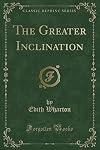
The Greater Inclination
by Edith Wharton
On This Page
Description
The following spring when he went abroad Mrs. Memorall offered him letters to everybody from the Archbishop of Canterbury to Louise Michel. She did not include Mrs. Anerton however and Danyers knew from a previous conversation that Silvia objected to people who brought letters. He knew also that she travelled during the summer and was unlikely to return to Rome before the term of his holiday should be reached and the hope of meeting her was not included among his anticipations.Tags
Recommendations

















Member Reviews
I am a dedicated fan of Edith Wharton, and probably should have appreciated these stories more as they are an opportunity to see her as she is finding her voice. Her singular, incisive way of seizing upon the way in which those who seem to have everything often turn out to have bargained away their selves, if not their souls, is there in each of the stories and the one short play included in this collection. Her protagonists are imprisoned within the bounds of social convention, just as they are in her later work, but here the plots are raw and lack the nuance that give Wharton's novels their timeless appeal.
Ratings
Members
- Recently Added By
Lists

Favourite 19th century fiction
257 works; 62 members

Newark Public Library's 1904 List of a Thousand of the Best Novels
95 works; 5 members
Author Information

378+ Works 63,654 Members
Edith Wharton was a woman of extreme contrasts; brought up to be a leisured aristocrat, she was also dedicated to her career as a writer. She wrote novels of manners about the old New York society from which she came, but her attitude was consistently critical. Her irony and her satiric touches, as well as her insight into human character, show more continue to appeal to readers today. As a child, Wharton found refuge from the demands of her mother's social world in her father's library and in making up stories. Her marriage at age 23 to Edward ("Teddy") Wharton seemed to confirm her place in the conventional role of wealthy society woman, but she became increasingly dissatisfied with the "mundanities" of her marriage and turned to writing, which drew her into an intellectual community and strengthened her sense of self. After publishing two collections of short stories, The Greater Inclination (1899) and Crucial Instances (1901), she wrote her first novel, The Valley of Decision (1902), a long, historical romance set in eighteenth-century Italy. Her next work, the immensely popular The House of Mirth (1905), was a scathing criticism of her own "frivolous" New York society and its capacity to destroy her heroine, the beautiful Lily Bart. As Wharton became more established as a successful writer, Teddy's mental health declined and their marriage deteriorated. In 1907 she left America altogether and settled in Paris, where she wrote some of her most memorable stories of harsh New England rural life---Ethan Frome (1911) and Summer (1917)---as well as The Reef (1912), which is set in France. All describe characters forced to make moral choices in which the rights of individuals are pitted against their responsibilities to others. She also completed her most biting satire, The Custom of the Country (1913), the story of Undine Spragg's climb, marriage by marriage, from a midwestern town to New York to a French chateau. During World War I, Wharton dedicated herself to the war effort and was honored by the French government for her work with Belgian refugees. After the war, the world Wharton had known was gone. Even her Pulitzer Prize-winning novel, The Age of Innocence (1920), a story set in old New York, could not recapture the former time. Although the new age welcomed her---Wharton was both a critical and popular success, honored by Yale University and elected to The National Institute of Arts and Letters---her later novels show her struggling to come to terms with a new era. In The Writing of Fiction (1925), Wharton acknowledged her debt to her friend Henry James, whose writings share with hers the descriptions of fine distinctions within a social class and the individual's burdens of making proper moral decisions. R.W.B. Lewis's biography of Wharton, published in 1975, along with a wealth of new biographical material, inspired an extensive reevaluation of Wharton. Feminist readings and reactions to them have focused renewed attention on her as a woman and as an artist. Although many of her books have recently been reprinted, there is still no complete collected edition of her work. (Bowker Author Biography) show less
Awards and Honors
Common Knowledge
- Original publication date
- 1899
- People/Characters
- Mary Anerton ('The muse's tragedy'); Lewis Danyers ('The muse's tragedy'); Mrs Memorall ('The muse's tragedy'); Vincent Rendle ('The muse's tragedy'); Lancelot Amyot ('The pelican'); Mrs Amyot ('The pelican') (show all 16); Irene Astarte Pratt ('The pelican'); Ralph Gannett ('Souls belated'); Lydia Tillotson Gannett ('Souls belated'); Mrs Cope (aka Mrs Linton, 'Souls belated'); Lord Trevene (aka Mr Linton, 'Souls belated'); Mrs Tillotson Snr. ('Souls belated'); Miss Pinsent ('Souls belated'); Lady Susan Condit ('Souls belated'); Mrs Ainger ('Souls belated'); Monsieur Grossart ('Souls belated')
- Important places
- London, England, UK ('The muse's tragedy'); Switzerland ('The muse's tragedy'); Harvard University, Cambridge, Massachusetts, USA; Colorado, USA ('A journey'); Buffalo, New York, USA ('A journey'); New York, USA ('A journey', 'Souls belated') (show all 13); Boston, Massachusetts, USA ('The pelican'); Hillbridge ('The pelican'); Paris, France ('Souls belated'); Bologna, Emilia Romagna, Italia ('Souls belated'); Roma, Lazio, Italia ('The muse's tragedy'); Milano, Lombardia, Italia ('Souls belated'); Venezia, Veneto, Italia ('The muse's tragedy')
- Quotations
- '...and am I to stay here, attitudinizing among my memories like a sort of female Tithonus', from 'The muses tragedy';
'...we took our seats in a lecture hall half full of strenuous females in ulsters'; '...fitting out... (show all) her subject with a whole wardrobe of slop-shop epithets irrelevant in cut and size'; '...for a whole winter I carried my cough, my themometre and my idleness from one fashionable orange grove to another', from 'The pelican';
'Nothing is more perplexing to the mental process of man than a woman who reasons her emotions'; '...she implored with a tearful prodigality of italics'; 'I know how very particular nice Americans are'; from 'Belated souls';
Classifications
Statistics
- Members
- 45
- Popularity
- 659,401
- Reviews
- 1
- Rating
- (3.36)
- Languages
- English
- Media
- Paper, Ebook
- ISBNs
- 36
- ASINs
- 9