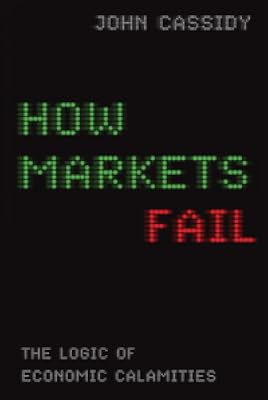
How Markets Fail: The Logic of Economic Calamities
by John Cassidy
On This Page
Description
John Cassidy describes the rising influence of what he calls utopian economics--thinking that is blind to how real people act and that denies the many ways an unregulated free market can produce disastrous unintended consequences. He then looks to the leading edge of economic theory, including behavioral economics, to offer a new understanding of the economy--one that casts aside the old assumption that people and firms make decisions purely on the basis of rational self-interest.Tags
Recommendations

Member Reviews
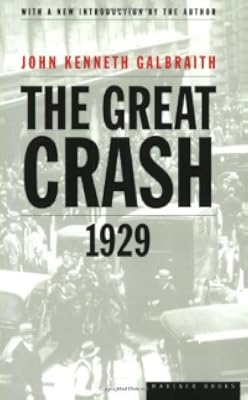
I've read several books about economics/finance and our current economic crisis this year and this is unquestionably the pick of the litter (with the exception of John Kenneth Galbraith's classic The Great Crash 1929, brilliantly written with an acid wit, and sometimes called more historically than economically valid). Cassidy, a journalist, is a lucid writer, who takes the reader on a tour of standard free-market/invisible hand theory and then what he calls "reality-based economics," showing how many factors, including "rational irrationality," "beauty contests," and the "law of lemons" affect how markets work in real life. Finally, in the last section, he applies these concepts to what happened in the real estate bubble, the collapse show more of the subprime housing market, and everything that ensued, as well as some recommendations for taming misplaced incentives. I found it informative, thought-provoking, readable, and scary. show less
Cassidy is an economist by education and did a lot of research for the book. If you've already know the basics of economic history you might want to skip that part of it. However, I did and I still found his non-denominational Brief History of Economics readable because he talks about a few lesser-known figures who figure into later parts of the book as well as more recent developments such as behavioral economics.
Likewise, the basics of why markets don't always operate as hoped or expected by one economic ideology or the other is well-presented. He labels the strong free market/rational econ thinking as utopian economics and advocates for non-ideological, pragmatic approach he calls reality-based economics.
When it comes to dealing with show more the 2007-2008 crisis, he carefully dissects the events, policies, and actions of the various players and shows how they created the incentives that led to the speculative bubble and then let it grow to gargantuan proportions. It was no one person or entity's fault, but rather the result of many entities acting together, most informed to one degree or another by utopian economic thinking. show less
Likewise, the basics of why markets don't always operate as hoped or expected by one economic ideology or the other is well-presented. He labels the strong free market/rational econ thinking as utopian economics and advocates for non-ideological, pragmatic approach he calls reality-based economics.
When it comes to dealing with show more the 2007-2008 crisis, he carefully dissects the events, policies, and actions of the various players and shows how they created the incentives that led to the speculative bubble and then let it grow to gargantuan proportions. It was no one person or entity's fault, but rather the result of many entities acting together, most informed to one degree or another by utopian economic thinking. show less
The best introductory explanation of two major theories of economy - Keynes vs Freedman - and how it all played out in a recent financial crisis. The author is very convincing even though he is definitely on the liberal side (for me). There is no question that government should be involved in regulation of the economy in general, and financial regulations in particular - but there is a fine line. The author acknowledges this line but completely omits discussion regarding it, dangers of too extensive government intervention and how to avoid it. As of financial crisis, the author acknowledges the role played in this crisis by the government through Fannie/Freddie mortgage purchasing/guarantees. However, he seems to dismiss the idea that show more such involvement was a critical, even crucial factor. I wonder how it would all develop without push from the US government to encourage as many mortgages as possible. Given such government role in the crisis, I believe it's impossible to argue that private sector alone caused it. Anyway, the book is extremely well written and gives a lot to think about. show less
Excellent. Thorough overview of the field of economics, from Adam Smith through JS Mill, Keynes and Hayek, Friedman, to the current financial collapse. Argues for a pragmatic approach, with the full acknowledgment that market failure exists, and that there is no invisible hand when it comes to the financial markets. The real joy for me comes in learning all sorts of things about economists I'd not really heard anything about, such as Arrow, Akerlof, and Minsky. It predates the Occupy movement, written in 2009, and it's late enough that you can see that Wall Street didn't learn a damn thing from the recent financial crisis.
4 stars oc
4 stars oc
Superb critical account of all that is wrong with economics and the economic system. Very clear and wide ranging.
For authors who write for the general public: brevity and presenting complex ideas in simple ways are a virtue. This author hadn't those virtues. Had to give up half way in.
sort of a history of economics (only as far as Adam Smith) - will need to interloan in the future
Members
- Recently Added By
Published Reviews
ThingScore 100
added by Shortride
Lists

Economics
60 works; 5 members

Non-Fiction Worth Reading
1,025 works; 264 members

Economics for the layperson
33 works; 9 members
Author Information

4+ Works 706 Members
John Cassidy, one of the country's leading business journalists, has been a staff writer at the New Yorker for six years, covering economics and finance. Previously he was business editor of the Sunday Times (London) and deputy editor of the New York Post. He lives in New York
Awards and Honors
Common Knowledge
- People/Characters
- Ben Bernanke; Milton Friedman; Alan Greenspan; Friedrich Hayek; John Maynard Keynes; Paul Samuelson (show all 7); Adam Smith
- First words
- A common reaction to extreme events is to say that they couldn't have been predicted.
Classifications
- Genres
- Economics, Nonfiction, Business, General Nonfiction, History
- DDC/MDS
- 381 — Society, government, & culture Commerce, communications & transportation regulations Domestic Trade (Commerce)
- LCC
- HB3722 .C37 — Social sciences Economic theory. Demography Economic theory. Demography Business cycles. Economic fluctuations
- BISAC
Statistics
- Members
- 456
- Popularity
- 67,326
- Reviews
- 8
- Rating
- (4.04)
- Languages
- 6 — Czech, Dutch, English, Italian, Portuguese, Spanish
- Media
- Paper, Audiobook, Ebook
- ISBNs
- 21
- ASINs
- 10