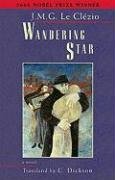
Wandering Star
by J.M.G. Le Clézio
On This Page
Description
While both Esther and Nejma want peace, each has a different experience during the founding of Israel; Esther is a Jewish girl who participtes in the founding, and Nejma is a Palestinian who becomes a refugee.Tags
Recommendations




Member Reviews
This was my first Le Clezio novel, and I feel tempted to read more. I like the way Le Clezio makes politics personal; in this case the Israeli/Palestinian conflict. Even though that is not literally the topic of this novel, it does seem to be at the heart of it.
The story centers mainly around Esther, a young Jewish girl growing up in southern France during the occupation. While the Italians are in charge life is more or less bearable, but once the Germans take over a dark period starts. Le Clezio takes a lot of time (and pages) to describe life in the occupied village, during spring and summer, the lovely nature, the children playing in the fields and at the riverside, the friendships. Life seems almost pretty, were it not that there show more is a continuous shadow of sentences foreboding great pain and misery in these chapters. When the Italians leave, most of the Jewish people try to flee across the mountains into Italy. Most of them don't make it. For Esther, her life as a refugee starts. She finds great comfort in religion, even if she was raised without it. Years later, she and her mother make it to Palestine, which soon becomes Israel.
The cynical truth is that while Esther thinks she is finding a home, her true and destined home, other people thereby become refugees. During a short moment Esther looks into the eyes of Nejma, a Palestinian girl, on her way to a refugee camp. Nejma is the second, though minor, protagonist of this novel. She arrives at a refugee camp, where she and her people are slowly forgotten by the international community. Her destiny remains unsure.
I thought this novel was very well written, though perhaps a little slow at times, and gave insight into a political conflict at a very individual level. Without putting blame on either party. I would recommend it. show less
The story centers mainly around Esther, a young Jewish girl growing up in southern France during the occupation. While the Italians are in charge life is more or less bearable, but once the Germans take over a dark period starts. Le Clezio takes a lot of time (and pages) to describe life in the occupied village, during spring and summer, the lovely nature, the children playing in the fields and at the riverside, the friendships. Life seems almost pretty, were it not that there show more is a continuous shadow of sentences foreboding great pain and misery in these chapters. When the Italians leave, most of the Jewish people try to flee across the mountains into Italy. Most of them don't make it. For Esther, her life as a refugee starts. She finds great comfort in religion, even if she was raised without it. Years later, she and her mother make it to Palestine, which soon becomes Israel.
The cynical truth is that while Esther thinks she is finding a home, her true and destined home, other people thereby become refugees. During a short moment Esther looks into the eyes of Nejma, a Palestinian girl, on her way to a refugee camp. Nejma is the second, though minor, protagonist of this novel. She arrives at a refugee camp, where she and her people are slowly forgotten by the international community. Her destiny remains unsure.
I thought this novel was very well written, though perhaps a little slow at times, and gave insight into a political conflict at a very individual level. Without putting blame on either party. I would recommend it. show less
I just finished this book last night, and I think it will take a long time to finish absorbing it. First of all, Le Clezio's writing is amazing: sensual, vivid, lyrical. The impressionistic style lends itself well to descriptions of nature and human emotions (there's plenty of both in this book). However, it was a bit frustrating for me to try and get at the historical facts and geographical details from this writing style. I did end up doing a bit of my own research to fill in the gaps. One really interesting aspect of this book is that though the Jewish diaspora, founding of Israel, and subsequent regional unrest are major historical events, the storytellers (two teenage girls) clearly do not understand or appreciate the implications show more of these events. They are focused on the basics of survival, friendships, young love, etc. Extracting the individual human experience from the historical panorama was brilliant. A very quick compelling read, highly recommended. 4.25 stars show less
Written by the winner of the 2008 Nobel Prize for Literature, this is the story of two young women who meet by chance in the turmoil of the Middle East.
During World War II, Esther is a Jewish girl living in a small town somewhere in southeastern France. The residents have an uneasy relationship with the Italian troops occupying the town, but they get along. When the Italians surrender and leave the town, the Jews know that the Germans will send them on a one-way trip to a concentration camp. So Esther, and her mother, Elizabeth, and the other Jews in town undertake a harrowing journey on foot through the mountains, to reach the coast, and passage to Jerusalem. Esther constantly worries that her father, who joined the resistance, will show more never be able to find them again.
After many days journey, carrying whatever they can, they reach the coast, and board a boat heading for Israel. The ship is halted by the authorities, and sent back to France, where the Jews are held for a time, before actually reaching Jerusalem. There, Esther meets a young Palestinian girl named Nejma, a refugee because of the fighting.
In the early days of their time in the camp, the Palestinians treat it like some sort of temporary setback; after a few days, weeks at the most, they’ll be able to return home. The women gather at the local well and gossip like they are already back home. As reality sets in, and they begin to realize that they aren’t leaving anytime soon (if ever), hope turns into despair and the feeling that they have been abandoned by the rest of the world. The only thing the Palestinians have to look forward to is the occasional arrival of the UN aid truck. Life becomes a daily struggle for survival. At the end, Nejma leaves the camp with Saadi, a black man who loves her, and wants to take her back to his homeland. As one person’s wanderings end, those of another person are just getting underway.
Told in first person by both young women, this is a quiet novel, but it’s also a beautifully written novel. So this is what Nobel-caliber fiction is like. I will make sure to look for more of it. show less
During World War II, Esther is a Jewish girl living in a small town somewhere in southeastern France. The residents have an uneasy relationship with the Italian troops occupying the town, but they get along. When the Italians surrender and leave the town, the Jews know that the Germans will send them on a one-way trip to a concentration camp. So Esther, and her mother, Elizabeth, and the other Jews in town undertake a harrowing journey on foot through the mountains, to reach the coast, and passage to Jerusalem. Esther constantly worries that her father, who joined the resistance, will show more never be able to find them again.
After many days journey, carrying whatever they can, they reach the coast, and board a boat heading for Israel. The ship is halted by the authorities, and sent back to France, where the Jews are held for a time, before actually reaching Jerusalem. There, Esther meets a young Palestinian girl named Nejma, a refugee because of the fighting.
In the early days of their time in the camp, the Palestinians treat it like some sort of temporary setback; after a few days, weeks at the most, they’ll be able to return home. The women gather at the local well and gossip like they are already back home. As reality sets in, and they begin to realize that they aren’t leaving anytime soon (if ever), hope turns into despair and the feeling that they have been abandoned by the rest of the world. The only thing the Palestinians have to look forward to is the occasional arrival of the UN aid truck. Life becomes a daily struggle for survival. At the end, Nejma leaves the camp with Saadi, a black man who loves her, and wants to take her back to his homeland. As one person’s wanderings end, those of another person are just getting underway.
Told in first person by both young women, this is a quiet novel, but it’s also a beautifully written novel. So this is what Nobel-caliber fiction is like. I will make sure to look for more of it. show less
J.M.G. Le Clézio’s Wandering Star is a beautiful, troubling book. The novel follows the lives of two young women: Esther, a WWII holocaust survivor; and Nejma, a Palestinian refugee. Of the two stories, Esther’s life is the more developed and her character more fully realized than that of Nejma. Ultimately Nejma vanishes from the novel leaving no trace but a name scribbled on a piece of paper, a woman who has become more invisible than all those who vanished in Hitler’s death camps. They, at least, have been memorialized with historic sites and museums. The Palestinians? They are the disappeared ones, the invisible men and women.
Read the rest of this review at Club Balzac
Read the rest of this review at Club Balzac
Dedicated to "the captured children", Wandering Star is the story of two young girls, each driven from her home, whose paths cross briefly on a dusty road outside Jerusalem. Esther is thirteen years old and living in exile in a remote corner of southeastern France in 1943. Her father is a member of the Resistance and is often in whispered conversations with strangers at their kitchen table or out guiding people through the mountains to Italy. Her mother insists on calling her Hélène, despite everyone in the village knowing they are Jewish because they must register with the Italian soldiers every morning. Helene grows up running wild in the village, with a couple of young admirers at her heels. Her exposure to the war is limited to show more little incidences: Mr. Ferne's piano, his one solace, is taken away for the amusement of the Italian soldiers; Rachel is ostracized in the village for having an affair with an officer. But everything changes when Italy surrenders and the town is turned over to the Germans. Esther and her mother flee, along with most of the other Jews in town, trying to cross the mountains into Italy. From there they hope to catch a boat to Palestine.
Nejma is introduced over half way through the book. She is a Palestinian girl who has been removed to the Nour Chams Camp in the summer of 1948 to make room for the new nation of Israel. Her life in the camp is lonely: her father is away fighting, her mother died when Nejma was young, and she was sent from the only home she knew to this barren stretch of desert. People in the camp are desperate. There is little water and the only food comes in on irregular United Nations trucks. Capable and mature for her age, Nejma takes in a newly arrived woman whom she calls aunt. Together they try to eke out an existence. She falls in love with a nomad, who is also at the camp, but theirs is a difficult relationship. Life and death balance on a knife's edge in the camp, and eventually Nejma flees, in an attempt to survive despite the threat of Israeli soldiers.
The reader is caught in a conundrum by the juxtaposition of the two girls. It is easy to sympathize with Esther, as the reader knows what awaits her if she is caught, better than she knows herself. Her flight creates tension that can only be eased by sanctuary in the land of light and Jerusalem. Yet, halfway through the story, the author introduces an equally sympathetic character, whose harsh fate is caused by the arrival of thousands of Jews like Esther. Nejma is forced into a concentration camp that one cannot help but compare to those that Esther escaped. Lacking the systematic slaughter of the Nazis for sure, but a camp ruled by neglect, starvation, and disease, nonetheless.
This moral comparison makes for an interesting premise, but something about the story falls flat. Perhaps it is the fault of the translation, but the writing is very bland. Short, bald narrative seems more appropriate for a young adult novel perhaps.
At dawn, the rain woke them. It was a fine drizzle rustling softly in the pine needles over their heads, mingling with the crashing of the torrent. Drops started coming through the roof of their shelter, ice-cold drops that spattered on their faces. Elizabeth tried to arrange the branches better, but she only succeeded in making it rain more. So they took their suitcases and, wrapped in their shawls, huddled up at the foot of a larch tree, shivering. The shapes of the trees stood out starkly in the dawn light. A white fog was creeping down the valley. It was so cold that Esther and Elizabeth just sat there hugging each other at the foot of the larch, not wanting to move.
In addition, the point of view changes frequently in the Esther plot line: sometimes the story is told in the third person, sometimes from Esther's point of view, occasionally from someone else's. It's not a major point, but makes the book feel hurried or like a rough draft.
While I wouldn't necessarily recommend [Wandering Star], I am interested in reading another work by Le Clézio to see if this one is an anomaly for the Nobel Prize winning author. The preponderance of his other works seem to be set in Africa and deal with colonialism. Perhaps a more usual topic for the author and a different translator will change my first impression of his writing. show less
Nejma is introduced over half way through the book. She is a Palestinian girl who has been removed to the Nour Chams Camp in the summer of 1948 to make room for the new nation of Israel. Her life in the camp is lonely: her father is away fighting, her mother died when Nejma was young, and she was sent from the only home she knew to this barren stretch of desert. People in the camp are desperate. There is little water and the only food comes in on irregular United Nations trucks. Capable and mature for her age, Nejma takes in a newly arrived woman whom she calls aunt. Together they try to eke out an existence. She falls in love with a nomad, who is also at the camp, but theirs is a difficult relationship. Life and death balance on a knife's edge in the camp, and eventually Nejma flees, in an attempt to survive despite the threat of Israeli soldiers.
The reader is caught in a conundrum by the juxtaposition of the two girls. It is easy to sympathize with Esther, as the reader knows what awaits her if she is caught, better than she knows herself. Her flight creates tension that can only be eased by sanctuary in the land of light and Jerusalem. Yet, halfway through the story, the author introduces an equally sympathetic character, whose harsh fate is caused by the arrival of thousands of Jews like Esther. Nejma is forced into a concentration camp that one cannot help but compare to those that Esther escaped. Lacking the systematic slaughter of the Nazis for sure, but a camp ruled by neglect, starvation, and disease, nonetheless.
This moral comparison makes for an interesting premise, but something about the story falls flat. Perhaps it is the fault of the translation, but the writing is very bland. Short, bald narrative seems more appropriate for a young adult novel perhaps.
At dawn, the rain woke them. It was a fine drizzle rustling softly in the pine needles over their heads, mingling with the crashing of the torrent. Drops started coming through the roof of their shelter, ice-cold drops that spattered on their faces. Elizabeth tried to arrange the branches better, but she only succeeded in making it rain more. So they took their suitcases and, wrapped in their shawls, huddled up at the foot of a larch tree, shivering. The shapes of the trees stood out starkly in the dawn light. A white fog was creeping down the valley. It was so cold that Esther and Elizabeth just sat there hugging each other at the foot of the larch, not wanting to move.
In addition, the point of view changes frequently in the Esther plot line: sometimes the story is told in the third person, sometimes from Esther's point of view, occasionally from someone else's. It's not a major point, but makes the book feel hurried or like a rough draft.
While I wouldn't necessarily recommend [Wandering Star], I am interested in reading another work by Le Clézio to see if this one is an anomaly for the Nobel Prize winning author. The preponderance of his other works seem to be set in Africa and deal with colonialism. Perhaps a more usual topic for the author and a different translator will change my first impression of his writing. show less
Esther, a young Jewish girl, lives with her parents in a small town way up in the mountains between France and Italy. The town is a refuge for Jews and other exiles who have fled the Nazis. They live, however, in mortal dread of the day when the enemy will reach the quiet slopes. Esther loves the mountains, she loves nothing more than climbing up their crevices and exploring secret places, spending entire days just looking at the town below and the distant peaks. Through her eyes and her love of this place, we not only see but feel its beauty and tranquility that evokes images of a Shangri-la. But all this is shattered forever one day when her father, who secretly helps Jews escape, doesn't come home. Esther, his "wandering star", show more continues to go back to her beloved places up there in the mountains but now only to watch the ridge where she wills her father to appear. Then the Nazi soldiers were heard coming. The escape, long, arduous, fraught with danger begins. The hope of Israel is what keeps Esther, her mother, and the survivors going.
The second part of the book is the story of another girl of Esther's age, Nejma, a Palestinian. Two groups of refugees meet on the road to/from Jerusalem -- the Jews on the way to the city, and the expelled Palestinians going away from it. Esther in one, Nejma in the other -- they meet very briefly, touching hands and exchanging names, nothing more. From Nejma's journal, we feel her anxiety, her confusion, her sorrow for the loss of the life she knew, her desire for a better one than the one she knows now. What will become of her?
I was blown away by Le Clezio's narrative of the mountain landscape and Esther's deep attachment to it. His prose evokes tremendous beauty accompanied by profound sadness. Esther's solitude, and later on, her sorrow, is portrayed so convincingly that my strongest image from this book is of a town which is perpetually gray and foggy, with appalling weather, and tall mountains always covered in thick dark clouds.
While Le Clezio for the most part writes very beautifully and in vivid prose, the part about Nejma and the adult Esther seems much less inspired. I understand that he meant to portray the parallels in the lives of 2 young women who lived in opposing sides, but it doesn't convince. The depth and the compassion of his writing trails off in the second part so that I found the ending rather weak and forgettable, and Nejma's story only half-told. show less
The second part of the book is the story of another girl of Esther's age, Nejma, a Palestinian. Two groups of refugees meet on the road to/from Jerusalem -- the Jews on the way to the city, and the expelled Palestinians going away from it. Esther in one, Nejma in the other -- they meet very briefly, touching hands and exchanging names, nothing more. From Nejma's journal, we feel her anxiety, her confusion, her sorrow for the loss of the life she knew, her desire for a better one than the one she knows now. What will become of her?
I was blown away by Le Clezio's narrative of the mountain landscape and Esther's deep attachment to it. His prose evokes tremendous beauty accompanied by profound sadness. Esther's solitude, and later on, her sorrow, is portrayed so convincingly that my strongest image from this book is of a town which is perpetually gray and foggy, with appalling weather, and tall mountains always covered in thick dark clouds.
While Le Clezio for the most part writes very beautifully and in vivid prose, the part about Nejma and the adult Esther seems much less inspired. I understand that he meant to portray the parallels in the lives of 2 young women who lived in opposing sides, but it doesn't convince. The depth and the compassion of his writing trails off in the second part so that I found the ending rather weak and forgettable, and Nejma's story only half-told. show less
http://nwhyte.livejournal.com/1406891.html
I was very impressed. Le Clézio tells the story of Esther, a Jewish girl displaced from France over the Alps to Italy and eventually to Israel in the mid-1940s; her story briefly touches on that of Nejda, a Palestinian girl who becomes a refugee as a result of the 1948 conflict. The book is beautifully expressive of both the geographical landscapes of the Alps and Palestine, and of the psychological landscape of displacement, homelessness, and building new ties. I did wish we had learned more about what happens to Nejda in the end, and was a bit disappointed that the last few chapters were about Esther's life decades later. But the pluses outweigh the minuses.
I was very impressed. Le Clézio tells the story of Esther, a Jewish girl displaced from France over the Alps to Italy and eventually to Israel in the mid-1940s; her story briefly touches on that of Nejda, a Palestinian girl who becomes a refugee as a result of the 1948 conflict. The book is beautifully expressive of both the geographical landscapes of the Alps and Palestine, and of the psychological landscape of displacement, homelessness, and building new ties. I did wish we had learned more about what happens to Nejda in the end, and was a bit disappointed that the last few chapters were about Esther's life decades later. But the pluses outweigh the minuses.
Members
- Recently Added By
Lists

Must read
10 works; 1 member
Author Information

118+ Works 6,276 Members
Jean-Marie Gustave Le Clézio, who was born in Nice, France on April 13, 1940, is usually identified as J. M. G. Le Clézio. After studying at the University of Bristol in England from 1958 to 1959, he finished his undergraduate degree at Institut d'etudes Litteraires in Nice. In 1964, he received a master's degree from the University of show more Aix-en-Provence with a thesis on Henri Michaux and wrote a doctoral thesis in 1983 on Mexico's early history for the University of Perpignan. He has taught at numerous universities throughout the world and has written around 30 books including novels, essays, and short stories. He received the Prix Renaudot Prize for his novel Le Procès-Verbal in 1963 and the Nobel Prize for Literature in 2008. (Bowker Author Biography) show less
Some Editions
Awards and Honors
Notable Lists
Series
Belongs to Publisher Series
Common Knowledge
- Canonical title
- Wandering Star
- Original title
- Étoile errante
- Original publication date
- 1992 (original French) (original French); 2004 (English: Dickson) (English: Dickson)
- People/Characters
- Esther (Hélène); Elizabeth; Jacques; Nejma
- Important places
- France; Italy; Israel
- Important events
- World War II (1939 | 1945); Israeli-Palestinian Conflict; Holocaust
- Epigraph
- Wandering star
Transitory love
Follows your path
Through seas and lands
It breaks your chains
Peruvian song - Dedication
- to the captured children
- First words
- She knew that winter was over when she heard the sound of water.
- Original language*
- Français
*Some information comes from Common Knowledge in other languages. Click "Edit" for more information.
Classifications
- Genres
- Fiction and Literature, General Fiction, Historical Fiction
- DDC/MDS
- 843.914 — Literature & rhetoric French & related literatures French fiction 1900- 20th Century 1945-1999
- LCC
- PQ2672 .E25 .E7613 — Language and Literature French, Italian, Spanish and Portuguese literatures French literature Modern literature 1961-2000
- BISAC
Statistics
- Members
- 407
- Popularity
- 75,845
- Reviews
- 18
- Rating
- (3.74)
- Languages
- 11 — Czech, English, Finnish, French, German, Greek, Italian, Japanese, Portuguese, Swedish, Turkish
- Media
- Paper
- ISBNs
- 23
- ASINs
- 4