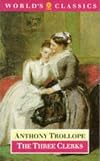
The Three Clerks
by Anthony Trollope
On This Page
Description
Set in the 1850s, The Three Clerks exposes and probes the relationships between three clerks and the three sisters who became their wives. At the same time it satirizes the Civil Service examinations and financial corruption in dealings on the stock market.Tags
Recommendations




















Member Reviews
This is my first time reading Trollope, but it's not likely to be my last. This is more of an ensemble piece in that none of the 6 main characters can be said to be hero or heroine material or the be the real leads. They also are not painted in black and white, they have their strengths and weaknesses. No one is entirely good or entirely evil, even the person who falls the lowest is lead astray. It acts better as a tale reflecting society than as a character study. Again it makes me quite pleased I'm not living in that period, the constraints placed on both men and women by the rules of society would be somewhat restricted. It's interesting in that opportunities for socialising were severely restricted, especially for young women. I show more have to say that I quite liked the inventiveness of the supporting character naming, some certainly made me snort. show less
The three clerks of the title are young men starting out on civil service careers in London. Harry Norman and the slightly older Alaric Tudor get positions in the office of Weights and Measures, while Alaric’s younger cousin, Charley Tudor, gets a position in Internal Navigation. Harry is an honest and generous young man with an unforgiving streak. The ambitious Alaric always has an eye out for the next opportunity for advancement, and despite Harry’s warnings, he allows the end to justify the means. Charley is a happy-go-lucky young man who drifts along with the tide. Charley doesn’t have the strength of character to withstand the temptations of city life, yet he has enough of a sense of morality to be troubled by his dissolute show more behavior. Harry has a widowed cousin in Hampton who has three young daughters, Gertrude, Linda, and Katie. Harry introduces first Alaric and then Charley into the family circle, giving rise to unforeseen jealousies and heartaches.
The pace of the novel is somewhat uneven, with a focus on Harry at the beginning of the novel, Alaric in the middle, and Charley at the end. Their stories overlap but don’t intertwine as well as they might. The comic passages stand out, with Charley’s stab at novel-writing (Crinoline and Macassar) being the highlight of the book for me. Katie’s first ball also had me laughing out loud. show less
The pace of the novel is somewhat uneven, with a focus on Harry at the beginning of the novel, Alaric in the middle, and Charley at the end. Their stories overlap but don’t intertwine as well as they might. The comic passages stand out, with Charley’s stab at novel-writing (Crinoline and Macassar) being the highlight of the book for me. Katie’s first ball also had me laughing out loud. show less
Characteristic Trollope, though not of the first rank. The lower echelons of the early Victorian Civil Service live again; family life at Surbiton Cottage is explored with Trollope's typical sensitivity to feminine emotion; the Hon. Undecimus Scott is the kind of nuanced upper-class villain that Dickens could never give us. It will not convert the skeptic, but it will entertain the Trollope true believer.
I've got a long term Read All Trollope Project going (along with Read All Dickens, Eliot, Cather, Wharton, and James). This I mostly listened to, some very excellent reading on LIbriVox. This still felt like an early work, clumsy and preachy in places. There were numerous long digressions about Parliment and the Civil Service that mostly went over me. The use of satirical names; Mr. Chaffanbrass, Mr. Nogo, etc., felt rather forced. But the story was interesting and I enjoyed getting to know the rather flawed Three Clerks of the title. The sisters Woodward were less distinguishable except for the rather melodramatic Katie. I didn't expect her later story from her introduction as just a fun and hearty young teen but she blossomed into show more full teen angst later. In the end, I was glad that the good were happy and the villanous put down. Yes, Harry Norman turned out a bit of a prig and Alaric and Charlie too easily led into trouble but they were all enjoyable to read about. The buying and selling of shares and influence in Parliment reminded me of The Gilded Age, though perhaps not handled with as much of a satirical skewer as Twain gives it. On to find more Trollope. show less
The story of three civil service clerks, Henry, Alaric and Charley and of the three daughters of Mrs Woodward, Gertrude, Linda and Katie. Alaric becomes a Civil Service Commissioner and plans to run for parliament, but his moral compass is being distorted by his despicable friend Undy. Alaric throws over one sister and marries another and finally receives his comeuppance. Charley is a young scoundrel who struggles to live up to his good intentions. Henry spends the entire novel being moral, unforgiving and extraordinarily boring.
It took me a while to get into this story, but it picks up from the halfway mark. I enjoyed the parts about Charley's literary endeavours and the topics and plot devices he is encouraged to include, although I show more could have done without the entire text of Crinoline and Macassar. I found Alaric an interesting character until his downfall, when he sort of faded out. Charley was the real hero to root for, although even his romance was a bit lacking somehow. I feared at one point that he would marry his bride on her deathbed, but thankfully that didn't happen. The women characters were not so prominent and well-developed as usual. No hunting on the plus side, but the minor characters weren't as developed as in other Trollope novels: Clementina was a bit unbelievable and I never warmed to the Neverbend sisters. Far far too many character with names like Neverbend and Oldeschole and so on.
Not one of my favourites. show less
It took me a while to get into this story, but it picks up from the halfway mark. I enjoyed the parts about Charley's literary endeavours and the topics and plot devices he is encouraged to include, although I show more could have done without the entire text of Crinoline and Macassar. I found Alaric an interesting character until his downfall, when he sort of faded out. Charley was the real hero to root for, although even his romance was a bit lacking somehow. I feared at one point that he would marry his bride on her deathbed, but thankfully that didn't happen. The women characters were not so prominent and well-developed as usual. No hunting on the plus side, but the minor characters weren't as developed as in other Trollope novels: Clementina was a bit unbelievable and I never warmed to the Neverbend sisters. Far far too many character with names like Neverbend and Oldeschole and so on.
Not one of my favourites. show less
The story focuses on three government clerks who enjoy the company of the Woodward sisters. Alaric steals Gertrude from Harry. Harry ends up marrying Linda. Katie likes Charley, but her mother doesn't. The best thing I can say about I've finished it and can say I've read it. It's just not my kind of story. The story does pick up a bit near the end when Alaric gets his just desserts , but even that doesn't quite redeem it.
Members
- Recently Added By
Lists

Favourite 19th century fiction
257 works; 62 members

Books Read in 2019
4,052 works; 108 members
Talk Discussions
Past Discussions
Group read: The Three Clerks by Anthony Trollope in 75 Books Challenge for 2019 (October 2019)
Author Information

335+ Works 50,725 Members
Anthony Trollope was born in London, England on April 24, 1815. In 1834, he became a junior clerk in the General Post Office, London. In 1841, he became a deputy postal surveyor in Banagher, Ireland. He was sent on many postal missions ending up as a surveyor general in the post office outside of London. His first novel, The Macdermots of show more Ballycloran, was published in 1847. His other works included Castle Richmond, The Last Chronicle of Barset, Lady Anna, The Two Heroines of Plumplington, and The Noble Jilt. He died after suffering from a paralytic stroke on December 6, 1882. (Bowker Author Biography) show less
Some Editions
Series
Belongs to Publisher Series
Work Relationships
Is contained in
Contains
Is abridged in
Common Knowledge
- Canonical title
- The Three Clerks
- Original title
- The Three Clerks
- Original publication date
- 1857
- People/Characters
- Harry Norman; Alaric Tudor; Gertrude Woodward
- First words
- All the English world knows, or knows of, that branch of the Civil Service which is popularly called the Weights and Measures.
- Last words
- (Click to show. Warning: May contain spoilers.)'What the devil is all the row about?' said he. But there was nobody to answer him.
Classifications
Statistics
- Members
- 388
- Popularity
- 81,022
- Reviews
- 7
- Rating
- (3.92)
- Languages
- English, French
- Media
- Paper, Audiobook, Ebook
- ISBNs
- 56
- ASINs
- 21