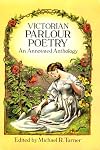
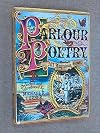
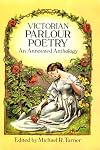
Parlour Poetry
by Michael R. Turner (Editor)
On This Page
Description
Features 117 gems by Longfellow, James Whitcomb Riley, Tennyson, Browning, John Greenleaf Whittier and dozens of lesser-known poets. Many poems difficult to find elsewhere. Includes "The Village Blacksmith," "Curfew Must Not Ring Tonight," "The Wreck of the Hesperus," "The Lips That Touch Liquor Shall Never Touch Mine," more. Preface. Index of poets, titles and first lines.Tags
Recommendations


















Member Reviews
This is a really solid gem-quality collection of sentimental verse which may have peaked in 1810. From "Little Jim" childenized poetry through the drums and oaks of Wilcox, Scot and Kipling. [No Harding. Hmmm.] With interesting Biographies.
These are the poems memorized by our grandparents' parents, almost none of which are anthologized today. As the Industrial Age opened, disaster lurked around every corner, even for children -- "the hymning of moribund babies" [vi] was a lucrative poetic industry -- but a century and a half ago, God was in his heaven, and England and America enjoyed simple moral values universally accepted: courage, honesty, tenderness, devotion, temperance, charity, and above-all, hope! There was an unabashed show more certainty in the security of the spirit if not the body.
And these poems lived in an oral tradition, their themes deeply imbedded in action. And it was no less than our Ella Wheeler Wilcox who wrote, "...it is not Art, but Heart, which wins the wide world over."
The Parlour Poem was a form of popular Art which had not existed before, and "probably never will again" [ix]. It is the expression of an emergent middle class, fearful of Rabelaisian rabble, and shocked by amoral aristocracy, and seeking the shield and sword of a stern but comforting ethic for itself.
The moral ground of sentimentality had not yet been bent by those giant worms of hypocritical sentimentality, the Bavarian Beer Garden Nazis and their royal English (1917 House name changed) and Ford cousins. show less
These are the poems memorized by our grandparents' parents, almost none of which are anthologized today. As the Industrial Age opened, disaster lurked around every corner, even for children -- "the hymning of moribund babies" [vi] was a lucrative poetic industry -- but a century and a half ago, God was in his heaven, and England and America enjoyed simple moral values universally accepted: courage, honesty, tenderness, devotion, temperance, charity, and above-all, hope! There was an unabashed show more certainty in the security of the spirit if not the body.
And these poems lived in an oral tradition, their themes deeply imbedded in action. And it was no less than our Ella Wheeler Wilcox who wrote, "...it is not Art, but Heart, which wins the wide world over."
The Parlour Poem was a form of popular Art which had not existed before, and "probably never will again" [ix]. It is the expression of an emergent middle class, fearful of Rabelaisian rabble, and shocked by amoral aristocracy, and seeking the shield and sword of a stern but comforting ethic for itself.
The moral ground of sentimentality had not yet been bent by those giant worms of hypocritical sentimentality, the Bavarian Beer Garden Nazis and their royal English (1917 House name changed) and Ford cousins. show less
Ratings
Members
- Recently Added By
Author Information
Series
Belongs to Publisher Series
Common Knowledge
- Original title
- Parlour Poetry: A Casquet of Gems
- Alternate titles
- Victorian Parlour Poetry; Favorite Parlour Poetry
- Original publication date
- 1967
- People/Characters
- Little Jim; Little Boy Blue; Jim Bludso; Barbara Frietchie
- First words
- Preface
The gaslight hisses softly in a front parlour in late-nineteenth-century Brooklyn or the Bronx
Classifications
Statistics
- Members
- 116
- Popularity
- 281,306
- Reviews
- 1
- Rating
- (4.17)
- Languages
- English
- Media
- Paper
- ISBNs
- 7
- UPCs
- 1
- ASINs
- 5