
Joseph Addison (1) (1672–1719)
Author of The Sir Roger de Coverley Papers
For other authors named Joseph Addison, see the disambiguation page.
About the Author
Addison, son of the Dean of Litchfield, took high honors at Oxford University and then joined the British army. He first came to literary fame by writing a poem, "The Campaign" (1704), to celebrate the Battle of Blenheim. When Richard Steele, whom he had known in his public school Charterhouse, show more started The Tatler in 1709, Addison became a regular contributor. But his contributions to a later venture The Spectator (generally considered the zenith of the periodical essay), were fundamental. While Steele can be credited with the editorial direction of the journal, Addison's essays, ranging from gently satiric to genuinely funny, secured the journal's success. In The Spectator, No. 10, Addison declared that the journal aimed "to enliven morality with wit, and to temper wit with morality." His brilliant character of Sir Roger de Coverley (followed from rake to reformation) distinguishes the most popular essays. Addison died in 1719. He is buried in Westminster Abbey. (Bowker Author Biography) show less
Works by Joseph Addison
Selections from The Tatler and The Spectator (Penguin Classics) (1957) — Author — 304 copies, 5 reviews
The Commerce of Everyday Life: Selections from The Tatler and The Spectator (Bedford Cultural Editions) (1998) 109 copies, 1 review
The Beggar's Opera and Other Eighteenth-Century Plays (Everyman's Library) (1995) 105 copies, 1 review
The Guardian 26 copies
Critical Essays from the Spectator by Joseph Addison: With Four Essays by Richard Steele (Oxford Paperback English Texts) (1970) 14 copies
SELECT ESSAYS OF ADDISON AND MACAULAY'S ESSAY ON ADDISON'S LIFE AND WRITINGS (1892) — Author — 14 copies
The English Comedie Humaine, The Spectator, the Vicar of Wakefield, The Man of Feeling (1904) 11 copies
The Poetical Works of Joseph Addison; Gay's Fables; and Somerville's Chase (2007) 10 copies, 1 review
Delphi Complete Works of Joseph Addison (Illustrated) (Delphi Series Eight Book 24) (2017) 10 copies
The Tatler 9 copies
The Spectator Vol VII 9 copies
Dialogues upon the usefulness of ancient medals. Especially in relation to the Latin and Greek poets 8 copies, 3 reviews
The Spectator Vol VIII 8 copies
Spectator Papers: Satirical & Philosophical Extracts From the Journal of That Name Written 1711-15 3 copies
The Works of Joseph Addison: Vol. IV 3 copies
The spectator. Volume 9. 3 copies
The Works of Joseph Addison: Vol. II 3 copies
The Works of Joseph Addison: Vol. I 2 copies
Criticisms On Milton 2 copies
The Works 2 copies
The Works of Joseph Addison: Vol. V 2 copies
The Free-Holder, or Political Essays. London, printed for D. Midwinter...and J. Tonson...MDCCXVI 1 copy
Select Essays, Together With Macaulay's Essay on Addison's Life and Writings. Edited by Samuel Thurber (2016) 1 copy
Sir Roger De Coverley (Addison's Sir Roger DeCoverley) - Essays From The Spectator - 1905 (1899) 1 copy
The Spectator. Vol. I 1 copy
The Miscellaneous Works, in Verse and Prose, of the Right Honourable Joseph Addison, Esq (1766) 1 copy
The Spectator by J. Addison, R. Steele, etc.. N. 1 -321, March 1., 1711 -March 8., 1712 (1747) 1 copy
The English Comedie Humaine: Sir Roger De Coverley; The Vicar of Wakefield; The Man of Feeling 1 copy
Addison's Works 1 copy
The spectator. Essays 1 copy
The Spectator: Vol. 1 (of 4) 1 copy
The Spectator: Essays I.-L. 1 copy
THE SPECTATOR, VOL X 1 copy
The old Whig 1 copy
The Spectator, Nos. 1 - 555 1 copy
The Spectator Vol. 10 1 copy
A man of business 1 copy
Catone 1 copy
The Works of Joseph Addison, Vol. 2 of 3: Embracing the Whole of the Spectator, Etc (Classic Reprint) (2017) 1 copy
Essay upon Wit 1 copy
Essays 1 copy
No 189 from The Spectator 1 copy
The Spectator, vol 5 1712 1 copy
The Spectator Volume 6 1 copy
The Spectator vol 2 of 2 1 copy
The Spectator, Vols 3 and 5 1 copy
Associated Works
Hymns of the Church of Jesus Christ of Latter-day Saints (1985) — Contributor — 318 copies, 3 reviews
Restoration and Eighteenth-Century Comedy [Norton Critical Edition] (1973) — Contributor — 282 copies, 2 reviews
British Dramatists from Dryden to Sheridan (1934) — Contributor, some editions — 93 copies, 1 review
English Short Stories from the Fifteenth Century to the Twentieth Century; #743 (1921) — Contributor — 29 copies
English Verse: Volume 3: The Eighteenth Century: Swift to Crabbe (Penguin English Verse) (1995) — Contributor — 11 copies
A Book of 'Characters' from Theophrastus, Joseph Hall, Sir Thomas Overbury, Nicolas Breton, John Earle, Thomas Fuller, (1924) — Contributor — 4 copies
The Works of Anacreon ... with Odes, Fragments, and Epigrams of Sappho — Translator, some editions — 1 copy
Tagged
Common Knowledge
- Birthdate
- 1672-05-01
- Date of death
- 1719-06-17
- Gender
- male
- Education
- University of Oxford (Queen's College)
- Occupations
- editor
essayist
poet
playwright
politician
hymnist - Organizations
- Kit Kat Club
Tatler
The Spectator
Member of Parliament - Relationships
- Addison, Lancelot (father)
- Nationality
- England
- Birthplace
- Milston, Wiltshire, England, UK
- Places of residence
- London, England, UK
Lichfield, England, UK - Place of death
- London, England, UK (then Great Britain)
- Burial location
- Westminster Abbey, London, England, UK
- Map Location
- England, UK
Members
Discussions
Folio Archives 371: Sir Roger de Coverly by Joseph Addison et al. - 1967 in Folio Society Devotees (April 2024)
Reviews

My copy was printed in 1784. France was a kingdom, America a colony and Australia an outline on a map. Not the kind of thing I normally read, but when someone offers you a copy for £1.99 you barrel the Blue Rinse Brigade out of the way in your haste to the till.
What we have here is literary fellatio. In the case of The Campaign Addison has been asked to drop to his knees, but looking at the addressees of the other poems - Dryden, Lord Keeper of the Great Seal, the King - it’s quite show more obvious that he has, without a by-your-leave, popped their cocks out and given suck.
The poems are technically pretty good and largely inoffensive, but the contents totally inconsequential. Addison’s interests are power, fame and Britannia. If he weren’t a man of such stature for other reasons they would never have been reprinted.
The best things in here are some translations out of Ovid and Vergil. I have no idea if they would be considered good translations, but Metamorphoses in particular is good fun. Highly imaginative with good CGI and funny at times. I think it’s interesting what he chooses to translate, so we have Vergil’s Fourth Georgic addressed to Maecenas, itself a patronage poem.
There’s also an introduction which is good even by modern standards.
On the whole I enjoyed the book but largely because it was nice to read something so old. show less
What we have here is literary fellatio. In the case of The Campaign Addison has been asked to drop to his knees, but looking at the addressees of the other poems - Dryden, Lord Keeper of the Great Seal, the King - it’s quite show more obvious that he has, without a by-your-leave, popped their cocks out and given suck.
The poems are technically pretty good and largely inoffensive, but the contents totally inconsequential. Addison’s interests are power, fame and Britannia. If he weren’t a man of such stature for other reasons they would never have been reprinted.
The best things in here are some translations out of Ovid and Vergil. I have no idea if they would be considered good translations, but Metamorphoses in particular is good fun. Highly imaginative with good CGI and funny at times. I think it’s interesting what he chooses to translate, so we have Vergil’s Fourth Georgic addressed to Maecenas, itself a patronage poem.
There’s also an introduction which is good even by modern standards.
On the whole I enjoyed the book but largely because it was nice to read something so old. show less

I love to stand in front of and admire the Vanity Fair "Spy" prints at The Grand Hotel when I visit. I love the droll humor and suppose the packed frames on a green wall is a Carlton Varney. Somehow, I thought this compendium of writing from a century before that would strike me the same way. Maybe with illustrations, it would! Addison and Steele could easily have been the Colbert and Jon Stewart of their time, but I mostly found the musings of Isaac Bickerstaff, William Honeycomb, etc. to show more ring fairly flat these days, IMO. Still, the chronological selections from The Tatler and The Spectator and an important part of journalistic history, and I respect that. The work includes footnotes to explain references and translate the Latin epigraphs which along with content on literature and stage (and a very interesting one doubting the reality of witchcraft) suggest writing for a more educated and sophisticated audience than popular mags of today aim for (People, etc.) making this seem like a cross between The Arts section from the NYT and Mad Magazine. show less
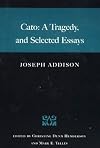
Cato: A Tragedy by Joseph Addison is a play from the early eighteenth century that bridges the gap between the era of classical drama and the coming era of Romanticism. Featuring an archetypal ideal hero in Cato (the younger) who is faced with the responsibility of leading the opposition to Julius Caesar. Caesar had been methodically defeating his foes; those who blocked his path to sole leadership of the Roman Republic. Trapped at Utica in Northern Africa near Carthage, Cato with the help show more of his sons and a very few friends must decide what to do. The drama is not suspenseful for anyone who knows his Roman History is aware of how it ends, but it does provide a platform for delineating the character of Cato and in doing so shed light on the culture of Rome.
The defining characteristic of Cato's character is virtue. That is virtue in the classical sense, true goodness and beauty and courage, that can be found in the works of Plato, Aristotle, and Cicero. It is the sort of virtue that leads his friend, Juba, to comment in the second act:
"I'll hence, and try to find
Some blest occasion that may set me right
In Cato's thoughts. I'd rather have that man
Approve my deeds, than worlds for my admirers."
While in the final act Cato's son, Marcus, says:
"He is all goodness, Lucia, always mild,
Compassionate, and gentle to his friends."
As he nears his death Cato turns to the Phaedo of Plato, meditating on the death of Socrates and the possibility of the immortality of the soul. Addison's play is as inspirational today as it was in eighteenth century America when the leaders of the Revolutionary War read it and shared the ideal of virtue embodied in this drama. show less
The defining characteristic of Cato's character is virtue. That is virtue in the classical sense, true goodness and beauty and courage, that can be found in the works of Plato, Aristotle, and Cicero. It is the sort of virtue that leads his friend, Juba, to comment in the second act:
"I'll hence, and try to find
Some blest occasion that may set me right
In Cato's thoughts. I'd rather have that man
Approve my deeds, than worlds for my admirers."
While in the final act Cato's son, Marcus, says:
"He is all goodness, Lucia, always mild,
Compassionate, and gentle to his friends."
As he nears his death Cato turns to the Phaedo of Plato, meditating on the death of Socrates and the possibility of the immortality of the soul. Addison's play is as inspirational today as it was in eighteenth century America when the leaders of the Revolutionary War read it and shared the ideal of virtue embodied in this drama. show less

Many of the selected essays seem so contemporary that it's interesting to reflect that they were written over 300 years ago. e.g. the shame of poverty vs. the fear of poverty.
Lists
Folio Society (1)
My List (1)
Awards

You May Also Like


Associated Authors
Statistics
- Works
- 170
- Also by
- 38
- Members
- 2,217
- Popularity
- #11,562
- Rating
- 4.0
- Reviews
- 31
- ISBNs
- 158
- Languages
- 2
- Favorited
- 2


