
William Hazlitt (1) (1778–1830)
Author of On the Pleasure of Hating
For other authors named William Hazlitt, see the disambiguation page.
About the Author
William Hazlitt was born on April 10, 1778 in Maidstone, England. As a young man, he studied for the ministry at Hackney College in London, but eventually realized that he wasn't committed to becoming a minister. After he lacked success as a portrait painter, he turned to writing. His first book, show more An Essay on the Principles of Human Action, was published in 1805. His other works include Free Thoughts on Public Affairs, Round Table, Table Talk, Spirit of the Age, Characters of Shakespeare, A View of the English Stage, English Poets, English Comic Writers, Political Essays with Sketches of Public Characters, Plain Speaker, and The Life of Napoleon. He died of stomach cancer on September 18, 1830. (Bowker Author Biography) show less
Image credit: Source: "The Book-Hunter in London"
by William Roberts (London, 1895)
(Project Gutenberg)
Works by William Hazlitt
Hazlitt on theatre; [selections from the View of the English stage, and Criticisms and dramatic essays] (1991) 15 copies
All That is Worth Remembering: Selected Essays of William Hazlitt (Classic Collection) (2014) 13 copies
The Letters of William Hazlitt (The Gotham library of the New York University Press) (1978) 12 copies
Lectures on the English comic writers,: With miscellaneous essays (Everyman's library. Essays and belles lettres) (1913) 11 copies
Characters of Shakespear's plays, & Lectures on the English poets (Library of English classics) (2011) 10 copies
Lectures on the literature of the age of Elizabeth, and Characters of Shakespeare's plays (1895) 7 copies
The Works of William Hazlitt 6 copies
Selected Writings of William Hazlitt 3 copies
Louis XVII, His Life, His Suffering, His Death: The Captivity of the Royal Family in the Temple (Volumes 1 and 2) (1852) — Editor; Translator — 3 copies
The Plain Speaker, Vol. 1 of 2: Opinions on Books, Men, and Things (Classic Reprint) (2017) 2 copies
The Complete Works of William Hazlitt 8. Edited by P. P. Howe, after the edition of A. R. Waller and Arnold Glover (1931) 2 copies
Select British Poets, or new elegant extracts from Chaucer to the present time, with critical remarks (2011) 2 copies
The Life of Napoleon - Volume I 2 copies
Selections from William Hazlitt 2 copies
Hazlitt On English Literature; An Introduction To The Appreciation Of Literature (BCL1-PR English Literature) (2013) 2 copies
ESSAYS OF WILLIAM HAZLITT 2 copies
The Fight and Other Writings — Author — 1 copy
Twee essays 1 copy
Hazlitt's Wit and Humour 1 copy
Essays of William Hazlitt 1 copy
Hazlitt's Selected Essays 1 copy
The fight : an essay 1 copy
Classic British Literature: 5 books by William Hazlitt in a single file, with active table of contents (2009) 1 copy
Essays and Characters 1 copy
Sketches of the principal picture-galleries in England: with a criticism on "Marriage a-la-mode." (1824) 1 copy
Associated Works
William Shakespeare: The Complete Works (1623) — Contributor, some editions — 35,664 copies, 177 reviews
The Norton Anthology of English Literature, 4th Edition, Volume 2 (1979) — Contributor — 269 copies, 1 review
Ben Jonson and the Cavalier Poets [Norton Critical Edition] (1975) — Contributor — 236 copies, 2 reviews
Neoclassicism and Romanticism, 1750-1850: Sources and Documents (Sources & Documents in History of Art), Volume 2 Restoration / Twilight of Humanism (1970) — Contributor — 22 copies
Works of Michael De Montaigne Comprising His Essays, Journey Into Italy, and Letters, with Notes From All the Commentato — some editions — 2 copies
A reader for writers — Contributor — 2 copies
Tagged
Common Knowledge
- Birthdate
- 1778-04-10
- Date of death
- 1830-09-18
- Gender
- male
- Education
- Hackney College
- Occupations
- painter
essayist
journalist
biographer
literary critic
philosopher - Relationships
- Stoddart Hazlitt, Sarah (wife)
- Nationality
- UK
- Birthplace
- Maidstone, Kent, England, UK
- Places of residence
- Boston, Massachusetts, USA
Wem, England, UK - Place of death
- Soho, London, England, UK
- Burial location
- St. Anne’s Churchyard, Soho, London, England, UK
- Map Location
- England, UK
Members
Reviews

[From The Gentleman in the Parlour, Vintage Classics, 2001 [1930], pp. 1-5:]
I have never been able to feel for Charles Lamb the affection that he inspires in most of his readers. There is a cross grain in my nature that makes me resent the transports of others and gush will dry up in me (against my will, for heaven knows I have no wish to chill by my coldness the enthusiasm of my neighbours) the capacity of admiration. Too many critics have written of Charles Lamb with insipidity for me show more ever to have been able to read him without uneasiness. He is like one of those persons of overflowing heart who seem to lie in wait for disaster to befall you so that they may envelop you with their sympathy. Their arms are so quickly outstretched to raise you when you fall that you cannot help asking yourself, as you rub your barked shin, whether by any chance they did not put in your path the stone that tripped you up. I am afraid of people with too much charm. They devour you. In the end you are made a sacrifice to the exercise of their fascinating gift and their insincerity. Nor do I much care for writers whose charm is their chief asset. It is not enough. I want something to get my teeth into, and when I ask for roast beef and Yorkshire pudding I am dissatisfied to be given bread and milk. I am put out of countenance by the sensibility of the Gentle Elia. For a generation Rousseau had pinned every writer’s heart to his sleeve and it was in his day still the fashion to write with a lump in the throat, but Lamb’s emotion, to my mind, too often suggests the facile lachrymosity of the alcoholic. I cannot but think his tenderness would have been advantageously tempered by abstinence, a blue pill and a black draught. Of course when you read the references made to him by his contemporaries, you discover that the Gentle Elia is an invention of the sentimentalists. He was a more robust, irascible and intemperate fellow than they have made him out, and he would have laughed (and with justice) at the portrait they have painted of him. If you had met him one evening at Benjamin Haydon’s, you would have seen a grubby little person, somewhat the worse for liquor, who could be very dull, and if he made a joke it might as easily have been a bad as a good one. In fact, you would have met Charles Lamb and not the Gentle Elia. And if you had read that morning one of his essays in The London Magazine you would have thought it an agreeable trifle. It would never have occurred to you that this pleasant piece would serve one day as a pretext for the lucubrations of the learned. You would have read it in the right spirit; for you it would have been a living thing. It is one of the misfortunes to which the writer is subject that he is too little praised when he is alive and too much when he is dead. The critics force us to read the classics as Machiavelli wrote, in Court dress; whereas we should do much better to read them, as though they were our contemporaries, in a dressing-gown.
And because I had read Lamb in deference to common opinion rather than from inclination I had forborne to read Hazlitt at all. What with the innumerable books it urgently imported me to read, I came to the conclusion that I could afford to neglect a writer who had but done mediocrely (I understood) what another had done with excellence. And the Gentle Elia bored me. It was seldom I had read anything about Lamb without coming across a fling and a sneer at Hazlitt. I knew that FitzGerald had once intended to write a life of him, but had given up the project in disgust of his character. He was a mean, savage, nasty little man and an unworthy hanger-on of the circle in which Lamb, Keats, Shelley, Coleridge and Wordsworth shone with so bright a lustre. There seemed no need to waste any time on a writer of so little talent and of so unpleasant a nature. But one day, about to start on a long journey, I was wondering round Bumpus’s looking for books to take with me when I came across a selection of Hazlitt’s Essays. It was an agreeable little volume in a green cover, and nicely printed, cheap in price and light to hold, and out of curiosity to know the truth about an author of whom I had read so much ill, I put it on the pile that I had already collected.
[…]
I began to read my Hazlitt. I was astonished. I found a solid writer, without pretentiousness, courageous to speak his mind, sensible and plain, with a passion for the arts that was neither gushing nor forced, various, interested in the life about him, ingenious, sufficiently profound for his purposes, but with no affectation of profundity, humorous, sensitive. And I liked his English. It was natural and racy, eloquent where eloquence was needed, easy to read, clear and succinct, neither below the weight of his matter nor with fine phrases trying to give it a specious importance. If art is nature seen through the medium of a personality, Hazlitt is a great artist.
I was enraptured. I could not forgive myself that I had lived so long without reading him and I raged against the idolaters of Elia whose foolishness had deprived me till now of so vivid an experience. Here certainly was no charm, but what a robust mind, sane, clear-cut and vivacious, and what vigour! Presently I came across the rich essay which is entitled On Going A Journey and I reached the passage that runs: ‘Oh! it is great to shake off the trammels of the world and of public opinion – to lose our importunate, tormenting, everlasting personal identity in the elements of nature, and become the creature of the moment, clear of all ties – to hold to the universe only by a dish of sweet-breads, and to owe nothing but the score of the evening – and no longer seeking for applause and meeting with contempt, to be known by no other title than The Gentleman in the Parlour!’ I could wish that Hazlitt had used fewer dashes in this passage. There is in the dash something rough, ready and haphazard that goes against my grain. I have seldom read a sentence in which it could not be well replaced by the elegant semi-colon or the discreet bracket. But I had no sooner read these words than it occurred to me that here was an admirable name for a book of travel and I made up my mind to write it.
[From The Summing Up, The Literary Guild of America, 1938, xiv, 45-46:]
It has been an advantage to American writers, many of whom at one time or another have been reporters, that their journalism has been written in a more trenchant, nervous, graphic English than ours. For we read the newspaper now as our ancestors read the Bible. Not without profit either; for the newspaper, especially when it is of the popular sort, offers us a part of experience that we writers cannot afford to miss. It is raw material straight from the knacker's yard, and we are stupid if we turn up our noses because it smells of blood and sweat. We cannot, however willingly we would, escape the influence of this workaday prose. But the journalism of a period has very much the same style; it might all have been written by the same hand; it is impersonal. It is well to counteract its effect by reading of another kind. One can do this only by keeping constantly in touch with the writing of an age not too remote from one's own. So can one have a standard by which to test one's own style and an ideal which in one's modern way one can aim at. For my part the two writers I have found most useful to study for this purpose are Hazlitt and Cardinal Newman. I would try to imitate neither. Hazlitt can be unduly rhetorical; and sometimes his decoration is as fussy as Victorian Gothic. Newman can be a trifle flowery. But at their best both are admirable. Time has little touched their style; it is almost contemporary. Hazlitt is vivid, bracing and energetic; he has strength and liveliness. You feel the man in his phrases, not the mean, querulous, disagreeable man that he appeared to the world that knew him, but the man within of his own ideal vision. (And the man within us is as true in reality as the man, pitiful and halting, of our outward seeming.) Newman had an exquisite grace, music, playful sometimes and sometimes grave, a woodland beauty of phrase, dignity and mellowness. Both wrote with extreme lucidity. Neither is quite as simple as the purest taste demands. Here I think Matthew Arnold excels them. Both had a wonderful balance of phrase and both knew how to write sentences pleasing to the eye. Both had an ear of extreme sensitiveness.
[From Books and You, Doubleday, Doran & Co., 1940, pp. 41-42:]
At this point I would draw your attention to Hazlitt. His fame has been overshadowed by that of Charles Lamb, but to my mind he was the better essayist. Charles Lamb, a charming, gentle, witty creature whom to know was to love, has always appealed to the affections of his readers. Hazlitt could hardly do that. He was rude, tactless, envious and quarrelsome; but, unfortunately, it is not always the most worthy men who write the best books. In the end it is the personality of the artist that counts, and for my part I find more to interest me in the tormented, striving, acrimonious soul of Hazlitt than in Charles Lamb’s patient but somewhat maudlin amiability. As a writer, Hazlitt was vigorous, bold and healthy. What he had to say, he said with decision. His essays are full of meat, and when you have read one of them you feel, not as you do when you have read one of Lamb’s, that you have made a meal of savoury kickshaws, but that you have satisfied your appetite with substantial fare. Much of his best work can be found in his Table Talk, but there have been published a number of selections from his essays, and none of these can fail to contain My First Acquaintance with Poets, which, I suppose, is not only the most thrilling piece he ever wrote but the finest essay in the English language. show less
I have never been able to feel for Charles Lamb the affection that he inspires in most of his readers. There is a cross grain in my nature that makes me resent the transports of others and gush will dry up in me (against my will, for heaven knows I have no wish to chill by my coldness the enthusiasm of my neighbours) the capacity of admiration. Too many critics have written of Charles Lamb with insipidity for me show more ever to have been able to read him without uneasiness. He is like one of those persons of overflowing heart who seem to lie in wait for disaster to befall you so that they may envelop you with their sympathy. Their arms are so quickly outstretched to raise you when you fall that you cannot help asking yourself, as you rub your barked shin, whether by any chance they did not put in your path the stone that tripped you up. I am afraid of people with too much charm. They devour you. In the end you are made a sacrifice to the exercise of their fascinating gift and their insincerity. Nor do I much care for writers whose charm is their chief asset. It is not enough. I want something to get my teeth into, and when I ask for roast beef and Yorkshire pudding I am dissatisfied to be given bread and milk. I am put out of countenance by the sensibility of the Gentle Elia. For a generation Rousseau had pinned every writer’s heart to his sleeve and it was in his day still the fashion to write with a lump in the throat, but Lamb’s emotion, to my mind, too often suggests the facile lachrymosity of the alcoholic. I cannot but think his tenderness would have been advantageously tempered by abstinence, a blue pill and a black draught. Of course when you read the references made to him by his contemporaries, you discover that the Gentle Elia is an invention of the sentimentalists. He was a more robust, irascible and intemperate fellow than they have made him out, and he would have laughed (and with justice) at the portrait they have painted of him. If you had met him one evening at Benjamin Haydon’s, you would have seen a grubby little person, somewhat the worse for liquor, who could be very dull, and if he made a joke it might as easily have been a bad as a good one. In fact, you would have met Charles Lamb and not the Gentle Elia. And if you had read that morning one of his essays in The London Magazine you would have thought it an agreeable trifle. It would never have occurred to you that this pleasant piece would serve one day as a pretext for the lucubrations of the learned. You would have read it in the right spirit; for you it would have been a living thing. It is one of the misfortunes to which the writer is subject that he is too little praised when he is alive and too much when he is dead. The critics force us to read the classics as Machiavelli wrote, in Court dress; whereas we should do much better to read them, as though they were our contemporaries, in a dressing-gown.
And because I had read Lamb in deference to common opinion rather than from inclination I had forborne to read Hazlitt at all. What with the innumerable books it urgently imported me to read, I came to the conclusion that I could afford to neglect a writer who had but done mediocrely (I understood) what another had done with excellence. And the Gentle Elia bored me. It was seldom I had read anything about Lamb without coming across a fling and a sneer at Hazlitt. I knew that FitzGerald had once intended to write a life of him, but had given up the project in disgust of his character. He was a mean, savage, nasty little man and an unworthy hanger-on of the circle in which Lamb, Keats, Shelley, Coleridge and Wordsworth shone with so bright a lustre. There seemed no need to waste any time on a writer of so little talent and of so unpleasant a nature. But one day, about to start on a long journey, I was wondering round Bumpus’s looking for books to take with me when I came across a selection of Hazlitt’s Essays. It was an agreeable little volume in a green cover, and nicely printed, cheap in price and light to hold, and out of curiosity to know the truth about an author of whom I had read so much ill, I put it on the pile that I had already collected.
[…]
I began to read my Hazlitt. I was astonished. I found a solid writer, without pretentiousness, courageous to speak his mind, sensible and plain, with a passion for the arts that was neither gushing nor forced, various, interested in the life about him, ingenious, sufficiently profound for his purposes, but with no affectation of profundity, humorous, sensitive. And I liked his English. It was natural and racy, eloquent where eloquence was needed, easy to read, clear and succinct, neither below the weight of his matter nor with fine phrases trying to give it a specious importance. If art is nature seen through the medium of a personality, Hazlitt is a great artist.
I was enraptured. I could not forgive myself that I had lived so long without reading him and I raged against the idolaters of Elia whose foolishness had deprived me till now of so vivid an experience. Here certainly was no charm, but what a robust mind, sane, clear-cut and vivacious, and what vigour! Presently I came across the rich essay which is entitled On Going A Journey and I reached the passage that runs: ‘Oh! it is great to shake off the trammels of the world and of public opinion – to lose our importunate, tormenting, everlasting personal identity in the elements of nature, and become the creature of the moment, clear of all ties – to hold to the universe only by a dish of sweet-breads, and to owe nothing but the score of the evening – and no longer seeking for applause and meeting with contempt, to be known by no other title than The Gentleman in the Parlour!’ I could wish that Hazlitt had used fewer dashes in this passage. There is in the dash something rough, ready and haphazard that goes against my grain. I have seldom read a sentence in which it could not be well replaced by the elegant semi-colon or the discreet bracket. But I had no sooner read these words than it occurred to me that here was an admirable name for a book of travel and I made up my mind to write it.
[From The Summing Up, The Literary Guild of America, 1938, xiv, 45-46:]
It has been an advantage to American writers, many of whom at one time or another have been reporters, that their journalism has been written in a more trenchant, nervous, graphic English than ours. For we read the newspaper now as our ancestors read the Bible. Not without profit either; for the newspaper, especially when it is of the popular sort, offers us a part of experience that we writers cannot afford to miss. It is raw material straight from the knacker's yard, and we are stupid if we turn up our noses because it smells of blood and sweat. We cannot, however willingly we would, escape the influence of this workaday prose. But the journalism of a period has very much the same style; it might all have been written by the same hand; it is impersonal. It is well to counteract its effect by reading of another kind. One can do this only by keeping constantly in touch with the writing of an age not too remote from one's own. So can one have a standard by which to test one's own style and an ideal which in one's modern way one can aim at. For my part the two writers I have found most useful to study for this purpose are Hazlitt and Cardinal Newman. I would try to imitate neither. Hazlitt can be unduly rhetorical; and sometimes his decoration is as fussy as Victorian Gothic. Newman can be a trifle flowery. But at their best both are admirable. Time has little touched their style; it is almost contemporary. Hazlitt is vivid, bracing and energetic; he has strength and liveliness. You feel the man in his phrases, not the mean, querulous, disagreeable man that he appeared to the world that knew him, but the man within of his own ideal vision. (And the man within us is as true in reality as the man, pitiful and halting, of our outward seeming.) Newman had an exquisite grace, music, playful sometimes and sometimes grave, a woodland beauty of phrase, dignity and mellowness. Both wrote with extreme lucidity. Neither is quite as simple as the purest taste demands. Here I think Matthew Arnold excels them. Both had a wonderful balance of phrase and both knew how to write sentences pleasing to the eye. Both had an ear of extreme sensitiveness.
[From Books and You, Doubleday, Doran & Co., 1940, pp. 41-42:]
At this point I would draw your attention to Hazlitt. His fame has been overshadowed by that of Charles Lamb, but to my mind he was the better essayist. Charles Lamb, a charming, gentle, witty creature whom to know was to love, has always appealed to the affections of his readers. Hazlitt could hardly do that. He was rude, tactless, envious and quarrelsome; but, unfortunately, it is not always the most worthy men who write the best books. In the end it is the personality of the artist that counts, and for my part I find more to interest me in the tormented, striving, acrimonious soul of Hazlitt than in Charles Lamb’s patient but somewhat maudlin amiability. As a writer, Hazlitt was vigorous, bold and healthy. What he had to say, he said with decision. His essays are full of meat, and when you have read one of them you feel, not as you do when you have read one of Lamb’s, that you have made a meal of savoury kickshaws, but that you have satisfied your appetite with substantial fare. Much of his best work can be found in his Table Talk, but there have been published a number of selections from his essays, and none of these can fail to contain My First Acquaintance with Poets, which, I suppose, is not only the most thrilling piece he ever wrote but the finest essay in the English language. show less
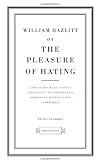
This little book of essays punctured my reluctance to tackle anything written more than a hundred years ago. What a foolish prejudice!
From the essay "Indian Jugglers": "No man is truly great, who is great only in his lifetime." Which brought to mind modern celebrity and the petty inflations of the media, with whom Hazlitt was familar in his own time, dissecting the great and ungreat personages, and the qualities that made them so, and not.
From "On the Spirit of Monarchy": "The right and the show more wrong are of little consequence, compared to the in and the out," discussing in this acerbic essay courts and kings; relevant to contemporary life, if not the enduring state of social affairs in whatever age.
"Reason and Imagination," a biting commentary on detached reasoning versus "natural feeling," with Hazlitt citing examples that bring to mind "enhanced interrogation"/torture, about which he writes (while discussing slavery): "Practices, the mention of which make the flesh creep, and that affront the light of day, ought to be put down the instant they are known, without inquiry and without repeal."
And the remarkable title essay, "On the Pleasure of Hating," which is so consistent and high-flying throughout that every phrase could be quoted and ruminated upon for its insight and application. show less
From the essay "Indian Jugglers": "No man is truly great, who is great only in his lifetime." Which brought to mind modern celebrity and the petty inflations of the media, with whom Hazlitt was familar in his own time, dissecting the great and ungreat personages, and the qualities that made them so, and not.
From "On the Spirit of Monarchy": "The right and the show more wrong are of little consequence, compared to the in and the out," discussing in this acerbic essay courts and kings; relevant to contemporary life, if not the enduring state of social affairs in whatever age.
"Reason and Imagination," a biting commentary on detached reasoning versus "natural feeling," with Hazlitt citing examples that bring to mind "enhanced interrogation"/torture, about which he writes (while discussing slavery): "Practices, the mention of which make the flesh creep, and that affront the light of day, ought to be put down the instant they are known, without inquiry and without repeal."
And the remarkable title essay, "On the Pleasure of Hating," which is so consistent and high-flying throughout that every phrase could be quoted and ruminated upon for its insight and application. show less
The pleasure of hating, like a poisonous mineral, eats into the heart of religion, and turns it to rankling spleen and bigotry; it makes patriotism an excuse for carrying fire, pestilence, and famine into other lands; it leaves to virtue nothing but the spirit of censoriousness, and a narrow, jealous, inquisitorial watchfulness over the actions and motives of others.
An alluring title, to be sure, but as with many of his contemporary essayists, Hazlitt rambles more often than he explains or show more enlightens. In each essay (The Fight, The Indian Jugglers, On the Spirit of Monarchy, What is The People, On Reason and Imagination, On the Pleasure of Hating - only two of which could be considered rewarding), there is perhaps a page of distilled Idea, a kernel such as the above which grew into an unnavigable thicket of prose once pen was laid to paper.
It is of a fashion to bemoan the spiteful and belligerent times we live in, and in this spirit I offer the following morsel:
Does the love of virtue denote any wish to discover or amend our own faults? No, but it atones for an obstinate adherence to our own vices by the most virulent intolerance to human frailties.show less
Nell’introduzione c’è scritto che Hazlitt è considerato “il saggista meno noioso del mondo”… immagino allora quanto deve essere soporifero il più noioso!
Non è che sia proprio tutto brutto questo libro, ogni tanto c’era qualche brano molto bello, ma il succo degli articoli mi è parso alquanto inconsistente, per non parlare poi della ripetitività: per spiegare un concetto, millemila esempi tutti uguali!
Anche quando poi non erano noiosi né ripetitivi, non sempre i contenuti show more erano accettabili: spesso Hazlitt risultava assurdo ed eccessivo.
Insomma, mi ha annoiato e deluso.
http://www.naufragio.it/iltempodileggere/6357 show less
Non è che sia proprio tutto brutto questo libro, ogni tanto c’era qualche brano molto bello, ma il succo degli articoli mi è parso alquanto inconsistente, per non parlare poi della ripetitività: per spiegare un concetto, millemila esempi tutti uguali!
Anche quando poi non erano noiosi né ripetitivi, non sempre i contenuti show more erano accettabili: spesso Hazlitt risultava assurdo ed eccessivo.
Insomma, mi ha annoiato e deluso.
http://www.naufragio.it/iltempodileggere/6357 show less
Lists
Awards

You May Also Like


Associated Authors
Statistics
- Works
- 158
- Also by
- 29
- Members
- 2,651
- Popularity
- #9,685
- Rating
- 4.3
- Reviews
- 20
- ISBNs
- 281
- Languages
- 7
- Favorited
- 17
