
Northrop Frye (1912–1991)
Author of Anatomy of Criticism: Four Essays
About the Author
Herman Northrop Frye was born in 1912 in Quebec, Canada. His mother educated him at home until the fourth grade. After graduating from the University of Toronto, he studied theology at Emmanuel College for several years and actually worked as a pastor before deciding he preferred the academic life. show more He eventually obtained his master's degree from Oxford, and taught English at the University of Toronto for more than four decades. Frye's first two books, Fearful Symmetry (1947) and Anatomy of Criticism (1957) set forth the influential literary principles upon which he continued to elaborate in his numerous later works. These include Fables of Identity: Studies in Poetic Mythology, The Well-Tempered Critic, and The Great Code: The Bible and Literature. Frye died in 1991. (Bowker Author Biography) show less
Image credit: Used by permission: Victoria University, E.J. Pratt Library
Works by Northrop Frye
Biblical and Classical Myths: The Mythological Framework of Western Culture (Frye Studies) (2004) 57 copies
Romanticism Reconsidered: Selected Papers from the English Institute (English Institute Essays) (1963) 22 copies
The Secular Scripture and Other Writings on Critical Theory, 1976 -1991 (Collected Works of Northrop Frye) (2006) 7 copies
The Morality of Scholarship 6 copies
The Critical Path and Other Writings on Critical Theory, 1963-1975 (Collected Works of Northrop Frye) (2009) 6 copies
The Correspondence of Northrop Frye and Helen Kemp, 1932-1939 (Collected Works of Northrop Frye, Vol. 2) (1996) 6 copies
A Glorious and Terrible Life with You: Selected Correspondence of Northrop Frye and Helen Kemp, 1932-1939 (2007) 4 copies
Northrop Frye's late notebooks, 1982-1990. architecture of the spiritual world / edited by Robert D. Denham. / Volume 6 (2000) 4 copies
Learning in Language and Literature: The Developing Imagination. Insistent Tasks in Language Learning (Burton Lectures) (1963) 2 copies
The Educated Imagination and Other Writings on Critical Theory 1933-1963 (Collected Works of Northrop Frye) (2006) 2 copies
The way and its power 1 copy
Veliki kod(eks) 1 copy
Mit i struktura 1 copy
Expanding Eyes 1 copy
La escritura profana 1 copy
Zohar, the Book of splendor 1 copy
Associated Works
Paradise Lost [Norton Critical Edition] (1667) — Contributor, some editions — 2,437 copies, 14 reviews
Literature: An Introduction to Fiction, Poetry, and Drama (1995) — Contributor, some editions — 1,025 copies, 7 reviews
A World of Ideas : Conversations With Thoughtful Men and Women About American Life Today and the Ideas Shaping Our Future (1989) — Interviewee — 603 copies, 1 review
Blake's Poetry and Designs [Norton Critical Edition, 2nd ed.] (2007) — Contributor — 239 copies, 1 review
Essays on Shakespeare and Elizabethan drama in honor of Hardin Craig (1962) — Contributor — 6 copies
Tagged
Common Knowledge
- Canonical name
- Frye, Northrop
- Legal name
- Frye, Herman Northrop
- Birthdate
- 1912-07-14
- Date of death
- 1991-01-23
- Gender
- male
- Education
- University of Toronto (BA|1933 - Victoria College, Emmanuel College)
University of Oxford (MA|1938 - Merton College) - Occupations
- minister
literary critic
university professor - Organizations
- United Church of Canada (ordained 1936)
University of Toronto - Awards and honors
- Lorne Pierce Medal (1958)
Order of Canada (Companion, 1972)
Molson Prize (1971)
American Academy of Arts and Letters (1981)
British Academy (Fellow, 1975)
Pierre Chaveau Medal (1970) (show all 14)
American Academy of Arts and Sciences (1969)
Fellow, Merton College, Oxford University (1974)
Royal Society of Canada (Fellow, 1951)
Royal Bank Award (1978)
Governor General's Literary Award (1987)
Toronto Arts Lifetime Achievement Award (1987)
American Philosophical Society (1976)
National Historic Person (2018) - Relationships
- Atwood, Margaret (student)
Thomas, Clara (student)
Kemp, Helen (spouse) - Cause of death
- heart attack
- Nationality
- Canada
- Birthplace
- Sherbrooke, Québec, Canada
- Places of residence
- Moncton, New Brunswick, Canada
- Place of death
- Toronto, Ontario, Canada
- Burial location
- Mount Pleasant Cemetery, Toronto, Ontario, Canada
- Associated Place (for map)
- Canada
Members
Reviews

The subtitle of The Double Vision is misleading: it should have been Language and Meaning in Christianity (or perhaps in Biblical Religion, a phrase to which Frye resorts in its pages). He does advert briefly to Oriental "cults" imported into North America in the 20th century, and to the paganism of the ancient near east and Hellenistic antiquity, but only in order to frame his own religion. Considering the origins of the volume, such provincialism (not a word I expected to use of Frye!) is show more unsurprising; the original audience for this material were his fellow alumni of Emmanuel College, the theological faculty of Victoria University.
The four chapters were originally given as three lectures and a paper. The third chapter "The Double Vision of Time" is the best of the lot; I would be profoundly impressed to hear it given as a sermon. (Frye was an ordained minister of the Methodist-descended United Church of Canada, even if his only pulpit was in a university English department.) "The Double Vision of God" at the end is the worst. It is full of terribly wrongheaded historical claims, such as the one that the solar element only "enters Christendom with the 'Sun King' Louis XIV of France." (61) This badness is also unsurprising in light of Frye's own earlier emphasis on the distinction between Weltgeschichte and Heilgeschichte:
"That the literal basis of faith in Christianity is a mythical and metaphorical basis, not one founded on historical facts or logical propositions." (17)
Frye's strength is obviously in myth and metaphor, not history. The ambition of this book to make more accessible his earlier works on literary hermeneutics of the bible (The Great Code and Words with Power) is thus frustrated by his insistence on attempting to connect with the historical context of modern secular culture. There is considerable intellectual value in those earlier books from a critic who views the Bible "not as a source of doctrine but as a source of story and vision." (3) But in The Double Vision, he is snared in a paradox, coming too close to repeating the very procedure he derides: "Most Protestantism ... turned to history rather than metaphysics as an infrastructure for revelation." (69) What is lost in the process is what made the revelation sacred, and the history that results tends toward the valorization of ignorance. show less
The four chapters were originally given as three lectures and a paper. The third chapter "The Double Vision of Time" is the best of the lot; I would be profoundly impressed to hear it given as a sermon. (Frye was an ordained minister of the Methodist-descended United Church of Canada, even if his only pulpit was in a university English department.) "The Double Vision of God" at the end is the worst. It is full of terribly wrongheaded historical claims, such as the one that the solar element only "enters Christendom with the 'Sun King' Louis XIV of France." (61) This badness is also unsurprising in light of Frye's own earlier emphasis on the distinction between Weltgeschichte and Heilgeschichte:
"That the literal basis of faith in Christianity is a mythical and metaphorical basis, not one founded on historical facts or logical propositions." (17)
Frye's strength is obviously in myth and metaphor, not history. The ambition of this book to make more accessible his earlier works on literary hermeneutics of the bible (The Great Code and Words with Power) is thus frustrated by his insistence on attempting to connect with the historical context of modern secular culture. There is considerable intellectual value in those earlier books from a critic who views the Bible "not as a source of doctrine but as a source of story and vision." (3) But in The Double Vision, he is snared in a paradox, coming too close to repeating the very procedure he derides: "Most Protestantism ... turned to history rather than metaphysics as an infrastructure for revelation." (69) What is lost in the process is what made the revelation sacred, and the history that results tends toward the valorization of ignorance. show less

The Great Code (a term borrowed from William Blake, who wrote that the Old and New Testaments are the great code of art) is one of the most interesting and challenging books about the Bible that I’ve come across. It doesn’t deal with matters of faith or doctrine but with “the impact of the Bible on the creative imagination.” Frye’s experience as a teacher convinced him that “a student of English literature who does not know the Bible does not understand a good deal of what is show more going on in what he reads.” Yet he distinguishes his work from the plethora of “Bible as literature” courses and books that had become fashionable by the time that he wrote. He does not treat the Bible as an anthology of Ancient Near Eastern texts. Yet, as the book’s subtitle, The Bible and Literature suggests, his approach is not far removed. Frye states his aim at the outset: to “study the Bible from the point of view of a literary critic.”
This requires, first, treating the collection of writings contained in the Bible not as an anthology but as a unit. He does this not only because the Bible has traditionally been read in this way, but more importantly, because it does have something very much like a plot, with a beginning and a conclusion, and because it contains “a body of concrete images,” which “recur so often that they clearly indicate some kind of unifying principle.”
Frye’s analysis is organized according to language, myth, metaphor, and typology. They are treated in that order in the four chapters of Part One, then in reverse order in Part Two, in which these topics are applied more directly to the Bible. Frye calls this structure a “double-mirror.” I thought the structure apt, since so many of the thought units of the Bible have a chiastic structure.
Having read Frye’s earlier book, Anatomy of Criticism, some of his terminology was familiar to me, as well as his adoption of Vico’s ages (mythical, heroic, vulgar), which Frye calls the hieroglyphic, the hieratic, and the demotic, each with its typical kind of language (metaphorical, allegorical or metonymic, and descriptive). Some other key terms are centripetal/centrifugal, categories of metaphor (importantly, the “royal metaphor,” which unites the individual and the group), and the ladder of polysemous sense.
The book is sprinkled with observations that go beyond the topic of the Bible and literature, such as: “A good deal of human activity is wasted on perverted energy, making war, feeding a parasitic class, building monuments to paranoid conquerors, and the like.” Plus ça change!
Implicit in the course of the book is a running controversy with “literalists.” I was one when this book appeared in 1982. I wonder what I would have made of it if I had read it then.
In this book, as in Anatomy, Frye faults those who rush to make judgments of quality. Yet he clearly has his standards of excellence — Homer, Dante, Shakespeare, Milton, and Blake. His distaste for evaluation as a subordinate activity would probably mean he would take a dim view of an entire website with star ratings. Nevertheless, I’ll give this a full five stars. Usually, that means I feel any reader could profit by reading. That may not be the case with this book, but I hadn’t gotten far in reading a copy borrowed from the library before deciding it’s one I know I’ll want on my shelf and refer to often. show less
This requires, first, treating the collection of writings contained in the Bible not as an anthology but as a unit. He does this not only because the Bible has traditionally been read in this way, but more importantly, because it does have something very much like a plot, with a beginning and a conclusion, and because it contains “a body of concrete images,” which “recur so often that they clearly indicate some kind of unifying principle.”
Frye’s analysis is organized according to language, myth, metaphor, and typology. They are treated in that order in the four chapters of Part One, then in reverse order in Part Two, in which these topics are applied more directly to the Bible. Frye calls this structure a “double-mirror.” I thought the structure apt, since so many of the thought units of the Bible have a chiastic structure.
Having read Frye’s earlier book, Anatomy of Criticism, some of his terminology was familiar to me, as well as his adoption of Vico’s ages (mythical, heroic, vulgar), which Frye calls the hieroglyphic, the hieratic, and the demotic, each with its typical kind of language (metaphorical, allegorical or metonymic, and descriptive). Some other key terms are centripetal/centrifugal, categories of metaphor (importantly, the “royal metaphor,” which unites the individual and the group), and the ladder of polysemous sense.
The book is sprinkled with observations that go beyond the topic of the Bible and literature, such as: “A good deal of human activity is wasted on perverted energy, making war, feeding a parasitic class, building monuments to paranoid conquerors, and the like.” Plus ça change!
Implicit in the course of the book is a running controversy with “literalists.” I was one when this book appeared in 1982. I wonder what I would have made of it if I had read it then.
In this book, as in Anatomy, Frye faults those who rush to make judgments of quality. Yet he clearly has his standards of excellence — Homer, Dante, Shakespeare, Milton, and Blake. His distaste for evaluation as a subordinate activity would probably mean he would take a dim view of an entire website with star ratings. Nevertheless, I’ll give this a full five stars. Usually, that means I feel any reader could profit by reading. That may not be the case with this book, but I hadn’t gotten far in reading a copy borrowed from the library before deciding it’s one I know I’ll want on my shelf and refer to often. show less
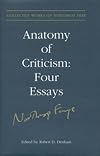
In this book, Northrop Frye sets out to further the practice of literary criticism, which has yet to progress very far, in his opinion, from Aristotle. His aim is not to eliminate various schools of criticism, whether historical and formal or what was in his day the New Criticism. Instead, he constructs a system of organization capable of containing them all, one whose orientation is not the individual literary work as much as literature as some sort of Platonic ideal (which is not simply show more the aggregate of all literary works).
The result is what Terry Eagleton calls “a mighty ‘totalization’ of all literary genres.” It is a structuralist approach, as reflected in his original title, Structural Poetics (which his editor insisted on changing). The intended title combined his debt to Aristotle’s enduring work on literary criticism, from whom he borrowed his organizing principles, and what Frye sought to bring to the discussion. The title adopted in its place also owes a telling debt: to Burton’s Anatomy of Melancholy, one of Frye’s favorite books.
However, Frye’s structure is not imposed a priori; he works inductively, based on seemingly omnivorous yet attentive reading.
Frye combats the notion that criticism is a parasitic endeavor by citing an analogy, physics. Physics, he writes, is “an organized body of knowledge about nature. A student of it says he is learning physics, not nature.” He envisages a similar relation of criticism to literature.
It’s easy to imagine how this approach might calcify in the hands of adepts, devolving into rigid classification. Frye, however, is not a slave to his system: “Once we have learned to distinguish the modes, however, we must learn to recombine them.” Many pleasurable works have elements of more than one mode. It seems that Frye offers a typology (or system of typologies), useful for coming to grips with any work of literature.
The value of this becomes apparent when he turns to literary works in prose, for which, he notes, Aristotle and the other Greeks did not provide us with a term, as they did for other genres. Frye notes the misunderstanding caused by the everyday use of the term fiction (the opposite of fact), as well as the widespread use of the term novel, which is but one of four chief strands of fiction he identifies (the others being confession, anatomy, and romance; as always, combinations are possible and do exist). Failure to recognize these strands results in judging Wuthering Heights a less successful novel than Pride and Prejudice when it is not a novel in Frye’s estimation but a romance.
Since Frye’s terminology abounds in transliterated Greek terms, neologisms, and words commonly used in another sense in everyday parlance, I found the Glossary at the end of the book helpful.
This book was a challenging read. Many passages were enjoyable and enlightening, while others were a slog. Yet the effort I expended to stay with it was amply rewarded. It helped that the text is peppered with memorable aphorisms such as, “The axiom of criticism must be, not that the poet does not know what he is talking about, but that he cannot talk about what he knows” and, “At the centre of liberal education, something surely ought to get liberated.”
That last sentiment alone might cause this book to be removed from the library shelf in some states, so read it while you can. show less
The result is what Terry Eagleton calls “a mighty ‘totalization’ of all literary genres.” It is a structuralist approach, as reflected in his original title, Structural Poetics (which his editor insisted on changing). The intended title combined his debt to Aristotle’s enduring work on literary criticism, from whom he borrowed his organizing principles, and what Frye sought to bring to the discussion. The title adopted in its place also owes a telling debt: to Burton’s Anatomy of Melancholy, one of Frye’s favorite books.
However, Frye’s structure is not imposed a priori; he works inductively, based on seemingly omnivorous yet attentive reading.
Frye combats the notion that criticism is a parasitic endeavor by citing an analogy, physics. Physics, he writes, is “an organized body of knowledge about nature. A student of it says he is learning physics, not nature.” He envisages a similar relation of criticism to literature.
It’s easy to imagine how this approach might calcify in the hands of adepts, devolving into rigid classification. Frye, however, is not a slave to his system: “Once we have learned to distinguish the modes, however, we must learn to recombine them.” Many pleasurable works have elements of more than one mode. It seems that Frye offers a typology (or system of typologies), useful for coming to grips with any work of literature.
The value of this becomes apparent when he turns to literary works in prose, for which, he notes, Aristotle and the other Greeks did not provide us with a term, as they did for other genres. Frye notes the misunderstanding caused by the everyday use of the term fiction (the opposite of fact), as well as the widespread use of the term novel, which is but one of four chief strands of fiction he identifies (the others being confession, anatomy, and romance; as always, combinations are possible and do exist). Failure to recognize these strands results in judging Wuthering Heights a less successful novel than Pride and Prejudice when it is not a novel in Frye’s estimation but a romance.
Since Frye’s terminology abounds in transliterated Greek terms, neologisms, and words commonly used in another sense in everyday parlance, I found the Glossary at the end of the book helpful.
This book was a challenging read. Many passages were enjoyable and enlightening, while others were a slog. Yet the effort I expended to stay with it was amply rewarded. It helped that the text is peppered with memorable aphorisms such as, “The axiom of criticism must be, not that the poet does not know what he is talking about, but that he cannot talk about what he knows” and, “At the centre of liberal education, something surely ought to get liberated.”
That last sentiment alone might cause this book to be removed from the library shelf in some states, so read it while you can. show less

This book was Northrop Frye's first, and probably his best. If he had never written another word, it would have been enough to make him a titan of English literary criticism. As a comprehensive study of William Blake's writings and art, it is so far-reaching and so penetrating as to make the reader suspect that no one had ever succeeded in reading Blake before Frye did so.
While Fearful Symmetry is trained on Blake, its consequences go far beyond him: "We cannot understand Blake without show more understanding how to read the Bible, Milton, Ovid and the Prose Edda at least as he read them, on the assumption that an archetypal vision, which all great art without exception shows forth to us, really does exist. If he is wrong, we have merely distorted the meaning of these other works of prophecy; if he is right, the ability we gain by deciphering him is transferable, and the value of studying him extends far beyond our personal interest in Blake himself" (418). Accordingly, in the final pages of Fearful Symmetry there is a clear adumbration of the project Frye was later to execute in his magisterial Anatomy of Criticism.
Frye's own prose is routinely beautiful. For example: "Jerusalem is Blake's contribution to the struggle between the prophet and the profiteer for the soul of England which is England's Armageddon: it is a burning-glass focusing the rays of a fiery city on London in the hope of kindling an answering flame" (392). But the book is not a fast read by any stretch; each page demands considered thought. Frye has so fiercely developed a sense of critical sympathy for his subject that he often continues for pages as though possessed by Blake, expressing the earlier man's views in the words of the later, "mentally fighting" the divide between the reader's situation and the transcendent imagination that is the prize for Blake and his ideal audience.
It is possible, despite Frye's indisputable intimacy with Blake's work, that there are inaccuracies involved with Frye's attempted representation of Blake's intentions and views. Even if that were the case, however, the fact remains that what Frye offers as "Blake" is a dynamic perspective removed from the conventional epistemes of Blake's 18th century, Frye's 20th, and our own 21st, and that it therefore has its own sovereign value. It exhibits genius, no matter whose. show less
While Fearful Symmetry is trained on Blake, its consequences go far beyond him: "We cannot understand Blake without show more understanding how to read the Bible, Milton, Ovid and the Prose Edda at least as he read them, on the assumption that an archetypal vision, which all great art without exception shows forth to us, really does exist. If he is wrong, we have merely distorted the meaning of these other works of prophecy; if he is right, the ability we gain by deciphering him is transferable, and the value of studying him extends far beyond our personal interest in Blake himself" (418). Accordingly, in the final pages of Fearful Symmetry there is a clear adumbration of the project Frye was later to execute in his magisterial Anatomy of Criticism.
Frye's own prose is routinely beautiful. For example: "Jerusalem is Blake's contribution to the struggle between the prophet and the profiteer for the soul of England which is England's Armageddon: it is a burning-glass focusing the rays of a fiery city on London in the hope of kindling an answering flame" (392). But the book is not a fast read by any stretch; each page demands considered thought. Frye has so fiercely developed a sense of critical sympathy for his subject that he often continues for pages as though possessed by Blake, expressing the earlier man's views in the words of the later, "mentally fighting" the divide between the reader's situation and the transcendent imagination that is the prize for Blake and his ideal audience.
It is possible, despite Frye's indisputable intimacy with Blake's work, that there are inaccuracies involved with Frye's attempted representation of Blake's intentions and views. Even if that were the case, however, the fact remains that what Frye offers as "Blake" is a dynamic perspective removed from the conventional epistemes of Blake's 18th century, Frye's 20th, and our own 21st, and that it therefore has its own sovereign value. It exhibits genius, no matter whose. show less
Lists
readingList (2)
Awards


You May Also Like


Associated Authors
Statistics
- Works
- 101
- Also by
- 19
- Members
- 7,096
- Popularity
- #3,460
- Rating
- 4.1
- Reviews
- 53
- ISBNs
- 275
- Languages
- 12
- Favorited
- 17