
Samuel Taylor Coleridge (1772–1834)
Author of The Rime of the Ancient Mariner [poem]
About the Author
Born in Ottery St. Mary, England, in 1772, Samuel Taylor Coleridge studied revolutionary ideas at Cambridge before leaving to enlist in the Dragoons. After his plans to start a communist society in the United States with his friend Robert Southey, later named poet laureate of England, were botched, show more Coleridge instead turned his attention to teaching and journalism in Bristol. Coleridge married Southey's sister-in-law Sara Fricker, and they moved to Nether Stowey, where they became close friends with William and Dorothy Wordsworth. From this friendship a new poetry emerged, one that focused on Neoclassic artificiality. In later years, their relationship became strained, partly due to Coleridge's moral collapse brought on by opium use, but more importantly because of his rejection of Wordworth's animistic views of nature. In 1809, Coleridge began a weekly paper, The Friend, and settled in London, writing and lecturing. In 1816, he published Kubla Kahn. Coleridge reported that he composed this brief fragment, considered by many to be one of the best poems ever written lyrically and metrically, while under the influence of opium, and that he mentally lost the remainder of the poem when he roused himself to answer an ill-timed knock at his door. Coleridge's The Rime of the Ancient Mariner, Christabel, and his sonnet Ozymandias are all respected as inventive and widely influential Romantic pieces. Coleridge's prose works, especially Biographia Literaria, were also broadly read in his day. Coleridge died in 1834. (Bowker Author Biography) show less
Disambiguation Notice:
Please be careful, when combining variants of the author's name, that you do not combine this page with that of the composer, Samuel Coleridge-Taylor. Thanks.
Image credit: Image © ÖNB/Wien
Works by Samuel Taylor Coleridge
Coleridge among the lakes & mountains: from his notebooks, letters and poems 1794-1804 (1991) 166 copies, 1 review
Coleridge: Poems: Introduction by John Beer (Everyman's Library Pocket Poets Series) (1997) 79 copies
Rime of the Ancient Mariner by Coleridge / Vision of Sir Launfal by Lowell (1919) 34 copies, 1 review
Coleridge's Essays and Lectures on Shakespeare and Some Other Old Poets and Dramatists (2015) 22 copies
The Rime of the Ancient Mariner, Kubla Khan, Christabel, and the Conversation Poems (2009) 20 copies, 1 review
The Collected Works of Samuel Taylor Coleridge, Volume 1 : Lectures, 1795 : On Politics and Religion (1971) 19 copies
The Collected Works of Samuel Taylor Coleridge, Volume 10 : On the Constitution of the Church and State (1976) 18 copies
The Collected Works of Samuel Taylor Coleridge, Volume 3 : Essays on His Times in The Morning Post and The Courier (3 Volume Set) (1975) 17 copies
Coleridge's Ancient Mariner: An Experimental Edition of Texts and Revisions 1798-1828 (Jungian Classics Series) (1993) 15 copies
William Wordsworth and Samuel T. Coleridge: Selected critical essays / edited by Thomas M. Raysor (Crofts classics) (1958) 14 copies
The Collected Works of Samuel Taylor Coleridge, Volume 12 : Marginalia : Part 1, Abbt to Byfield (1980) 14 copies
THE RIME OF THE ANCIENT MARINER AND OTHER POEMS AND LOCHIEL'S WARNING AND OTHER POEMS BY THOMAS CAMPBELL (2009) 13 copies
The Collected Works of Samuel Taylor Coleridge, Volume 13: Logic (Collected Works of Samuel Taylor Coleridge, 32) (1981) — Author — 13 copies
The Rime of the Ancient Mariner and Other Poems of the Romatic Era: Literary Touchstone Classic (2006) 13 copies
The Collected Works of Samuel Taylor Coleridge, Volume 16 : Poetical Works: Part 1. Poems (Reading Text) (2001) 12 copies
The poetical works of Coleridge, Shelley, and Keats : complete in one volume (1838) — Author — 11 copies
Poesie e prose 10 copies
The Collected Works of Samuel Taylor Coleridge, Volume 16 : Poetical Works: Part 2. Poems (Variorum Text) (2001) 10 copies
The Collected Works of Samuel Taylor Coleridge, Volume 16 : Poetical Works: Part 3. Plays (Two Volume Set) (2001) 9 copies
Coleridge's The Ancient Mariner: Lowell's The Vision of Sir Launfal; Burn's The Cotter's Saturday Night (The Studen (1917) — Contributor — 8 copies
The Collected Works of Samuel Taylor Coleridge, Volume 5 : Lectures 1808-1819 : On Literature (2 Volume Set) (1987) 8 copies
The Collected Works of Samuel Taylor Coleridge, Volume 12 : Marginalia : Part 6. Valckenaer to Zwick (2001) 7 copies
The Collected Works of Samuel Taylor Coleridge, Volume 12 : Marginalia : Part 5, Sherlock to Unidentified (Bollingen Series, 288) (1999) 7 copies
The Collected Works of Samuel Taylor Coleridge, Volume 12 : Marginalia : Part 3, Irving to Oxlee (1992) 6 copies
The Collected Works of Samuel Taylor Coleridge, Volume 12 : Marginalia : Part 2, Camden to Hutton (1985) — Author — 6 copies
The collected works of Samuel Taylor Coleridge vol 11 Shorter Works and Fragments part I (2019) 5 copies
Coleridge poetry 5 copies
The Collected Works of Samuel Taylor Coleridge, Volume 12 : Marginalia : Part 4, Pamphlets to Shakespeare (1998) 5 copies
The Collected Works of Samuel Taylor Coleridge, Volume 11 : Shorter Works and Fragments (2 Volume Set) (1995) 5 copies
The Collected Works of Samuel Taylor Coleridge, Volume 14: Table Talk, Part I (Bollingen Series Book 5622) (2019) 4 copies
The Collected Works of Samuel Taylor Coleridge, Volume 3 : Essays on His Times in The Morning Post and The Courier (Volume 2 of 3) (1978) 4 copies
The Collected Works of Samuel Taylor Coleridge, Volume 5 : Lectures 1808-1819 : On Literature (Volume 1 of 2) (1987) 4 copies
The Collected Works of Samuel Taylor Coleridge, Volume 3 : Essays on His Times in The Morning Post and The Courier (Volume 3 of 3) (1971) 4 copies
The Collected Works of Samuel Taylor Coleridge, Volume 3 : Essays on His Times in The Morning Post and The Courier (Volume 1 of 3) (1978) 4 copies
The Notebooks of Samuel Taylor Coleridge, Volume 4: 1819-1826: Notes (Princeton Legacy Library Book 5612) (2019) 3 copies
Gustave Dore Classics: The Rime of the Ancient Mariner: 43 Gustave Dore Illustrations (2019) 3 copies
Verse and prose 3 copies
The poetical works of Samuel Taylor Coleridge. Edited by William B. Scott. 1889 [Leather Bound] 2 copies
"Work Without Hope" 2 copies
The Notebooks of Samuel Taylor Coleridge, Volume 4: 1819-1826: Text: 5609 (Princeton Legacy Library, 5609) (2019) 2 copies
Selections from Coleridge, the Rime of the Ancient Mariner, Christable, and Kubla Khan (1916) 2 copies
Letter 116 to Thomas Wedgewood 2 copies
The Poems 2 copies
Select Poetry & Prose, Letters 2 copies
Poemetti e liriche 2 copies
Fears in Solitude, written in 1798, during the alarm of an invasion. To which are added, France, an ode; and Frost at Midnight. (2012) 2 copies
Coleridge's Poems 2 copies
The Complete Works of Samuel Taylor Coleridge, Volume I: Aids to reflection and Statesman's Manual 2 copies
Coleridge: Poetry and Prose 2 copies
Poesía completa 2 copies
Christabel Part I 1 copy
Aforyzmy 1 copy
"Stikhi" 1 copy
Selected Poetry and Prose 1 copy
The Poetical Works of S T Coleridge. Reprinted from the Early Editions with Memoir and Notes. (1920) 1 copy
Poesie 1 copy
Poetical Works, The 1 copy
Poèmes (Bilingue, texte et traduction en regard) - Chronologie, introduction et bibliographie de Christian La Cassagnère - Traduction de Henri Parisot 1 copy, 1 review
The Pains of Sleep 1 copy
Samuel Taylor Coleridge Read by Yvonne Bonnamy, Richard Burton, William Devlin & John Neville 1 copy
A Lay Sermon, Addressed To The Higher And Middle Classes, On The Existing Distresses And Discontents 1 copy
The Golden Poets: Poems of Coleridge — Author — 1 copy
Ballata del Vecchio Marinaio 1 copy
Christabel and the Lyrical and Imaginative Poems of S. T. Coleridge, with Essays By Algernon Swinburne (1869) 1 copy
Maynards English Classic Series the Rime of the Ancient Mariner (Maynards English Classic Series, No. 17) (1897) 1 copy
Poems of Coleridge 1 copy
Spirit and Imagination 1 copy
Instructor Literature Series No. 126C: the Rime of the Ancient Mariner with introduction and notes 1 copy
The Butterfly 1 copy
Rege a vén tengerészről 1 copy
ANTOLOGÍA POÉTICA 1 copy
İHTİYAR DENİZCİNİN EZGİSİ 1 copy
Select Poems of Samuel Taylor Coleridge; arranged in chronological order with introduction and notes 1 copy
Time, Real and Imaginary 1 copy
Selected Works 1 copy
Three Narrative Poems 1 copy
The Collected Works of Samuel Taylor Coleridge, Volume 11: Shorter Works and Fragments: Volume I (Bollingen Series, 723) (2019) 1 copy
... Coleridge's The rime of the ancient mariner,: Christabel and Kubla Khan; (Longmans' English classics) (1914) 1 copy
The Ancient Mariner; Kubla Khan; Christabel (Coleridge); Sohrab and Rustum, and Other Poems (Arnold) 1 copy
The golden gift 1 copy
Shakespeare 1 copy
Poems 1 copy
Coleridge's Works (2 vols.) 1 copy
Osorio; a tragedy 1 copy
Coleridge: Vingt-Cinq Poèmes 1 copy
The Voyage 1 copy
The Collected Works of Samuel Taylor Coleridge, Volume 12: Marginalia IV - Pamphlets to Shakespeare (2019) 1 copy
Kublah Khan 1 copy
“The Eolian Harp” 1 copy
“Frost at Night” 1 copy
“To William Wordsworth” 1 copy
Eclectic English classics 1 copy
Coleridge's poems 1 copy
The Raven 1 copy
The Piccolomini; or, The first part of Wallenstein. Tr. from Schiller. The death of Wallenstein (2018) 1 copy
Poetry and prose 1 copy
Specimens of the table talk of the late Samuel Taylor Coleridge .. 1835 [Leather Bound] (2019) 1 copy
The poems 1 copy
Associated Works
William Shakespeare: The Complete Works (1623) — Contributor, some editions — 35,717 copies, 177 reviews
Paradise Lost [Norton Critical Edition] (1667) — Contributor, some editions — 2,437 copies, 14 reviews
The Making of a Poem: A Norton Anthology of Poetic Forms (2000) — Contributor — 1,474 copies, 9 reviews
The Best Poems of the English Language: From Chaucer Through Robert Frost (2004) — Contributor — 1,249 copies, 3 reviews
Literature: An Introduction to Fiction, Poetry, and Drama (1995) — Contributor, some editions — 1,017 copies, 7 reviews
World Poetry: An Anthology of Verse from Antiquity to Our Time (1998) — Contributor — 499 copies, 2 reviews
The Norton Anthology of English Literature, 4th Edition, Volume 2 (1979) — Contributor — 271 copies, 1 review
Blake's Poetry and Designs [Norton Critical Edition, 2nd ed.] (2007) — Contributor — 238 copies, 1 review
Poems Bewitched and Haunted (Everyman's Library Pocket Poets Series) (2005) — Contributor — 231 copies
The Graphic Canon, Vol. 2: From "Kubla Khan" to the Brontë Sisters to The Picture of Dorian Gray (2012) — Contributor — 213 copies, 2 reviews
Buzz Words: Poems About Insects (Everyman's Library Pocket Poets Series) (2021) — Contributor — 56 copies
The Dedalus Book of British Fantasy: 19th Century (European Literary Fantasy Anthologies) (1991) — Contributor — 47 copies
Out of the Best Books: An Anthology of Literature, Vol. 1: The Individual and Human Values (1964) — Contributor — 40 copies
Out of the Best Books: An Anthology of Literature, Vol. 3: Intelligent Family Living (1967) — Contributor — 34 copies
Out of the Best Books: An Anthology of Literature, Vol. 4: The World Around Us (1968) — Contributor — 28 copies
Edexcel Poetry Anthology for Advanced subsidiary and advanced GCE examinations in English Literature (2000) — Contributor, some editions — 6 copies
Fantastic Imaginings: A Journey Through 3500 Years of Imaginative Writing, Comprising Fantasy, Horror, and Science Fiction (2012) — Contributor — 4 copies
A reader for writers — Contributor — 2 copies
Shadows from a Veiled Creation: Classic Tales of Supernatural Fiction in the Christian Tradition (2006) — Contributor — 2 copies
Tagged
Common Knowledge
- Legal name
- Coleridge, Samuel Taylor
- Other names
- Comberbache, Silas Tomkyn
- Birthdate
- 1772-10-21
- Date of death
- 1834-07-25
- Gender
- male
- Education
- Christ's Hospital, Horsham, Sussex, England, UK
Jesus College, Cambridge - Occupations
- poet
teacher
journalist
soldier (Dragoons)
philosopher
critic - Awards and honors
- Royal Society of Literature (Fellow, 1824)
- Relationships
- Coleridge, Sara Fricker (wife)
Coleridge, Sara (daughter)
Coleridge, Hartley (son)
Coleridge, Henry Nelson (nephew, son-in-law)
Coleridge, Ernest Hartley (grandson)
Coleridge, Christabel (granddaughter) (show all 15)
Coleridge, Sir John Taylor (nephew)
Coleridge, Henry James (great-nephew)
Coleridge, Arthur Duke (great-nephew)
Coleridge, Mary (great-grandniece)
Coleridge, Stephen (great-grandnephew)
Coleridge, Bernard John Seymour (great-grandnephew)
Coleridge, Derwent (son)
Wordsworth, William (friend)
Keats, John (friend) - Cause of death
- heart failure
- Nationality
- Great Britain
- Birthplace
- Ottery St Mary, Devon, England, UK
- Places of residence
- Ottery St Mary, Devon, England, UK
London, Middlesex, England, UK
Cambridge, Cambridgeshire, England, UK
Bristol, Gloucestershire, England, UK
Nether Stowey, Somerset, England, UK
Highgate, London, Middlesex, England, UK - Place of death
- Highgate, London, Middlesex, England, UK
- Burial location
- St. Michael's Church, London, Middlesex, England, UK
- Map Location
- England, UK
- Disambiguation notice
- Please be careful, when combining variants of the author's name, that you do not combine this page with that of the composer, Samuel Coleridge-Taylor. Thanks.
Members
Discussions
Folio Archives 372: The Rime of the Ancient Mariner by Samuel Taylor Coleridge – LIMITED EDITION 2010 in Folio Society Devotees (October 2025)
Folio Archives 373: The Rime of the Ancient Mariner by Samuel Taylor Coleridge - 1994 in Folio Society Devotees (May 2024)
Folio Archives 265: Coleridge Among the Lakes and Mountains by Roger Hudson 1991 in Folio Society Devotees (April 2022)
Reviews
Biographia literaria or biographical sketches of my literary life and opinions by Samuel Taylor Coleridge

It’s frustrating that the book description on Goodreads of this edition of Coleridge’s Biographia Literaria should perpetuate the traditional account of its genesis, an account that the editor, George Watson, takes pains to refute.
Watson describes the origins of the book, dating back to more than fifteen years before its eventual publication. From the outset, Coleridge intended a work that would reflect his dual interest in philosophy and poetry. Watson concedes that the formal design of show more the book cannot be defended, but argues that Coleridge succeeded “for the first and (so far) for the last time in English criticism” in “discovering a causal link between the two” in the poet’s imagination, set out by Coleridge in chapters 12 and 13, the heart of the book. Hitherto, “imagination” and “fancy” had been used interchangeably, but Coleridge differentiates the two, assigning to imagination, especially the poetic imagination, the power to dissolve sense perceptions to recreate, idealize, or unify them. In contrast, fancy, a lesser power, can only recall, with its creativity limited to association. At least that’s what I make of it, though I had a hard time following his discussion. He even coined a term to describe this faculty, “esemplastic” (the power to form into one), but this hasn’t caught on.
This achievement has been clouded not only by the ever-perpetuated tale that the Biographia is nothing more than an overgrown preface to a collection of poems, but also because a printer’s miscalculation forced Coleridge to hurriedly pad the manuscript at the last minute. This edition omits the padding and thus, Watson claims, is “the first to present the Biographia as nearly as possible according to the author’s intention.”
I can understand the widespread currency of the “garrulous preface” legend, however. Like a magpie, Coleridge seems to hop about, collecting shiny objects. The result: a fascinating record of a lively mind. He read widely and thought deeply, but the fecundity of his mind seems to have sabotaged his production. The footnotes of this book teem with announcements of forthcoming projects that never saw the light of day, mirroring the fifteen-year gap between plan and execution of this book.
One of the pleasures of reading Biographia was to follow a great literary critic at work as he shows by precept and example what makes great poetry. I noted several passages, including this: “The ultimate end of criticism is much more to establish the principles of writing than to furnish rules how to pass judgement on what has been written by others; if indeed it were possible that the two could be separated.” Coleridge’s work as a great critic is supported by his acute psychological insight.
One of Coleridge’s notable services rendered was to transmit the best of contemporary German philosophy to the English-speaking world. This book includes lengthy passages translated from Schelling and Lessing. He names both, but should have been clearer about where their words (in his translation) begin and end. His carelessness left him open to charges of plagiarism. He, in turn, felt misunderstood, one of many things that rankled him when others criticized his work. No doubt much of the criticism was unjustified, but his counterattacks are some of the least enjoyable passages in this book.
Still, overall, I enjoyed the book and learned a great deal from it. show less
Watson describes the origins of the book, dating back to more than fifteen years before its eventual publication. From the outset, Coleridge intended a work that would reflect his dual interest in philosophy and poetry. Watson concedes that the formal design of show more the book cannot be defended, but argues that Coleridge succeeded “for the first and (so far) for the last time in English criticism” in “discovering a causal link between the two” in the poet’s imagination, set out by Coleridge in chapters 12 and 13, the heart of the book. Hitherto, “imagination” and “fancy” had been used interchangeably, but Coleridge differentiates the two, assigning to imagination, especially the poetic imagination, the power to dissolve sense perceptions to recreate, idealize, or unify them. In contrast, fancy, a lesser power, can only recall, with its creativity limited to association. At least that’s what I make of it, though I had a hard time following his discussion. He even coined a term to describe this faculty, “esemplastic” (the power to form into one), but this hasn’t caught on.
This achievement has been clouded not only by the ever-perpetuated tale that the Biographia is nothing more than an overgrown preface to a collection of poems, but also because a printer’s miscalculation forced Coleridge to hurriedly pad the manuscript at the last minute. This edition omits the padding and thus, Watson claims, is “the first to present the Biographia as nearly as possible according to the author’s intention.”
I can understand the widespread currency of the “garrulous preface” legend, however. Like a magpie, Coleridge seems to hop about, collecting shiny objects. The result: a fascinating record of a lively mind. He read widely and thought deeply, but the fecundity of his mind seems to have sabotaged his production. The footnotes of this book teem with announcements of forthcoming projects that never saw the light of day, mirroring the fifteen-year gap between plan and execution of this book.
One of the pleasures of reading Biographia was to follow a great literary critic at work as he shows by precept and example what makes great poetry. I noted several passages, including this: “The ultimate end of criticism is much more to establish the principles of writing than to furnish rules how to pass judgement on what has been written by others; if indeed it were possible that the two could be separated.” Coleridge’s work as a great critic is supported by his acute psychological insight.
One of Coleridge’s notable services rendered was to transmit the best of contemporary German philosophy to the English-speaking world. This book includes lengthy passages translated from Schelling and Lessing. He names both, but should have been clearer about where their words (in his translation) begin and end. His carelessness left him open to charges of plagiarism. He, in turn, felt misunderstood, one of many things that rankled him when others criticized his work. No doubt much of the criticism was unjustified, but his counterattacks are some of the least enjoyable passages in this book.
Still, overall, I enjoyed the book and learned a great deal from it. show less

This is a revisit, I spent a couple of months reading and rereading -- and I'm glad to have done it. Moving on to Wordsworth now. I have to confess that at this juncture in my life I am as much if not more interested in the romantic poets in the context of their time period. I am not done with Coleridge the man and philosopher -- will read his essay on the connection between the poet and the scientist, for example and maybe a biography. He exemplifies the response of an educated and show more thoughtful person during a period of almost epic change in every sphere of life. Some of his poems are surprisingly racy, btw, but are I guess the result of his opium adventures which tend to loosen inhibitions--but this conflicts with his conservatism and faith. Two poems grabbed me by the throat- in the first he takes his fretful son out to see the moon:
lines 97 to 106 in The Nightingale
". . . . . . . . . . . . He knows well
The evening star; and once when he awoke
In most distressful mood (some inward pain
Had made up that strange thing, an infant's dream--)
I hurried with him to our orchard-plot,
And he beheld the moon, and, hushed at once,
Suspends his sobs, and laughs most silently,
While his fair eyes, that swam with undropped tears,
Did glitter in the yellow moon-beam! Well!--
It is a father's tale . . . "
and A Sunset
Upon the mountain's edge with light touch resting,
There a brief while the globe of splendour sits
And seems a creature of the earth, but soon
More changeful than the Moon,
To wane fantastic his great orb submits,
Or cone or mow of fire: till sinking slowly
Even to a star he lessens wholly.
Abrupt, as Spirits vanish, he is sunk!
A soul-like breeze possesses all the wood.
The boughs, the sprays have stood
As motionless as stands the ancient trunk!
But every leaf through all the forest flutters,
And deep the cavern of the fountain mutters. show less
lines 97 to 106 in The Nightingale
". . . . . . . . . . . . He knows well
The evening star; and once when he awoke
In most distressful mood (some inward pain
Had made up that strange thing, an infant's dream--)
I hurried with him to our orchard-plot,
And he beheld the moon, and, hushed at once,
Suspends his sobs, and laughs most silently,
While his fair eyes, that swam with undropped tears,
Did glitter in the yellow moon-beam! Well!--
It is a father's tale . . . "
and A Sunset
Upon the mountain's edge with light touch resting,
There a brief while the globe of splendour sits
And seems a creature of the earth, but soon
More changeful than the Moon,
To wane fantastic his great orb submits,
Or cone or mow of fire: till sinking slowly
Even to a star he lessens wholly.
Abrupt, as Spirits vanish, he is sunk!
A soul-like breeze possesses all the wood.
The boughs, the sprays have stood
As motionless as stands the ancient trunk!
But every leaf through all the forest flutters,
And deep the cavern of the fountain mutters. show less
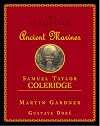
After enjoying the Big Read presentation of Coleridge’s “Rime of the Ancient Mariner” on YouTube, I found I couldn’t get the poem out of my mind. The annotated edition by Martin Gardner was perfect for delving deeper into this ballad. Gardner’s notes are primarily on the version printed in Coleridge’s Poetical Works, 1834, but he also includes the original text as published in Lyrical Ballads, the poet’s joint venture with Wordsworth in 1798.
Gardner provides a short biography show more and a brief survey of critical interpretations as well.
Gardner’s notes range from philological explanations of archaic words to the religious and philosophical underpinnings of the work. Drawing on the work of previous scholars, which he acknowledges, Gardner also shows the way Coleridge mined many works of sea travel for details. He also explains the science behind many of the observations, such as the luminescence of the ocean at night and the polar lights.
As I had hoped, this book helped me to have a deeper appreciation of this strange poem, especially how Coleridge’s attention to realistic description made the supernatural elements resonate in the imagination. show less
Gardner provides a short biography show more and a brief survey of critical interpretations as well.
Gardner’s notes range from philological explanations of archaic words to the religious and philosophical underpinnings of the work. Drawing on the work of previous scholars, which he acknowledges, Gardner also shows the way Coleridge mined many works of sea travel for details. He also explains the science behind many of the observations, such as the luminescence of the ocean at night and the polar lights.
As I had hoped, this book helped me to have a deeper appreciation of this strange poem, especially how Coleridge’s attention to realistic description made the supernatural elements resonate in the imagination. show less

‘I closed my lids, and kept them close,
And the balls like pulses beat;
For the sky and the sea, and the sea and the sky
Lay dead like a load on my weary eye,
And the dead were at my feet.’
The Rime of the Ancient Mariner is, inarguably, one of the five or six most important poems ever recorded in the English language. And while Samuel Coleridge may have abhorred the Gothic excesses nourished to increasingly baroque heights during the years he was busy writing literary criticism, a younger show more Coleridge—perhaps, even, a more naïve and spiritually-aware Coleridge—managed to pen the only one of those five or six paramount poems to feature the supernatural as more than a passing reference: and certainly the only one to regard it with the mingled aura of terror, awe, and beauty that we have come to define as ‘Sublime.’ With this, Coleridge gave birth to Romantic literature (particularly the Romantic as we define it today: the Romantic as it breathes in the works of Mary Shelley, James Hogg, and—later—Poe, Hawthorne, and Melville).
The poem is so familiar, that I will avoid summarizing it in detail: suffice it to say that the story of the Ancient Mariner, who kills the albatross and is cursed to suffer at the hands of a Nature that is at turns mournful, spiteful, and furious, is one of the more archetypal scenarios in Romantic literature (and perhaps English literature, and popular culture, as a whole: the tale of the man who underestimates the forces that protect the natural world, and their contingent retribution, has been retold through lenses as diverse as comedy, horror, high fantasy, pulp adventure, and children’s television). Any underestimation of its impact, similar to Shakespeare, can be dispelled with examples of its gifts to popular culture and the popular lexicon: the notion of an ‘albatross hanging about one’s neck’ is a common enough allusion that it borders, nearly, on the cliché; meanwhile, lines like ‘Water, water, everywhere/Nor any drop to drink’ have become references so pervasive that many who have never even read the poem are aware of them. This parallels, say, the aggressive influence of a novel like Frankenstein on the popular imagination; unlike that novel, though, The Rime of the Ancient Mariner has not entered the zeitgeist through the vehicle of cinematic adaptation or references in a body of literature that bears little relation to it (although, coincidentally, Frankenstein makes numerous references to Coleridge’s poem, and is one of the earlier works of literature to truly embody the full scope of its impact—aside from operating as an extrapolation upon its central, supremely Romantic theme).
I have neatly avoided the relationship of Coleridge to Wordsworth, or The Rime of the Ancient Mariner’s inclusion in Lyrical Ballads: these details bear little relation to the concerns of this journal. I will, however, dwell for a moment on the initial details of the poem’s publication: as most are aware, the poem was originally presented without a gloss and utilizing the most arcane variety of spelling; this was corrected in a later publication (which has since become standard) largely because the format was not in keeping with Romantic ideals. That said, though, this return to an earlier, more esoteric device and the mysteries suggested by avoiding comment or explanation, are very much in keeping with the ethos of the Gothic, both as an extension of the Romantic imagination and a separate set of motifs. The Rime of the Ancient Mariner’s early concern with itself as a text, by utilizing a unique (and antique) format is both indebted to the early Gothic of Radcliffe, Beckford, and Walpole, and influential on the later Gothicism of the Shelleys, Maturin, and Poe. Reorganized, with gloss and modern spelling, the poem takes on a new, more obvious, concern with itself as a text, which in its own right has become influential on the ‘epic’ poetry of later authors.
Interspersed throughout this review (see the original post at therealmoftheunreal.blogspot.com) are several of Gustave Dore’s illustrations for The Rime of the Ancient Mariner: but this is only the tip of the iceberg: the weight of allusion to Coleridge’s masterpiece over the past two centuries has been so incredible that to list even a dozen of them here would take more space than is permissible; needless to say, the breadth of this fascination with The Rime of the Ancient Mariner is not relegated merely to fine art and literature: again and again, up to and including the present day, the poem resurfaces in allusions and analysis both obscure and immediate in forums as diverse as popular music, animated television, and even video games. Still, it must be said, the most impactful and haunting of these references and homages to Coleridge’s famous poetic conceit rest in those that have taken illustration as the nature of their devotions: Dore’s images, while possessing a value to art uniquely their own (and, in many ways, remaining the standard illustrations to Coleridge’s opus), are, as I said, merely the tip of the iceberg. And this, in my eyes, remains the measuring stick by which we judge the canonicity of a given work of literature: not merely how often it is read—nor by whom—nor the nature of its subject matter, nor its ability to stand as a document of its time and circumstances, but by the degree to which it propels Art, and hence Imagination, as a whole, towards higher and higher atmospheres: both by stimulating the creative faculties of other artists and by drawing forth these faculties in the minds of those who have not yet developed them.
The Rime of the Ancient Mariner is, indeed, one of the great works of English poetry; but it is also one of the great works of world literature in its entirety, standing confidently among works as diverse as The Arabian Nights, Hamlet, and the Bible as a major influence on the art of those who have yet to even experience it first-hand. And for this, Coleridge was a prophet—and a guide. show less
And the balls like pulses beat;
For the sky and the sea, and the sea and the sky
Lay dead like a load on my weary eye,
And the dead were at my feet.’
The Rime of the Ancient Mariner is, inarguably, one of the five or six most important poems ever recorded in the English language. And while Samuel Coleridge may have abhorred the Gothic excesses nourished to increasingly baroque heights during the years he was busy writing literary criticism, a younger show more Coleridge—perhaps, even, a more naïve and spiritually-aware Coleridge—managed to pen the only one of those five or six paramount poems to feature the supernatural as more than a passing reference: and certainly the only one to regard it with the mingled aura of terror, awe, and beauty that we have come to define as ‘Sublime.’ With this, Coleridge gave birth to Romantic literature (particularly the Romantic as we define it today: the Romantic as it breathes in the works of Mary Shelley, James Hogg, and—later—Poe, Hawthorne, and Melville).
The poem is so familiar, that I will avoid summarizing it in detail: suffice it to say that the story of the Ancient Mariner, who kills the albatross and is cursed to suffer at the hands of a Nature that is at turns mournful, spiteful, and furious, is one of the more archetypal scenarios in Romantic literature (and perhaps English literature, and popular culture, as a whole: the tale of the man who underestimates the forces that protect the natural world, and their contingent retribution, has been retold through lenses as diverse as comedy, horror, high fantasy, pulp adventure, and children’s television). Any underestimation of its impact, similar to Shakespeare, can be dispelled with examples of its gifts to popular culture and the popular lexicon: the notion of an ‘albatross hanging about one’s neck’ is a common enough allusion that it borders, nearly, on the cliché; meanwhile, lines like ‘Water, water, everywhere/Nor any drop to drink’ have become references so pervasive that many who have never even read the poem are aware of them. This parallels, say, the aggressive influence of a novel like Frankenstein on the popular imagination; unlike that novel, though, The Rime of the Ancient Mariner has not entered the zeitgeist through the vehicle of cinematic adaptation or references in a body of literature that bears little relation to it (although, coincidentally, Frankenstein makes numerous references to Coleridge’s poem, and is one of the earlier works of literature to truly embody the full scope of its impact—aside from operating as an extrapolation upon its central, supremely Romantic theme).
I have neatly avoided the relationship of Coleridge to Wordsworth, or The Rime of the Ancient Mariner’s inclusion in Lyrical Ballads: these details bear little relation to the concerns of this journal. I will, however, dwell for a moment on the initial details of the poem’s publication: as most are aware, the poem was originally presented without a gloss and utilizing the most arcane variety of spelling; this was corrected in a later publication (which has since become standard) largely because the format was not in keeping with Romantic ideals. That said, though, this return to an earlier, more esoteric device and the mysteries suggested by avoiding comment or explanation, are very much in keeping with the ethos of the Gothic, both as an extension of the Romantic imagination and a separate set of motifs. The Rime of the Ancient Mariner’s early concern with itself as a text, by utilizing a unique (and antique) format is both indebted to the early Gothic of Radcliffe, Beckford, and Walpole, and influential on the later Gothicism of the Shelleys, Maturin, and Poe. Reorganized, with gloss and modern spelling, the poem takes on a new, more obvious, concern with itself as a text, which in its own right has become influential on the ‘epic’ poetry of later authors.
Interspersed throughout this review (see the original post at therealmoftheunreal.blogspot.com) are several of Gustave Dore’s illustrations for The Rime of the Ancient Mariner: but this is only the tip of the iceberg: the weight of allusion to Coleridge’s masterpiece over the past two centuries has been so incredible that to list even a dozen of them here would take more space than is permissible; needless to say, the breadth of this fascination with The Rime of the Ancient Mariner is not relegated merely to fine art and literature: again and again, up to and including the present day, the poem resurfaces in allusions and analysis both obscure and immediate in forums as diverse as popular music, animated television, and even video games. Still, it must be said, the most impactful and haunting of these references and homages to Coleridge’s famous poetic conceit rest in those that have taken illustration as the nature of their devotions: Dore’s images, while possessing a value to art uniquely their own (and, in many ways, remaining the standard illustrations to Coleridge’s opus), are, as I said, merely the tip of the iceberg. And this, in my eyes, remains the measuring stick by which we judge the canonicity of a given work of literature: not merely how often it is read—nor by whom—nor the nature of its subject matter, nor its ability to stand as a document of its time and circumstances, but by the degree to which it propels Art, and hence Imagination, as a whole, towards higher and higher atmospheres: both by stimulating the creative faculties of other artists and by drawing forth these faculties in the minds of those who have not yet developed them.
The Rime of the Ancient Mariner is, indeed, one of the great works of English poetry; but it is also one of the great works of world literature in its entirety, standing confidently among works as diverse as The Arabian Nights, Hamlet, and the Bible as a major influence on the art of those who have yet to even experience it first-hand. And for this, Coleridge was a prophet—and a guide. show less
Lists
18th Century (1)
Mariners (1)
Tom's Bookstore (1)
Favourite Poems (1)
A Reading List (2)
Folio Society (2)
Werkausgaben (2)
Favourite Books (1)
Sonlight Books (1)
Put a Bird On It (1)
Awards


You May Also Like


Associated Authors
Statistics
- Works
- 516
- Also by
- 83
- Members
- 14,209
- Popularity
- #1,618
- Rating
- 4.2
- Reviews
- 129
- ISBNs
- 763
- Languages
- 14
- Favorited
- 61


