
Richard Holmes (1) (1945–)
Author of The Age of Wonder: How the Romantic Generation Discovered the Beauty and Terror of Science
For other authors named Richard Holmes, see the disambiguation page.
About the Author
Richard Holmes is the author of Footsteps: Adventures of a Romantic Biographer; Dr. Johnson & Mr. Savage; Shelley: The Pursuit; Coleridge: Early Visions, 1772-1804; and Coleridge: Darker Reflections, 1804-1834, which was a 1999 New York Times Book Review Editor's Choice and a National Book Critics show more Circle Awards finalist. He lives in England. (Bowker Author Biography) show less
Series
Works by Richard Holmes
The Age of Wonder: How the Romantic Generation Discovered the Beauty and Terror of Science (2008) 3,007 copies, 68 reviews
NPG Insights: Romantic Poets & Their CircleThe Romantic Poets and their Circle (National Portrait Gallery Insights) (1997) 69 copies, 2 reviews
Scott on Zelide: Portrait of Zelide by Geoffrey Scott (Flamingo classic biographies) (2004) — Editor — 2 copies
Inside Stories 1 copy
“Out of Control” 1 copy
Associated Works
Seeing Further: The Story of Science, Discovery, and the Genius of the Royal Society (2010) — Contributor — 1,161 copies, 19 reviews
A Short Residence in Sweden, Norway, and Denmark and Memoirs of the Author of 'The Rights of Woman' (1796) — Editor, some editions — 174 copies, 4 reviews
Defoe on Sheppard and Wild: The True and Genuine Account of the Life and Actions of the Late Jonathan Wild (2004) — Editor, some editions — 20 copies
Godwin on Wollstonecraft: The Life of Mary Wollstonecraft by William Godwin (Lives That Never Grow Old) (2005) — Editor, some editions — 12 copies
Tagged
Common Knowledge
- Canonical name
- Holmes, Richard
- Legal name
- Holmes, Richard Gordon Heath
- Birthdate
- 1945-11-05
- Gender
- male
- Education
- Churchill College, University of Cambridge (BA|1967)
Downside School, Somerset - Occupations
- biographer
- Organizations
- University of East Anglia
- Awards and honors
- Order of the British Empire (Officer, 1992)
British Academy (Fellow, 1997)
Royal Society of Literature (Fellow, 1975)
Heinemann Award (1998)
BIO Award (2018) - Relationships
- Tremain, Rose (wife)
- Nationality
- UK
- Birthplace
- London, England, UK
- Places of residence
- London, England, UK
Norfolk, England, UK - Map Location
- England, UK
Members
Reviews
The Age of Wonder: The Romantic Generation and the Discovery of the Beauty and Terror of Science by Richard Holmes

Holmes examines the transition period between 1770 to 1830 with his closest focus on the period between 1800-1830 when scientific categories of study and the methodologies required begin to emerge and solidify. Most significantly -- Holmes illuminates the fact, seldom mentioned, of the interplay between the romantic poets and scientists -- how will poetic imagination and the new hyper-rational inductive methods interact and influence each other? They are not yet seen as mutually exclusive show more (which, in fact, is a false view). Coleridge, in 1819 gives a lecture on the topic at the Royal Society that epitomizes this relationship of scientific genius and poetic inspiration as necessary to one another. The two men Holmes focusses on the most involved in broadening the movement are Joseph Banks, the botanist who accompanied Cook on his first voyage and William Herschel the astronomer who created the first enormous telescopes that could penetrate the universe and then studied, theorized and put to rest any thought that the universe is anything other than unimaginably immense (unless you are a stubborn git, of course) and many other discoveries we take for granted now but were almost shattering then. As the president of the Royal Society Banks nurtured the next generation of scientists, a lively and engaging person. Herschel by revolutionizing astronomy provided an example, literally, of 'no limits' to study. Holmes examines many other aspects of the period, not the least of which is that this is when 'explainers' (my word) began to emerge to make the concepts of maths and sciences accessible. Books and public lectures become popular. Holmes also examines how Mary Shelley's Frankenstein embodies this union between imagination and science, and unites the anxieties evoked by learning about the micro and macroscopic, and spectrums of sound and vision invisible to our senses. All of the romantic poets from Wordsworth to Keats were drawing from this urge to unlock and reveal the unknown: was there any mystery that could not be dissected and explained? I had no idea of this close relationship -- this most certainly wasn't ever mentioned by any teacher or professor of mine and I had two rounds with romanticism, one in high school (and intense) and the other in college -- the separation, academically, at that time was too complete. For me it suggests a new dimension to consider of the poetry of that time. I've always been drawn to this time period and now I've been swept in deeper. ***** show less

This is a kind of "behind-the-scenes" of literary biography, four extended essays in which Richard Holmes describes the process of getting to know the subject of a biography and the way that process is influenced by the subjective circumstances in which it takes place — the external events of the times and the particular situation of the biographer's life. He follows Robert Louis Stevenson and Modestine through the Cevennes, Mary Wollstonecraft and her fellow English radical exiles through show more the revolutionary Paris of May 1968, and Shelley and his elective family through the Italy of the hippie generation, and pursues Gérard de Nerval through a cloud of seventies esoterica and tries to locate him in the new thinking on mental illness due to R D Laing and Michel Foucault. And, repeatedly, shows us that contrary to what the plots of dozens of historical novels pretend, human lives are not detective stories where clues fall into place to create a single, definitive solution. Even if you're called Holmes and the book is set in Baskerville.
There are plenty of modest little jokes of this kind against himself: we see him hiding behind a silly hat on the Stevenson trail, falling into a river or dropping through a Paris skylight whilst reflecting on the starry night, and constantly being put back on the right track by farmers, monks and little old ladies. But in between times he manages to sneak in brief but very convincing biographical sketches of his four main subjects and a considerable number of bystanders, and he gives us some superbly beautiful descriptive travel writing. A very lovely, human book, a real joy to read. show less
There are plenty of modest little jokes of this kind against himself: we see him hiding behind a silly hat on the Stevenson trail, falling into a river or dropping through a Paris skylight whilst reflecting on the starry night, and constantly being put back on the right track by farmers, monks and little old ladies. But in between times he manages to sneak in brief but very convincing biographical sketches of his four main subjects and a considerable number of bystanders, and he gives us some superbly beautiful descriptive travel writing. A very lovely, human book, a real joy to read. show less
The Age of Wonder: How the Romantic Generation Discovered the Beauty and Terror of Science by Richard Holmes
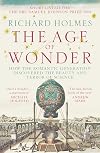
'The Age of Wonder' reads like several biographies intertwined; offering a narrative reflecting a whole era and its zeitgeist now clearly (or so I personally think...) alien to us.
The time period being highlighted (roughly: late 18th century and the first half of the 19th century) given that it’s a book mainly concerned about science, is remarkable by itself. First, because it’s a time when the term ‘science’ itself hadn’t been coined yet (it will be in 1834, and Richard Holmes show more stops at Darwin and his voyage onboard the Beagle…). Then, because it’s the triumph of the Romantic era, an intellectual trend that, because of it being underpinned by Idealism, we might not especially associate with how we perform science nowadays. The author, though, brilliantly challenges such perception, in clearly showing that here was a time which had nothing to envy to the first scientific revolution, or, for that matter, any other prior era of discoveries. And this, this is precisely what makes the book so striking and engrossing.
Yes: it’s all very well researched and with a lot of facts to assimilate. Yes too: because of its depth and wealth of information, here’s not a read that you will fly through in a hurry while being deeply engrossed. On the contrary, if it’s -undeniably- impossible to put down and is an amazing page turner indeed, it remains a long, sloooow read, which takes time to navigate especially if (like me) you are not already familiar with most of the people involved. Having said that, both the personalities outlined and their worldviews and attitudes are fascinating, not least because they made no disconnection between the theoretical world and the practical one. On the contrary, Robert Hook was also an instrument maker, and William Herschel had to make his own telescopes to suit his needs! Scientist weren’t living off in ivory towers either, many having passionate and dedicated audiences that they loved to cater for (Humphry Davy and his lectures are a case in point). More, if we tend to think in term of black and white when it comes to sciences and the arts, as if the two were cohabiting with not much in common, this was everything but the case back then. This, again, may sound counter-intuitive given that with Romanticism came Idealism, but, as the author shows, there was in fact some cross pollinating. We’re all familiar with ‘Frankenstein’ by Mary Shelley, getting to grip with progress and technology. The thing is, the likes of Samuel T. Coleridge or Percy Shelley also embraced the concerns and passions of the ‘natural philosophers’, in the same way that many such scientists weren’t stranger to the arts either (Herschel, for instance, was also a musician).
In the end, then, here’s the fascinating portray of a whole era, when the discoveries of foreign lands and new species went hand-in-hand with a contagious curiosity -from the microscopic (Robert Hook’s micrographia) to the gigantically cosmic (the Herschel sibling’s work) and, even, architecture. Here's the retelling of an age of wonder, then, that can only leave us wonderous too. show less
The time period being highlighted (roughly: late 18th century and the first half of the 19th century) given that it’s a book mainly concerned about science, is remarkable by itself. First, because it’s a time when the term ‘science’ itself hadn’t been coined yet (it will be in 1834, and Richard Holmes show more stops at Darwin and his voyage onboard the Beagle…). Then, because it’s the triumph of the Romantic era, an intellectual trend that, because of it being underpinned by Idealism, we might not especially associate with how we perform science nowadays. The author, though, brilliantly challenges such perception, in clearly showing that here was a time which had nothing to envy to the first scientific revolution, or, for that matter, any other prior era of discoveries. And this, this is precisely what makes the book so striking and engrossing.
Yes: it’s all very well researched and with a lot of facts to assimilate. Yes too: because of its depth and wealth of information, here’s not a read that you will fly through in a hurry while being deeply engrossed. On the contrary, if it’s -undeniably- impossible to put down and is an amazing page turner indeed, it remains a long, sloooow read, which takes time to navigate especially if (like me) you are not already familiar with most of the people involved. Having said that, both the personalities outlined and their worldviews and attitudes are fascinating, not least because they made no disconnection between the theoretical world and the practical one. On the contrary, Robert Hook was also an instrument maker, and William Herschel had to make his own telescopes to suit his needs! Scientist weren’t living off in ivory towers either, many having passionate and dedicated audiences that they loved to cater for (Humphry Davy and his lectures are a case in point). More, if we tend to think in term of black and white when it comes to sciences and the arts, as if the two were cohabiting with not much in common, this was everything but the case back then. This, again, may sound counter-intuitive given that with Romanticism came Idealism, but, as the author shows, there was in fact some cross pollinating. We’re all familiar with ‘Frankenstein’ by Mary Shelley, getting to grip with progress and technology. The thing is, the likes of Samuel T. Coleridge or Percy Shelley also embraced the concerns and passions of the ‘natural philosophers’, in the same way that many such scientists weren’t stranger to the arts either (Herschel, for instance, was also a musician).
In the end, then, here’s the fascinating portray of a whole era, when the discoveries of foreign lands and new species went hand-in-hand with a contagious curiosity -from the microscopic (Robert Hook’s micrographia) to the gigantically cosmic (the Herschel sibling’s work) and, even, architecture. Here's the retelling of an age of wonder, then, that can only leave us wonderous too. show less
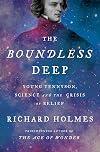
"When that which drew out
the boundless deep
Turns again home."
Richard Holmes delivered a brilliantly researched and smooth flowing tale of Young Tennyson!
The entire first chapter is devoted to THE KRAKEN. This may make people feel sorry for it since
it is clearly not bothering anyone, "far far beneath the abysmal sea."
Adopted by an owl when he was a boy, Alfred kept a life long respect for all animals.
The author follows him from the Somersby Rectory through all his jaunts through show more Mablethorpe
and on into London and Europe. Haunted by the loss of his best friend, Hallam, Tennyson's
deep recurring depression guided his solitude and his eventual wondrous poetry,
as it wound from Faith through Astronomy and Geology and back again.
The accompanying photographs are truly amazing.
Still hard to understand is Tennyson's exclusion and ignoring of his good, trusted and faithful Friend, FitzGerald, from his later life, as Alfred became the renowned poet laureate. show less
the boundless deep
Turns again home."
Richard Holmes delivered a brilliantly researched and smooth flowing tale of Young Tennyson!
The entire first chapter is devoted to THE KRAKEN. This may make people feel sorry for it since
it is clearly not bothering anyone, "far far beneath the abysmal sea."
Adopted by an owl when he was a boy, Alfred kept a life long respect for all animals.
The author follows him from the Somersby Rectory through all his jaunts through show more Mablethorpe
and on into London and Europe. Haunted by the loss of his best friend, Hallam, Tennyson's
deep recurring depression guided his solitude and his eventual wondrous poetry,
as it wound from Faith through Astronomy and Geology and back again.
The accompanying photographs are truly amazing.
Still hard to understand is Tennyson's exclusion and ignoring of his good, trusted and faithful Friend, FitzGerald, from his later life, as Alfred became the renowned poet laureate. show less
Lists
Take Four Books (1)
Awards


You May Also Like


Associated Authors
Statistics
- Works
- 22
- Also by
- 16
- Members
- 5,971
- Popularity
- #4,131
- Rating
- 4.0
- Reviews
- 112
- ISBNs
- 389
- Languages
- 16
- Favorited
- 18