
John Keats (1) (1795–1821)
Author of John Keats: The Complete Poems (Penguin Classics)
For other authors named John Keats, see the disambiguation page.
About the Author
John Keats was born in London, the oldest of four children, on October 31, 1795. His father, who was a livery-stable keeper, died when Keats was eight years old, and his mother died six years later. At age 15, he was apprenticed to an apothecary-surgeon. In 1815 he began studying medicine but soon show more gave up that career in favor of writing poetry. The critic Douglas Bush has said that, if one poet could be recalled to life to complete his career, the almost universal choice would be Keats, who now is regarded as one of the three or four supreme masters of the English language. His early work is badly flawed in both technique and critical judgment, but, from his casually written but brilliant letters, one can trace the development of a genius who, through fierce determination in the face of great odds, fashioned himself into an incomparable artist. In his tragically brief career, cut short at age 25 by tuberculosis, Keats constantly experimented, often with dazzling success, and always with steady progress over previous efforts. The unfinished Hyperion is the only English poem after Paradise Lost that is worthy to be called an epic, and it is breathtakingly superior to his early Endymion (1818), written just a few years before. Isabella is a fine narrative poem, but The Eve of St. Agnes (1819), written soon after, is peerless. In Lamia (1819) Keats revived the couplet form, long thought to be dead, in a gorgeous, romantic story. Above all it was in his development of the ode that Keats's supreme achievement lies. In just a few months, he wrote the odes "On a Grecian Urn" (1819), "To a Nightingale" (1819), "To Melancholy" (1819), and the marvelously serene "To Autumn" (1819). Keats is the only romantic poet whose reputation has steadily grown through all changes in critical fashion. Once patronized as a poet of beautiful images but no intellectual content, Keats is now appreciated for his powerful mind, profound grasp of poetic principles, and ceaseless quest for new forms and techniques. For many readers, old and young, Keats is a heroic figure. John Keats died in Rome on February 23, 1821 and was buried in the Protestant Cemetery, Rome. His last request was to be placed under a tombstone bearing no name or date, only the words, "Here lies One whose Name was writ in Water." (Bowker Author Biography) show less
Image credit: Wikipedia commons
Works by John Keats
So Bright and Delicate: Love Letters and Poems of John Keats to Fanny Brawne (2009) 313 copies, 9 reviews
Selected Letters of John Keats: Based on the texts of Hyder Edward Rollins, Revised Edition (2005) 79 copies
On First Looking Into Chapman's Homer 56 copies
Delphi Complete Works of John Keats (Illustrated) (Delphi Poets Series Book 1) (2015) 42 copies, 1 review
Letters 25 copies
The poetical works of Coleridge, Shelley, and Keats : complete in one volume (1838) — Author — 11 copies
The Folio Poets 8 copies
Eve of St. Agnes, The (among others) 6 copies
Selected Poems of John Keats 5 copies
Poems and Letters 5 copies
Iperione, odi e sonetti 5 copies
The Poems Of John Keats 5 copies
Selected Poetry (Poetry Library) 5 copies
Richtmass des Schönen : Briefe. [Aus d. Engl.]. [Übers. von Christa Schuenke. Hrsg. von Horst Höhne], Reclams Universal-Bibliothek ; Bd. 1099 : Belletristik (1985) — Author — 4 copies
John Keats: a thematic reader 4 copies
Keats Poesia Completa - Tomo 1 4 copies
Iperione e altri scritti poetici — Author — 4 copies
The Romantic Poets; John Keats 3 copies
The poems and verses of John Keats 3 copies
Poetry & prose, with essays by Charles Lamb, Leigh Hunt, Robert Bridges & others; with an introduction and notes by Henry Ellershaw (2010) 3 copies
The Poems of John Keats Volume One 3 copies
POEMS OF JOHN KEATS, ARRANGED IN CHRONOLOGICAL ORDER WITH A PREFACE BY SIDNEY COLVIN. Volume 1 2 copies
The Complete Poems of John Keats (Wordsworth Poetry Library) by John Keats (1994-01-05) (1758) 2 copies
Poetical Works P. McC. 2 copies
John Keats, 1795-1821 2 copies
Selected Poems (Crofts Classics) 2 copies
Keats 2 copies
John Keats poesia completa. Vol II 2 copies
Poesía Completa - Tomo I 2 copies
Fulgida stella 2 copies
John Keats. Selected poems - Poèmes choisis (bilingue) Traduction, préface et notes par Albert Laffay (1968) 2 copies
A Selection from John Keats 2 copies
John Keats. An Approach to His Poetry. Commentary by K R Roberts. Illustrations by Brian Halton. (1982) 2 copies
Když mraky září 2 copies
Keats' Poems 2 copies
Poems of John Keats: Edited and Selected by Rosalind Vallance, with an Introduction by B.Ifor Evans (1950) 2 copies
JOHN KEATS COMPLETE WORKS ULTIMATE COLLECTION 50 Works ALL poems, poetry, posthumous works, letters and BIOGRAPHY (2013) 2 copies
Il labile nome 1 copy
Epistola Caledoniensa 1 copy
Gedichte und Briefe 1 copy
The Poetical Works Of John Keats. Edited With An Introduction And Textual Notes By H. Buxton Forman (1931) 1 copy
The Shorter Poems 1 copy
Author: John Keats 1 copy
John Keats' Poetry 1 copy
Keats Poetry & Prose 1 copy
Keats: Collected Poems 1 copy
Sixteen Select Poems 1 copy
Love Poems of John Keats 1 copy
A Keats Selection 1 copy
キーツ詩集 (岩波文庫) 1 copy
The Poems of John Keats Arranged in Chronological Order With a Preface by Sydney Colvin (1928) 1 copy
Стихотворения 1 copy
The Letters Of John Keats 1 copy
Poemas esenciales 1 copy
"To Homer" 1 copy
The Complete Poetry of Keats 1 copy
"On Fame" 1 copy
"In Drear-Nighted December" 1 copy
"What the Thrush Said" 1 copy
Keats Poesie 1 copy
Cartas 1 copy
Oda a un ruiseñor 1 copy
Selected Poem 1 copy
A Concordance to the Poems of John Keats — Contributor — 1 copy
The Making of a poet 1 copy
Selection From Keats 1 copy
Odes, sonnets and lyrics 1 copy
Keats and Shelley 1 copy
Keats day by day 1 copy
The Complete Poetical Works and Letters of John Keats. (Edited by H. E. Scudder.) [With a portrait.] 1 copy
"Ode to Psyche" 1 copy
Ormanda Unutulan Askerler 1 copy
Lamia and Other Poems. 1 copy
John Keats: Selected Poems 1 copy
Twang Dillo Dee 1 copy
Meg Merrilies 1 copy
Odi e Sonetti 1 copy
THE POEMS AND VERSES OF JOHN KEATS, Edited and Arranged in Chronological Order By JOHN MIDDLETON MURRAY, (1949) 1 copy
Keats Poetical Works 1 copy
Lettres 1 copy
On Seeing the Elgin Marbles (included in The Norton Introduction to Literature - 5th Edition) 1 copy
John Keats - Gedichte 1 copy
Yönkirkas taivas 1 copy
John Keats 1 copy
The Eve of St. Agnes, Pastora Poems, L'Allegro - All in One Volume — Contributor — 1 copy
Sonno e poesia 1 copy
John Keat's poems 1 copy
a poet has no identity 1 copy
Notes on Keats' poetry 1 copy
Letters: 1819 and 1820 1 copy
Poems etc. Vol. II. 1 copy
Poesías 1 copy
Selected letters & poems 1 copy
Autobiography of John Keats 1 copy
The Poems of Keats 1 copy
Poetry, F3 1 copy
Ode on indolence 1816 1 copy
Ode on melancholy, 1816 1 copy
John Keats 50 Greatest Poems 1 copy
Collected Poetry 1 copy
Poemas de John Keats 1 copy
The Poems of Keats 1 copy
Associated Works
Paradise Lost [Norton Critical Edition] (1667) — Contributor, some editions — 2,419 copies, 14 reviews
The Making of a Poem: A Norton Anthology of Poetic Forms (2000) — Contributor — 1,462 copies, 9 reviews
The Best Poems of the English Language: From Chaucer Through Robert Frost (2004) — Contributor — 1,239 copies, 3 reviews
Literature: An Introduction to Fiction, Poetry, and Drama (1995) — Contributor, some editions — 1,011 copies, 7 reviews
The Illustrated Treasury of Children's Literature, Volumes 1-2 (1955) — Contributor — 520 copies, 4 reviews
World Poetry: An Anthology of Verse from Antiquity to Our Time (1998) — Contributor — 496 copies, 2 reviews
The Norton Anthology of English Literature, 4th Edition, Volume 2 (1979) — Contributor — 269 copies, 1 review
Poems Bewitched and Haunted (Everyman's Library Pocket Poets Series) (2005) — Contributor — 231 copies
The Vampire Archives: The Most Complete Volume of Vampire Tales Ever Published (2007) — Contributor — 214 copies, 5 reviews
The Graphic Canon, Vol. 2: From "Kubla Khan" to the Brontë Sisters to The Picture of Dorian Gray (2012) — Contributor — 210 copies, 2 reviews
The Poetry Pharmacy: Tried-and-True Prescriptions for the Heart, Mind, and Soul (2017) 196 copies, 5 reviews
Vampires, Wine and Roses: Chilling Tales of Immortal Pleasure (1997) — Contributor — 169 copies, 2 reviews
The Great Romantics: Selected Poems: Lord Byron, Percy Bysshe Shelley, John Keats (1993) — Author — 155 copies
The Sophisticated Cat: A Gathering of Stories, Poems, and Miscellaneous Writings About Cats (1992) — Contributor — 112 copies, 1 review
The Dedalus Book of English Decadence: Vile Emperors and Elegant Degenerates (2004) — Contributor — 60 copies
Buzz Words: Poems About Insects (Everyman's Library Pocket Poets Series) (2021) — Contributor — 55 copies
The Dedalus Book of British Fantasy: 19th Century (European Literary Fantasy Anthologies) (1991) — Contributor — 47 copies
Benjamin Franklin's Autobiography [Norton Critical Edition, 2nd ed.] (2012) — Contributor — 47 copies
Out of the Best Books: An Anthology of Literature, Vol. 1: The Individual and Human Values (1964) — Contributor — 40 copies
Out of the Best Books: An Anthology of Literature, Vol. 2: Love, Marriage, and the Family (1966) — Contributor — 36 copies
Out of the Best Books: An Anthology of Literature, Vol. 4: The World Around Us (1968) — Contributor — 28 copies
Sunlight on the River: Poems About Paintings, Paintings About Poems (2015) — Contributor — 11 copies, 2 reviews
Keats Circle Letters and Papers and More Letters and Poems of the Keats Circle (1965) — Contributor — 10 copies
Quest for Permanence: Symbolism of Wordsworth, Shelley and Keats (1959) — Featured Artist — 9 copies
Edexcel Poetry Anthology for Advanced subsidiary and advanced GCE examinations in English Literature (2000) — Contributor, some editions — 6 copies
Tagged
Common Knowledge
- Canonical name
- Keats, John
- Birthdate
- 1795-10-31
- Date of death
- 1821-02-23
- Gender
- male
- Education
- Guy's Hospital, London (surgeon's assistant)
- Occupations
- poet
- Organizations
- Guy's Hospital, London
- Relationships
- Hunt, Leigh (friend)
Brawne, Fanny (fiancée)
Reynolds, John Hamilton (friend)
Clarke, Charles Cowden (friend)
Haydon, Benjamin Robert (friend)
Coleridge, Samuel Taylor (friend) (show all 7)
Brown, Charles Armitage (friend) - Short biography
- When dying, Keats asked for his headstone to be engraved with the words, "Here lies one whose name was writ in water."
- Cause of death
- tuberculosis
- Nationality
- Great Britain
- Birthplace
- London, Middlesex, England, UK
- Places of residence
- London, Middlesex, England, UK
Rome, Italy - Place of death
- Rome, Italy
- Burial location
- Protestant Cemetery, Rome, Italy
- Map Location
- England, UK
Members
Reviews

”Let me have another opportunity of years before me and I will not die without being remember’d” pleads John Keats in one of the thirty-seven surviving love letters he sent to his “angel”, Fanny Brawne. It was some months before his partying to Italy, where he was sent following his doctor’s advice as the last chance to survive a long, strenuous illness. He was supposed to benefit from the milder winter there. He would never return to England, dying in Rome at the premature age show more of twenty-five and without having ever replied to a single letter from Fanny. He wrote to his friend Mr.Brown instead explaining he could not bear to write to her knowing that he would never see her again in this life. Fanny’s unopened letters were buried with him in Rome, where a simple stone pays homage to him, with no name engraved, only the words “Here lies one whose name was writ in water” , as he requested.
Keats’s spell has gone very deep for me. This short collection of letters and poems has left me emotionally drained, they bear compelling witness to Keats’s tenderness, passion, genius and vulnerability. It was sometime during the spring of 1819, the one he spent next to Fanny, that Keats experienced the great outpouring of his poetic life, managing to write about love with the only authority he ever accepted, that of experience itself. It was also the year he fell mortally sick.
"You are to me an object intensely desirable – the air I breathe in a room empty of you is unhealthy."
Letter sent to Fanny from Kentish Town, preparing for his trip to Italy, 1819.
Keats published only fifty-four poems in three slim volumes and, in spite of achieving little public notoriety during his brief life, I believe him to be the quintessential British poet of all times. Keats’s grace, which is sometimes nearly “humoristic”, along with his verbal skill and his dry wit can take by surprise any reader who believed him to be the unmanly, delicate poet, at first glance innocent, he seemed to be. We can sense some of this ingenious playfulness in his short poem called "On Fame”.
Fame, like a wayward girl, will still be coy
To those who woo her with too slavish knees,
But makes surrender to some thoughtless boy,
And dotes the more upon a heart at ease;
She is a Gipsey, - will not speak to those
Who have not learnt to be content without her.
And if one bothers to look deeper, he will discover an unknown, exotic Keats. An acute poet who plays with his own expressive virtuosity, creating poetry from poetizing, without an inch of seriousness or philosophical pretensions, his verses appear charged with irony, impregnating the reader with flashing tastes of melancholy. Taking Wordsworth, Milton and Shakespeare for inspiration, Keats’s mature sense makes the career of the artist become an exploration of art’s power to bring solace and meaning to human suffering.
His four Odes are perfect examples of the way his poems, through a highly self-conscious art, embody meditation on desire and its fulfilment and also on wishes, dreams, and romance.
Forlorn! the very word is like a bell
To toll me back from thee to my sole self!
Adieu! the fancy cannot cheat so well
As she is fam'd to do, deceiving elf.
Adieu! adieu! thy plaintive anthem fades
Past the near meadows, over the still stream,
Up the hill-side; and now 'tis buried deep
In the next valley-glades:
Was it a vision, or a waking dream?
Fled is that music:—Do I wake or sleep?
Ode to a Nightingale
Keats mastered an unusual willingness to embrace uncertainty, live with mystery and make peace with ambiguity, a term which has been called Negative Capability, in which the poet is able to forget about his self and, in vacating his mind, he can fully succumb into the intensity of countless experiences, creating poems out of them. It’s in this fashion that the reader can “feel” rather than “read” Keats’s verses because they don’t struggle with aesthetic form but for meaning against the limits of experience, and always with the under shadowing presence of death behind beauty.
Their sorrows. Pale were the sweet lips I saw,
Pale were the lips I kissed, and fair the form
I floated with, about that melancholy storm.
A Dream, after reading Dante’s Episode of Paolo and Francesca.
Keats’s relationship to Fanny Brawne has tantalized generations of lovers of his poetry, moved and shocked them by their frank passion and intense feelings. I count myself among them. His letters and poems, are all part of the alchemy that makes Keats so special. The young man who died devastated, convinced that he would be forgotten, has been repeatedly re-discovered and remains immortal in the pulsating hearts of all the readers who ache and delight in the way in which beauty reveals the subtle truth behind Keats’s distressing verses. Keats rests in peace knowing he left this earthly world more beloved than most of us will ever be.
Bright star, would I were stedfast as thou art—
Not in lone splendour hung aloft the night
And watching, with eternal lids apart,
Like nature's patient, sleepless Eremite,
The moving waters at their priestlike task
Of pure ablution round earth's human shores,
Or gazing on the new soft-fallen mask
Of snow upon the mountains and the moors--
No--yet still stedfast, still unchangeable,
Pillow'd upon my fair love's ripening breast,
To feel for ever its soft fall and swell,
Awake for ever in a sweet unrest, S
till, still to hear her tender-taken breath,
And so live ever--or else swoon to death.
Bright Star, dedicated to Fanny Brown. show less
Keats’s spell has gone very deep for me. This short collection of letters and poems has left me emotionally drained, they bear compelling witness to Keats’s tenderness, passion, genius and vulnerability. It was sometime during the spring of 1819, the one he spent next to Fanny, that Keats experienced the great outpouring of his poetic life, managing to write about love with the only authority he ever accepted, that of experience itself. It was also the year he fell mortally sick.
"You are to me an object intensely desirable – the air I breathe in a room empty of you is unhealthy."
Letter sent to Fanny from Kentish Town, preparing for his trip to Italy, 1819.
Keats published only fifty-four poems in three slim volumes and, in spite of achieving little public notoriety during his brief life, I believe him to be the quintessential British poet of all times. Keats’s grace, which is sometimes nearly “humoristic”, along with his verbal skill and his dry wit can take by surprise any reader who believed him to be the unmanly, delicate poet, at first glance innocent, he seemed to be. We can sense some of this ingenious playfulness in his short poem called "On Fame”.
Fame, like a wayward girl, will still be coy
To those who woo her with too slavish knees,
But makes surrender to some thoughtless boy,
And dotes the more upon a heart at ease;
She is a Gipsey, - will not speak to those
Who have not learnt to be content without her.
And if one bothers to look deeper, he will discover an unknown, exotic Keats. An acute poet who plays with his own expressive virtuosity, creating poetry from poetizing, without an inch of seriousness or philosophical pretensions, his verses appear charged with irony, impregnating the reader with flashing tastes of melancholy. Taking Wordsworth, Milton and Shakespeare for inspiration, Keats’s mature sense makes the career of the artist become an exploration of art’s power to bring solace and meaning to human suffering.
His four Odes are perfect examples of the way his poems, through a highly self-conscious art, embody meditation on desire and its fulfilment and also on wishes, dreams, and romance.
Forlorn! the very word is like a bell
To toll me back from thee to my sole self!
Adieu! the fancy cannot cheat so well
As she is fam'd to do, deceiving elf.
Adieu! adieu! thy plaintive anthem fades
Past the near meadows, over the still stream,
Up the hill-side; and now 'tis buried deep
In the next valley-glades:
Was it a vision, or a waking dream?
Fled is that music:—Do I wake or sleep?
Ode to a Nightingale
Keats mastered an unusual willingness to embrace uncertainty, live with mystery and make peace with ambiguity, a term which has been called Negative Capability, in which the poet is able to forget about his self and, in vacating his mind, he can fully succumb into the intensity of countless experiences, creating poems out of them. It’s in this fashion that the reader can “feel” rather than “read” Keats’s verses because they don’t struggle with aesthetic form but for meaning against the limits of experience, and always with the under shadowing presence of death behind beauty.
Their sorrows. Pale were the sweet lips I saw,
Pale were the lips I kissed, and fair the form
I floated with, about that melancholy storm.
A Dream, after reading Dante’s Episode of Paolo and Francesca.
Keats’s relationship to Fanny Brawne has tantalized generations of lovers of his poetry, moved and shocked them by their frank passion and intense feelings. I count myself among them. His letters and poems, are all part of the alchemy that makes Keats so special. The young man who died devastated, convinced that he would be forgotten, has been repeatedly re-discovered and remains immortal in the pulsating hearts of all the readers who ache and delight in the way in which beauty reveals the subtle truth behind Keats’s distressing verses. Keats rests in peace knowing he left this earthly world more beloved than most of us will ever be.
Bright star, would I were stedfast as thou art—
Not in lone splendour hung aloft the night
And watching, with eternal lids apart,
Like nature's patient, sleepless Eremite,
The moving waters at their priestlike task
Of pure ablution round earth's human shores,
Or gazing on the new soft-fallen mask
Of snow upon the mountains and the moors--
No--yet still stedfast, still unchangeable,
Pillow'd upon my fair love's ripening breast,
To feel for ever its soft fall and swell,
Awake for ever in a sweet unrest, S
till, still to hear her tender-taken breath,
And so live ever--or else swoon to death.
Bright Star, dedicated to Fanny Brown. show less

Looking back over my life in books—or books in my life—there are those I read for pleasure and those I read for information and those I read for spiritual enlightenment. There are books I taught time and time again, and books I studied, and textbooks that engaged me as a student from second grade to graduate school. There are books I’ve read more than once, and books I’ve only read around in, and books I fully intend to read one of these days. There are massive tomes, and little show more books that just fit in the palm of one’s hand. There are books that are artifacts, like works of art or antiques, that I need to keep in sight or within easy reach—maybe because they’re beautiful, maybe because they’re old, maybe because of what they mean to me personally. Like the three old Grosset & Dunlaps my sister gave me for Christmas when I was nine years old (Tom Sawyer, Huck Finn, and Little Men). Like the Goodpasture Bible I won as a senior graduating from college, heading (I thought then) into the ministry. There is a whole bookcase of well-worn children’s books that we read aloud as a family when our children were growing up. There are books that speak to the eye, to the intellect, to the imagination, to the soul.
We define ourselves by the books we cherish. They speak volumes.
For Father’s Day, June 19, 1966, my first son—he was all of two and a half years old—gave me a leather-bound copy of The Poetical Works of John Keats (Oxford, 1962). Of course, his mother chose the book, arranged the custom binding, penned the inscription, and somehow managed what would have been the outlandish cost for the family of a poor graduate student living in married-student housing. Among the many books I treasure, it is the apex.
Understand, I rarely let myself read in it. I have other editions of Keats’ poetry that I have read—indeed, studied carefully—through the years. This one I revere. I enshrine it upon a pedestal, as it were, always near at hand.
Keats’ youthful sonnet written to his friend and tutor, Charles Cowden Clarke, “On First Looking into Chapman’s Homer,” speaks for me. It tells how I felt upon discovering Keats himself and, through him, the world of poetry. “Then felt I like some watcher of the skies / When a new planet swims into his ken.” Just three pages on in this volume is another sonnet, “On the Grasshopper and the Cricket,” not as well known, but one that spoke to me as a young man finding himself: “The poetry of earth is never dead . . . .”
I always rejoice to see how many of Keats’ works make it into those lists of 100 greatest poems of all time. If I were publishing such an anthology, besides the two poems I’ve already cited it would include the first thirty-three lines of Endymion (“A thing of beauty is a joy forever: / Its loveliness increases . . . .”), Lamia, “The Eve of St. Agnes,” “La Belle Dame sans Merci,” “To Autumn,” “Ode to a Nightingale,” and “On Sitting Down to Read King Lear Once Again”:
Chief Poet! and ye clouds of Albion,
Begetters of our deep-eternal theme!
When through the old oak Forest I am gone,
Let me not wander in a barren dream,
But, when I am consumed in the fire,
Give me new Phoenix wings to fly at my desire.
For young readers, I would have to start with the verse he wrote about himself in a letter to his young sister Fanny, while he was on that final, fateful walking tour to the north:
There was a naughty Boy,
A naughty boy was he,
For nothing would he do
But scribble poetry—
No collecton of Keats’ poetry would be complete without his own subconscious elegy to himself:
When I have fears that I may cease to be
Before my pen has glean’d my teeming brain,
Before high-piled books, in charactery,
Hold like rich garners the full ripen’d grain . . . .
But, of course #1 in my list of all-time favorites would be “Ode on a Grecian Urn.” This poem persuaded me to major in English (who as a high school student just a year earlier would have whooped and hollered in protest at the merest suggestion that I might make such a decision—but that’s another story); it has been one I have taught over and over again; it rewards me still each time I read it:
Heard melodies are sweet, but those unheard
Are sweeter; therefore, ye soft pipes, play on;
Not to the sensual ear, but, more endear’d,
Pipe to the spirit ditties of no tone . . . .
That one to challenge the mind, and this one to evoke the deepest emotions:
Bright star, would I were stedfast as thou art—
Not in lone splendour hung aloft the night
. . . . . . . . . .
No—yet still stedfast, still unchangeable,
Pillow’d upon my fair love’s ripening breast,
To feel for ever its soft fall and swell,
Awake for ever in a sweet unrest,
Still, still to hear her tender-taken breath,
And so live ever—or else swoon to death.
Ah, yes, Keats spoke to me as a young man, and speaks still to the young man deep within me.
The leather binding of this gift is deep burgundy, embossed with gold. It is still as new, pure luxury to hold in one’s hand. It is an “objective correlative” to the touch, an artifact suitable for the unheard melodies it houses: a thing of beauty, a joy forever.
Therefore, ye soft pipes, play on . . . . show less
We define ourselves by the books we cherish. They speak volumes.
For Father’s Day, June 19, 1966, my first son—he was all of two and a half years old—gave me a leather-bound copy of The Poetical Works of John Keats (Oxford, 1962). Of course, his mother chose the book, arranged the custom binding, penned the inscription, and somehow managed what would have been the outlandish cost for the family of a poor graduate student living in married-student housing. Among the many books I treasure, it is the apex.
Understand, I rarely let myself read in it. I have other editions of Keats’ poetry that I have read—indeed, studied carefully—through the years. This one I revere. I enshrine it upon a pedestal, as it were, always near at hand.
Keats’ youthful sonnet written to his friend and tutor, Charles Cowden Clarke, “On First Looking into Chapman’s Homer,” speaks for me. It tells how I felt upon discovering Keats himself and, through him, the world of poetry. “Then felt I like some watcher of the skies / When a new planet swims into his ken.” Just three pages on in this volume is another sonnet, “On the Grasshopper and the Cricket,” not as well known, but one that spoke to me as a young man finding himself: “The poetry of earth is never dead . . . .”
I always rejoice to see how many of Keats’ works make it into those lists of 100 greatest poems of all time. If I were publishing such an anthology, besides the two poems I’ve already cited it would include the first thirty-three lines of Endymion (“A thing of beauty is a joy forever: / Its loveliness increases . . . .”), Lamia, “The Eve of St. Agnes,” “La Belle Dame sans Merci,” “To Autumn,” “Ode to a Nightingale,” and “On Sitting Down to Read King Lear Once Again”:
Chief Poet! and ye clouds of Albion,
Begetters of our deep-eternal theme!
When through the old oak Forest I am gone,
Let me not wander in a barren dream,
But, when I am consumed in the fire,
Give me new Phoenix wings to fly at my desire.
For young readers, I would have to start with the verse he wrote about himself in a letter to his young sister Fanny, while he was on that final, fateful walking tour to the north:
There was a naughty Boy,
A naughty boy was he,
For nothing would he do
But scribble poetry—
No collecton of Keats’ poetry would be complete without his own subconscious elegy to himself:
When I have fears that I may cease to be
Before my pen has glean’d my teeming brain,
Before high-piled books, in charactery,
Hold like rich garners the full ripen’d grain . . . .
But, of course #1 in my list of all-time favorites would be “Ode on a Grecian Urn.” This poem persuaded me to major in English (who as a high school student just a year earlier would have whooped and hollered in protest at the merest suggestion that I might make such a decision—but that’s another story); it has been one I have taught over and over again; it rewards me still each time I read it:
Heard melodies are sweet, but those unheard
Are sweeter; therefore, ye soft pipes, play on;
Not to the sensual ear, but, more endear’d,
Pipe to the spirit ditties of no tone . . . .
That one to challenge the mind, and this one to evoke the deepest emotions:
Bright star, would I were stedfast as thou art—
Not in lone splendour hung aloft the night
. . . . . . . . . .
No—yet still stedfast, still unchangeable,
Pillow’d upon my fair love’s ripening breast,
To feel for ever its soft fall and swell,
Awake for ever in a sweet unrest,
Still, still to hear her tender-taken breath,
And so live ever—or else swoon to death.
Ah, yes, Keats spoke to me as a young man, and speaks still to the young man deep within me.
The leather binding of this gift is deep burgundy, embossed with gold. It is still as new, pure luxury to hold in one’s hand. It is an “objective correlative” to the touch, an artifact suitable for the unheard melodies it houses: a thing of beauty, a joy forever.
Therefore, ye soft pipes, play on . . . . show less
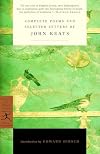
The introduction speaks of Keat's "verbal sumptuousness" and that's apt--particularly if you read these out loud, they're a feast for the ears. That said, I didn't love everything. I was less than wild about Keats' two longest poems, particularly the longest, Endymion, which at over a hundred pages is the only one that could be described as "epic" and the only one that after reading part of it I skipped. I think part of what I don't much like about that poem is that it feels less personal show more than the others. Although the shorter poetry has a lot of classical allusions, here the world of Greek myth is central, and strikes me as too artificial and pedantic unlike the way it hits me when it comes from a Homer or Vergil. Poems such as "On Chapman's Homer," "Ode to a Grecian Urn" and "On Seeing the Elgin Marbles For the First Time" are about Keats' reaction to things classical, which is a different story. Or maybe it's just Keats wasn't then ready to handle an epic theme. He himself said he was stretching himself and saw the poem as flawed, if a great learning experience, and when it was published, the poem drew scathing reviews.
Yet, even Endymion has its riches--the first line is "a thing of beauty is a joy forever." That certainly can be said of Keats' poetry. There are so many of the shorter lyric poetry and sonnets that are so absolutely gorgeous it would just be too long to list all I loved in a review, but I'll try to list my five favorites in order they're found in the book--even though I know the choices are rather predictable.
1) "On First Looking into Chapman's Homer" - because it expresses so well the wonder of discovery to be found in reading with its "realms of gold."
2) "When I Have Fears" - because it's heartbreaking, especially knowing Keat's fate.
3) "La Belle Dame sans Merci" - because it's a creepy, haunting horror story.
4) "Ode on a Grecian Urn" - because well, it's brilliant. ("Beauty is truth, truth beauty.")
5) "To Autumn" - because the imagery is so lush. ("Season of mists and mellow fruitfulness")
Yet it's not just famous ones such as "Ode to a Grecian Urn" or "La Belle Dans Merci" but it's the ones such as say "Fancy" that don't often make it into anthologies that thus justify reading a book devoted to Keats alone. Ordinarily, given I didn't like a poem which takes up a quarter of the book's length, I'd mark the book down in the rating, but with Keats I can't bear to. Absolutely a first-rate poet, it's obscene that he died at twenty-five years old. show less
Yet, even Endymion has its riches--the first line is "a thing of beauty is a joy forever." That certainly can be said of Keats' poetry. There are so many of the shorter lyric poetry and sonnets that are so absolutely gorgeous it would just be too long to list all I loved in a review, but I'll try to list my five favorites in order they're found in the book--even though I know the choices are rather predictable.
1) "On First Looking into Chapman's Homer" - because it expresses so well the wonder of discovery to be found in reading with its "realms of gold."
2) "When I Have Fears" - because it's heartbreaking, especially knowing Keat's fate.
3) "La Belle Dame sans Merci" - because it's a creepy, haunting horror story.
4) "Ode on a Grecian Urn" - because well, it's brilliant. ("Beauty is truth, truth beauty.")
5) "To Autumn" - because the imagery is so lush. ("Season of mists and mellow fruitfulness")
Yet it's not just famous ones such as "Ode to a Grecian Urn" or "La Belle Dans Merci" but it's the ones such as say "Fancy" that don't often make it into anthologies that thus justify reading a book devoted to Keats alone. Ordinarily, given I didn't like a poem which takes up a quarter of the book's length, I'd mark the book down in the rating, but with Keats I can't bear to. Absolutely a first-rate poet, it's obscene that he died at twenty-five years old. show less

There was a naughty boy
And a naughty boy was he,
For nothing would he do
But scribble poetry . . . .
My copy of this book is a rare one – in fact, it’s unique! The verse was written long ago by the English Romantic poet John Keats. It was never, ever meant to be published, but was a bit of nonsense included in a letter to his sister Fanny, a youngster, whom he was writing while he and his friend were on their famous walking tour through northern England, bound for Scotland. This edition show more (Viking, 1965) was illustrated by Caldecott winner Ezra Jack Keats (Keats illustrating Keats, get it?). That might be enough to make it a rare book (though there are currently nine copies available through ABE for $15 or less), but what makes this copy unique is a third dimension. It was once, over forty years ago, a gift to our young son, also named Keats (for the poet, not the illustrator!). So it’s a book written by Keats, illustrated by Keats, and scribbled in by Keats (or another one of our five children or five grandchildren). Ezra Jack illustrated it in two colors: red and black. The scribbling is done – on a good many pages and the end papers, front and back – with a blunt, blue crayon. Unique! Rare book dealers would have to label it fair (it does have a good dj and the binding is reasonably tight), but in our family it is priceless.
Even without such a personal history, the book is delightful. If you’re interested in children’s books – or book illustrators – you should grab one of these while they’re still available at such a bargain price. At the time, Ezra Jack had just won the Caldecott medal for The Snowy Day, the first of a series of books that show Peter growing up. Peter is a black kid at home in a city, making his way around city streets – unusual in children’s books in the early 1960s, one might almost say “unique.” These books were also unusual in that Keats chose collage as his medium, usually combined with gouache painting. Hence, it was the subject matter, the medium, and Keats’s distinctive style that won him widespread readership, and probably the attention of the Caldecott judges. He had not intended to become an illustrator of children’s books. He worked on WPA art projects during the Great Depression; then on the Captain Marvel comic books in the early 1940s, and eventually illustrated books including the popular Danny Dunn series for children. He was almost fifty years old when he came out with The Snowy Day, which he had written himself. Born Jacob Ezra Katz in 1916, he had changed his name after World War II because of the prevalence of anti-Semitism at the time. It was his name, no doubt, which prompted his publisher to let him do the John Keats nonsense verse as a little book for children.
It is a little book for little hands (4’x5’), just right for the tinkling tripping of the verse. Unfortunately (or, perhaps, fortunately, depending on how you feel about the illustrations), he publishers did not have him exploit his usual four-color collages, but this did not prevent him from achieving his inimitable style. The illustrations are whimsical – matching the nonsense of the verse.
He took
An ink stand
In his hand
And a pen
Big as ten
In the other.
And away
In a potcher
He ran.
The dull gray inkstand is bigger than the naughty boy’s head, and the bright red feather pen longer than he is tall. Even in black and white, Ezra Jack uses collage with its tactile sense of texture: a piece of linoleum, or bathroom tile, for a Scottish castle, swirly paper for the earth (“he found / That the ground [in Scotland] / was as hard”), a piece of wood for a door (“a door / Was as wooden / As in England”), even black and white striped paper for the naughty boy’s coat and trousers. (Regrettably, Ezra Jack chose to make the boy a prim little dandy in a suit with a red vest – hardly the rugged, frolicsome young outdoorsman John Keats had in mind – himself, of course – but Ezra Jack’s version is at least plucky and daring.) On a few pages the illustrations feature a simple black silhouette; for example, in a very small silhouette of the boy with his inkstand and feather running across and the top of a white, double-page spread with the words of the repeated chorus:
Och, the charm
When we chose
To follow one’s nose
To the north,
To the north,
To follow one’s nose to the North!
This design is notable, one of my favorite pages in this book. An equally dramatic page, also a favorite of mine, has splotches of red ink in the background with a silhouette of a hag on a broomstick (“ghostes / And Postes / And witches / And ditches”) with the naughty boy perched, confidently, right behind her.
The little book has only thirty-two pages, but the verse is delightful, the illustrations and design appealing, and the boy just pert enough to engage young readers. They may be tempted by the implicit motion across the pages to pirouette across the room, book in hand. Oh, and to add a little color with copious blue scribbling. Keep the crayons handy!
Our young Keats did NOT become a poet – nor even a reader of poetry, to my knowledge. He’s now a biochemist in Melbourne, Australia, and he’s gone through life having to spelling his name (“no, not Keith, but Keats, K-E-A-T-S . . . yeah, like the poet”); however, he is a painter on the side, his art work clever and adept, not unlike Ezra Jack’s. In the verse, the adventuresome young lad finds out that “the North,” even Scotland, is not that different from his home in England, after all. It’s the imagination that makes it so.
So he stood in
His shoes and he wonder’d.
He wonder’d,
He stood in
His shoes and he wonder’d. show less
And a naughty boy was he,
For nothing would he do
But scribble poetry . . . .
My copy of this book is a rare one – in fact, it’s unique! The verse was written long ago by the English Romantic poet John Keats. It was never, ever meant to be published, but was a bit of nonsense included in a letter to his sister Fanny, a youngster, whom he was writing while he and his friend were on their famous walking tour through northern England, bound for Scotland. This edition show more (Viking, 1965) was illustrated by Caldecott winner Ezra Jack Keats (Keats illustrating Keats, get it?). That might be enough to make it a rare book (though there are currently nine copies available through ABE for $15 or less), but what makes this copy unique is a third dimension. It was once, over forty years ago, a gift to our young son, also named Keats (for the poet, not the illustrator!). So it’s a book written by Keats, illustrated by Keats, and scribbled in by Keats (or another one of our five children or five grandchildren). Ezra Jack illustrated it in two colors: red and black. The scribbling is done – on a good many pages and the end papers, front and back – with a blunt, blue crayon. Unique! Rare book dealers would have to label it fair (it does have a good dj and the binding is reasonably tight), but in our family it is priceless.
Even without such a personal history, the book is delightful. If you’re interested in children’s books – or book illustrators – you should grab one of these while they’re still available at such a bargain price. At the time, Ezra Jack had just won the Caldecott medal for The Snowy Day, the first of a series of books that show Peter growing up. Peter is a black kid at home in a city, making his way around city streets – unusual in children’s books in the early 1960s, one might almost say “unique.” These books were also unusual in that Keats chose collage as his medium, usually combined with gouache painting. Hence, it was the subject matter, the medium, and Keats’s distinctive style that won him widespread readership, and probably the attention of the Caldecott judges. He had not intended to become an illustrator of children’s books. He worked on WPA art projects during the Great Depression; then on the Captain Marvel comic books in the early 1940s, and eventually illustrated books including the popular Danny Dunn series for children. He was almost fifty years old when he came out with The Snowy Day, which he had written himself. Born Jacob Ezra Katz in 1916, he had changed his name after World War II because of the prevalence of anti-Semitism at the time. It was his name, no doubt, which prompted his publisher to let him do the John Keats nonsense verse as a little book for children.
It is a little book for little hands (4’x5’), just right for the tinkling tripping of the verse. Unfortunately (or, perhaps, fortunately, depending on how you feel about the illustrations), he publishers did not have him exploit his usual four-color collages, but this did not prevent him from achieving his inimitable style. The illustrations are whimsical – matching the nonsense of the verse.
He took
An ink stand
In his hand
And a pen
Big as ten
In the other.
And away
In a potcher
He ran.
The dull gray inkstand is bigger than the naughty boy’s head, and the bright red feather pen longer than he is tall. Even in black and white, Ezra Jack uses collage with its tactile sense of texture: a piece of linoleum, or bathroom tile, for a Scottish castle, swirly paper for the earth (“he found / That the ground [in Scotland] / was as hard”), a piece of wood for a door (“a door / Was as wooden / As in England”), even black and white striped paper for the naughty boy’s coat and trousers. (Regrettably, Ezra Jack chose to make the boy a prim little dandy in a suit with a red vest – hardly the rugged, frolicsome young outdoorsman John Keats had in mind – himself, of course – but Ezra Jack’s version is at least plucky and daring.) On a few pages the illustrations feature a simple black silhouette; for example, in a very small silhouette of the boy with his inkstand and feather running across and the top of a white, double-page spread with the words of the repeated chorus:
Och, the charm
When we chose
To follow one’s nose
To the north,
To the north,
To follow one’s nose to the North!
This design is notable, one of my favorite pages in this book. An equally dramatic page, also a favorite of mine, has splotches of red ink in the background with a silhouette of a hag on a broomstick (“ghostes / And Postes / And witches / And ditches”) with the naughty boy perched, confidently, right behind her.
The little book has only thirty-two pages, but the verse is delightful, the illustrations and design appealing, and the boy just pert enough to engage young readers. They may be tempted by the implicit motion across the pages to pirouette across the room, book in hand. Oh, and to add a little color with copious blue scribbling. Keep the crayons handy!
Our young Keats did NOT become a poet – nor even a reader of poetry, to my knowledge. He’s now a biochemist in Melbourne, Australia, and he’s gone through life having to spelling his name (“no, not Keith, but Keats, K-E-A-T-S . . . yeah, like the poet”); however, he is a painter on the side, his art work clever and adept, not unlike Ezra Jack’s. In the verse, the adventuresome young lad finds out that “the North,” even Scotland, is not that different from his home in England, after all. It’s the imagination that makes it so.
So he stood in
His shoes and he wonder’d.
He wonder’d,
He stood in
His shoes and he wonder’d. show less
Lists
Awards


You May Also Like


Associated Authors
Statistics
- Works
- 444
- Also by
- 89
- Members
- 13,774
- Popularity
- #1,680
- Rating
- 4.1
- Reviews
- 88
- ISBNs
- 572
- Languages
- 16
- Favorited
- 112
