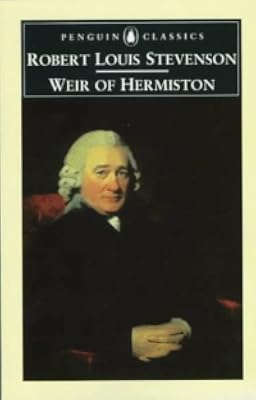
Weir of Hermiston
by Robert Louis Stevenson
On This Page
Description
Although considered by many to be Robert Louis Stevenson's greatest work of literature, Weir of Hermiston was left unfinished by its author's untimely death in 1894. Archie Weir is estranged from his father, a harsh criminal court judge with no time for Archie's Romantic sensibilities. Sent to live as laird of a family property in Hermiston, Archie soon falls in love with a local girl named Kirstie..
Tags
Recommendations



















Member Reviews
By either account, it is a blessing that this novel remains unfinished. The two people who shared Stevenson’s confidences, reveal endings that could have seriously degraded his effort. The “Weir of Hermiston” carries us to the point where whatever “inevitable mechanics” were about to bring the story into conformity with one genre or another. Then Stevenson died, suddenly, in Samoa.
The first part of a tragedy is always the best and least punishing.The father and son who anchor the novel receive narrative sympathy and criticism in a pleasantly unresolved mixture. Even a number of the minor characters are thrown into varying lights as they are sketched into the happenings. This keeps things fresh and interesting. The reader is show more not allowed to get comfortable with his judgments or confident in his interpretations. Critics emphasize that this has to do with Stevenson’s contention that the Scotch character is divided—a theme he made most famous with “Dr. Jekyll and Mr. Hyde.”
His language also vacillates between two poles; one is the exquisitely crafted, psychologically aware 19th century prose that Stevenson had been refining throughout his career: “Clem and Gib, who were men exactly virtuous, swallowed the dose of Dand’s irregularities as a kind of clog or drawback in the mysterious providence God affixed to bards;” “Her view of history was wholly artless, a design in snow and ink; upon the one side, tender innocents with psalms upon their lips; upon the other, the persecutors, booted, bloody-minded, flushed with wine.”
The other pole is Scots dialect (make sure your edition includes a glossary or explanatory footnotes): “Ye daft auld wife! A bonny figure I would be, palmering about in bauchles!” “You and your noansense! What do I want with a Christian faim’ly? I want Christian broth! Get me a lass that can plain-boil a potato, if she was a whure off the streets.”
It is only moments of deep human connection and drama that prompt the rare combination of these opposite modes of communication. I do not intend to reveal the details of the story (betrayal, love, rivalry etc)—it is finely wrought and believable, little more than one hundred pages. Absolutely worth an afternoon of reading. show less
The first part of a tragedy is always the best and least punishing.The father and son who anchor the novel receive narrative sympathy and criticism in a pleasantly unresolved mixture. Even a number of the minor characters are thrown into varying lights as they are sketched into the happenings. This keeps things fresh and interesting. The reader is show more not allowed to get comfortable with his judgments or confident in his interpretations. Critics emphasize that this has to do with Stevenson’s contention that the Scotch character is divided—a theme he made most famous with “Dr. Jekyll and Mr. Hyde.”
His language also vacillates between two poles; one is the exquisitely crafted, psychologically aware 19th century prose that Stevenson had been refining throughout his career: “Clem and Gib, who were men exactly virtuous, swallowed the dose of Dand’s irregularities as a kind of clog or drawback in the mysterious providence God affixed to bards;” “Her view of history was wholly artless, a design in snow and ink; upon the one side, tender innocents with psalms upon their lips; upon the other, the persecutors, booted, bloody-minded, flushed with wine.”
The other pole is Scots dialect (make sure your edition includes a glossary or explanatory footnotes): “Ye daft auld wife! A bonny figure I would be, palmering about in bauchles!” “You and your noansense! What do I want with a Christian faim’ly? I want Christian broth! Get me a lass that can plain-boil a potato, if she was a whure off the streets.”
It is only moments of deep human connection and drama that prompt the rare combination of these opposite modes of communication. I do not intend to reveal the details of the story (betrayal, love, rivalry etc)—it is finely wrought and believable, little more than one hundred pages. Absolutely worth an afternoon of reading. show less
I hadn't realized until I got to the end that "an unfinished romance" is not a poetic subtitle but a literal description: the author died before completing it. However, it is less frustrating than Dickens's "Mystery of Edwin Drood", since we have a better idea of how the plot was intended to proceed. Although I wouldn't rate this as a great work of literature, there are some nice little vignettes of early 19th-century Scottish lowland life. MB 11-xii-06
Am I allowed to be mad at RLS for dying while writing this? It was so slow, and had finally just starting to get better!
Also, it’s basically David Copperfield without the orphaning part.
Also, it’s basically David Copperfield without the orphaning part.
J’ai découvert ce livre il y a peu sur une liste de lecture amie, et j’ai été surprise de le trouver sur les rayonnages d’une boutique d’occasions alors que je regardais les titres sans idée précise en tête. Mon édition, dans la collection biblio du Livre de poche, est un cadeau dans le cadre d’une offre promotionnelle. Cela explique peut-être la mise en page assez désagréable (lettres qui bavent un peu, et une police de caractère beaucoup trop dense pour être agréable), mais j’étais vraiment curieuse de lire cette œuvre inachevée, alors je me suis accrochée.
C’est facile de dire d’une œuvre inachevée qu’elle aurait été le chef-d’œuvre de son auteur, comme le fait abondamment la quatrième de show more couverture ou l’appareil critique qui entoure ce début de roman… C’est un roman d’aventure de Stevenson qui commence de façon assez classique. Une opposition entre un père conservateur et son fils exalté, une histoire d’amour qui va à l’encontre des conventions sociales, une nature omniprésente qui reflète les caractères tourmentés et les sentiments sombres… Un roman prometteur, dont on peut deviner les grands traits de la suite qui ne sera jamais écrite.
Une lecture plutôt intéressante et agréable pour moi qui n’avait pas lu de roman d’aventure de Stevenson depuis longtemps, il faut juste accepter de se voir couper dans son élan, ce qui a un petit caractère frustrant mais pas dénué de piquant. C’est marrant, j’ai sur mes étagères un autre roman inachevé de Stevenson, [La Malle de cuir] (lui achevé par Michel Le Bris), je me demande si Stevenson était habitué à laisser des œuvres en plan. Mais ici, c’est la mort qui a empêché Stevenson de mener à bien cette histoire, puisqu’il y travaillait encore la veille de sa mort. Une curiosité à découvrir donc que ce début de roman, qui peut-être, c’est vrai ; aurait pu être un chef-d’œuvre d’aventure et de noirceur. show less
C’est facile de dire d’une œuvre inachevée qu’elle aurait été le chef-d’œuvre de son auteur, comme le fait abondamment la quatrième de show more couverture ou l’appareil critique qui entoure ce début de roman… C’est un roman d’aventure de Stevenson qui commence de façon assez classique. Une opposition entre un père conservateur et son fils exalté, une histoire d’amour qui va à l’encontre des conventions sociales, une nature omniprésente qui reflète les caractères tourmentés et les sentiments sombres… Un roman prometteur, dont on peut deviner les grands traits de la suite qui ne sera jamais écrite.
Une lecture plutôt intéressante et agréable pour moi qui n’avait pas lu de roman d’aventure de Stevenson depuis longtemps, il faut juste accepter de se voir couper dans son élan, ce qui a un petit caractère frustrant mais pas dénué de piquant. C’est marrant, j’ai sur mes étagères un autre roman inachevé de Stevenson, [La Malle de cuir] (lui achevé par Michel Le Bris), je me demande si Stevenson était habitué à laisser des œuvres en plan. Mais ici, c’est la mort qui a empêché Stevenson de mener à bien cette histoire, puisqu’il y travaillait encore la veille de sa mort. Une curiosité à découvrir donc que ce début de roman, qui peut-être, c’est vrai ; aurait pu être un chef-d’œuvre d’aventure et de noirceur. show less
May 29, 2023French
La società scozzese, i suoi valori, la transizione da un mondo di certezze a una situazione ricca di dilemmi e contraddizioni, il tema della memoria come rivisitazione delle proprie radici socio-culturali nell'ultimo, incompiuto romanzo di Stevenson
Nel suo ultimo romanzo, rimasto incompiuto, Stevenson affronta il tema della memoria intesa sia come rivisitazione nostalgica delle proprie radici storico-culturali, sia come poderosa sintesi delle molte voci - storiche e leggendarie - che costituivano il cuore e l'essenza della Scozia. Un aspetto saliente di Weir di Hermiston riguarda la valenza conflittuale che lo caratterizza, facendo dei vari livelli narrativi il luogo di una tensione che mai si risolve: il figlio contro il padre, il show more presente contro il passato, la lingua inglese contro il dialetto scozzese, Edimbugo contro Hermiston, la legge contro l'anarchia, la memoria contro l'oblio. Nella scelta tematica della figura del giudice, implacabile anche nei confronti del proprio figlio, Stevenson delinea la crisi dei valori fondanti della società scozzese e la drammatica transizione da un mondo di certezze e verità incrollabili a una società percorsa da dilemmi e contraddizioni. show less
Nel suo ultimo romanzo, rimasto incompiuto, Stevenson affronta il tema della memoria intesa sia come rivisitazione nostalgica delle proprie radici storico-culturali, sia come poderosa sintesi delle molte voci - storiche e leggendarie - che costituivano il cuore e l'essenza della Scozia. Un aspetto saliente di Weir di Hermiston riguarda la valenza conflittuale che lo caratterizza, facendo dei vari livelli narrativi il luogo di una tensione che mai si risolve: il figlio contro il padre, il show more presente contro il passato, la lingua inglese contro il dialetto scozzese, Edimbugo contro Hermiston, la legge contro l'anarchia, la memoria contro l'oblio. Nella scelta tematica della figura del giudice, implacabile anche nei confronti del proprio figlio, Stevenson delinea la crisi dei valori fondanti della società scozzese e la drammatica transizione da un mondo di certezze e verità incrollabili a una società percorsa da dilemmi e contraddizioni. show less
Mar 8, 2012Italian
Ratings
Members
- Recently Added By
Lists

Harold Bloom - The Western Canon: C. The Democratic Age
336 works; 15 members

Book Titles Mentioned In Newberry Medal And Honor Books
884 works; 3 members
Author Information

2,801+ Works 139,356 Members
Novelist, poet, and essayist Robert Louis Stevenson was born in Edinburgh, Scotland. A sickly child, Stevenson was an invalid for part of his childhood and remained in ill health throughout his life. He began studying engineering at Edinburgh University but soon switched to law. His true inclination, however, was for writing. For several years show more after completing his studies, Stevenson traveled on the Continent, gathering ideas for his writing. His Inland Voyage (1878) and Travels with a Donkey (1878) describe some of his experiences there. A variety of essays and short stories followed, most of which were published in magazines. It was with the publication of Treasure Island in 1883, however, that Stevenson achieved wide recognition and fame. This was followed by his most successful adventure story, Kidnapped, which appeared in 1886. With stories such as Treasure Island and Kidnapped, Stevenson revived Daniel Defoe's novel of romantic adventure, adding to it psychological analysis. While these stories and others, such as David Balfour and The Master of Ballantrae (1889), are stories of adventure, they are at the same time fine studies of character. The Master of Ballantrae, in particular, is a study of evil character, and this study is taken even further in The Strange Case of Dr. Jekyll and Mr. Hyde (1886). In 1887 Stevenson and his wife, Fanny, went to the United States, first to the health spas of Saranac Lake, New York, and then on to the West Coast. From there they set out for the South Seas in 1889. Except for one trip to Sidney, Australia, Stevenson spent the remainder of his life on the island of Samoa with his devoted wife and stepson. While there he wrote The Wrecker (1892), Island Nights Entertainments (1893), and Catriona (1893), a sequel to Kidnapped. He also worked on St. Ives and The Weir of Hermiston, which many consider to be his masterpiece. He died suddenly of apoplexy, leaving both of these works unfinished. Both were published posthumously; St. Ives was completed by Sir Arthur Quiller-Couch, and The Weir of Hermiston was published unfinished. Stevenson was buried on Samoa, an island he had come to love very much. Although Stevenson's novels are perhaps more accomplished, his short stories are also vivid and memorable. All show his power of invention, his command of the macabre and the eerie, and the psychological depth of his characterization. (Bowker Author Biography) show less
Some Editions
Series
Belongs to Publisher Series
Tusitala (volume xvi)
Work Relationships
Is contained in
Is abridged in
Common Knowledge
- Canonical title
- Weir of Hermiston
- Original title
- Weir of Hermiston
- Original publication date
- 1896: Weir of Hermiston
- Dedication
- To my wife
I saw rain falling and the rainbow drawn
On Lammermuir. Hearkening I heard again
In my precipitous city beaten bells
Winnow the keen sea wind. And here afar,
Intent on my own race and place, I wro... (show all)te.
Take thou the writing: thine it is. For who
Burnished the sword, blew on the drowsy coal,
Held still the target higher, chary of praise
And prodigal of counsel - who but thou?
So now, in the end, if this the least be good,
If any deed be done, if any fire
Burn in the imperfect page, the praise be thine. - First words
- In the wild end of a moorland parish, far out of the sight of any house, there stands a cairn among the heather, and a little by east of it, in the going down of the braeside, a monument with some verses half defaced.
... (show all)(Introductory)
The Lord-Justice Clerk was a stranger in that part of the country; but his lady wife was known there from a child, as her race had been before her. - Last words*
- (Click to show. Warning: May contain spoilers.)Davanti a lui s'alzò il sipario dell'adolescenza e gli apparve, per la prima volta, il volto ambiguo della donna nella sua realtà. Ripensò invano al loro colloquio. Non capì in che cosa l'avesse offesa. Gli sembrò una reazione immotivata, un'ostinata convulsione di materia bruta...
- Disambiguation notice
- This is the main work - Stevenson's Weir of Hermiston (unabridged). Please do not combine with omnibus/combined editions, anthologies or abridged editions.
*Some information comes from Common Knowledge in other languages. Click "Edit" for more information.
Classifications
Statistics
- Members
- 263
- Popularity
- 122,997
- Reviews
- 5
- Rating
- (3.42)
- Languages
- 6 — Catalan, English, French, German, Italian, Spanish
- Media
- Paper, Ebook
- ISBNs
- 58
- ASINs
- 17