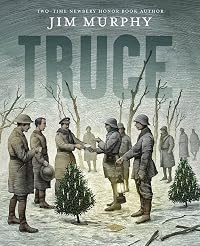
Truce
by Jim Murphy
On This Page
Description
Describes the Christmas truce that occurred along Western Front trenches in 1914 and features quotations from young men on both sides, a timeline, and additional source material.Tags
Recommendations








Member Reviews
"[I]f I had my way, some person in authority would proclaim that Christmas will not be celebrated this year....Enemy, Death, and a Christmas tree - they cannot live so close together." German Captain Rudolf Binding (from Truce)
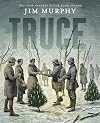
Jim Murphy's Truce, tells the remarkable true story of the spontaneous truces that broke out all along the entrenched battle lines of Europe in December, 1914. It is estimated that tens of thousands of British, German and Belgian soldiers took part in the cease-fires that lasted, in some instances, for several weeks. More than a cessation of hostilities, the hiatus was almost joyful as soldiers fraternized with each other - singing, exchanging gifts, and taking photos.
In six chapters, Murphy provides ample show more background information to give meaning and context to the remarkable occurrence of the many spontaneous truces and celebrations. One chapter recounts enemy soldiers praying together, translating the sermon from English to German, and burying their dead in solemn ceremonies. In another instance, German and British soldiers sing Christmas carols, alternating verses, one in English, one in German, and then joining in Latin to sing Adeste Fideles.
The truces ended, not because the men desired to resume fighting, but rather, because they could no longer hold out against the will of their commanders.
"The German High Command ... issued a terse order: "Commander Second Army directs that informal understandings with enemy are to cease. Officers ...allowing them are to be brought before a court-martial." In some areas, these orders had immediate results. British private Bernard Brookes was standing guard at midnight on December 25 when "our artillery sent over ... four shells of small caliber to let them know that the truce, at which the whole world would wonder, was ended, and it its place, Death and Bloodshed would once again reign supreme." The Germans countered with an artillery barrage of their own."
The award-winning, Murphy, has meticulously researched his topic, and includes a Timeline, Notes and Sources, More about World War I, an Index, and a wealth of photographs, maps, period art and newspapers. The Epilogue, while factual, is more editorial than informational in nature.
The text is large and sepia-toned, to match the many accompanying photographs. Photographs of the desolate and razor-wired No Man's Land and the hideous trench conditions offer a stark contrast to those of smiling enemy soldiers posing for posterity.
To read this story in the men's' own words, is both compelling and thought-provoking. Readers will not come away unaffected.
Best for ages 10 and up. Truce should be a Sibert Medal contender. show less
Jim Murphy's Truce, tells the remarkable true story of the spontaneous truces that broke out all along the entrenched battle lines of Europe in December, 1914. It is estimated that tens of thousands of British, German and Belgian soldiers took part in the cease-fires that lasted, in some instances, for several weeks. More than a cessation of hostilities, the hiatus was almost joyful as soldiers fraternized with each other - singing, exchanging gifts, and taking photos.
In six chapters, Murphy provides ample show more background information to give meaning and context to the remarkable occurrence of the many spontaneous truces and celebrations. One chapter recounts enemy soldiers praying together, translating the sermon from English to German, and burying their dead in solemn ceremonies. In another instance, German and British soldiers sing Christmas carols, alternating verses, one in English, one in German, and then joining in Latin to sing Adeste Fideles.
The truces ended, not because the men desired to resume fighting, but rather, because they could no longer hold out against the will of their commanders.
"The German High Command ... issued a terse order: "Commander Second Army directs that informal understandings with enemy are to cease. Officers ...allowing them are to be brought before a court-martial." In some areas, these orders had immediate results. British private Bernard Brookes was standing guard at midnight on December 25 when "our artillery sent over ... four shells of small caliber to let them know that the truce, at which the whole world would wonder, was ended, and it its place, Death and Bloodshed would once again reign supreme." The Germans countered with an artillery barrage of their own."
The award-winning, Murphy, has meticulously researched his topic, and includes a Timeline, Notes and Sources, More about World War I, an Index, and a wealth of photographs, maps, period art and newspapers. The Epilogue, while factual, is more editorial than informational in nature.
The text is large and sepia-toned, to match the many accompanying photographs. Photographs of the desolate and razor-wired No Man's Land and the hideous trench conditions offer a stark contrast to those of smiling enemy soldiers posing for posterity.
To read this story in the men's' own words, is both compelling and thought-provoking. Readers will not come away unaffected.
Best for ages 10 and up. Truce should be a Sibert Medal contender. show less
While this book is in the Juvenile section of the library, I have to say it's the best book on WWI (or any war) that I've ever read. The causes and consequences of WWI are so much clearer to me; I could probably even carry on a lengthy discussion about it. I have read textbook chapters about WWI both in high school and college, and once I started this text, I felt like I didn't know a THING about it. So, I do recommend this to adults who love history but don't necessarily love reading adult nonfiction books about history.
As for the targeted audience: this book will be just right for someone who is at a solid middle school reading level. The vocabulary is 7-9th grade (according to Oxford-Sadlier), and it is extremely well written and show more totally fascinating. The reader learns how the public was misled to support the war, how the leaders blundered here and there, how the war defied expectations and how it led to trench warfare, what the Western Front was actually like, and how the miraculous Christmas truce came about and how it was forcefully ended. The author even provides commentary in the Epilogue on how there are similar issues with the Iraq war. Definitely the author is anti-war but very interested in it, and he succeeded in educating me without boring me; war is my least favorite historical topic.
Well, I recommend it! show less
As for the targeted audience: this book will be just right for someone who is at a solid middle school reading level. The vocabulary is 7-9th grade (according to Oxford-Sadlier), and it is extremely well written and show more totally fascinating. The reader learns how the public was misled to support the war, how the leaders blundered here and there, how the war defied expectations and how it led to trench warfare, what the Western Front was actually like, and how the miraculous Christmas truce came about and how it was forcefully ended. The author even provides commentary in the Epilogue on how there are similar issues with the Iraq war. Definitely the author is anti-war but very interested in it, and he succeeded in educating me without boring me; war is my least favorite historical topic.
Well, I recommend it! show less
This is a book for young adults, but sophisticated enough for any age, about various opposing military units in World War I which decided to stop fighting on Christmas Day in 1914, sang carols to each other across the trenches, and even went so far as climb out of the trenches, exchange food and souvenirs for each others’ kids and even in some instances celebrate together. Needless to say, the military commanders were quite unhappy about this fraternizing with the enemy, had it stopped as soon as they could and made sure nothing like it happened next year. A few units apparently tried, but heavy losses suffered by both sides during the elapsed year, as much as the orders, made the efforts nowhere as widespread as the first year. The show more author also gives a wider picture of the war, such as pointing out that while new powerful weapons had just been invented, no adequate defenses had evolved to match them, which accounted for so many dead, in addition to weather conditions. show less
Jim Murphy's research and writing bring to life the beginnings of World War I, its causes, terrible miscalculations and what could have been an early end to the war. During the first few months of the Great War, fighting bogged down into trench warfare. Fighting cold and despair on both sides of the Front Line, German, English, French and Belgian soldiers called their own truce despite orders from senior officers at Christmas time. For some units, this truce lasted until nearly Easter of 1915. The historical illustrations and photographs coupled with a clear, narrative style and large text, make this an excellent introduction to the details of the beginning of World War I. While it is written for middle school age students, this would show more work well as an easy introduction for senior students as well. show less
An excellent companion to the 2005 French film, Joyeux Noël. This is a must read for anyone who knows little to nothing about World War One or knows a great deal about this war in our history. In other words everyone should read it! It is a travesty we are not taught more about the 'war to end all wars'. We need to hear more stories like this one that humanize the components of warfare beyond a "good guy" and a "bad guy".
Jim Murphy does a tremendous service for readers with not only focusing on the Christmas Truce, but also detailing precursors to the war and leading into it.
Jim Murphy does a tremendous service for readers with not only focusing on the Christmas Truce, but also detailing precursors to the war and leading into it.
Content: Truce tells the true story of how the German and British troops called a Christmas truce and ceased fighting for Christmas day during WWI. The book begins with explaining the reasons and causes of the war in order for readers to understand how strange and miraculous this temporary truce was.
My reaction: I have been fascinated by the Christmas truce ever since I first heard Garth Brooks sing “Belleau Wood” as a child. This book was very well written and even someone with extremely limited knowledge of WWI is able to get a complete (and remarkably unbiased) perspective through this book.
Recommended Age Level: 11+
My reaction: I have been fascinated by the Christmas truce ever since I first heard Garth Brooks sing “Belleau Wood” as a child. This book was very well written and even someone with extremely limited knowledge of WWI is able to get a complete (and remarkably unbiased) perspective through this book.
Recommended Age Level: 11+
VOYA 5Q, 4P. This was an excellent book about WW1 and I think that it would really appeal to teens. In only 144 pages the author is able to give a solid background about the complex causes of the war, the way in which young men flocked to join, and finally the gruesome application of industrial weapons capable of killing millions of men in a matter of hours. This book portrays the horror of war through the carnage of life in the trenches.
After painting this harrowing picture, the author tells the story of Christmas in 1914. Through the week leading up to Christmas, the soldiers on both sides of the battle could hear the other side singing and laughing in the trenches. Eventually individuals began to cross "No Man's Land" to share gifts show more and exchange pleasantries. On Christmas day, large groups of soldiers from both sides came out into the open to sing, share food, and exchange gifts. Despite orders from their superiors to fight, the men took a day off to remember humanity.
This would be a very good book for teens to read. Not only is it important to know the cost of war, but it is important for them to learn the power of humanity. The language is easy to follow, and the pictures are frequent and help the story immensely. show less
After painting this harrowing picture, the author tells the story of Christmas in 1914. Through the week leading up to Christmas, the soldiers on both sides of the battle could hear the other side singing and laughing in the trenches. Eventually individuals began to cross "No Man's Land" to share gifts show more and exchange pleasantries. On Christmas day, large groups of soldiers from both sides came out into the open to sing, share food, and exchange gifts. Despite orders from their superiors to fight, the men took a day off to remember humanity.
This would be a very good book for teens to read. Not only is it important to know the cost of war, but it is important for them to learn the power of humanity. The language is easy to follow, and the pictures are frequent and help the story immensely. show less
Members
- Recently Added By
Lists

Children's Books about World War I (1914-1918)
91 works; 11 members

A High School Trip to France
57 works; 5 members
Author Information

41+ Works 12,308 Members
Jim Murphy has written more than twenty-five books for young people. In addition to the Newbery Honor, which he received for The Great Fire, he has won many other awards, including the Robert F. Sibert Informational Book Award and a Boston Globe/Horn Book Honor. He is also the two-time winner of both the SCBWI Golden Kite Award and the NCTE Orbis show more Pictus Award Mr. Murphy lives with his family in Maplewood, New Jersey show less
Awards and Honors
Awards
Distinctions
Common Knowledge
- Important events
- World War I, Christmas Truce (1914); World War I (1914 | 1918)
- First words
- On July 29, 1914, the world's peace was shattered as the artillery of Austria-Hungary began shelling the troops of the country to its south, Serbia.
As the twentieth century began, much of Europe was restless and fearful. For over forty years, countries had eyed one another suspiciously and prepared for a fight.
Classifications
Statistics
- Members
- 483
- Popularity
- 62,864
- Reviews
- 28
- Rating
- (4.13)
- Languages
- English
- Media
- Paper, Ebook
- ISBNs
- 5
- ASINs
- 3