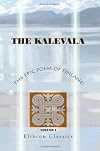
The Kalevala, Volume 1
by Elias Lönnrot
On This Page
Description
Excerpt from Kalevala, the Land of Heroes, Vol. 1 N 0 national epic lies so firmly in the heart of its people as the Kalevala. Its influence on modern Finland has been and is - to Offer the least remote of possible comparisons - an immensely more potent force than the tradition of the Edda collections in western Scandinavia or the Nibelungen cycle among the Germanic nations. As the poem holds up its bright mirror to the life of the Finns moving among the first long shadows of medieval show more civilization it suggests in our minds the proto-twilight of Homeric Greece. Its historic background is the misty age Of feud and foray between the people of Kaleva and their more ancient neighbours Of Pohjola, possibly the Lapps. Poetically it recounts the long quest Of that singular and prolific talisman, the Sampo, and ends upon the first note of Christianity, the introduction of which was completed in the fourteenth century. Heroic but human, its men and women march boldly through the fifty cantos, raiding, drinking, abducting, outwitting, weeping, but always active and always at Odds with the very perils that confront their countrymen today: the forest, with its savage animals, its myriad lakes and rocks and torrents; wind, fire, and darkness; and the cold. Yet, wild as the scene may be, it is far from barbaric. The craft of the shipwright, the blacksmith, the goldsmith, or the brewer has plainly reached a. High level; household manage ment and the laws Of hospitality are well understood; fine fabrics are woven, fine jewels esteemed; personal cleanliness and the rites of the sauna, or Finnish steam-bath, are fully practised; music is an important part of life, and songs are Often accompanied on the kantele, a stringed instrument still in use; there is constant and highly poetic praise of beauty, whether of bird or tree or maiden. Imagination is perhaps the outstanding talent Of the characters, who conspicuously prefer skill or guile or magic to the use of force. About the Publisher Forgotten Books publishes hundreds of thousands of rare and classic books. Find more at www.forgottenbooks.com This book is a reproduction of an important historical work. Forgotten Books uses state-of-the-art technology to digitally reconstruct the work, preserving the original format whilst repairing imperfections present in the aged copy. In rare cases, an imperfection in the original, such as a blemish or missing page, may be replicated in our edition. We do, however, repair the vast majority of imperfections successfully; any imperfections that remain are intentionally left to preserve the state of such historical works. show lessTags
Recommendations






















Member Reviews
In the early to mid-1800’s Elias Lönnrot traveled throughout Finland collecting bardic folk poems and arranging them into what eventually became the two volume Kalevala, Finland’s national epic. All of the poems are written in trochaic tetrameter (think: The Song of Hiawatha or The Raven) with a lot of parallelism (similar to the Hebrew poetry of the Psalms).
The classic translation I read by Kirby maintained the original meter and did an acceptable job on the parallelism. Some newer translations opt for a meter “more pleasing to the modern ear.” Personally, I think that approach is unfortunate. The meter is one of the distinguishing features of this poem (it’s even referred to as Kalevala Meter!), and to do away with it is to show more lose a crucial part of the reading experience. Yes, it can become grating after a while…just read it in smallish chunks (I will be taking a bit of a break before reading volume 2).
One reason I picked this up is that J. R. R. Tolkien claimed it was a big influence on his writing. I can see how this world inspired a young J. R. R. Tolkien to begin creating his own magic-infused world of Middle Earth. There are definite echoes in Tom Bombadil, Fëanor, Turin, and more (mostly from The Silmarillion).
I’ll talk more about the actual content of the poem when I read volume 2. For now, I’ll say that I find it much less interesting than Norse mythology but still worth reading as a fan of narrative mythological poetry (and J. R. R. Tolkien). show less
The classic translation I read by Kirby maintained the original meter and did an acceptable job on the parallelism. Some newer translations opt for a meter “more pleasing to the modern ear.” Personally, I think that approach is unfortunate. The meter is one of the distinguishing features of this poem (it’s even referred to as Kalevala Meter!), and to do away with it is to show more lose a crucial part of the reading experience. Yes, it can become grating after a while…just read it in smallish chunks (I will be taking a bit of a break before reading volume 2).
One reason I picked this up is that J. R. R. Tolkien claimed it was a big influence on his writing. I can see how this world inspired a young J. R. R. Tolkien to begin creating his own magic-infused world of Middle Earth. There are definite echoes in Tom Bombadil, Fëanor, Turin, and more (mostly from The Silmarillion).
I’ll talk more about the actual content of the poem when I read volume 2. For now, I’ll say that I find it much less interesting than Norse mythology but still worth reading as a fan of narrative mythological poetry (and J. R. R. Tolkien). show less
Ratings
Members
- Recently Added By
Author Information

60+ Works 3,193 Members
Some Editions
Series
Belongs to Publisher Series
Everyman's Library (259)
Work Relationships
Is contained in
Common Knowledge
- Canonical title
- The Kalevala, Volume 1
Classifications
- Genres
- Fiction and Literature, Poetry, Fantasy
- DDC/MDS
- 894 — Literature & rhetoric Asian Literature Literatures of Altaic, Uralic, Hyperborean, Dravidian languages; literatures of miscellaneous languages of south Asia
- LCC
- PH324 .E5 .B6313 — Language and Literature Uralic languages. Basque language Uralic. Basque Finnish
- BISAC
Statistics
- Members
- 70
- Popularity
- 446,393
- Reviews
- 1
- Rating
- (3.36)
- Languages
- English, Finnish, French
- Media
- Paper, Ebook
- ISBNs
- 7
- ASINs
- 6