The Indiscreet Jewels
by Denis Diderot
On This Page
Description
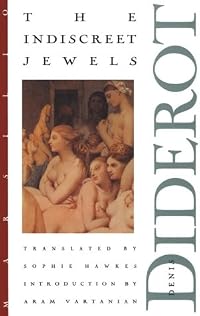
"Philosopher, critic, novelist, and editor of the monumental Encyclopedie, Denis Diderot was one of the eighteenth century's most influential and provocative figures. For the first time complete in English translation, The Indiscreet Jewels is the earliest and, perhaps, most daring of Diderot's "philosophical" novels - a fearessly libertine fable on the order of such ribald classics as Boccaccio and Rabelais."--BOOK JACKET. "Published in 1748, with three chapters added later in the author's show more career, this extraordinary fiction is a take-off on the erotic-oriental tales popular at the time. Set in a sultan's court in the Congo, the novel begins with Mangogul (the Sultan) suffering from acute boredom, only to be rescued by a genie offering the potentate a magic ring that, when pointed at women, causes their genitals, or "jewels," to speak. The resulting story, exuberant and delightful in its wit and satire, was so openly irreverent and critical of the French Court at Versailles - with the Sultan as Louis XV and his favorite as Mme de Pompadour - that it secured its author some egregious trouble with the Parisian authorities."--BOOK JACKET. "But The Indiscreet Jewels is far from being just a political roman a clef. The Sultan's "scientific method" reveals an allegory of the female body, perennially silent, at last recovering its voice and daring to speak. What the "jewels" say is at once a parody and supreme example of the French Enlightenment's urge to seek knowledge above and beyond the hypocrisies, inhibitions, and limitations of everyday life."--BOOK JACKET. show lessTags
Recommendations






















Member Reviews
"such is shall i say it.. the ungrateful nature of Toys, that they never take the good-will for the deed"
Well that made me laugh quite a bit. An 18th century comedy/satire. It features Mangogul king of Congo, loosely based on *Charles II, who asks his wizard for something that will make women tell him the truth.
He receives a magic ring that causes vagina's to speak because that apparently is the only honest part of a woman... ok so not the most pc thing in the world ;) . Surprisingly though i didn't find it as sexist as i thought i would. The author is at times quite moderate, he tends to present multiple viewpoints and mock either extreme.
There's a lot of witty banter and the writing style is a highlight for me. There are some show more downsides in that some of the humour is definitely topical and doesn't hold up, but i laughed a lot more reading this than [b:Don Quixote|3836|Don Quixote|Miguel de Cervantes Saavedra|https://images.gr-assets.com/books/1364958765s/3836.jpg|121842] or [b:Gargantua and Pantagruel|18266|Gargantua and Pantagruel|François Rabelais|https://images.gr-assets.com/books/1336964698s/18266.jpg|2663468].
There's also some hilariously subtle filth. On at least a few occasions it took me a minute to parse the language and found something very naughty, and for each of those i spotted i imagine a few more probably snuck past me.
The first volume is better than the second, it almost approaches sci-fi, as people know about the talking vagina phenomenon but don't know the cause. Which leads to all sorts of different effects on society.
The scientists, philosophers and priests all have theories, people start selling vagina muzzles to shut them up etc.
The second volume is a bit more hit and miss, there are various discussions of art and other subjects but it starts to feel a bit repetitive and ultimately you find there was never any great over-arcing plot. It just sort of ends.
Still, if you can parse the Ye Olde language this is quite a fun one.
Edit: *King Louis XV not Charles II, i don't know where i got that from. show less
Well that made me laugh quite a bit. An 18th century comedy/satire. It features Mangogul king of Congo, loosely based on *Charles II, who asks his wizard for something that will make women tell him the truth.
He receives a magic ring that causes vagina's to speak because that apparently is the only honest part of a woman... ok so not the most pc thing in the world ;) . Surprisingly though i didn't find it as sexist as i thought i would. The author is at times quite moderate, he tends to present multiple viewpoints and mock either extreme.
There's a lot of witty banter and the writing style is a highlight for me. There are some show more downsides in that some of the humour is definitely topical and doesn't hold up, but i laughed a lot more reading this than [b:Don Quixote|3836|Don Quixote|Miguel de Cervantes Saavedra|https://images.gr-assets.com/books/1364958765s/3836.jpg|121842] or [b:Gargantua and Pantagruel|18266|Gargantua and Pantagruel|François Rabelais|https://images.gr-assets.com/books/1336964698s/18266.jpg|2663468].
There's also some hilariously subtle filth. On at least a few occasions it took me a minute to parse the language and found something very naughty, and for each of those i spotted i imagine a few more probably snuck past me.
The first volume is better than the second, it almost approaches sci-fi, as people know about the talking vagina phenomenon but don't know the cause. Which leads to all sorts of different effects on society.
The scientists, philosophers and priests all have theories, people start selling vagina muzzles to shut them up etc.
The second volume is a bit more hit and miss, there are various discussions of art and other subjects but it starts to feel a bit repetitive and ultimately you find there was never any great over-arcing plot. It just sort of ends.
Still, if you can parse the Ye Olde language this is quite a fun one.
Edit: *King Louis XV not Charles II, i don't know where i got that from. show less
¿ De qué se trata en esta serie de estudios? De transcribir como historia la fábula de Los dijes indiscretos>>, declara Michel Foucault en su reciente Historia de la sexualidad. ¿ Y cuál es esta fábula? > Tal sería para Foucault, una de las grandes necesidades, de las grandes obsesiones de nuestra época: hacer hablar al sexo, saberlo todo de él, desentrañar su misterio.
Nov 14, 2024Spanish
Flammarion. Chronologie et préface par Antoine Adam
Jun 13, 2019Spanish
Ratings
Members
- Recently Added By
Lists

Erotic Fiction
53 works; 5 members
Talk Discussions
Past Discussions
Diderot - The Indiscreet Jewels in Literary Centennials (October 2013)
Author Information

Denis Diderot was a French philosopher and critic during the Age of Enlightenment. Born in 1713 in Langres, France, Diderot was educated at the University of Paris. From 1745 to 1772 he served as editor of L'Encyclopedie, which he fashioned as a journal of radical revolutionary opinion. He was a leader in the movement to challenge both church and show more state by furthering knowledge. Diderot also wrote several critical and philosophical works including Pensees sur l'interpretation de la nature (Thoughts on the Interpretation of Nature, 1754). In addition, he published essays based on personal experience, as well as several plays. As a philosopher, Diderot speculated on free will and held a completely materialistic view of the universe; he suggested all human behavior is determined by heredity. He is recognized now as an art critic of the first rank. His Essai sur la peinture (Essay on Painting, 1796) won him posthumous praise as a critic of painting technique and aesthetics. He died in Paris in 1784 and was buried in the city's Église Saint-Roch. His heirs sent his vast library to Catherine II, who had it deposited at the National Library of Russia. (Bowker Author Biography) show less
Some Editions
Series
Belongs to Publisher Series
Work Relationships
Is contained in
Common Knowledge
- Canonical title
- The Indiscreet Jewels
- Original title
- Les Bijoux indiscrets
- Alternate titles*
- Die geschwätzigen Kleinode
- Original publication date
- 1748
- First words
- Yaouf Zeles Tanzai had long ruled in greater Chechiana, and this lustrous prince still continued to be the delight of his subjects.
- Last words
- (Click to show. Warning: May contain spoilers.)With these words, the hooded specter seized his owl's tails and went off with a whirl, just as he had come.
- Original language*
- Français
*Some information comes from Common Knowledge in other languages. Click "Edit" for more information.
Classifications
Statistics
- Members
- 306
- Popularity
- 103,652
- Reviews
- 3
- Rating
- (3.52)
- Languages
- 8 — Dutch, English, French, German, Hungarian, Italian, Portuguese, Spanish
- Media
- Paper, Ebook
- ISBNs
- 40
- ASINs
- 25