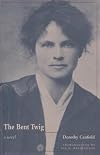
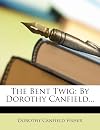
The Bent Twig
by Dorothy Canfield
On This Page
Description
Like most happy childhoods, Sylvia's early years lay back of her in a long, cheerful procession of featureless days, the outlines of which were blurred into one shimmering glow by the very radiance of their sunshine.Tags
Recommendations






















Member Recommendations

by anonymous user
Member Reviews
The virtue in Dorothy Canfield Fisher's writing is what I can only describe as experiencing the same bracing air I breathe every time I walk outside, for, as she was, I am privileged to live in Vermont. Part of her charm is the way her characters can shift from being as subtle and rational as anyone in a James novel, to being as wild and emotional and even as sensual as a Lawrence character, not as bluntly, to be sure but, like Wharton, she doesn't overlook the physicality of being alive and in love or suffering. So there is a mix and the work is anchored in a reality. I'm always astonished by how "modern" the early 19th century already was--how we have changed, since then, less than we like to think. I find people from true Victorian show more novels distant, exotic, even strange at times, but I recognize the young woman, Sylvia Marshall, as a contemporary. She would have been about contemporaneous with my grandmothers, in fact. Sylvia is brought up out West, in a big college town, a Madison, where her father is a professor of economics. Her parents both have Vermont roots, her father's very wealthy, her mother's yeomanly. Needless to say his choice of wife casts him out of the family and he believes in making his own way. Their children are brought up simply in a household that works and plays together--a bit idealized--but whatever. The conflict is in Sylvia herself, whether she will adopt her parents' values or if she will choose to marry someone wealthy and live a life of ease and luxury. No doubt Fisher was familiar with Marx, Veblen and etc. and was exploring how a young woman might come to a true understanding of what exploitation of others, both in private and public ways, consists of and what it can do to people. She is also unblinkingly straight about the fact that people choose for themselves--"society" per se, is not to blame for all ills-- and, same as we do now, she ponders the gray area between character and upbringing. How a functional and healthy upbringing might make the most difference of all to the more vulnerable characters (in which category the protagonist would include herself). The novel moves characteristic of its era, slowly, that is, building up a picture of this young woman and the choices she must face. I expect it is a Virago book, but I came across it for (almost) free in a library discard bin. She makes fun of James here and there, and I enjoyed that! I also detected that one of the characters is most likely modeled on Morton Fullerton, Edith Wharton's (very briefly) lover and life long friend. ***1/2 show less
I am really enjoying, no other word for it, Canfield's exploration of educational methods. I'm halfway through this wonderful novel, my first by this author, and thought I'd see what other readers had written about it on goodreads. Surprisingly to me, one mentioned its Montessori and socialist underpinnings...certainly it's a more modern (I hesitate to use that word, though) view of life, society, than I would have thought even existed in 1916, the year this book was published.
Her descriptions of a rich home life, of a righteously angry nine-year-old, oh, of lots of different things, are so completely enjoyable to read and ponder.
An interesting tag from Amazon for this book is Faculty Families. And that's true - the father of the family show more is a professor at a state university show less
Her descriptions of a rich home life, of a righteously angry nine-year-old, oh, of lots of different things, are so completely enjoyable to read and ponder.
An interesting tag from Amazon for this book is Faculty Families. And that's true - the father of the family show more is a professor at a state university show less
A peculiar reading experience, as the intellectual ideas Canfield explores here are quite dated. Canfield was interested in Montessori and socialism. The entire book is focused on the heroine's struggles in choosing between a life of amoral beauty or simplicity and comradeship. Guess which she chooses? It's actually a good read. Canfield's characters are interesting and complex enough to shine through the didactic tone.
Intellectual, socially progressive family produces a daughter who craves lifestyle wherein which things are magically done for her without thinking about the work that is put into the task. The narrative--which drags somewhat in the middle sections--focuses on the daughter's expectations of life and her definition of living.
Quite good--if not for the slow middle section, I would have given it 5 stars.
Quite good--if not for the slow middle section, I would have given it 5 stars.
Ratings
Members
- Recently Added By
Lists

Best 20th Century Books as of 1924
100 works; 6 members

1970s
657 works; 23 members

Children's Literature 1900 - 1950 in order
413 works; 8 members
Author Information

57+ Works 6,158 Members
Author Dorothy Canfield Fisher was born in Lawrence, Kansas on February 17, 1879. She received a Ph.D. in romance languages from Columbia University in 1904. She wrote novels, short stories, children's books, educational works, and memoirs. In 1912, she met Maria Montessori in Italy and was so impressed by the educator's theories that she wrote A show more Montessori Mother, The Montessori Manual, and Mothers and Children. She worked for many environmental, children's and education causes in the 1940s and 1950s. She died in Arlington, Vermont on November 9, 1958. (Bowker Author Biography) show less
Work Relationships
Is contained in
Common Knowledge
- Original publication date
- 1915
- First words
- Like most happy childhoods, Sylvia's early years lay back of her in a long, cheerful procession of featureless days, the outlines of which were blurred into one shimmering glow by the very radiance of their sunshine.
Classifications
Statistics
- Members
- 81
- Popularity
- 397,771
- Reviews
- 4
- Rating
- (3.87)
- Languages
- English
- Media
- Paper, Audiobook, Ebook
- ISBNs
- 43
- ASINs
- 12