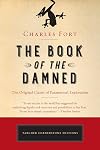
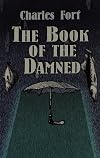
The Book of the Damned
by Charles Fort
On This Page
Description
In the Book of the Damned Charles Fort investigates UFOs, poltergeists, mysterious planets, stigmata, strange falls of both organic and inorganic materials from the sky, odd weather patterns, the possible existence of mythological creatures, disappearances of people under strange circumstances and much much more. Fort writes in a caustic entertaining style as he exposes the flaws in modern science's handling of these paranormal phenomena.Tags
Recommendations































Member Recommendations

Member Reviews
Some people dismiss Fort as an unscientific crank, some people embrace him whole-heartedly as a reporter of the paranormal, others just love him as a champion of the ABnormal. I like his language - wch may generally go undercommented on as people pay more attn to the more spectacular "Fortean" phenomena described. I find Fort's language to be EXTREMELY CAREFUL in its attempt to NOT BE DEFINITIVE & it's in this that, for me, therein lies Fort's extreme importance. It's not just that he stresses that scientists are capable of ignoring data/experiences that fall outside 'convenient' &/or 'consensus' 'reality', it's also that Fort describes things in such a way that's both expressive of & CONDUCIVE TO a state-of-mind of CONTINUAL show more QUESTIONING. Bravo! show less
The classic work that prompted Ben Hecht to coin the term "Fortean". Charles Fort was a great collector of quirky newspaper stories about strange phenenomena. He was acutely aware of the human habit of consigning to oblivion strange stories with no ready explanation.
But Fort was not one of those credulous UFO-geeks who sees cover-up and conspiracy in every failure to confirm his belief in extraterrestrials. Rather he was an open-minded man who sought honest inquiry in response to the facts, no matter how baffling.
But Fort was not one of those credulous UFO-geeks who sees cover-up and conspiracy in every failure to confirm his belief in extraterrestrials. Rather he was an open-minded man who sought honest inquiry in response to the facts, no matter how baffling.
In the fictional world of the TV show The X-Files, I can imagine this book being in Fox Mulders' library. It purports to be is a list of occurrences and UFO sightings that have been damned - that is, excluded from history - because there are no satisfactory scientific explanations for these incidents. Published in 1919, long before the Age of Space Travel, Charles Fort's major premise was that other worlds or entities, undetected by humanity, lurked nearby in the heavens, even closer than the Moon.
The money sentence from this tedious book (Boni & Liveright, 2nd printing, 1920 as found at Google Books) by Charles Fort is found on page 252: "I think that we're fished for." This sentence, made famous by William Gaddis in his masterful show more novel THE RECOGNITIONS where characters discuss Fort's ideas as part of an intellectual conversation taking place at a post-WWII social gathering in Manhattan, is Fort's humorous retort to an August 27, 1885 UFO sighting where a "'strange object in the clouds'" was reported to resemble a "triangular shape, and seemed to be about the size of a pilot-boat mainsail, with chains attached to the bottom of it." Fort wonders if there was "something [alien life] trawling overhead" fishing for humans below. As it turns out, the object was most likely a partially collapsed balloon.
As an impressive catalog of strange objects reported to have fallen to the ground since 1700 A.D., and as a collection of widely-scattered witticisms from Fort in his commentary upon these strange objects, this book retains some value, but don't expect much entertainment. show less
The money sentence from this tedious book (Boni & Liveright, 2nd printing, 1920 as found at Google Books) by Charles Fort is found on page 252: "I think that we're fished for." This sentence, made famous by William Gaddis in his masterful show more novel THE RECOGNITIONS where characters discuss Fort's ideas as part of an intellectual conversation taking place at a post-WWII social gathering in Manhattan, is Fort's humorous retort to an August 27, 1885 UFO sighting where a "'strange object in the clouds'" was reported to resemble a "triangular shape, and seemed to be about the size of a pilot-boat mainsail, with chains attached to the bottom of it." Fort wonders if there was "something [alien life] trawling overhead" fishing for humans below. As it turns out, the object was most likely a partially collapsed balloon.
As an impressive catalog of strange objects reported to have fallen to the ground since 1700 A.D., and as a collection of widely-scattered witticisms from Fort in his commentary upon these strange objects, this book retains some value, but don't expect much entertainment. show less
A procession of data collected from sources dating around the 1800's, overlooked by science.
Ratings
Members
- Recently Added By
Author Information

10+ Works 1,378 Members
Some Editions
Series
Belongs to Publisher Series
Work Relationships
Is contained in
Common Knowledge
- Original title
- The Book of the Damned
- Original publication date
- 1919
- First words
- A procession of the damned.
By the damned, I mean the excluded. - Quotations
- It is our expression that the flux between that which isn't and that which won't be, or the state that is commonly and absurdly called "existence," is a rhythm of heavens and hells: that the damned won't stay damned; that sal... (show all)vation only precedes perdition. The inference is that some day our accursed tatterdemalions will be sleek angels. Then the sub-inference is that some later day, back they'll go whence they came.
I conceive of one inter-continuous nexus, in which and of which all seeming things are only different expressions, but in which all things are localizations of one attempt to break away and become real things, or to establish... (show all) entity or positive difference or final demarcation or unmodified independence—or personality or soul, as it is called in human phenomena—
Our general expression:
That the state that is commonly and absurdly called "existence," is a flow, or a current, or an attempt, from negativeness to positiveness, and is intermediate to both.
By positiveness we... (show all) mean:
Harmony, equilibrium, order, regularity, stability, consistency, unity, realness, system, government, organization, liberty, independence, soul, self, personality, entity, individuality, truth, beauty, justice, perfection, definiteness—
That all that is called development, progress, or evolution is movement toward, or attempt toward, this state for which, or for aspects of which, there are so many names, all of which are summed up in the one word "positiveness."
We are not realists. We are not idealists. We are intermediatists—that nothing is real, but that nothing is unreal: that all phenomena are approximations one way or the other between realness and unrealness.
If all things are of a oneness, which is a state intermediate to unrealness and realness, and if nothing has succeeded in breaking away and establishing entity for itself, and could not continue to "exist" in intermediateness... (show all), if it should succeed, any more than could the born still at the same time be the uterine, I of course know of no positive difference between Science and Christian Science—and the attitude of both toward the unwelcome is the same—"it does not exist."
A Lord Kelvin and a Mrs. Eddy, and something not to their liking—it does not exist.
Of course not, we Intermediates say: but, also, that, in Intermediateness, neither is there absolute non-existence. - Last words
- (Click to show. Warning: May contain spoilers.)In the Illustrated London News, March 17, 1855, a correspondent from Heidelberg writes, "upon the authority of a Polish Doctor of Medicine," that on the Piashowa-gora (Sand Hill) a small elevation on the border of Galicia, but in Russian Poland, such marks are to be seen in the snow every year, and sometimes in the sand of this hill, and "are attributed by the inhabitants to supernatural influences."
- Blurbers
- Dreiser, Theodore; Caldwell, Taylor; Thayer, Tiffany; Hecht, Ben
- Canonical DDC/MDS
- 001.94
Classifications
Statistics
- Members
- 469
- Popularity
- 65,040
- Reviews
- 4
- Rating
- (3.64)
- Languages
- 8 — English, French, German, Italian, Polish, Portuguese, Russian, Spanish
- Media
- Paper, Audiobook, Ebook
- ISBNs
- 72
- UPCs
- 1
- ASINs
- 23