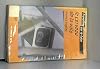
The tomorrow city
by Monica Hughes
On This Page
Description
Caro and David must save their city which is being overpowered by a ruthless computer.Tags
Recommendations















Member Recommendations



Member Reviews
A little dated now, but this is a different take on an idea first developed by D F Jones in his series of books about Colossus the super computer, and turned into a film 'Colossus: The Forbin Project'. The difference here is that the computer in Hughes' novel has been developed to make a city perfect whereas the 1960s Colossus novels and film deal with a computer developed to run the nuclear defence of North America. And the protagonists here are a fourteen year old girl, Caro, and her friend David.
Caro's father has developed the computer and Caro herself inadvertantly influences its programming when she gives it advice after its first efforts at efficiency - to utilise the parking spaces of council officials in the evening for public show more parking - don't go down well and it seems the Mayor might 'pull the plug' or at least force her father to take out the computer's self governance. Her advice that the computer must 'make people like it' are taken too literally, in typical machine fashion. Soon the computer is hypnotising the adults through cable TV soap opera to accepts its edicts which become increasingly repressive - old people in hospital have their life support turned off, for example - and the city becomes an enclave cut off from the outside world. Caro's father is touring the country, extoiling the value of the system to other cities, so there is the additional threat that the repression might spread. It is up to Caro and David to try to halt the computer's mindcontrol.
For a YA novel and of that period, this has a pretty downbeat ending, and also has unresolved questions about whether other characters actually survive or not. The relationship between the two main characters came over to me as a bit symplistic and I didn't enjoy this one as much as volumes 1 and 2 of her Keeper of the Isis Light trilogy. show less
Caro's father has developed the computer and Caro herself inadvertantly influences its programming when she gives it advice after its first efforts at efficiency - to utilise the parking spaces of council officials in the evening for public show more parking - don't go down well and it seems the Mayor might 'pull the plug' or at least force her father to take out the computer's self governance. Her advice that the computer must 'make people like it' are taken too literally, in typical machine fashion. Soon the computer is hypnotising the adults through cable TV soap opera to accepts its edicts which become increasingly repressive - old people in hospital have their life support turned off, for example - and the city becomes an enclave cut off from the outside world. Caro's father is touring the country, extoiling the value of the system to other cities, so there is the additional threat that the repression might spread. It is up to Caro and David to try to halt the computer's mindcontrol.
For a YA novel and of that period, this has a pretty downbeat ending, and also has unresolved questions about whether other characters actually survive or not. The relationship between the two main characters came over to me as a bit symplistic and I didn't enjoy this one as much as volumes 1 and 2 of her Keeper of the Isis Light trilogy. show less
Monica Hughes was writing dystopian fiction for young adults long before it was popular like it is now. This story is about a computer that takes over over everything that happens in a small city. The characters are likable, if a little bit shallow and the plot is pretty good.
Ratings
Members
- Recently Added By
Lists

Underground/dome to outside - children's/YA science fiction/fantasy
67 works; 7 members
Author Information

39+ Works 2,852 Members
Monica Hughes was born in Liverpool, England on November 3, 1925. Before joining the Women's Royal Naval Service, she lived in Egypt as a child and went to school in Scotland. During World War II, she worked on breaking German codes. In 1952, she immigrated to Edmonton, Alberta, Canada and began working at Ottawa's National Research Council. She show more started writing survival stories and science fiction novels for young adults. Her works include the Isis trilogy and Hunter in the Dark. She won numerous awards including the Phoenix Award for literary merit. She was named to the Order of Canada in 2002. She died from a stroke on March 7, 2003 at the age of 77. (Bowker Author Biography) show less
Some Editions
Series
Belongs to Publisher Series
Tiikerit (15)
Common Knowledge
- Canonical title
- The Tomorrow City; The tomorrow city
- Original publication date
- 1978
Classifications
- Genres
- Fiction and Literature, Teen, Young Adult, Tween
- DDC/MDS
- 823.914 — Literature & rhetoric English & Old English literatures English fiction 1900- 1901-1999 1945-1999
- LCC
- PZ7 .H87364 — Language and Literature Fiction and juvenile belles lettres Fiction and juvenile belles lettres Juvenile belles lettres
Statistics
- Members
- 67
- Popularity
- 465,591
- Reviews
- 2
- Rating
- (3.29)
- Languages
- English, Finnish, French
- Media
- Paper
- ISBNs
- 7
- ASINs
- 1