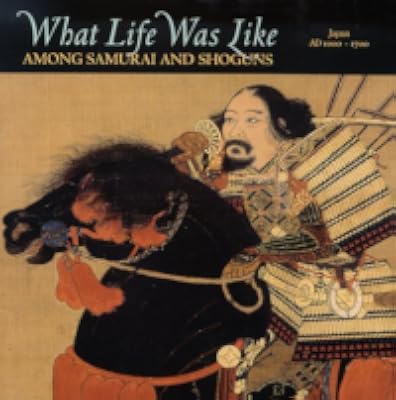
What Life Was Like Among Samurai and Shoguns: Japan AD 1000-1700
by Time-Life Books, Denise Dersin (Editor)
What Life Was Like (10)
On This Page
Description
A comprehensive view of how the Samurai and Shoguns lived in Japan, their discipline and battle gear as well as other facts about typical behavior.Tags
Recommendations
























Member Reviews
I picked up this book after watching the short docu-series on Netflix called Age of Samurai: Battle for Japan. The series was fascinating, and I wanted to learn more about the lifestyles of these larger than life figures. This book by Dersin seemed like the best introduction, being brief, full of pictures, but still covering a lot of ground. There's so much to impart that the iconic Oda Nobunaga, Hideyoshi Toyotomi, and Tokugawa Ieyasu only appear near the end of this book. Samurai and Shoguns does not only discuss the daily lives of these figures, but it also does a lot to setup up the world they inhabit and gives added dimension to their motives. This book is thought-provoking, informative, but also entertaining to read about.
Unlike show more Dersin's other book in this series about Imperial China, Samurai and Shoguns delves into the daily lives of its characters. You learn about the fashions of the people, as well as the women who helped shape the empire of Japan. You learn about how the merchant class organized themselves into guilds alongside learning about historic battles. Overall, Dersin does a much better job here of painting a complete picture of 16th-17th century Japanese society, to the point where users can imagine it for themselves.
If you're interested in this period of Japanese history, I highly recommend both the book and the docu-series. Together, the two paint a really compelling and complex picture of medieval Japan that is truly incomparable. show less
Unlike show more Dersin's other book in this series about Imperial China, Samurai and Shoguns delves into the daily lives of its characters. You learn about the fashions of the people, as well as the women who helped shape the empire of Japan. You learn about how the merchant class organized themselves into guilds alongside learning about historic battles. Overall, Dersin does a much better job here of painting a complete picture of 16th-17th century Japanese society, to the point where users can imagine it for themselves.
If you're interested in this period of Japanese history, I highly recommend both the book and the docu-series. Together, the two paint a really compelling and complex picture of medieval Japan that is truly incomparable. show less
from dust jacket
When Grand Empress Senshi, mother of Emperor Ichijo, heard that aspiring regent Korechika was seizing 'every opportunity to malign her' and her choice for regent, Fujiwara Michinaga, she was outraged. Senshi was popular and well-respected at court, and like many women of her status, she wielded considerable power and influence within her family. For his part, Korechika, a handsome and intelligent but arrogant young man who counted the emperor among his friends, felt entitled to the office because his father, had he not died so precipitously, would have passed it on to his beloved son.
But even a godlike emperor had to answer to his mother. Senshi, telling Michinaga to accompany her, marched to the imperial apartments. show more Leaving the anxious would-be regent to wait for her in an anteroom, she entered here son's inner chamber. When at last she emerged, her smile told Michinata all he needed to know.
What Life Was Like among Samurai and Shoguns tells the story of a grand empress's unstoppable ambition to determine who would rule her nation, along with many other compelling tales of the men and women of medieval Japan. One volume in a world-history series form Time-Life Books, Among Samurai and Shoguns focuses on the daily lives of emperoer and artisans, samurai and poets, and courtesans and monks in the capitals of Kyoto and Edo, in the countryside, in various castle towns and military fortifications, as well as in action on the battlefield. People like Mursasiki Shikibu, who wrote of the romantic lives of the Kyoto couriers in her Tale of Genji, the great warrior Kusnoki Masashige, who commtted seppuku rather than face capture by ememy troops, and Toyotomi Hideyoshi, who succeeded, when so many others had failed, in unifying Japan.
Distinctive and colorful scroll paintings bring Japan's people, places, and events vividly to life. In them, Heian period nobility pursue their many leisure activities, such as picnicking, boating, and reading; samurai prepare for battle and fight with legendary ferocity; artists and artisans work at their crafts and market them in streetside shops; and throngs of visitors make their way through the pleasure quarters in search of the amusements of the 'the floating world.' Fabuklous artifacts, such as gold-and silver-dusted lacquerware boxes; kimonos of rich, embroidered silk; enigmatic No masks; and fearsome samurai body armor complete the setting of the scene.
For this exciting series, What Life Was Like, the editors and researchers of Time-Life Books have delved deeply into the collection of scholars, travelers, museums, and universities in order to assemble an accurate depiction of daily life. Every volume in the series is richly illustrated with art and artifacts, as well as with detailed maps and reconstructions of buildings, towns, and the world as it was. An in-depth introduciton and an accessible timeline open each book to provide a panoramic perspective of the era. Brought together in an original and appealing way, each detail, image, anecdote, and historical nugget offers you a unique experience-what life was like.
Contents
In the Land of the Rising Sun-Overview and Timeline
The Court of the Shining Prince
Swords of the Samurai
Peace and the Floating World
Essays-Heian Courtshiip and Marriage; Creating Beauty in Everyday Life; Zen Gardens
Glossry
Pronunciation Guide
Acknowledgments
Picture Credits
Bibliography
Index show less
When Grand Empress Senshi, mother of Emperor Ichijo, heard that aspiring regent Korechika was seizing 'every opportunity to malign her' and her choice for regent, Fujiwara Michinaga, she was outraged. Senshi was popular and well-respected at court, and like many women of her status, she wielded considerable power and influence within her family. For his part, Korechika, a handsome and intelligent but arrogant young man who counted the emperor among his friends, felt entitled to the office because his father, had he not died so precipitously, would have passed it on to his beloved son.
But even a godlike emperor had to answer to his mother. Senshi, telling Michinaga to accompany her, marched to the imperial apartments. show more Leaving the anxious would-be regent to wait for her in an anteroom, she entered here son's inner chamber. When at last she emerged, her smile told Michinata all he needed to know.
What Life Was Like among Samurai and Shoguns tells the story of a grand empress's unstoppable ambition to determine who would rule her nation, along with many other compelling tales of the men and women of medieval Japan. One volume in a world-history series form Time-Life Books, Among Samurai and Shoguns focuses on the daily lives of emperoer and artisans, samurai and poets, and courtesans and monks in the capitals of Kyoto and Edo, in the countryside, in various castle towns and military fortifications, as well as in action on the battlefield. People like Mursasiki Shikibu, who wrote of the romantic lives of the Kyoto couriers in her Tale of Genji, the great warrior Kusnoki Masashige, who commtted seppuku rather than face capture by ememy troops, and Toyotomi Hideyoshi, who succeeded, when so many others had failed, in unifying Japan.
Distinctive and colorful scroll paintings bring Japan's people, places, and events vividly to life. In them, Heian period nobility pursue their many leisure activities, such as picnicking, boating, and reading; samurai prepare for battle and fight with legendary ferocity; artists and artisans work at their crafts and market them in streetside shops; and throngs of visitors make their way through the pleasure quarters in search of the amusements of the 'the floating world.' Fabuklous artifacts, such as gold-and silver-dusted lacquerware boxes; kimonos of rich, embroidered silk; enigmatic No masks; and fearsome samurai body armor complete the setting of the scene.
For this exciting series, What Life Was Like, the editors and researchers of Time-Life Books have delved deeply into the collection of scholars, travelers, museums, and universities in order to assemble an accurate depiction of daily life. Every volume in the series is richly illustrated with art and artifacts, as well as with detailed maps and reconstructions of buildings, towns, and the world as it was. An in-depth introduciton and an accessible timeline open each book to provide a panoramic perspective of the era. Brought together in an original and appealing way, each detail, image, anecdote, and historical nugget offers you a unique experience-what life was like.
Contents
In the Land of the Rising Sun-Overview and Timeline
The Court of the Shining Prince
Swords of the Samurai
Peace and the Floating World
Essays-Heian Courtshiip and Marriage; Creating Beauty in Everyday Life; Zen Gardens
Glossry
Pronunciation Guide
Acknowledgments
Picture Credits
Bibliography
Index show less
Ratings
Members
- Recently Added By
Author Information

2,328+ Works 90,789 Members

All Editions
Series

Work Relationships
Is contained in
Common Knowledge
- Canonical title
- What Life Was Like Among Samurai and Shoguns: Japan AD 1000-1700
- Important places
- Japan
Classifications
Statistics
- Members
- 194
- Popularity
- 168,367
- Reviews
- 2
- Rating
- (4.11)
- Languages
- English, German
- Media
- Paper
- ISBNs
- 3
- UPCs
- 1