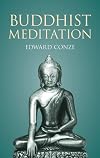
Buddhist Meditation
by Edward Conze
On This Page
Description
As an intensely practical religion, Buddhism has concentrated on devising a great number of meditations. In recent years psychologists have shown great interest in the therapeutic value of these meditations, but accurate information about them has been hard to come by. The most outstanding original documents have now been made accessible by Edward Conze, who translated them from Pali, Sanskrit and Tibetan. The volume, originally published in 1956, also deals with the meaning of Buddhist show more meditation, and the relation of its methods and presuppositions to modern psychology. show lessTags
Recommendations

























Member Reviews
'Meditational practices constitute the very core of the Buddhist apprach to ife...As prayer in Christianity, so meditation is heare the very heartbeat of the religion. 'Enlightenment, or the state of Nirvana, is, of course, the ultimate aim of Buddhist meditations. On the way to Nirvana they serve to promote spiritual development, to diminish the impact of suffering, to calm the mind and to reveal the true facts of existence.... 'Mental health is the goal of the practitioner of meditation and of the modern psychologist. Apart from that there is little contact or similarity between them. They differ profoundly in their definitions of mental health, in their theorectical assumptions about the structure of the mind and the purpose of human show more existence, and in the methods which they prescribe.... 'Discontent with modern life is widespread, and a great spiritual hunger makes itself felt in all classes of society. One cannot pretend that a little book like this one contains all the information necessary for salvation. Within its limitations it may, however, give some guidance to the children of light who are still dispersed in our midst. And even the others may find in it some historical and psychological information, as well as plenty of food for discussion.'-Edward Conze, from the Inroduction cover design by Richard Milone
Contents General introduction INTRODUCTION 1 The meaning and purpose of Buddhist Meditation. 2 Its range and principal divisions. 3 The literary sourcs. The arrangement of the selections. 4 Buddhist meditation and modern psychotherapy. SELECTIONS I. Devotional exercises 1. The three treasures a. The recollection of the Buddha. b. The recollection of the Dharma. c. The recollection of the Sangha. 2. The Bodhisattva's example. 3. Worship. 4. A note on visions. II Mindfulness 1 The mindful awareness of the body. a. Bodily postures, attitudes and behaviour. b. Breathing mindfulness. 2 The mindful awareness of mental processes. a. Feelings. b. The five hindrances. 3 The repudiation of the sensory world. a. Guarding te senses; The control of the mind. b. Similes for the evils of senseo-desires. 4 The recollecitonof death. 5 Distatste for the body, and its functionsj-the thirty-two parts of the body. b. The repulsiveness of food; c. The foul. The corpses on the charnel field. 6 The goal (nirvana). The recollection of peace. III Trance 1 The practice of introversion. a. The withdrawal from the world. b. The eight stages of trance 2 The culitvation of the social emotions. a. Nine preliminary reflections on hate. b. Unlimited friendliness. c. Unlimited compassion. d. Unlimited sympathetic joy. e. Unlimited evenmindedness. 3 The evocation of deities. IV Wisdom 1 The four holy truths a. The truth of ill. b. The sixteen aspects. 2 The three marks of conditioned things. a. The 165 considerations. b. The three marks defined. 3. Survey of conditons. a. The range of conditioning b. The automatic nature of conditioning c. Conditioned co-production 4 Withdrawal from the world (the eight cognitions) 5. Emptiness NUMERICAL LISTS SOURCES EDITIONS USED show less
Hardcover, 3rd impression (1968) of first edition (1956)
Ratings
Members
- Recently Added By
Author Information

57+ Works 2,971 Members
Series
Belongs to Publisher Series
Common Knowledge
- First words
- Meditational practices constitute the very core of the Buddhist approach to life. An intensely practical religion, Buddhism is by contrast inclined to treat doctrinal definitions and historical facts with some degree of uncon... (show all)cern. As prayer in Christianity, so meditation is here the very heartbeat of the religion.
Introduction - Quotations
- [...] I decided to concentrate on the main stream of the Buddhist tradition. The bulk of the selections are derived from the Old Wisdom School, and in particular from Buddhaghosa's Path of Purity, a work of unquestione... (show all)d authority. No justice could be done to later development, which often gratly depart form the original impulse. Of the very important Tantra only one extract could be included (III 3). The bhaktic Amida schools, with their visions of Buddhas and their Paradises, are represented by no more than a brief Note (I 4). And the Ch'an school has not be mentioned at all, although it developed a new and fascinating system of meditation, based on koans, and upheld the Buddhist tradition in a typically Buddhist way by denying it. (p.27)
- Last words
- (Click to show. Warning: May contain spoilers.)One cannot pretend that a little book like this one contains all the information necessary for salvation. Within its limitations it may, however, give some guidance to the children of the light who are still dispersed in our midst. And even the others may find in it some historical and psychological information, as well as plenty of food for discussion.
Introduction
Classifications
Statistics
- Members
- 145
- Popularity
- 226,338
- Reviews
- 2
- Rating
- (3.50)
- Languages
- English
- Media
- Paper, Ebook
- ISBNs
- 13
- UPCs
- 1
- ASINs
- 7