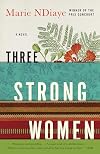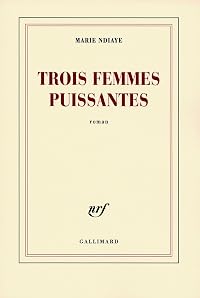
Three Strong Women
by Marie NDiaye
On This Page
Description
Follows the stories of three women who discover the power of saying no, including a lawyer who must save a victim of her tyrannical father, a Dakar teacher whose happiness is thwarted by a depressed boyfriend, and a penniless widow desperate to escape homelessness.Tags
Recommendations


































Member Reviews
Jag rekommenderade denna till en äldre dam på biblioteket där jag arbetar. Hon var om inte arg så lätt stött av det faktum att jag tipsat henne om denna förfärliga bok. Faktum är att Tre starka kvinnor är en bok med tre tämligen drabbande berättelser som alla cirkulerar mer eller mindre kring tre kvinnor. Jag tycker detta är förfärligt bra. Hon skriver för att locka fram känslor hos läsaren och använder sig flitigt av upprepningar som litterärt grepp. Det är kroppar som talar. Kroppar som rister, knakar och gnyr under tillvarons obarmhärtiga tryck. De är kroppar som får stå ut med mer än de kan bära. Det är en triptyk av klåda, sår, svält, obehag, förrutnelse och död. När jag läser den finns hela tiden show more ett obehag i mig. I de första två delarna svagt molande någonstans i en vrå av mitt medvetande. I den sista berättelsen blir obehaget mycket mer påtagligt och faktum är att jag inte kan rekommendera den som en läsa-innan-jag-somnar-bok.
En hemsk och drabbande bok som sätter känslorna i svajning och som inte ger något utrymme för att värja sig mot dessa karaktärers öden. show less
En hemsk och drabbande bok som sätter känslorna i svajning och som inte ger något utrymme för att värja sig mot dessa karaktärers öden. show less
This is not an easy read, but it is powerful and memorable. The book is in three sections which are almost independent of each other, which makes it very difficult to assess as a unified whole. All of them talk of journeys between France and Senegal.
I can't resist talking about the final section first. This is an unflinching, powerful and harrowing depiction of a journey undertaken by a poor and ignorant woman who has been rejected by her dead husband's family in Senegal and is trying to reach France. For me this was very moving and the conclusion is devastating.
The first part tells of a French lawyer returning to Senegal to visit her African father, who has summoned her because he thinks she can help her brother who is in prison show more accused of murdering the young stepmother with whom he has been having an affair.
The second part is the longest, and I struggled a little to maintain interest in it, partly because it is told from the viewpoint of a man who is not a sympathetic narrator because he is full of guilt and self hatred. The strong woman in this part is his wife, who has left a good job as a teacher in Senegal after her husband has been dismissed after a fight with some students triggered when one of them brings up the subject of his father who murdered his business partner. His French mother has found him a job in France, but he is not happy there, and believes that his wife has been sleeping with his boss.
The book is full of startling imagery and symbolism, and NDiaye is a talented writer, but it is a very bleak read. show less
I can't resist talking about the final section first. This is an unflinching, powerful and harrowing depiction of a journey undertaken by a poor and ignorant woman who has been rejected by her dead husband's family in Senegal and is trying to reach France. For me this was very moving and the conclusion is devastating.
The first part tells of a French lawyer returning to Senegal to visit her African father, who has summoned her because he thinks she can help her brother who is in prison show more accused of murdering the young stepmother with whom he has been having an affair.
The second part is the longest, and I struggled a little to maintain interest in it, partly because it is told from the viewpoint of a man who is not a sympathetic narrator because he is full of guilt and self hatred. The strong woman in this part is his wife, who has left a good job as a teacher in Senegal after her husband has been dismissed after a fight with some students triggered when one of them brings up the subject of his father who murdered his business partner. His French mother has found him a job in France, but he is not happy there, and believes that his wife has been sleeping with his boss.
The book is full of startling imagery and symbolism, and NDiaye is a talented writer, but it is a very bleak read. show less
On the face of it, this is a similar sort of deal to Gertrude Stein's Three lives: three novella-length pieces, each involving a strong female character. But it's also a kind of novel, as the three stories intersect in ways that aren't entirely straightforward and logical, and in places verge on the mystical. All three straddle the physical and cultural space between France and Senegal: in the first, Paris lawyer Norah is summoned to Senegal by her estranged father to deal with the aftermath of a family tragedy; in the second, we are in a small French town watching the life of disgraced schoolteacher Rudy unravel as his Senegalese wife Fanta remains enigmatically offstage; in the third, the young widow Khady Demba gets caught up in the show more horrors of the illegal migration trail across the Sahara to Europe.
NDiaye's women are "strong" not in the conventional sense of being able to exercise power, but in the more particular sense that they have to have the moral strength to deal with more than their fair share of other people's (read: men's) problems without unravelling themselves. It's a book that's packed with anger at the injustices of the world and the selfishness of men and Europeans, and occasionally it seems to lose its direction in all that rage, but most of the time NDiaye's writing is sharp and devastating: it's well worth hanging in there through the woolly patches. show less
NDiaye's women are "strong" not in the conventional sense of being able to exercise power, but in the more particular sense that they have to have the moral strength to deal with more than their fair share of other people's (read: men's) problems without unravelling themselves. It's a book that's packed with anger at the injustices of the world and the selfishness of men and Europeans, and occasionally it seems to lose its direction in all that rage, but most of the time NDiaye's writing is sharp and devastating: it's well worth hanging in there through the woolly patches. show less
He'd worked so hard at persuading himself of the contrary that he was no longer sure what was true and what wasn't.The first woman of color to win the prestigious Prix Goncourt, Marie NDiaye is certainly a gifted, uncompromising writer. Her collection All My Friends was my first foray into her work, and, in some ways, the stories there are stronger than the "novel" Three Strong Women; however, similar themes of how isolating intimacy can be, how identity is subsumed beneath others: at the personal and cultural level, and how marginal experiences are as critical to listen to as those we encounter in more mainstream fiction are present throughout NDiaye's work.
Similarly, her use of narrative skill is impressive: using both free indirect show more style and figural narratives, NDiaye is able to begin—perhaps paradoxically, but this is her talent—both at the highly specific and at the very general levels. Slowly, in the course of the narrative, NDiaye's omniscience and increasingly nuanced use of the figural allow the reader to be both welcomed into each characters' mindsets while at the same time ejected from them.
This can make for frustrating reading, and, indeed, as some reviews have pointed out, the second part (which is the longest part and gives portraits of several woman from the perspective of a male character, Ruby, especially his wife, Fanta) can be downright infuriating to read. This is not necessarily because of subject matter, but more due to NDiaye's use of style to mimic the repetitive and flickering states of our consciousness: so when Ruby muses for ten pages—all of which take place in the time span of placing a telephone call and letting it ring without answer—about the words he said (or didn't say) to Fanta, about his meagre, unimpressive job, about how inconsequential he feels as a man, as a husband, as a father, as a son, this is NDiaye doing what she does best. In essence, she is rendering our thought processes as they take place but stretching them out in a linear fashion, unlike someone like Woolf for whom imagery and rhythm are more important. Indeed, when NDiaye makes use of symbolism it is often heavy-handed, with symbols such as buzzards, poinciana trees, crows, and so on to make appearances on nearly each page as if to stress and overemphasize their import much to the narrative's discredit.
As interconnected stories, these three pieces work rather well, but as a novel it simply doesn't have the cohesion to be read in that light. The first piece deals with a thirty-something woman named Norah who has come from Paris to visit her father in Dakar at his insistence; while there, she is forced to come to terms with not only the memories of his brutality and neglect in her youth—and how this figures in his current life, and thus hers, at present—but also her dissatisfaction with motherhood and the more independent life she desires for herself and which her job as a lawyer serves to underscore. The second piece centers on Rudy and is linked to the first by way of a Proustian nom de pays; here, NDiaye captures very brilliantly a man in the midst of a midlife crisis: Rudy's crisis is as much one of masculinity as it is of nationalism and imperialism, a meditation on how the oedipal relations of one's youth are prefigurations of how one's adult relationships will form in terms of dynamics and roles. The last piece, which is perhaps the most affecting, concerns Khady's plight after her in-laws, with whom she has been living since her husband's death, force her to leave as she is childless and without a dowry. Khady's narrative is linked by way of a nom de famille to the second piece in Three Strong Women and is as much about the confines of cultural expectations of femininity as it is about the internalization of gender roles which cause women to view themselves solely in relation to men, as future mothers, and in economic rather than loving structures of kinship.
To me, the translation of puissantes from the French title should be rendered as "powerful" rather than "strong" women; in addition, the blurb from the French edition of the novel is misleading in its statement: trois femmes qui disent non. NDiaye is not concerned with saying no or with resistance, or, rather, if she is, it is about the futility of these desires in a world and in relations that prevent flight and instead see the individual trapped in existential circumstances which they must accept in some way in order to quell their uneasiness, their loneliness, and their alienation. And this is indeed her strong suit. Although the book is more likely a three-star book, the project itself and the sheer originality of NDiaye's vision here are worthy of four stars, in my view, without question. She is definitely a writer to watch. show less
4.5/5
Out of all the Prix Goncourt-winning books I've read, this one has the lowest rating on Goodreads. It's doing worse than coprophilic Nazis, colonial pedophilia, ferociously internalized misogyny, and some of the longest sentences that ever longed. It bugged and bugged to the point that, feminist with a strong streak of engineering mentality that I am, I went and crunched the data of the books on my own to read shelf, specifically regarding the intersection of women authors with books with less than a 3.7 rating, the popular line that separates wheat from the chaff. While books by women make up 36.8% of my to be reads, they are 50.1% of the 3.6's and below, the chance of such show more a rating being 27.9% as compared to the 16.1% of books by men. I could just have shitty ass taste in choosing future female-authored reads, but it does make me wonder, especially when considering the 3.83 average this book enjoys among my GR friends.
The poor rating's a shame, for this is some of the best anti-girlfriend in a refrigerator I've read in every sense of the word. I know the whole shifty-eyed reaction to affirmative action and all the "first _________ to ____________" in the third millenia but seriously, this book is so beautiful in its inherent clarity of thought and imagery that their application to the rarest of scenes encountered in literature is just an added bonus. Immigration is a popular byline in the book awards these days, but the triptych offered here of colonizer, colonized, and postcolonial is nothing short of masterful, a mind behind every face and a reckoning in every mind.
There's the demon of so called "political correctness" you're looking for. Not respect, not recognition, not even a simple attempt at communication, but an assumption of pompous charity that believes itself altruistic while refusing to become as selfless as the descriptor implies. Sentiment breeds failure, failure breeds guilt, and guilt doesn't do shit so long as your personal preoccupation with your privilege prevents you from seeing others as human beings with their own lives, goals, and concerns that for the most part lie far outside the ring of -isms. So long as you obsess without acknowledging the need for time and patience, you'll never discover that those descended from the crimes of your ancestors don't need your overeager overtures of friendship. Commitment to empathetic effort forevermore, yes. Defensive charity, no.
There's one of those long sentences people liked to complain about for you. I hardly register them these days, but I have to say, it doesn't read half bad to me.
Objectification is the practice of depriving both the objectifier and the objectified of the capacity to forgive. As much as we like to think otherwise, there's a world of thought and form beyond the clumsy interrelations of humanity, where every one does far more to restore one's status as subject than anyone else is capable of. No quick fixes here, but there's nothing to condemn when it comes to the constant effort of peaceful living. show less
How does the fact that others are doing well diminish you?
Out of all the Prix Goncourt-winning books I've read, this one has the lowest rating on Goodreads. It's doing worse than coprophilic Nazis, colonial pedophilia, ferociously internalized misogyny, and some of the longest sentences that ever longed. It bugged and bugged to the point that, feminist with a strong streak of engineering mentality that I am, I went and crunched the data of the books on my own to read shelf, specifically regarding the intersection of women authors with books with less than a 3.7 rating, the popular line that separates wheat from the chaff. While books by women make up 36.8% of my to be reads, they are 50.1% of the 3.6's and below, the chance of such show more a rating being 27.9% as compared to the 16.1% of books by men. I could just have shitty ass taste in choosing future female-authored reads, but it does make me wonder, especially when considering the 3.83 average this book enjoys among my GR friends.
If only, he thought, he could prove before his inner tribunal that he'd had good reason to get so terribly angry, he'd be in a better position to regret his behavior and his whole nature would be improved thereby.
The poor rating's a shame, for this is some of the best anti-girlfriend in a refrigerator I've read in every sense of the word. I know the whole shifty-eyed reaction to affirmative action and all the "first _________ to ____________" in the third millenia but seriously, this book is so beautiful in its inherent clarity of thought and imagery that their application to the rarest of scenes encountered in literature is just an added bonus. Immigration is a popular byline in the book awards these days, but the triptych offered here of colonizer, colonized, and postcolonial is nothing short of masterful, a mind behind every face and a reckoning in every mind.
…an exaggerated, resolute, anxious friendship that bore no relationship to the boy’s particular qualities and that could suddenly turn to hatred without Rudy’s realizing it, or even understanding that hatred…
There's the demon of so called "political correctness" you're looking for. Not respect, not recognition, not even a simple attempt at communication, but an assumption of pompous charity that believes itself altruistic while refusing to become as selfless as the descriptor implies. Sentiment breeds failure, failure breeds guilt, and guilt doesn't do shit so long as your personal preoccupation with your privilege prevents you from seeing others as human beings with their own lives, goals, and concerns that for the most part lie far outside the ring of -isms. So long as you obsess without acknowledging the need for time and patience, you'll never discover that those descended from the crimes of your ancestors don't need your overeager overtures of friendship. Commitment to empathetic effort forevermore, yes. Defensive charity, no.
Because their only son had married her against her wishes, because she had not produced a child, and because she enjoyed no one's protection, they had tacitly, naturally, without animus or ulterior motive, separated her from the human community, and so their hard, narrow, old people's eyes made no distinction between the shape called Khady and the innumerable forms of animals and things that also inhabit the world.
There's one of those long sentences people liked to complain about for you. I hardly register them these days, but I have to say, it doesn't read half bad to me.
What right had he to include her in his feelings of abjection just because he lacked her strength of spirit?
Objectification is the practice of depriving both the objectifier and the objectified of the capacity to forgive. As much as we like to think otherwise, there's a world of thought and form beyond the clumsy interrelations of humanity, where every one does far more to restore one's status as subject than anyone else is capable of. No quick fixes here, but there's nothing to condemn when it comes to the constant effort of peaceful living. show less
An absolutely excellent work of literature. Three stories, that vaguely overlap, tell of different perspectives of isolation, identity and migration. Told between Senegal and France, there is a dream-like quality and a biting reality to each tale. Occasionally funny and grim, the characters are the driving force here; each is uniquely compelling. This is a wonderful book, only really let down by the dreadful, meaningless title (an exercise in bad marketing?).
An emotionally stirring and memorable book. This is the story of three women although one of the stories follows the unraveling of a woman's husband leaving the wife behind.
The first story starts with Norah who is returning to Senegal to help out in a murky family affair. The second concerns Rudy and his African wife Fanta, and the last and most grim is the story of Khady.
Norah and then Rudy try to discover the source of their blocked memories amid lives endured with indifferent , if not altogether hostile, families. Rudy , raised in Africa and now in France, is adrift in his unending failures and downward spiral of violence and disillusionment. Norah and then Rudy try to remember the circumstances of their exile. Norah returns to a show more father who tries to exploit her as he has betrayed his son. They all find themselves in a fog unable to see clearly the family crimes that haunt them.
None of the characters is able to overcome the greed and malice of those around them. I try to describe the book in generalities as I hate revealing too much of the plot(s).
I loved the book for its stunning writing, the bits of the surreal, and its sense of mystery overall. show less
The first story starts with Norah who is returning to Senegal to help out in a murky family affair. The second concerns Rudy and his African wife Fanta, and the last and most grim is the story of Khady.
Norah and then Rudy try to discover the source of their blocked memories amid lives endured with indifferent , if not altogether hostile, families. Rudy , raised in Africa and now in France, is adrift in his unending failures and downward spiral of violence and disillusionment. Norah and then Rudy try to remember the circumstances of their exile. Norah returns to a show more father who tries to exploit her as he has betrayed his son. They all find themselves in a fog unable to see clearly the family crimes that haunt them.
None of the characters is able to overcome the greed and malice of those around them. I try to describe the book in generalities as I hate revealing too much of the plot(s).
I loved the book for its stunning writing, the bits of the surreal, and its sense of mystery overall. show less
Members
- Recently Added By
Published Reviews
ThingScore 100
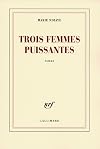
Trois Femmes puissantes is a fine book, full of NDiaye’s narrative gusto, stylistic virtuosity and command of tone. If it is less wild and strange than some of her earlier work, it is no less bold.
added by christiguc
C’est un roman qui parle de la déchéance morale, de la bassesse des hommes envers les femmes, de l’humanité souffrante, mais qui laisse entrevoir, du fond du malheur, une possibilité de rédemption. Un livre puissant.
added by christiguc
added by sokotof
Lists

International IMPAC Dublin Literary Award
179 works; 6 members

Black Authors
384 works; 28 members

Best African and African diaspora books
111 works; 4 members

Books Read in 2015
3,299 works; 129 members

Books Read in 2022
5,226 works; 115 members

IMPAC Dublin Literary Award 2014 longlist
150 works; 3 members

Books Read in 2018
4,360 works; 110 members

Rebel Women Reading List
25 works; 2 members

Schomburg Centennial Reading List
100 works; 4 members
Author Information

41+ Works 2,091 Members
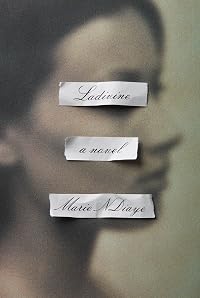
Marie NDiaye was born on June 4, 1967 in Pithiviers, France. Her first novel, Quant au Riche Avenir, was published in 1985. Her novels and short stories include Autoportrait en vert, Mon couer a l'etroit, Trois femmes puissantes, and Ladivine. One of her plays, Papa Doit Manger, has been taken into the repertoire of the Comédie Française. She show more also writes children's novels, essays and screenplays. Her awards include The 2001 Prix Femina for Rosie Carpe, the 2009 Prix Goncourt for Three Strong Women, and the 2015 Nelly Sachs Prize. (Bowker Author Biography) show less
Some Editions
Awards and Honors
Awards
Distinctions
Series
Belongs to Publisher Series
Common Knowledge
- Canonical title
- Three Strong Women
- Original title
- Trois femmes puissantes
- Original publication date
- 2009-08-20 (original French) (original French); 2012 (English translation) (English translation)
- People/Characters*
- Norah; Khady Demba; Fanta Descas; Lucie; Jakob Ganz; Greta Ganz (show all 19); Sony; Masseck; Rudy Descas; Manille; Djibril Descas; Madame Pulmaire; Cathie; Madame Menotti; Gauquelin; Abel Descas; Salif; Madame Plat; Lamine
- Important places*
- Dakar, Sénégal; Gironde, Nouvelle-Aquitaine, France
- Dedication*
- À Laurène, Silvère et Romaric
- First words
- Et celui qui l'accueillit ou qui parut comme fortuitement sur le seuil de sa grande maison de béton, dans une intensité de lumière soudain si forte que son corps vêtu de clair paraissait la produire et la répandre lui-mÃ... (show all)ªme, cet homme qui se tenait là, petit, alourdi, diffusant un éclat blanc comme une ampoule au néon, cet homme surgi au seuil de sa maison démeusurée n'avait plus rien, se dit aussitôt Norah, de sa superbe, de sa stature, de sa jeunesse auparavant si mystérieusement constante qu'elle semblait impérissable.
And the man who was waiting for her at the entrance to the big concrete house - or who happened by chance to be standing in the doorway - was bathed in a light so suddenly intense that his whole body and pale clothing seemed ... (show all)to produce and project it: this short, thick-set man standing there, glowing as brightly as a neon tube, this man who had just emerged from his enormous house displayed no longer, Norah straight away realised, any of the stature, arrogance and youth that was once so mysteriously characteristic of him as to seem everlasting. - Last words
- (Click to show. Warning: May contain spoilers.)Et quand, à certaines heures ensoleillées, il levait son visage, l'offrait à la chaleur, il n'était pas rare qu'un demi-jour tombât soudain inexplicable, et alors il parlait à la fille et doucement il lui racontait ce qu'il advenait de lui, il lui rendait grâce, un oiseau disparaissait au loin.
(Click to show. Warning: May contain spoilers.)A bird flew away: far, far away. - Original language
- French
*Some information comes from Common Knowledge in other languages. Click "Edit" for more information.
Classifications
Statistics
- Members
- 729
- Popularity
- 38,878
- Reviews
- 35
- Rating
- (3.27)
- Languages
- 14 — Catalan, Czech, Danish, Dutch, English, Finnish, French, German, Italian, Norwegian (Bokmål), Polish, Portuguese, Spanish, Swedish
- Media
- Paper, Audiobook, Ebook
- ISBNs
- 42
- ASINs
- 7