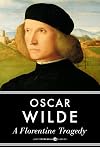
A Florentine Tragedy
by Oscar Wilde 
On This Page
Description
Oscar Fingal O'Flahertie Wills Wilde was born on the 16th October 1854 in Dublin Ireland. The son of Dublin intellectuals Oscar proved himself an outstanding classicist at Dublin, then at Oxford. With his education complete Wilde moved to London and its fashionable cultural and social circles. With his biting wit, flamboyant dress, and glittering conversation, Wilde became one of the most well-known personalities of his day. His only novel, The Picture of Dorian Gray was published in 1890 show more and he then moved on to writing for the stage with Salome in 1891. His society comedies produced enormous hits and turned him into one of the most successful writers of late Victorian London. Whilst his masterpiece, The Importance of Being Earnest, was on stage in London, Wilde had the Marquess of Queensberry, the father of his lover, Lord Alfred Douglas, prosecuted for libel. The trial unearthed evidence that caused Wilde to drop his charges and led to his own arrest and trial for gross indecency. He was convicted and imprisoned for two years' hard labour. It was to break him. On release he left for France, There he wrote his last work, The Ballad of Reading Gaol in 1898. He died destitute in Paris at the age of forty-six sipping champagne a friend had brought with the line 'Alas I am dying beyond my means'. Here we publish the classic short story Lord Arthur Savile's Crime that even if read once deserves another read to fully appreciate his mastery of the written word. show lessTags
Recommendations



























Member Reviews
This is such a strange little play I'm not sure that I can make heads or trails of it, but here goes none the less. The premise for the play is straightforward enough, with the action centred around a marital affair and a rather motely group of players, but it seems like Wilde is trying to explore the characters in a more complex manner than expected. Of course, the play is unfinished, so we aren't able to see the final result that he was aiming for, but I was quite intrigued by the finale and definitely wished that he had the time to complete the story. How did the affair start, why is the merchant husband so desperate for cash, and why in the end are the two male players reverse in stature? So many questions, and not nearly enough show more space for them to be fully developed, but clearly Wilde had the start of something interesting here. show less
This fragment of a play written by Wilde comes across as rather silly and bland, though containing some of his normal character-based humour.
Oscar Wildes A Florentine Tragedy är något av en atavism: drama skrivet på blankvers, under 1800-talet, vafalls? Om ett sidenhandlarpar i Florens som får besök av hertigens enfödde son? Nåväl, det svartsjukedrama som sedan utspelar sig är något Strindberg kunnat nicka erkännande åt; den gode handlaren Simone försöker lura ut om hans hustru Bianca verkligen varit otrogen med Guido Bardi på diverse sätt, för att när han nått säkerhet agera direkt.
Kort och enkelt uppbyggt är det; inga bihandlingar finns här som kan irritera, bara ett rum fyllt med misstänksamhet, svartsjuka, skuldkänslor och avsky. Blankversen löper på, inte i Shakespeareska vändningar förutom för att särskilt markera vissa passager, men show more ändå vältaligt; speciellt nyttjas Shakespeares teknik att genom upprepningar få ett visst ord att verka suspekt, närmast ironiskt.
Att säga något mer låter sig nästan inte göras utan att avslöja slutet; pjäsen tillhör trots allt de mindre kända ur Wildes produktion, men även om den kanske inte har den urbant cyniska kulör man vant sig vid så är den ändå fullt njutbar, som en märklig kombination av två helt skildra traditioner. show less
Kort och enkelt uppbyggt är det; inga bihandlingar finns här som kan irritera, bara ett rum fyllt med misstänksamhet, svartsjuka, skuldkänslor och avsky. Blankversen löper på, inte i Shakespeareska vändningar förutom för att särskilt markera vissa passager, men show more ändå vältaligt; speciellt nyttjas Shakespeares teknik att genom upprepningar få ett visst ord att verka suspekt, närmast ironiskt.
Att säga något mer låter sig nästan inte göras utan att avslöja slutet; pjäsen tillhör trots allt de mindre kända ur Wildes produktion, men även om den kanske inte har den urbant cyniska kulör man vant sig vid så är den ändå fullt njutbar, som en märklig kombination av två helt skildra traditioner. show less
Aug 23, 2011Swedish
Ratings
Members
- Recently Added By
Author Information

1,762+ Works 120,799 Members
Flamboyant man-about-town, Oscar Wilde had a reputation that preceded him, especially in his early career. He was born to a middle-class Irish family (his father was a surgeon) and was trained as a scholarship boy at Trinity College, Dublin. He subsequently won a scholarship to Magdalen College, Oxford, where he was heavily influenced by John show more Ruskin and Walter Pater, whose aestheticism was taken to its radical extreme in Wilde's work. By 1879 he was already known as a wit and a dandy; soon after, in fact, he was satirized in Gilbert and Sullivan's Patience. Largely on the strength of his public persona, Wilde undertook a lecture tour to the United States in 1882, where he saw his play Vera open---unsuccessfully---in New York. His first published volume, Poems, which met with some degree of approbation, appeared at this time. In 1884 he married Constance Lloyd, the daughter of an Irish lawyer, and within two years they had two sons. During this period he wrote, among others, The Picture of Dorian Gray (1891), his only novel, which scandalized many readers and was widely denounced as immoral. Wilde simultaneously dismissed and encouraged such criticism with his statement in the preface, "There is no such thing as a moral or an immoral book. Books are well written or badly written. That is all." In 1891 Wilde published A House of Pomegranates, a collection of fantasy tales, and in 1892 gained commercial and critical success with his play, Lady Windermere's Fan He followed this comedy with A Woman of No Importance (1893), An Ideal Husband (1895), and his most famous play, The Importance of Being Earnest (1895). During this period he also wrote Salome, in French, but was unable to obtain a license for it in England. Performed in Paris in 1896, the play was translated and published in England in 1894 by Lord Alfred Douglas and was illustrated by Aubrey Beardsley. Lord Alfred was the son of the Marquess of Queensbury, who objected to his son's spending so much time with Wilde because of Wilde's flamboyant behavior and homosexual relationships. In 1895, after being publicly insulted by the marquess, Wilde brought an unsuccessful slander suit against the peer. The result of his inability to prove slander was his own trial on charges of sodomy, of which he was found guilty and sentenced to two years of hard labor. During his time in prison, he wrote a scathing rebuke to Lord Alfred, published in 1905 as De Profundis. In it he argues that his conduct was a result of his standing "in symbolic relations to the art and culture" of his time. After his release, Wilde left England for Paris, where he wrote what may be his most famous poem, The Ballad of Reading Gaol (1898), drawn from his prison experiences. Among his other notable writing is The Soul of Man under Socialism (1891), which argues for individualism and freedom of artistic expression. There has been a revived interest in Wilde's work; among the best recent volumes are Richard Ellmann's, Oscar Wilde and Regenia Gagnier's Idylls of the Marketplace , two works that vary widely in their critical assumptions and approach to Wilde but that offer rich insights into his complex character. (Bowker Author Biography) show less
Oscar Wilde has a Legacy Library. Legacy libraries are the personal libraries of famous readers, entered by LibraryThing members from the Legacy Libraries group.
Some Editions
Series
Belongs to Publisher Series
Work Relationships
Is contained in
Common Knowledge
- Original publication date
- 1885
- People/Characters
- Simone; Bianca; Guido Bardi
Classifications
Statistics
- Members
- 22
- Popularity
- 1,186,399
- Reviews
- 3
- Rating
- (3.35)
- Languages
- English
- Media
- Paper, Ebook
- ISBNs
- 5
- ASINs
- 2