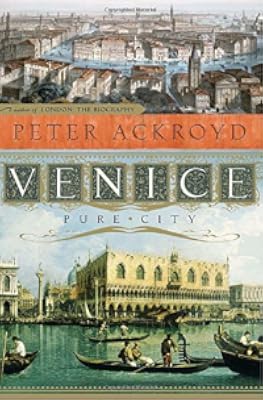
Venice: Pure City
by Peter Ackroyd
On This Page
Description
A glittering, evocative, fascinating, story-filled portrait of Venice, the ultimate city, embracing facts and romance, history and artists, carnival masks and leper colonies, wars and sieges, and scandals and seductions.Tags
Recommendations












Member Reviews
Peter Ackroyd has a knack for crafting biographies of "place" quite as compelling as any biography of a living, breathing human being, and in this latest book he does an impressive job of making Venice -- often described as a dying city -- live and breathe for the reader.
True, it's not up to the standard of his books on London and the Thames, and a knowledgeable reader may find that much of its contents are familiar. But it's still an excellent thematic look at this unique city through the eyes of its residents and visitors over the centuries. It's not a straightforward history -- he explores themes and ideas, jumping back and forth in time to address the issue of light, of food, of justice and the family, as they evolved in the unique show more environment of Venice, which remained a medieval state until Napoleon walked in and took it over in 1797, but which also was a city-state one of whose occupants could declare as early as the 16th century that he saw himself as a free man in a free country.
Ackroyd draws on a lot of other well-known Venice observers -- Jan Morris, Ruskin, Mary McCarthy, to name only a few -- as well as the obvious literary commentators, from Byron to Henry James and some lesser known figures of the early Renaissance. For me, it was the tiny details that abound here that made this book fascinating to read, rather than the scope itself -- to those who know a lot about Venice, there's probably very little tremendously new beyond Ackroyd's rather unexpected view of the city as both literally and metaphorically "insular" and one that has always relied on being able to command the attention of outsiders (through trade, or today through tourism).
My only quibbles are minor ones: Ackroyd's passion for staccato sentences became annoying after a while, and he has a propensity for repeating himself (I assume it's done deliberately) that became downright annoying. Ultimately, I felt like screaming that I KNOW that Venetians are private and don't like inviting people into their homes, I understood that the last five times it was mentioned!
Overall rating: 4.2 stars; recommended. It would make a great gift to someone traveling to Venice, in addition to the standard tour guides with maps and lists of top sights. show less
True, it's not up to the standard of his books on London and the Thames, and a knowledgeable reader may find that much of its contents are familiar. But it's still an excellent thematic look at this unique city through the eyes of its residents and visitors over the centuries. It's not a straightforward history -- he explores themes and ideas, jumping back and forth in time to address the issue of light, of food, of justice and the family, as they evolved in the unique show more environment of Venice, which remained a medieval state until Napoleon walked in and took it over in 1797, but which also was a city-state one of whose occupants could declare as early as the 16th century that he saw himself as a free man in a free country.
Ackroyd draws on a lot of other well-known Venice observers -- Jan Morris, Ruskin, Mary McCarthy, to name only a few -- as well as the obvious literary commentators, from Byron to Henry James and some lesser known figures of the early Renaissance. For me, it was the tiny details that abound here that made this book fascinating to read, rather than the scope itself -- to those who know a lot about Venice, there's probably very little tremendously new beyond Ackroyd's rather unexpected view of the city as both literally and metaphorically "insular" and one that has always relied on being able to command the attention of outsiders (through trade, or today through tourism).
My only quibbles are minor ones: Ackroyd's passion for staccato sentences became annoying after a while, and he has a propensity for repeating himself (I assume it's done deliberately) that became downright annoying. Ultimately, I felt like screaming that I KNOW that Venetians are private and don't like inviting people into their homes, I understood that the last five times it was mentioned!
Overall rating: 4.2 stars; recommended. It would make a great gift to someone traveling to Venice, in addition to the standard tour guides with maps and lists of top sights. show less
What follows are more some thoughts on Venice: Pure City than a review. I was hoping it would help me understand some of the mystique surrounding Venice. When I visited there, I thought it was interesting, and sort of pretty, but I wasn't really transported by the experience. I liked wandering the streets aimlessly (on my first day trip there, I didn't buy a map, with the idea that getting lost was kind of the point), and I liked the glimpses of actual Venetian life going on around the tourists. But I wasn't enamored of it like people seem frequently to be. So, that was my motivation in picking up this title, and I think it helped me understand some aspects of the appeal. Some of the things to consider:
- it's unlike any other city in show more structure. This is perhaps obvious, but it takes a while of walking around to realize what's missing - not only cars, but any form of wheeled transportation. No bikes, no skates, no scooters. The only thing you'll see are strollers (with miserable parents carrying them up and down the steps of all the bridges) and delivery people yelling "Attenzione! Attenzione!"
- canals, and what they mean to the city. I was visiting from Gent, so I knew canals. Once you live around some, the romance dissipates. They are filthy things. However, they do make for nice reflections. One point that Ackroyd makes in the book is that these reflections give Venice a dual nature, with the whole city being twin to a more ephemeral version of itself in the water.
- speaking of water and ephemeralness, the fact that Venice shouldn't exist at all, and seems to always have someone panicking with fear that it will cease to exist. The city always seems to be balancing on the very edge of destruction, but somehow perseveres. It's a very romantic idea.
- community. Venice is quite a lot like a prison or a college dormitory - everyone lives close together, everyone has to see each other on a personal level (no getting into your anonymous car and driving to your anonymous supermarket), the houses face onto campi through which everyone will pass in the course of a day. Do your neighbors know your business? You bet.
- and conversely, secrecy. The obvious example is Carnival, giving people a period of relief from prying eyes. Even if people could tell who you were under your mask, it was the early version of "what happens in Vegas stays in Vegas." But even more than that, Venice has had a history of secrecy and subterfuge. Abroad, their diplomats were infamous observers and informers. At home, there were certain mailboxes throughout the city which could be used to anonymously inform on your neighbors. The streets (narrow and full of dead ends) can be considered a physical manifestation of the love of secrecy. The system of addresses is such that giving one to even a life-long Venetian is likely to result in a confused shake of the head.
- it's a place of sometimes frustrating traditionalism. In The City of Falling Angels, John Berendt talks about the rebuilding of the Fenice Opera House and how the rallying cry was "com'era, dov'era", which means "as it was, where it was." Well, that's been the case with everything for centuries upon centuries. If a building collapses, it's built in exactly the same form in the same place, often using as many of the same bricks and stones as they can salvage. This creates a timeless city, or perhaps one suspended in time.
There's more, including the history and mythology of the city's founding, the character of the Venetian people, the pilfered saints' relics all over the city, the role of art in society, and why Venice was never a literary hotbed (for natives; obviously plenty of foreigners wrote about Venice). A lot of it was really fascinating, but the way the book is structured (around ideas, rather than chronology) leads to repetition and made me feel like I wasn't intended to read it straight through. Also, sometimes Ackroyd lets his literary self have a bit too much free rein and says things that would sound pretty in a novel but seem out of place and overblown in nonfiction. show less
- it's unlike any other city in show more structure. This is perhaps obvious, but it takes a while of walking around to realize what's missing - not only cars, but any form of wheeled transportation. No bikes, no skates, no scooters. The only thing you'll see are strollers (with miserable parents carrying them up and down the steps of all the bridges) and delivery people yelling "Attenzione! Attenzione!"
- canals, and what they mean to the city. I was visiting from Gent, so I knew canals. Once you live around some, the romance dissipates. They are filthy things. However, they do make for nice reflections. One point that Ackroyd makes in the book is that these reflections give Venice a dual nature, with the whole city being twin to a more ephemeral version of itself in the water.
- speaking of water and ephemeralness, the fact that Venice shouldn't exist at all, and seems to always have someone panicking with fear that it will cease to exist. The city always seems to be balancing on the very edge of destruction, but somehow perseveres. It's a very romantic idea.
- community. Venice is quite a lot like a prison or a college dormitory - everyone lives close together, everyone has to see each other on a personal level (no getting into your anonymous car and driving to your anonymous supermarket), the houses face onto campi through which everyone will pass in the course of a day. Do your neighbors know your business? You bet.
- and conversely, secrecy. The obvious example is Carnival, giving people a period of relief from prying eyes. Even if people could tell who you were under your mask, it was the early version of "what happens in Vegas stays in Vegas." But even more than that, Venice has had a history of secrecy and subterfuge. Abroad, their diplomats were infamous observers and informers. At home, there were certain mailboxes throughout the city which could be used to anonymously inform on your neighbors. The streets (narrow and full of dead ends) can be considered a physical manifestation of the love of secrecy. The system of addresses is such that giving one to even a life-long Venetian is likely to result in a confused shake of the head.
- it's a place of sometimes frustrating traditionalism. In The City of Falling Angels, John Berendt talks about the rebuilding of the Fenice Opera House and how the rallying cry was "com'era, dov'era", which means "as it was, where it was." Well, that's been the case with everything for centuries upon centuries. If a building collapses, it's built in exactly the same form in the same place, often using as many of the same bricks and stones as they can salvage. This creates a timeless city, or perhaps one suspended in time.
There's more, including the history and mythology of the city's founding, the character of the Venetian people, the pilfered saints' relics all over the city, the role of art in society, and why Venice was never a literary hotbed (for natives; obviously plenty of foreigners wrote about Venice). A lot of it was really fascinating, but the way the book is structured (around ideas, rather than chronology) leads to repetition and made me feel like I wasn't intended to read it straight through. Also, sometimes Ackroyd lets his literary self have a bit too much free rein and says things that would sound pretty in a novel but seem out of place and overblown in nonfiction. show less
Not really a history; not a travelogue; not a visitors guide; hardly a mention of individual personalities and then only in the sketchiest form. Yet, this book includes all these properties and succeeds in bringing to the reader the essence and character of the city of Venice. Ackroyd is not interested in the historical and technical details of the city - how it came to be, what it looks like, who lives and lived there and what major events shaped Venice - but seems to address all these in his magical and atmospheric descriptions. This must be essential reading for visitors to Venice who want to see just a little beyond the tourist attractions.
Ackroyd has written a history book that is a quick and easy read. He covers Venice from prehistory to its current state. He has a ton of details on many topics but they are easy to keep track of. I am amazed that a history book reads like a novel.
I was well-set to read this book. I've visited Venice a couple of times; I've read and enjoyed several other books on this singular city; and I had heard Peter Ackroyd was remarkably good at capturing the essence of places and times.
Well, 150 or so pages in, whatever reading magic there might have been is long gone, and I'm abandoning this surprisingly tedious tome.
Ackroyd's certainly got a style all his own -- Sudden Insights! Changes of topic -- not just within a paragraph, but within sentences! Within phrases! Squirrel!! Oh, wait, that's the Simpsons.
Anyway, Ackroyd's randomly-roaming forays quickly wore me down. Charming for a few pages, perhaps, Ackroyd's lack of discipline grinds down any attempt to find thematic, chronological or show more aesthetic patterns, as he jumps from time to time, and subject to subject.
Ackroyd strikes me as a classic example of an author whose work some may enjoy, but whose idiosyncrasies drive many others (including me) away.
Not recommended. show less
Well, 150 or so pages in, whatever reading magic there might have been is long gone, and I'm abandoning this surprisingly tedious tome.
Ackroyd's certainly got a style all his own -- Sudden Insights! Changes of topic -- not just within a paragraph, but within sentences! Within phrases! Squirrel!! Oh, wait, that's the Simpsons.
Anyway, Ackroyd's randomly-roaming forays quickly wore me down. Charming for a few pages, perhaps, Ackroyd's lack of discipline grinds down any attempt to find thematic, chronological or show more aesthetic patterns, as he jumps from time to time, and subject to subject.
Ackroyd strikes me as a classic example of an author whose work some may enjoy, but whose idiosyncrasies drive many others (including me) away.
Not recommended. show less
Anyone who has gone swimming in the Lido probably has serious issues with the title of this book. It actually refers to a comment by Italo Calvino, who once wrote that: “every time I describe a city I am saying something about Venice.” Ackroyd has organized his book topically, and the lack of chronological structure results in a desultory feeling, with not a little redundancy. The book is not poorly written by any means and contains many interesting comments and reflections. The recurring theme, though, is an odd one. Again and again, Ackroyd insists on the lack of individuality of Venetians, on their typicality. Even such famous names as Casanova, Titian and Marco Polo are presented as examples of common traits in the Venetian show more psyche. Only when he's forced to deal with Antonio Vivaldi does he encounter someone whose eccentricity is just too formidable to pigeonhole. show less
Ackroyd knows his subject and he knows how to write. This is thematic rather than a chronological history. Full of detail and interesting reflections on how Venice has grown and developed and, now, seems to be dying.
Members
- Recently Added By
Lists

Recommend the 20 best books you've read in the last five years
2,168 works; 606 members
Author Information

90+ Works 31,852 Members
Peter Ackroyd was born in London in 1949. He graduated from Cambridge University and was a Fellow at Yale (1971-1973). A critically acclaimed and versatile writer, Ackroyd began his career while at Yale, publishing two volumes of poetry. He continued writing poetry until he began delving into historical fiction with The Great Fire of London show more (1982). A constant theme in Ackroyd's work is the blending of past, present, and future, often paralleling the two in his biographies and novels. Much of Ackroyd's work explores the lives of celebrated authors such as Dickens, Milton, Eliot, Blake, and More. Ackroyd's approach is unusual, injecting imagined material into traditional biographies. In The Last Testament of Oscar Wilde (1983), his work takes on an autobiographical form in his account of Wilde's final years. He was widely praised for his believable imitation of Wilde's style. He was awarded the British Whitbread Award for biography in 1984 of T.S. Eliot, and the Whitbread Award for fiction in 1985 for his novel Hawksmoor. Ackroyd currently lives in London and publishes one or two books a year. He still considers poetry to be his first love, seeing his novels as an extension of earlier poetic work. (Bowker Author Biography) Peter Ackroyd is the award-winning author of four biographies, most recently the national bestseller "The Life of Thomas More", as well as ten novels, including "Chatterton" & "Hawksmoor". He lives in London, where he is at work on his next book, "London: The Biography. (Publisher Provided) Peter Ackroyd is a bestselling writer of both fiction and nonfiction. He lives in London. (Publisher Provided) show less
Awards and Honors
Distinctions
Common Knowledge
- Original publication date
- 2009
- People/Characters
- Enrico Dandolo
- Important places
- Venice, Veneto, Italy
- Dedication
- For Alison Samuel
- First words
- They voyaged into the remote and secluded waters.
- Last words
- (Click to show. Warning: May contain spoilers.)Oh! Venezia!
- Original language
- English
Classifications
Statistics
- Members
- 707
- Popularity
- 40,261
- Reviews
- 12
- Rating
- (3.50)
- Languages
- English, German, Polish
- Media
- Paper, Audiobook, Ebook
- ISBNs
- 14
- ASINs
- 10