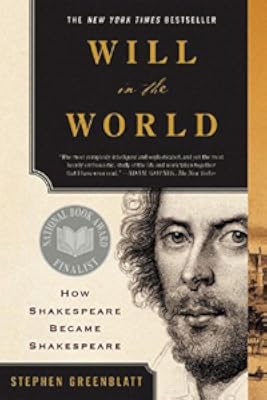
Will in the World: How Shakespeare Became Shakespeare
by Stephen Greenblatt
On This Page
Description
Will in the World interweaves a searching account of Elizabethan England with a vivid narrative of the playwright's life. We see Shakespeare learning his craft, starting a family, and forging a career for himself in the wildly competitive London theater world, while at the same time grappling with dangerous religious and political forces that took less-agile figures to the scaffold. The basic biographical facts of Shakespeare's life have been known for over a century, but now Stephen show more Greenblatt shows how this particular life history gave rise to the world's greatest writer. show lessTags
Recommendations







Member Recommendations
Member Reviews
Gosh, this is good. Greenblatt, as I think has been pointed out elsewhere, wears his erudtion lightly -- you could be excused for not recognizing this as the work of a highly-respected scholar: it's written clearly, engagingly, and is -- at least for this reader -- very much "compulsively readable" if that is synonymous with "hard to put down."
Is it speculative? sure, it has to be. It's not, as the "Oxfordians" and other conspiracy theorist-types might argue, that there is NO (or suspiciously little) evidence for the Shakespeare who wrote all those plays -- it's just that the bulk of the evidence is so mundane. It's there -- it just doesn't necessarily speak the way we might want it to. That said, I find Greenblatt's army of "may have show more been"s quite well-grounded, and at their best they do illuminate the works that we have. My favorite chapter might be "Laughter at the Scaffold" which goes into Shakespeare's eternally-discomfiting exploration of Jewishness in "The Merchant of Venice," playing it off his probable-rival Marlowe's roughly contemporary effort "The Jew of Malta" and demonstrating how much further Shakespeare went -- and why he might have done so.
As I'd hoped it would, this book is filling me with a strong desire to return to the plays, which at one time were the center of my world and certainly deserve to be there once again. show less
Is it speculative? sure, it has to be. It's not, as the "Oxfordians" and other conspiracy theorist-types might argue, that there is NO (or suspiciously little) evidence for the Shakespeare who wrote all those plays -- it's just that the bulk of the evidence is so mundane. It's there -- it just doesn't necessarily speak the way we might want it to. That said, I find Greenblatt's army of "may have show more been"s quite well-grounded, and at their best they do illuminate the works that we have. My favorite chapter might be "Laughter at the Scaffold" which goes into Shakespeare's eternally-discomfiting exploration of Jewishness in "The Merchant of Venice," playing it off his probable-rival Marlowe's roughly contemporary effort "The Jew of Malta" and demonstrating how much further Shakespeare went -- and why he might have done so.
As I'd hoped it would, this book is filling me with a strong desire to return to the plays, which at one time were the center of my world and certainly deserve to be there once again. show less
This is an engrossing and convincing look at how William Shakespeare actually managed to have the knowledge needed to write his plays. It put me in Shakespeare's world better than anything I have read--though perhaps not as well as Shakespeare in Love!
Why should we read Stephen GreenblattÕs Will in the World? There have been innumerable biographies of William Shakespeare, but the greatest of all writers remains the great unknowable. We know about the petty business dealings, the death of his son, his career as a man of the theatre, and (of course) the seemingly contemptuous bequeath to Anne Hathaway of his Ãsecond best bedÃ. But any biographer is left scratching for much more than that--apart, of course, from adducing what can be read of the man's characters from his work (an enterprise fraught with danger). Shakespeare is not Hamlet, Lear or Benedict--though, of course, he is also, in a real sense, all three. What makes Greenblatt's account the most valuable in many years show more (literally so, since famously massive advances were paid for it) is the synthesis of incisive scholarship, immense enthusiasm for the subject and an unparalleled ability to conjure up the Elizabethan world with colour and veracity. If the author's conclusion's about the genius at the centre of his narrative are open to question, Will in the World is none the worse for that--Greenblatt enjoys provoking the reader, and the result is an energetic conjuring of a brilliant man and those around him (Christopher Marlowe and Ben Johnson are evoked with enviable skill, as are such figures as the prototype for Falstaff, Robert Green). With something of the vigour of the BardÃs writing, Greenblatt takes us through the bawdy, teeming Bankside district (centuries before it became a tourist destination), and the Machiavellian, dangerous world of the court--in fact, all the splendour and misery of the Elizabethan age--and at the centre of it all, its greatest artist. The Will we meet here may owe much to GreenblattÃs very personal interpretation, but the portrait is fascinating.--Barry Forshaw show less
On June 29, 1613, the King’s Players put on Henry VIII at the Globe Theater in Southwark. Miniature cannons were fired during a scene representing Henry VIII attending a masque at Cardinal Wolsey’s house; some bits of wadding lodged in the thatched roof of the theater and set it on fire. Fortunately, the fire was slow, and there was plenty of time to rescue costumes, props, and manuscripts before the Globe burned to the ground. The rescued manuscripts included the only copies of Henry VI, Part 1; Comedy of Errors, Taming of the Shrew, Two Gentlemen of Verona, King John, Julius Caesar, As You Like It, Twelfth Night, All’s Well That Ends Well, Measure for Measure, Othello, Macbeth, Antony and Cleopatra, Coriolanus, Timon of Athens, show more Cymbeline, The Winter’s Tale, The Tempest, Henry VIII, and The Two Noble Kinsmen. That’s how close we came.
Will in the World is an uneven but ultimately worthwhile biography of Shakespeare. The problem all Shakespeare biographers have – and what provides fuel for centuries of “Who Wrote Shakespeare?” theorists – is that other than the plays, poems and sonnets there is precious little documentation on the man. We know that he was baptized in Stratford on April 26, 1564 and that he was married, still in Stratford, sometime in late November or early December 1582. He had children in 1583 (daughter) and 1585 (son and daughter twins). Sometime soon after the birth of his twins he left Stratford and went to London, where there are sparse records of him; some business transactions, minor lawsuits, property tax receipts. He did well at his trade, amassing enough money to buy substantial properties in Stratford and a building in London. He retired to a comfortable manor in Stratford sometime between 1611 and 1616; he was buried in Stratford on April 25, 1616.
This is all author Stephen Greenblatt has to work with; he has to fill it in with assumptions, hearsay from contemporaries and near-contemporaries, and, of course, inferences from the writings. Some of the assumptions, hearsay, and inference is reasonable; some is more speculative. Greenblatt goes furthest out on a limb trying to figure out what Shakespeare was doing as a child and young adult. There was a school in Stratford, and it’s reasonable Shakespeare attended it; he had to learn his small Latin and less Greek somewhere. He may have had some sort of run-in with a noble neighbor over poaching. His family fortunes seem to have declined; his father John, a glover, worked up gradually through public positions (one of his jobs was official ale taster) until he was bailiff (essentially mayor) of Stratford and then gradually loses prominence until he’s no longer mentioned in public records. Shakespeare’s marriage has provided a lot of material for speculation; he put up a £40 bond to avoid having the banns read and seems to have had marriage licenses for two different women (the question is if the William Shagspere licensed to marry Anne Hathwey on November 28 1582 is the same as the William Shaxpere licensed to marry Anne Whatley on November 27 1582, and if Anne Hathwey is the same as Anne Whatley; i.e., are there two, three, or four different people involved). The marriage question is one of the places I’d like to see some numbers; Greenblatt notes that the £40 bond represented a huge sum of money; two year’s salary for the Stratford schoolmaster. However, although he explains why the bond was necessary (you were supposed to read the banns on three successive Sundays to see if anyone objected, and Anne Hathaway was already three months pregnant) he doesn’t say how common this was; were such bonds routine or rare?. Similarly he proposes that the name “Shakespeare” in its numerous orthographic variants was common for the place and time, to provide a possible explanation for the multiple marriage licenses, he doesn’t say how common; are there a couple of other Shakespeares, or a dozen, or tens, or hundreds? Given the scanty evidence, Greenblatt accepts the relatively common position that Shakespeare and his wife didn’t really get along. The general idea is that her pregnancy made it a fowling-piece marriage; her family was relatively well-to-do and would have pressured the Shakespeares to do the right thing. They did have children, of course; however after the twins were born in 1585 there aren’t any more, even after Shakespeare’s only son died in 1596. There’s no evidence that Shakespeare even visited Stratford between 1586 and his retirement to there in 1611 or after. A lot is made of the fact that all he left to Anne was his “second best bed”; in fact Greenblatt notes that nothing was left to her in the original will at all; the bed bequest was added in a later codicil, as if Shakespeare had to be nudged to remember her with something.
Greenblatt doesn’t know quite what to do with Shakespeare in between his wedding and his arrival in London (or even exactly when that arrival was). Was he working as a glover, working as a tutor in some noble household, wandering around the country, or what? There’s a whole chapter, based on sparse to nonexistent evidence, suggesting that Shakespeare was up in the north of England working in some capacity (presumably tutor) for a cryptoCatholic family. Not impossible but not well supported either.
Once Shakespeare’s in London, Greenblatt can start using his writings as evidence for various hypotheses. The catch, of course, is Shakespeare’s writings are like the Bible; if you are sufficiently determined and willing to disregard context you can find support for just about anything you want. Thus the questions Catholic/Protestant, misogynist/philogynist, straight/gay/bi are all discussed with support for one position or another drawn from the plays/poems/sonnets but there’s no real conclusion.
Still, there’s a lot of good stuff here – background on the religious controversy in England; James I’s fear of witchcraft, and the role of actors in contemporary life (I learned that “role” is derived from “roll”; because play manuscripts were bulky and scarce, actors were given a roll of paper with only their lines and entry cues rather than the whole play). I also discovered there are several “unknown” Shakespeare plays floating around; Sir Thomas More, which exists in a single manuscript copy penned in multiple hands (Hand “D” is supposed to be Shakespeare); The Tragedy of Gowrie, banned after two performances and with no extant copies; The Two Noble Kinsmen, a collaboration between Shakespeare and John Fletcher; and the lost (maybe; might be a play renamed as The Second Maiden’s Tragedy) History of Cardenio, another Fletcher/Shakespeare collaboration.
Worth it, then, just to see the range of speculation available for the Bard of Avon. show less
Will in the World is an uneven but ultimately worthwhile biography of Shakespeare. The problem all Shakespeare biographers have – and what provides fuel for centuries of “Who Wrote Shakespeare?” theorists – is that other than the plays, poems and sonnets there is precious little documentation on the man. We know that he was baptized in Stratford on April 26, 1564 and that he was married, still in Stratford, sometime in late November or early December 1582. He had children in 1583 (daughter) and 1585 (son and daughter twins). Sometime soon after the birth of his twins he left Stratford and went to London, where there are sparse records of him; some business transactions, minor lawsuits, property tax receipts. He did well at his trade, amassing enough money to buy substantial properties in Stratford and a building in London. He retired to a comfortable manor in Stratford sometime between 1611 and 1616; he was buried in Stratford on April 25, 1616.
This is all author Stephen Greenblatt has to work with; he has to fill it in with assumptions, hearsay from contemporaries and near-contemporaries, and, of course, inferences from the writings. Some of the assumptions, hearsay, and inference is reasonable; some is more speculative. Greenblatt goes furthest out on a limb trying to figure out what Shakespeare was doing as a child and young adult. There was a school in Stratford, and it’s reasonable Shakespeare attended it; he had to learn his small Latin and less Greek somewhere. He may have had some sort of run-in with a noble neighbor over poaching. His family fortunes seem to have declined; his father John, a glover, worked up gradually through public positions (one of his jobs was official ale taster) until he was bailiff (essentially mayor) of Stratford and then gradually loses prominence until he’s no longer mentioned in public records. Shakespeare’s marriage has provided a lot of material for speculation; he put up a £40 bond to avoid having the banns read and seems to have had marriage licenses for two different women (the question is if the William Shagspere licensed to marry Anne Hathwey on November 28 1582 is the same as the William Shaxpere licensed to marry Anne Whatley on November 27 1582, and if Anne Hathwey is the same as Anne Whatley; i.e., are there two, three, or four different people involved). The marriage question is one of the places I’d like to see some numbers; Greenblatt notes that the £40 bond represented a huge sum of money; two year’s salary for the Stratford schoolmaster. However, although he explains why the bond was necessary (you were supposed to read the banns on three successive Sundays to see if anyone objected, and Anne Hathaway was already three months pregnant) he doesn’t say how common this was; were such bonds routine or rare?. Similarly he proposes that the name “Shakespeare” in its numerous orthographic variants was common for the place and time, to provide a possible explanation for the multiple marriage licenses, he doesn’t say how common; are there a couple of other Shakespeares, or a dozen, or tens, or hundreds? Given the scanty evidence, Greenblatt accepts the relatively common position that Shakespeare and his wife didn’t really get along. The general idea is that her pregnancy made it a fowling-piece marriage; her family was relatively well-to-do and would have pressured the Shakespeares to do the right thing. They did have children, of course; however after the twins were born in 1585 there aren’t any more, even after Shakespeare’s only son died in 1596. There’s no evidence that Shakespeare even visited Stratford between 1586 and his retirement to there in 1611 or after. A lot is made of the fact that all he left to Anne was his “second best bed”; in fact Greenblatt notes that nothing was left to her in the original will at all; the bed bequest was added in a later codicil, as if Shakespeare had to be nudged to remember her with something.
Greenblatt doesn’t know quite what to do with Shakespeare in between his wedding and his arrival in London (or even exactly when that arrival was). Was he working as a glover, working as a tutor in some noble household, wandering around the country, or what? There’s a whole chapter, based on sparse to nonexistent evidence, suggesting that Shakespeare was up in the north of England working in some capacity (presumably tutor) for a cryptoCatholic family. Not impossible but not well supported either.
Once Shakespeare’s in London, Greenblatt can start using his writings as evidence for various hypotheses. The catch, of course, is Shakespeare’s writings are like the Bible; if you are sufficiently determined and willing to disregard context you can find support for just about anything you want. Thus the questions Catholic/Protestant, misogynist/philogynist, straight/gay/bi are all discussed with support for one position or another drawn from the plays/poems/sonnets but there’s no real conclusion.
Still, there’s a lot of good stuff here – background on the religious controversy in England; James I’s fear of witchcraft, and the role of actors in contemporary life (I learned that “role” is derived from “roll”; because play manuscripts were bulky and scarce, actors were given a roll of paper with only their lines and entry cues rather than the whole play). I also discovered there are several “unknown” Shakespeare plays floating around; Sir Thomas More, which exists in a single manuscript copy penned in multiple hands (Hand “D” is supposed to be Shakespeare); The Tragedy of Gowrie, banned after two performances and with no extant copies; The Two Noble Kinsmen, a collaboration between Shakespeare and John Fletcher; and the lost (maybe; might be a play renamed as The Second Maiden’s Tragedy) History of Cardenio, another Fletcher/Shakespeare collaboration.
Worth it, then, just to see the range of speculation available for the Bard of Avon. show less
Much of the life of William Shakespeare is a mystery. He carefully did not keep a diary nor send love letters to his wife. Shakespeare, the prolific writer who, in just over 50 years wrote an almost unbelievable number of remarkable poems and plays, did not leave many personal details of his life beyond public records (which are spotty 400 years later). There was not a market for biographies of famous playwrights in the 1600s, and many details of his life were not written down until he was long gone.
Yet, in Will in the World, Stephen Greenblatt attempts to explain Shakespeare’s life by reading what he did write: his plays. In a truly remarkable way, Greenblatt ties the Bard’s life into the context of Victorian England by visiting show more the context of his plays.
Despite being an English major, I am not very familiar with most of Shakespeare’s work, let alone his life. I found Greenblatt’s look at Shakespeare’s life through his plays be utterly fascinating. Even if none of the suppositions Greenblatt provides were true, understanding the cultural context of the plays will help me in my future studies of the plays. I loved this “literary” biography, and I’d highly recommend it to those interested in the cultural context of the Bard.
More detailed review on my blog show less
Yet, in Will in the World, Stephen Greenblatt attempts to explain Shakespeare’s life by reading what he did write: his plays. In a truly remarkable way, Greenblatt ties the Bard’s life into the context of Victorian England by visiting show more the context of his plays.
Despite being an English major, I am not very familiar with most of Shakespeare’s work, let alone his life. I found Greenblatt’s look at Shakespeare’s life through his plays be utterly fascinating. Even if none of the suppositions Greenblatt provides were true, understanding the cultural context of the plays will help me in my future studies of the plays. I loved this “literary” biography, and I’d highly recommend it to those interested in the cultural context of the Bard.
More detailed review on my blog show less
Really interesting and fun. In describing events, conflicts, and culture in Shakespeare's world, Greenblatt freely admits at many points that he is speculating when he makes connections between events which may have occurred in Shakespeare's life or may otherwise have made an impression on him, and aspects of his work as a poet and a playwright. Even when the connections seemed particularly tenuous (such as whether Shakespeare worked briefly as a tutor in a wealthy Catholic household), the history was interesting to me, and even without a direct connection, I suppose someone as alive to his times as Shakespeare was would probably have been affected to some extent by what was “in the air.” The only chapter when Greenblatt's show more “supposings” seemed to get out of hand was the one on the sonnets. I found his arguments here inconsistent and unconvincing – he admits, for example, that Shakespeare's intentions regarding the order and relations between the sonnets cannot be known, not to mention the extent, if any, to which they were “personal” rather than imaginative (and commercial) art, and then he goes on to build an elaborate story based on his preferred interpretation. Still, he more than makes up for this in the chapters where he treats Elizabethan antisemitism and witchcraft, both of which were particularly well done and will add to my enjoyment next time I read “The Merchant of Venice” and “Macbeth.” Definitely worth a look for those who enjoy Shakespeare! show less
Will in the World – How Shakespeare Became Shakespeare by Stephen Greenblatt. 2004. Read in December, 2009.
The book represents my first meeting with Shakespeare scholar Stephen Greenblatt. It has proven to be a fruitful acquaintance and I often use Greenblatt's analyses in my texts these days.
There are three (at least) strengths in Greenblatt's approach to this book: he is a materialist historian with a profound knowledge of the period, he is a profound Shakespearean and he is a very good writer.
It's fun to read this book, which is jam-packed with historical details. He opens the book with one of them, the first two lines of a nursery rhyme Shakespeare's mother might well have sung to him, “Pillycock, pillycock, sate on a show more hill/If he's not gone – he sits there still.” This emerges some thirty or so years later, Greenblatt tells us, in King Lear when Poor Tom sings “Pillicock sat on Pillicock-hill” (p.23).
Shakespeare is placed squarely in his time in this book, a time of violence, hierarchy, disease and poverty but also a time of great change and excitement. One of the paradoxes of this society “ - art as the source both of settled calm and of deep disturbance – was central to Shakespeare's entire career...” and “he was simultaneously the agent of civility and the agent of subversion” (page 48).
The book seems to cover everything. On the speculations on Shakespeare's religious beliefs the conclusion is: “If his father was both Catholic and Protestant, William Shakespeare was on his way to becoming neither” (page 113). On the question of love, Shakespeare's view on “intense courting and pleading and longing” is shown to be “one of his abiding preoccupations, [and] one of the things he understood and expressed more profoundly than almost anyone in the world” (page 119). In relating the very complex and generally negative view of marriage in the plays to Shakespeare's own marriage to Anne Hathaway, Greenblatt lands on a very unhappy interpretation which was later refuted by Germaine Greer in her Shakespeare's Wife and I will reserve comment until I get to that book.
But we're still only halfway through the book. Another example. On the anti-antisemitism of Shakespeare's day and the difficulty some modern readers have in reading The Merchant of Venice, for example, Greenblatt writes that “”something enabled him to discover in his stock villain a certain music – the sounds of a tense psychological inwardness, a soul under siege” (page 272) and “he wanted at the same time to call laughter into question, to make the amusement excruciatingly uncomfortable” (page 278). Even though Shylock is indeed a nasty character, “the play gives us too much insight into his inner life, too much of a stake in his identity and fate, to enable us to laugh freely and without pain” (page 286). Maybe I'm emphasizing this because Hal and I are in the middle of reading The Merchant of Venice right now, but these words I find applicable to almost all of Shakespeare.
I really must stop writing or I'll end up making this review as long as the book itself but Greenblatt's ending chapter, “The Triumph of the Everyday” must be mentioned. Shakespeare chose to live out his life far from the glamor and excitement of the London theater world and retired to Stratford for his last years. We don't know why but Greenblatt gives us a reasonable explanation, found in the plays themselves. Yes, Shakespeare loved the exotic, the dramatic, the fantastical and imaginative. But what makes him still read and loved is what he shows us of the everyday, “the ordinariness in the midst of the extraordinary.” Interspersed amongst his kings, queens, nobles, arch-villains and superheros we find the “small talk, trivial pursuits, and foolish games of ordinary people”. He returned home to his wife, his remaining children, his grandchild, his neighbors, as he so often had throughout the years, for the “strange, slightly melancholy dimension, a joy intimately braided together with renunciation...[the] strangeness that hides within the boundaries of the everyday” that characterizes all of his plays, and “that is where he was determined to end his days” (pages 388-390).
This book is vital for anyone interested in Shakespeare and his world.
First posted on rubyjandshakespearecalling@blogspot.com show less
The book represents my first meeting with Shakespeare scholar Stephen Greenblatt. It has proven to be a fruitful acquaintance and I often use Greenblatt's analyses in my texts these days.
There are three (at least) strengths in Greenblatt's approach to this book: he is a materialist historian with a profound knowledge of the period, he is a profound Shakespearean and he is a very good writer.
It's fun to read this book, which is jam-packed with historical details. He opens the book with one of them, the first two lines of a nursery rhyme Shakespeare's mother might well have sung to him, “Pillycock, pillycock, sate on a show more hill/If he's not gone – he sits there still.” This emerges some thirty or so years later, Greenblatt tells us, in King Lear when Poor Tom sings “Pillicock sat on Pillicock-hill” (p.23).
Shakespeare is placed squarely in his time in this book, a time of violence, hierarchy, disease and poverty but also a time of great change and excitement. One of the paradoxes of this society “ - art as the source both of settled calm and of deep disturbance – was central to Shakespeare's entire career...” and “he was simultaneously the agent of civility and the agent of subversion” (page 48).
The book seems to cover everything. On the speculations on Shakespeare's religious beliefs the conclusion is: “If his father was both Catholic and Protestant, William Shakespeare was on his way to becoming neither” (page 113). On the question of love, Shakespeare's view on “intense courting and pleading and longing” is shown to be “one of his abiding preoccupations, [and] one of the things he understood and expressed more profoundly than almost anyone in the world” (page 119). In relating the very complex and generally negative view of marriage in the plays to Shakespeare's own marriage to Anne Hathaway, Greenblatt lands on a very unhappy interpretation which was later refuted by Germaine Greer in her Shakespeare's Wife and I will reserve comment until I get to that book.
But we're still only halfway through the book. Another example. On the anti-antisemitism of Shakespeare's day and the difficulty some modern readers have in reading The Merchant of Venice, for example, Greenblatt writes that “”something enabled him to discover in his stock villain a certain music – the sounds of a tense psychological inwardness, a soul under siege” (page 272) and “he wanted at the same time to call laughter into question, to make the amusement excruciatingly uncomfortable” (page 278). Even though Shylock is indeed a nasty character, “the play gives us too much insight into his inner life, too much of a stake in his identity and fate, to enable us to laugh freely and without pain” (page 286). Maybe I'm emphasizing this because Hal and I are in the middle of reading The Merchant of Venice right now, but these words I find applicable to almost all of Shakespeare.
I really must stop writing or I'll end up making this review as long as the book itself but Greenblatt's ending chapter, “The Triumph of the Everyday” must be mentioned. Shakespeare chose to live out his life far from the glamor and excitement of the London theater world and retired to Stratford for his last years. We don't know why but Greenblatt gives us a reasonable explanation, found in the plays themselves. Yes, Shakespeare loved the exotic, the dramatic, the fantastical and imaginative. But what makes him still read and loved is what he shows us of the everyday, “the ordinariness in the midst of the extraordinary.” Interspersed amongst his kings, queens, nobles, arch-villains and superheros we find the “small talk, trivial pursuits, and foolish games of ordinary people”. He returned home to his wife, his remaining children, his grandchild, his neighbors, as he so often had throughout the years, for the “strange, slightly melancholy dimension, a joy intimately braided together with renunciation...[the] strangeness that hides within the boundaries of the everyday” that characterizes all of his plays, and “that is where he was determined to end his days” (pages 388-390).
This book is vital for anyone interested in Shakespeare and his world.
First posted on rubyjandshakespearecalling@blogspot.com show less
Members
- Recently Added By
Lists

Top Five Books of 2013
1,562 works; 715 members

Biografías eminentes
24 works; 1 member

Unread books
1,063 works; 87 members

Non-Fiction Worth Reading
1,015 works; 255 members

College Reads (Lit Edition)
75 works; 5 members

Books Read in 2025
4,091 works; 97 members
Author Information

112+ Works 18,769 Members
Stephen Greenblatt is a literary critic, theorist and scholar. He is the author of Three Modern Satirists: Waugh, Orwell, and Huxley (1965); Renaissance Self-Fashioning: From More to Shakespeare (1980); Learning to Curse: Essays in Early Modern Culture (1990); Redrawing the Boundaries: The Transformation of English and American Literary Studies show more (1992); The Norton Shakespeare (1997); Will in the World: How Shakespeare Became Shakespeare (2004); Shakespeare's Freedom (2010); and The Swerve: How the World Became Modern (2011). (Bowker Author Biography) show less
Awards and Honors
Awards
Distinctions
Notable Lists
Work Relationships
Is a commentary on the text of
Has as a student's study guide
Common Knowledge
- Canonical title
- Will in the World: How Shakespeare Became Shakespeare
- Original publication date
- 2004
- People/Characters
- William Shakespeare; Elizabeth I, Queen of England; Rodrigo Lopez
- Important places
- England, UK
- Important events
- Tudor Era; Elizabethan Era; Jacobean Era; English Renaissance; Renaissance; 16th century (show all 7); 17th century
- First words
- A young man from a small provincial town--a man without independent wealth, without powerful family connections, and without a university education--moves to London in the late 1580s and, in a remarkably short time, becomes t... (show all)he greatest playwright not of his age alone but of all time.
- Quotations
- A pack of paper that, neatly folded and cut, yielded about 50 small sheets, would have cost at least fourpence, or the equivalent of eight pints of ale, more than a pound of raisins, a pound of mutton and a pound of beef, two... (show all) dozen eggs or two loaves of bread.
- Last words
- (Click to show. Warning: May contain spoilers.)And that is where he was determined to end his days.
- Blurbers
- Mee, Charles; Pinsky, Robert; Packer, Tina; Beale, Simon Russell; Wells, Stanley; Davis, Natalie Zemon (show all 7); Gopnik, Adam
Classifications
- Genres
- Literature Studies and Criticism, Biography & Memoir, Nonfiction, Poetry, History
- DDC/MDS
- 822.33 — Literature & rhetoric English & Old English literatures English drama 1558-1625 Elizabethan period William Shakespeare
- LCC
- PR2894 .G74 — Language and Literature English English Literature English renaissance (1500-1640)
- BISAC
Statistics
- Members
- 3,734
- Popularity
- 4,288
- Reviews
- 59
- Rating
- (3.89)
- Languages
- 13 — Czech, Dutch, English, Finnish, French, German, Italian, Lithuanian, Polish, Portuguese, Russian, Spanish, Turkish
- Media
- Paper, Audiobook, Ebook
- ISBNs
- 41
- UPCs
- 1
- ASINs
- 17