William Tell Told Again
by P. G. Wodehouse
On This Page
Description
Please visit www.ManorWodehouse.com to see the complete selection of P. G Wodehouse books available in the Manor Wodehouse Collection.Tags
Recommendations















Member Reviews
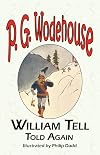
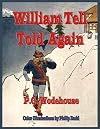
By 1904, the young P.G. Wodehouse was doing relatively well as a journalist and as an author of public-school stories for boys' magazines, but he was still far from established and was happy to take on anything that promised to pay well. His sole children's book, William Tell told again, clearly falls into this category. It was a kind of Pickwick Papers project: the publisher had already commissioned the illustrations from Kate Greenaway's nephew, Philip Dadd, some years before, but they needed a text go with them, and they obviously wanted to get the book out quickly to benefit from interest in the subject due to the centenary of the Schiller play.
Wodehouse obliged with a short, flippant retelling of the story cribbed directly from show more Schiller (presumably a translation, as he didn't speak German). The only entirely original part is the opening, where he condenses everything that takes up Schiller's Acts I and II into a scene where a delegation of concerned citizens visit Gessler to ask him to reduce their tax burden: he sends them packing with a comically trivial bit of torture. We might have our doubts about whether comic torture belongs in a children's book, but then again, the whole story is "don't try this at home" territory. At least two of Wodehouse's later adult books have scenes where small boys get into trouble for attempting to re-enact Tell's apple shot (in one case the Empress is asked to play the part of Tell jr.).
Where Wodehouse really enjoys himself is the scene with the two men-at-arms, which is turned into something like a London crowd jostling a couple of nervous policemen, with some of Schiller's best lines re-used in clever ways. He doesn't bother with the hollow way scene, but borrows Rossini's ending instead, having Tell shoot Gessler in the boat, directly after his leap ashore. As the pictures were done first, it's not always clear who was responsible for the line the narrative takes, of course: Dadd probably had more to do with it than Wodehouse.
Most Wodehouse biographers are rather snooty about this book, if they mention it at all (David Jasen: "If nothing else the book must have been a sore disappointment to boys who bought it in expectation of another familiar school story."). That's probably a bit unfair, and might be largely because it was very difficult to get hold of before it was digitised by Project Gutenberg. It's not great literature, but it's no worse than all the other things Wodehouse was doing to earn money at the time, and it's conscientiously executed with quite a few good jokes. show less
Wodehouse obliged with a short, flippant retelling of the story cribbed directly from show more Schiller (presumably a translation, as he didn't speak German). The only entirely original part is the opening, where he condenses everything that takes up Schiller's Acts I and II into a scene where a delegation of concerned citizens visit Gessler to ask him to reduce their tax burden: he sends them packing with a comically trivial bit of torture. We might have our doubts about whether comic torture belongs in a children's book, but then again, the whole story is "don't try this at home" territory. At least two of Wodehouse's later adult books have scenes where small boys get into trouble for attempting to re-enact Tell's apple shot (in one case the Empress is asked to play the part of Tell jr.).
Where Wodehouse really enjoys himself is the scene with the two men-at-arms, which is turned into something like a London crowd jostling a couple of nervous policemen, with some of Schiller's best lines re-used in clever ways. He doesn't bother with the hollow way scene, but borrows Rossini's ending instead, having Tell shoot Gessler in the boat, directly after his leap ashore. As the pictures were done first, it's not always clear who was responsible for the line the narrative takes, of course: Dadd probably had more to do with it than Wodehouse.
Most Wodehouse biographers are rather snooty about this book, if they mention it at all (David Jasen: "If nothing else the book must have been a sore disappointment to boys who bought it in expectation of another familiar school story."). That's probably a bit unfair, and might be largely because it was very difficult to get hold of before it was digitised by Project Gutenberg. It's not great literature, but it's no worse than all the other things Wodehouse was doing to earn money at the time, and it's conscientiously executed with quite a few good jokes. show less
First released in 1904, this was P. G. Wodehouse’s fifth publication. His first four books are set in an all-boys’ school, whereas this is a complete departure, mixing historical fiction, humour, and child fiction.
I almost avoided this tale with it being aimed at children, but after reading a few reviews by adults I thought I’d give it a go. It’s not bad and makes a change whilst featuring elements of what would become Mr Wodehouse’s unique writing style.
I almost avoided this tale with it being aimed at children, but after reading a few reviews by adults I thought I’d give it a go. It’s not bad and makes a change whilst featuring elements of what would become Mr Wodehouse’s unique writing style.
Endeariŋ, humorous retelliŋ of the legend
Ratings
Members
- Recently Added By
Lists

A Child's Book Tour of Switzerland
25 works; 3 members

Children's Literature 1900 - 1950 in order
413 works; 8 members
Author Information

656+ Works 110,701 Members
P. G. Wodehouse was born in Guildford, United Kingdom on October 15, 1881. After completing school, he spent two years as a banker at the Hong Kong and Shanghai Bank in London and then took a job as a sports reporter and columnist for the Globe newspaper. His first novel, The Pothunters, was published in 1902. He wrote over 100 novels and short show more story collections during his lifetime including A Perfect Uncle, Love Among the Chickens, The Swoop, P. Smith in the City, Meet Mr. Milliner, Doctor Sally, Quick Service, The Old Reliable, Uneasy Money, A Damsel in Distress, Jill the Reckless, The Adventures of Sally, A Pelican at Blandings, The Girl in Blue, and Aunts Aren't Gentlemen. His most famous characters, Bertie Wooster and his manservant, Jeeves, appeared in books such as Much Obliged, Jeeves. He also wrote lyrics for musical comedies and worked as screenwriter in Hollywood in the 1930s. In 1939, he bought a villa in Le Touquet on the coast of France. He remained there when World War II started in 1939. The following year, the Germans appropriated the villa, confiscated property, and arrested him. He was detained in various German camps for almost one year before being released in 1941. He went to Berlin and spoke of his experience in five radio talks to be broadcast to America and England. The talks themselves were completely innocuous, but he was charged with treason in England. He was cleared, but settled permanently in the United States. He became a citizen in 1955. He was made a Knight Commander of the Order of the British Empire in 1975. He died from a heart attack after a long illness on February 14, 1975 at the age of 93. (Bowker Author Biography) show less
Some Editions
Series
Belongs to Publisher Series
Common Knowledge
- Canonical title
- William Tell Told Again
- Original publication date
- 1904
- People/Characters
- William Tell; Hermann Gessler
- Important places
- Switzerland
- Important events
- William Tell's defiance
- Dedication
- To Biddy O'Sullivan
for a Christmas present - First words
- Once upon a time, more years ago that any body can remember, before the first hotel had been built or the first Englishman had taken a photograph of Mont Blanc and brought it home to be pasted in an album and shown after tea ... (show all)to his envious friends, Switzerland belong to the Emperor of Austria to do what he liked with.
- Last words
- (Click to show. Warning: May contain spoilers.)As for William Tell, he retired to his home, and lived there very happily ever afterwards with his wife and his two sons, who in a few years became very nearly as skillful in the use of the cross-bow as their father.
(Click to show. Warning: May contain spoilers.). . . I only know
That taxes aren't abolished.
Classifications
Statistics
- Members
- 120
- Popularity
- 271,386
- Reviews
- 3
- Rating
- (3.56)
- Languages
- English
- Media
- Paper, Audiobook, Ebook
- ISBNs
- 30
- ASINs
- 7