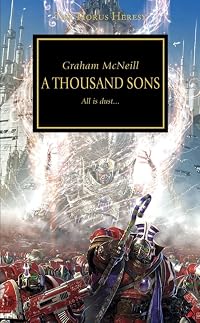
A Thousand Sons
by Graham McNeill
The Horus Heresy Novels (12), The Horus Heresy (XII), Warhammer 40,000 (fiction) (Horus Heresy novel #12)
On This Page
Description
Book twelve in the New York Times bestselling series The Great Crusade is at its height, and the Thousand Sons are its most dedicated warriors. Though utterly loyal, the Legion of Magnus the Red is viewed with suspicion for its arcane methods. Feared by the Imperium he has sworn to serve, Magnus is called to the planet of Nikaea to answer charges of sorcery. When the ill-fated primarch foresees the treachery of Warmaster Horus and warns the Emperor with forbidden powers, the Master of show more Mankind dispatches Leman Russ, Primarch of the Space Wolves, to attack Prospero. But Magnus has seen far more than the betrayal of Horus and his revelations will seal the fate of his Legion forever. show lessTags
Recommendations










Member Recommendations
leigonj Events in Thousand Sons intersect with those in False Gods.
Member Reviews
This Warhammer entry, by whom I consider the master writer thus far of the Horus Heresy saga, is epic in plot, characters, and emotion. A basic summary without getting too long winded like so many reviews I see: the Emperor has decreed that any sorcery by his beloved primarchs and their Legions as an abomination. Snap back to the main protagonists of this book, the Thousand Sons Legion and their primarch Magnus, who basically were created out of the ashes of Chaos infected genes, and rely on some unholy sorceristic methods of fighting, and the reader then sees the beginnings of some tremendous conflict between the Emperor and Magnus. On top of this, as a tie in to the overall saga, Magnus defies the Emperor to warn of upcoming show more traitorous actions by none other than Horus himself. This sets in motion the Emperor's direction of the Space Wolves, led by Leman Russ, to extinguish the Thousand Sons on their home world of Prospero. A gathering of very well-developed characters, fast paced plot, and emotionally wrenching details of the final battle make this what I believe to arguably be the best of the twelve Horus Heresy novels I've read to this point. Simply fantastic. show less
I read this as part of Horus Heresy Omnibus Project reading guide Omnibus III: The Burning of Prospero
(https://www.heresyomnibus.com/omnibus/iii-the-burning-of-prospero) as part of my Oath of Moment to complete the series.
When I think of the Horus Heresy series, especially before starting this endeavor, the Burning of Prospero, encompassing the Council of Nikaea, Magnus' folly, and the razing of Tizca, is the second thing that comes to mind, after the Rise and Fall of Horus that leads to Isstvan, so I have been absolutely gagging to get back to the epic duology that starts here (trilogy if you include Battle of the Fang that continues the story from Prospero Burns a cool 10,000 years later [and the Hunt for Magnus and John French's show more Ahriman series]).
I believe this was my third time reading this book, with the first being upon release and the second being a handful of years later, so it's been a long time. I had a bizarre time that was definitely borne of expectations and familiarity of re-reading, having read a lot more, in general, Warhammer, and Horus Heresy, and just how heavily invested in and sympathetic to the Word Bearers and Lorgar (never ever Erebus or Kor Phaeron) with Argal Tal and Kurtha Sedd being two of my favourite characters in the whole series. I think I was hoping to feel a powerful connection with an event, aspect, or character early that would really get me invested, as sheer trauma and shame in the razing of Monarchia for the XVII and the utter devastation and betrayal with the Battle of Calth for the Ultramarines. I definitely got there, but this book is a slow starter that becomes a Juggernaut (of Khorne stolen and being joyridden by pink and blue horrors) of momentum by the end.
*Vague outline of the plot that could be considered spoilers*
The first part of the book sees the Thousand Sons and Space Wolves deployed together to bring down the hammer of the Emperor on a world that refused colonisation and adoption of complete Imperial hegemony aka Compliance. Magnus is far more interested in an ancient Aeldari temple that guards something both intriguing and portentous, ultimately leading to awakening the temples defences and pitched battle. Later in the same campaign Magnus witnesses must how destructive the VI are and makes a stand in front of a library to protect it from the murder-make. What should he a simple 'guys, chill. I just want to check some books out before you Wolf Smash', but it becomes a whole thing because in the Dark Millennia if two groups have a reason for hating each other, half the time they already hate each other anyway. Ahriman, the Thousand Sons Chief Librarian, and, the Rune Priest, Wyrdmake, strike up an unlikely friendship, bonding over being Space Wizards. We also get introduced to the Remembrancers with the XV, who all have some kind of psychic ability.
The second part covers the Council of Nikaea aka Everybody Hates Magnus, where the the level and amount of psykers in his Legion, the powers they have, and the entire concept of whether the Imperium even wants proto human armoured Space Battle Wizards at all takes place. Lots of opinions, accusations, and heartfelt statements are made...it's a whole thing.
The third part sees Magnus emulating Nick Fury and having a vision of Horus and the future leading him to do big magic to go have a word, which is where we see him appearing in False Gods when Horus is being 'treated' for getting shanked with the Athame, and even biggerer, darker magic to fax himself to the Emperor to let him know. To which the Emperor replies, "You got a problem, son. I'm on the motherfucker. Go back in there, chill them Tizcas out and wait for the Wolf, who should be coming directly.'
**Less vague discussion that may contain spoilers**
I really struggled with the opening of this because I found it rather boring, which is at least somewhat on me. I remember the first time reading it being absolutely wrapt by seeing he Wraithbone statues because I had not really seen any Eldar stuff on books before, which isn't actually very interesting because there's very little detail or discussion until it really kicks off. This time though I didn't have the impact of seeing the big ole thing for the first time, and I'd been around the Thousand Sons for a while, without really getting a feel for them or caring about them enough to really feel any engagement or peril from the battle. There is the intriguing thing in the temple, furtive work of magnus, and his Astartes being disconcerted, but the crumbs were too small for me to really be tantalised.
I think the thing I struggled with most about the opening section is the rather weak characterisation and introduction of a new trio of Remembrancers that give this whole part a feel of a weaker Horus Rising re-tread. A bit like how Marvel went through a whole period of just remaking Iron Man with different characters. It's not helped by how not dissimilar they are to Keeler, Oliton, and Karkasy, with Karkasy's analogue seemingly a more polite version of him with less talent and providing McNeill a male perspective on the two women he's friends with and one of a number of just fucking weird and gross old dudebro misogyny and embarrassing bits of narration that show just how alien the idea of gender politics, and women as a whole gender, are to him. For example the narration around this Remembrancer uses the word "deflower" when describing how a lot of guys fancy a grown arse woman and "things a gentleman shouldn't see" when, presumably, menstrual products fall out of one of the women's bags as she is literally having a fit. Alas, this is par for the course with Black Library, but especially McNeill, and I just have to roll my eyes and highlight how fucked up and not OK this is when I review his books. Shattersong and with it Fulgrim creeps ever closer for his most virulent expressions of misogyny and bioessentialism.
Anyways, I found the first part boring and off-putting, but written well and containing promise, so it felt like making sure you eat your sexist vegetables so you can have pudding.
The second part with the Council of Nikaea is infinitely more interesting and actually heartbreaking with some intimate moments between Magnus and his closest sons, foreboding visions, and some truly heinous and heartfelt statements, as well as a truly shocking and brutal end to proceedings that I'm not going to get into because spoilers. Sometimes it's hard to talk about good stuff without giving to much away, but I do want to make the point that, for me, this is where I feel like the book really starts and I actually start to really get invested.
I also like the classic tradition of the Warhammer galaxy being filled with riffs on historical events and aspects of, primarily, Abrahamic religions, coming into play here. The Council of Nikaea explicitly evokes the First Council of Nicaea where a lot of Christian law and the biblical canon was decided upon. I don't know a huge amount about this, but in a cursory search I saw some Christian people pushing back on the latter point with the argument that it's just a conspiracy to say that only the wealthy and powerful held sway over the biblical canon and the way the various churches operate. I absolutely respect anyone's faith that isn't causing them to harm others. It is not religiously intolerant to find the idea the hierarchal structures of organised religion aren't predominantly influenced by money and power absolutely hilarious and fundamentally not true--this isn't a criticism of any one faith or anyone's individual beliefs to be explicit.
Anyways...
The third part is really the beating hearts of this story where secrets are revealed or kept and more lies told, characters are so naive and egotistical they damn themselves and everyone around them, father's and sons are not just angry or disappointed, they're both, and heatbroken, oh, and an absolutely ridiculously epic and terribly sad battle takes place.
(taking a break to come back to this another time, as this has already taken ages - and we're back!)
The last act or this book contains so many significant moments with ramifications for the Thousand Sons, Magnus, the Space Wolves, Horus, the Emperor, and the entire course of the Horus Heresy, the Imperium, and the Dark Millennium, and this doesn't even include the Council and Edict of Nikaea and their ramifications. I am unsure if there is an agreed upon word for a group of Epochs, so I'm going to go with mu gut.
This book, particularly the last act, is an absolute clusterfuck of Epochs.
***Endeavouring to stay within a reasonable level and long established in Warhammer 40K lore to avoid too much, but potentially SPOILERS from now on - Honestly, it's kinda baffling the idea of someone getting this far in the series, let alone this review, without having some prior knowledge of the Darker Red vs Lighter Blue cousins to the more traditional pallete of the Word Bearers and Ultramarines***
It was at this point I realised the narrative of this story and the tragedy of Magnus and his Thousand Sons was something rather different to the Luna Wolves/ Sons of Horus, the Word Bearers, and the Ultramarines. This story is more of a slow burn, though I don't believe this excuses how bland I personally find much of the first act, and the tragedy is less of getting to know and love characters who are devastated by the actions of others, Nikaea notwithstanding, and fall to darkness through internal conflict, despair, and/ or specifically being done dirty by the Emperor; the sin of the XV and their Crimson King is hubris. Like the Emperor's Children, ego is the core of their damnation, but while Fulgrim and his sons believe themselves to martial and aesthetic perfection, the Sons of Prospero are self-assured in their command of knowledge and the abilites of the warp to not become the become the quantum curiosity of Schrodinger's cat, which is kinda apropos when you think about how Rubric Marines can be seen as both dead and alive, but the answer becomes definitive if you open their armour up. These are not traits thar create likeable characters (on an emotional level), but they are fascinating, and when their fall comes, as brutally and tragically as it does for Prospero (and how insidiously creeping for the Phoenician and his sons), liking them is irrelevant. In fact, my surprise at feeling so unsympathetic to Magnus for the majority of this book and not really connecting with Ahriman for a long time actually made the crescendo of their true intentions and intense emotions shock and hit me all the harder.
One or the things that I most cherish about the Horus Heresy is the allusions to mythology, historic figures and events, and the legendary archetypes it employs, retelling, conglomerating, and remixing tales from all manner of stories from various creeds, cultures, and traditions from throughout history and across the world in a way that is rich and engaging. It's a strange cousin to historical and mythological fiction, but in a grimdark space opera format. I am fascinated my myths, legends, and folklore, but can find translations of this wonderful ancient stories impenetrable because they are often told in an (understandably) archaic manner that bounces of my AuDHD addled brain. This is why I find books like the Children of Jocasta by Natalie Haynes and Circe by Madeline Miller so satisfying, but found Neil Gaiman's Norse Mythology an impressive tome, but rather disappointing compared to something like American Gods, as I was hoping for expanded and immersive retelling, grounded in the detail of the originals, but injected with the intimate and personal that I am most drawn to opposed to a well-written and more accessible version of the stories that maintains the 'being told a story by the text ', rather than 'observing the story taking place as a witness.'
Unfortunately, this comes with the wildly vacillating sensitivity from a group of predominantly white, British, cishet men without sensitivity reading, cultural consultants, or, seemingly, any grasp of feminism. But when it works it is a beautiful thing.
Magnus most obviously embodying Odin, who gave his eye and one form of his life for knowledge, with the Cult of the Corvidae's name and prognostication evoking the All-Father's ravens, Huginn and Muninn, but there are so many other mythological shards his contains; Pandora and the dangers of forbidden knowledge (in many ways passed to Ahriman, along with the Book of Magnus), Sophia bringing instability through knowledge, Prometheus and sharing the knowledge fire with man, figuratively with manipulating the warp and literally wirh the XV's Cult of the Pyrae, and Kassandra, often depicted with red-auburn hair, and true prophecies ignored, to name a few.
This leads to rhe glorious irony and imagery of Magnus and Russ as mortal enemies, with the Wolf King as the apotheosis of the Space Sword Dane and the Emperor's 'justice', making there's a confrontation between Odin, whose name can be derived as 'leader of the possessed', and Týr, the Norse god of war and justice. The Vlka Fenryka call the Emperor the All-Father, one of Odin's titles, which is also perfect as in many ways Magnus is the Primarch most closely modelled on their father, reinforced by certain plans...
(Oh no! Looks like I'm about to start a document to chart refernces I come across...)
[We also really gotta talk about the sheer amount of corvid refernces, not just in the Thousand Sons and Raven Guard, but throughout the Legions and all of the Dark Millennia, including the shrouded and covetous Blood Ravens somewhen... I mean, the most likely short answer is that black birds are omenous and synonymous with death, so many gods, etc. and the birds themselves, feathers, and skulls all look cool and have a variety of cultural significances]
It is this mythological element, along with with the dramatic irony of the Horus Heresy and it's after effects being largely known, aside from the details and various twists of fate over the years that, depending on your perspective of him as figure, have not been kind to Sanguinius, that comes up in negative reviews of people acting in ridiculous ways or making wild decisions. At times it's a weak response, but it is also true - that's myths and drama, baybee! Without the ludicrous events, archetypal characters, and huge melodramatic swings, you don't get stories and events on this scale. A lot of myths and legends don't makes sense to assumed logic and sometimes the tragedy comes from the 'if you had just not done the thing, told the truth, actually had a conversation, etc.' You absolutely don't have to like it, and there are certainly times when it does more effectively than others, but it is what it is - a feature not a bug.
In the same vein, I have realised that the Emperor is, at least for me, best viewed as some kind of cthonic amalgamation of Zeus and a completely unknowable and alien being with godlike powers and perceptions that are anathema to truly understanding like Cthulhu.
I had a whole bunch of quotes and comments from my posted updates while reading this, but this has already gone on way too long and gotten too granular, so let's start wrapping this up.
Something I found very funny and probably are far more dotted throughout the book, like allusions to Blake, Crowley, magick, and gnosticism, are just a couple of absolutely ridiculous, but in my opinion glorious, references McNeill thrown into the Battle of Prospero, quothing The Raven by Edgar Allan Poe for the Corvidae Ahriman remembering having a good read one time in the middle of fighting, which would be cooler if McNeill didn't straight up copy paste the exact same line in reference to Magnus in his Primarchs novel (I will not be accepting George Lucas 'poetry' and 'rhyming' excuses at this time), and Magister Templi of the Pyrae, Khalophis, reciting the higher numeration of 'The Crazy World of Arthur Brown' on some Space Wolves that had me absolutely cracking up! (https://youtu.be/-4SnIJJCH8w?si=1FRAmU62xDZbPzY8). I can totally see how some people might feel torn away from the grief and carnage of the battle like seeing an Ed Sheeran cameo as a Remembrancer, but it's so silly and spot on that I love it.
I don't have anything particular to say, but it should be noted that McNeill's writing of combat vacillates between frenetic and visceral, tragic, and truly ridiculous, and he's one of the best at it.
***ABSOLUTELY SPOILERS NOW***
Magnus is an arse and establishes himself repeatedly as someone who obscures the truth, outright lies, and is consumed by his naive, egotistical certainty that he is absolutely the wisest, most knowledgeable, and powerful being in the galaxy, second only to the Emperor (Malcador get wrecked! [This series truly needs flashbacks awkward and fractious interactions between the Sorcerer-King and the Sigillite]). He talks about his connection and communication with the Emperor, even as the Primarch was being created (raising an interesting philosophical point for anti choice advocates) and that they are always connected. This is all called into question and possibly proven to be entirely false by the means with which Magnus feels compelled to use to warn the Emperor of Horus, his ultimate folly and damnation of his Legion. BUT the tragedy of Magnus is that, as much of an smug, elitist prick he is and the ignorant, unspeakable, and indefendable things he does, at his core he does them for what he believes is the right reasons.
He gave everything to make the deal that seemed to cure the Fleshchange and then genuinely tried to offer himself again when it came back, he was sure he had the best chance to save Horus and then notify the Emperor and believed the ends justified the means to enact the rituals involved in these endeavours (though this, like Ahriman burning out the Remembrancer for knowledge and the Mournival decimating the civilians on the embarkation deck of the Vengeful Spirit, all speak to the transhuman disregard for human life), he felt true shame and regret at everything he had wrought with a misplaced belief that the recompense would be served to him alone, and that refusing to defend themselves was the only way to prove they weren't monsters, and ultimately that submitting to, by any other name, Tzeentch, and bringing the survivors to the Planet of the Sorcerers would save what was left from further destruction and damnation. Clearly, he was wrong on all counts and I refuse to give him the excuse of protecting his sons by being the first to kill a son of Prospero in Tizca, but that doesn't matter because he believed it and the sudden shock of guilt, shame, and introspection he has, the first time we are given a deeper look into the mind of Magnus, is an incredibly powerful unleashing of tension and emotion that has been building up, barely acknowledged, throughout the novel. Honestly, it came out of the blue and truly dealt me the emotional blow I had been asking for, similar, if not as powerfully upsetting, as the incredibly depressing, but perfect, Know No Fear epilogue.
McNeill needs to get better at writing women and not to use lazy and racist orientalist tropes, like having the Chief Librarian of the White Scars speaking in broken English as if any Astartes couldn’t speak fluent Gothic, least of all a Master of Librarius. At least Gareth Armstrong doesn't do the unfortunate stereotypical accent the V Legion get lumbered with by predominantly white British directors and voice actors.
It took me a while to get there, but by the end I remembered just how much and why I love this book so much. McNeill continues to be a problematic fave and I pray his bioessentialist misogynistic fuckery in Fulgrim doesn't break me.
Taking a Primarch's holiday to Morningstar with Magnus and catching up with Russ as an intermission before Prospero Burns show less
(https://www.heresyomnibus.com/omnibus/iii-the-burning-of-prospero) as part of my Oath of Moment to complete the series.
When I think of the Horus Heresy series, especially before starting this endeavor, the Burning of Prospero, encompassing the Council of Nikaea, Magnus' folly, and the razing of Tizca, is the second thing that comes to mind, after the Rise and Fall of Horus that leads to Isstvan, so I have been absolutely gagging to get back to the epic duology that starts here (trilogy if you include Battle of the Fang that continues the story from Prospero Burns a cool 10,000 years later [and the Hunt for Magnus and John French's show more Ahriman series]).
I believe this was my third time reading this book, with the first being upon release and the second being a handful of years later, so it's been a long time. I had a bizarre time that was definitely borne of expectations and familiarity of re-reading, having read a lot more, in general, Warhammer, and Horus Heresy, and just how heavily invested in and sympathetic to the Word Bearers and Lorgar (never ever Erebus or Kor Phaeron) with Argal Tal and Kurtha Sedd being two of my favourite characters in the whole series. I think I was hoping to feel a powerful connection with an event, aspect, or character early that would really get me invested, as sheer trauma and shame in the razing of Monarchia for the XVII and the utter devastation and betrayal with the Battle of Calth for the Ultramarines. I definitely got there, but this book is a slow starter that becomes a Juggernaut (of Khorne stolen and being joyridden by pink and blue horrors) of momentum by the end.
*Vague outline of the plot that could be considered spoilers*
The first part of the book sees the Thousand Sons and Space Wolves deployed together to bring down the hammer of the Emperor on a world that refused colonisation and adoption of complete Imperial hegemony aka Compliance. Magnus is far more interested in an ancient Aeldari temple that guards something both intriguing and portentous, ultimately leading to awakening the temples defences and pitched battle. Later in the same campaign Magnus witnesses must how destructive the VI are and makes a stand in front of a library to protect it from the murder-make. What should he a simple 'guys, chill. I just want to check some books out before you Wolf Smash', but it becomes a whole thing because in the Dark Millennia if two groups have a reason for hating each other, half the time they already hate each other anyway. Ahriman, the Thousand Sons Chief Librarian, and, the Rune Priest, Wyrdmake, strike up an unlikely friendship, bonding over being Space Wizards. We also get introduced to the Remembrancers with the XV, who all have some kind of psychic ability.
The second part covers the Council of Nikaea aka Everybody Hates Magnus, where the the level and amount of psykers in his Legion, the powers they have, and the entire concept of whether the Imperium even wants proto human armoured Space Battle Wizards at all takes place. Lots of opinions, accusations, and heartfelt statements are made...it's a whole thing.
The third part sees Magnus emulating Nick Fury and having a vision of Horus and the future leading him to do big magic to go have a word, which is where we see him appearing in False Gods when Horus is being 'treated' for getting shanked with the Athame, and even biggerer, darker magic to fax himself to the Emperor to let him know. To which the Emperor replies, "You got a problem, son. I'm on the motherfucker. Go back in there, chill them Tizcas out and wait for the Wolf, who should be coming directly.'
**Less vague discussion that may contain spoilers**
I really struggled with the opening of this because I found it rather boring, which is at least somewhat on me. I remember the first time reading it being absolutely wrapt by seeing he Wraithbone statues because I had not really seen any Eldar stuff on books before, which isn't actually very interesting because there's very little detail or discussion until it really kicks off. This time though I didn't have the impact of seeing the big ole thing for the first time, and I'd been around the Thousand Sons for a while, without really getting a feel for them or caring about them enough to really feel any engagement or peril from the battle. There is the intriguing thing in the temple, furtive work of magnus, and his Astartes being disconcerted, but the crumbs were too small for me to really be tantalised.
I think the thing I struggled with most about the opening section is the rather weak characterisation and introduction of a new trio of Remembrancers that give this whole part a feel of a weaker Horus Rising re-tread. A bit like how Marvel went through a whole period of just remaking Iron Man with different characters. It's not helped by how not dissimilar they are to Keeler, Oliton, and Karkasy, with Karkasy's analogue seemingly a more polite version of him with less talent and providing McNeill a male perspective on the two women he's friends with and one of a number of just fucking weird and gross old dudebro misogyny and embarrassing bits of narration that show just how alien the idea of gender politics, and women as a whole gender, are to him. For example the narration around this Remembrancer uses the word "deflower" when describing how a lot of guys fancy a grown arse woman and "things a gentleman shouldn't see" when, presumably, menstrual products fall out of one of the women's bags as she is literally having a fit. Alas, this is par for the course with Black Library, but especially McNeill, and I just have to roll my eyes and highlight how fucked up and not OK this is when I review his books. Shattersong and with it Fulgrim creeps ever closer for his most virulent expressions of misogyny and bioessentialism.
Anyways, I found the first part boring and off-putting, but written well and containing promise, so it felt like making sure you eat your sexist vegetables so you can have pudding.
The second part with the Council of Nikaea is infinitely more interesting and actually heartbreaking with some intimate moments between Magnus and his closest sons, foreboding visions, and some truly heinous and heartfelt statements, as well as a truly shocking and brutal end to proceedings that I'm not going to get into because spoilers. Sometimes it's hard to talk about good stuff without giving to much away, but I do want to make the point that, for me, this is where I feel like the book really starts and I actually start to really get invested.
I also like the classic tradition of the Warhammer galaxy being filled with riffs on historical events and aspects of, primarily, Abrahamic religions, coming into play here. The Council of Nikaea explicitly evokes the First Council of Nicaea where a lot of Christian law and the biblical canon was decided upon. I don't know a huge amount about this, but in a cursory search I saw some Christian people pushing back on the latter point with the argument that it's just a conspiracy to say that only the wealthy and powerful held sway over the biblical canon and the way the various churches operate. I absolutely respect anyone's faith that isn't causing them to harm others. It is not religiously intolerant to find the idea the hierarchal structures of organised religion aren't predominantly influenced by money and power absolutely hilarious and fundamentally not true--this isn't a criticism of any one faith or anyone's individual beliefs to be explicit.
Anyways...
The third part is really the beating hearts of this story where secrets are revealed or kept and more lies told, characters are so naive and egotistical they damn themselves and everyone around them, father's and sons are not just angry or disappointed, they're both, and heatbroken, oh, and an absolutely ridiculously epic and terribly sad battle takes place.
(taking a break to come back to this another time, as this has already taken ages - and we're back!)
The last act or this book contains so many significant moments with ramifications for the Thousand Sons, Magnus, the Space Wolves, Horus, the Emperor, and the entire course of the Horus Heresy, the Imperium, and the Dark Millennium, and this doesn't even include the Council and Edict of Nikaea and their ramifications. I am unsure if there is an agreed upon word for a group of Epochs, so I'm going to go with mu gut.
This book, particularly the last act, is an absolute clusterfuck of Epochs.
***Endeavouring to stay within a reasonable level and long established in Warhammer 40K lore to avoid too much, but potentially SPOILERS from now on - Honestly, it's kinda baffling the idea of someone getting this far in the series, let alone this review, without having some prior knowledge of the Darker Red vs Lighter Blue cousins to the more traditional pallete of the Word Bearers and Ultramarines***
It was at this point I realised the narrative of this story and the tragedy of Magnus and his Thousand Sons was something rather different to the Luna Wolves/ Sons of Horus, the Word Bearers, and the Ultramarines. This story is more of a slow burn, though I don't believe this excuses how bland I personally find much of the first act, and the tragedy is less of getting to know and love characters who are devastated by the actions of others, Nikaea notwithstanding, and fall to darkness through internal conflict, despair, and/ or specifically being done dirty by the Emperor; the sin of the XV and their Crimson King is hubris. Like the Emperor's Children, ego is the core of their damnation, but while Fulgrim and his sons believe themselves to martial and aesthetic perfection, the Sons of Prospero are self-assured in their command of knowledge and the abilites of the warp to not become the become the quantum curiosity of Schrodinger's cat, which is kinda apropos when you think about how Rubric Marines can be seen as both dead and alive, but the answer becomes definitive if you open their armour up. These are not traits thar create likeable characters (on an emotional level), but they are fascinating, and when their fall comes, as brutally and tragically as it does for Prospero (and how insidiously creeping for the Phoenician and his sons), liking them is irrelevant. In fact, my surprise at feeling so unsympathetic to Magnus for the majority of this book and not really connecting with Ahriman for a long time actually made the crescendo of their true intentions and intense emotions shock and hit me all the harder.
One or the things that I most cherish about the Horus Heresy is the allusions to mythology, historic figures and events, and the legendary archetypes it employs, retelling, conglomerating, and remixing tales from all manner of stories from various creeds, cultures, and traditions from throughout history and across the world in a way that is rich and engaging. It's a strange cousin to historical and mythological fiction, but in a grimdark space opera format. I am fascinated my myths, legends, and folklore, but can find translations of this wonderful ancient stories impenetrable because they are often told in an (understandably) archaic manner that bounces of my AuDHD addled brain. This is why I find books like the Children of Jocasta by Natalie Haynes and Circe by Madeline Miller so satisfying, but found Neil Gaiman's Norse Mythology an impressive tome, but rather disappointing compared to something like American Gods, as I was hoping for expanded and immersive retelling, grounded in the detail of the originals, but injected with the intimate and personal that I am most drawn to opposed to a well-written and more accessible version of the stories that maintains the 'being told a story by the text ', rather than 'observing the story taking place as a witness.'
Unfortunately, this comes with the wildly vacillating sensitivity from a group of predominantly white, British, cishet men without sensitivity reading, cultural consultants, or, seemingly, any grasp of feminism. But when it works it is a beautiful thing.
Magnus most obviously embodying Odin, who gave his eye and one form of his life for knowledge, with the Cult of the Corvidae's name and prognostication evoking the All-Father's ravens, Huginn and Muninn, but there are so many other mythological shards his contains; Pandora and the dangers of forbidden knowledge (in many ways passed to Ahriman, along with the Book of Magnus), Sophia bringing instability through knowledge, Prometheus and sharing the knowledge fire with man, figuratively with manipulating the warp and literally wirh the XV's Cult of the Pyrae, and Kassandra, often depicted with red-auburn hair, and true prophecies ignored, to name a few.
This leads to rhe glorious irony and imagery of Magnus and Russ as mortal enemies, with the Wolf King as the apotheosis of the Space Sword Dane and the Emperor's 'justice', making there's a confrontation between Odin, whose name can be derived as 'leader of the possessed', and Týr, the Norse god of war and justice. The Vlka Fenryka call the Emperor the All-Father, one of Odin's titles, which is also perfect as in many ways Magnus is the Primarch most closely modelled on their father, reinforced by certain plans...
(Oh no! Looks like I'm about to start a document to chart refernces I come across...)
[We also really gotta talk about the sheer amount of corvid refernces, not just in the Thousand Sons and Raven Guard, but throughout the Legions and all of the Dark Millennia, including the shrouded and covetous Blood Ravens somewhen... I mean, the most likely short answer is that black birds are omenous and synonymous with death, so many gods, etc. and the birds themselves, feathers, and skulls all look cool and have a variety of cultural significances]
It is this mythological element, along with with the dramatic irony of the Horus Heresy and it's after effects being largely known, aside from the details and various twists of fate over the years that, depending on your perspective of him as figure, have not been kind to Sanguinius, that comes up in negative reviews of people acting in ridiculous ways or making wild decisions. At times it's a weak response, but it is also true - that's myths and drama, baybee! Without the ludicrous events, archetypal characters, and huge melodramatic swings, you don't get stories and events on this scale. A lot of myths and legends don't makes sense to assumed logic and sometimes the tragedy comes from the 'if you had just not done the thing, told the truth, actually had a conversation, etc.' You absolutely don't have to like it, and there are certainly times when it does more effectively than others, but it is what it is - a feature not a bug.
In the same vein, I have realised that the Emperor is, at least for me, best viewed as some kind of cthonic amalgamation of Zeus and a completely unknowable and alien being with godlike powers and perceptions that are anathema to truly understanding like Cthulhu.
I had a whole bunch of quotes and comments from my posted updates while reading this, but this has already gone on way too long and gotten too granular, so let's start wrapping this up.
Something I found very funny and probably are far more dotted throughout the book, like allusions to Blake, Crowley, magick, and gnosticism, are just a couple of absolutely ridiculous, but in my opinion glorious, references McNeill thrown into the Battle of Prospero, quothing The Raven by Edgar Allan Poe for the Corvidae Ahriman remembering having a good read one time in the middle of fighting, which would be cooler if McNeill didn't straight up copy paste the exact same line in reference to Magnus in his Primarchs novel (I will not be accepting George Lucas 'poetry' and 'rhyming' excuses at this time), and Magister Templi of the Pyrae, Khalophis, reciting the higher numeration of 'The Crazy World of Arthur Brown' on some Space Wolves that had me absolutely cracking up! (https://youtu.be/-4SnIJJCH8w?si=1FRAmU62xDZbPzY8). I can totally see how some people might feel torn away from the grief and carnage of the battle like seeing an Ed Sheeran cameo as a Remembrancer, but it's so silly and spot on that I love it.
I don't have anything particular to say, but it should be noted that McNeill's writing of combat vacillates between frenetic and visceral, tragic, and truly ridiculous, and he's one of the best at it.
***ABSOLUTELY SPOILERS NOW***
Magnus is an arse and establishes himself repeatedly as someone who obscures the truth, outright lies, and is consumed by his naive, egotistical certainty that he is absolutely the wisest, most knowledgeable, and powerful being in the galaxy, second only to the Emperor (Malcador get wrecked! [This series truly needs flashbacks awkward and fractious interactions between the Sorcerer-King and the Sigillite]). He talks about his connection and communication with the Emperor, even as the Primarch was being created (raising an interesting philosophical point for anti choice advocates) and that they are always connected. This is all called into question and possibly proven to be entirely false by the means with which Magnus feels compelled to use to warn the Emperor of Horus, his ultimate folly and damnation of his Legion. BUT the tragedy of Magnus is that, as much of an smug, elitist prick he is and the ignorant, unspeakable, and indefendable things he does, at his core he does them for what he believes is the right reasons.
He gave everything to make the deal that seemed to cure the Fleshchange and then genuinely tried to offer himself again when it came back, he was sure he had the best chance to save Horus and then notify the Emperor and believed the ends justified the means to enact the rituals involved in these endeavours (though this, like Ahriman burning out the Remembrancer for knowledge and the Mournival decimating the civilians on the embarkation deck of the Vengeful Spirit, all speak to the transhuman disregard for human life), he felt true shame and regret at everything he had wrought with a misplaced belief that the recompense would be served to him alone, and that refusing to defend themselves was the only way to prove they weren't monsters, and ultimately that submitting to, by any other name, Tzeentch, and bringing the survivors to the Planet of the Sorcerers would save what was left from further destruction and damnation. Clearly, he was wrong on all counts and I refuse to give him the excuse of protecting his sons by being the first to kill a son of Prospero in Tizca, but that doesn't matter because he believed it and the sudden shock of guilt, shame, and introspection he has, the first time we are given a deeper look into the mind of Magnus, is an incredibly powerful unleashing of tension and emotion that has been building up, barely acknowledged, throughout the novel. Honestly, it came out of the blue and truly dealt me the emotional blow I had been asking for, similar, if not as powerfully upsetting, as the incredibly depressing, but perfect, Know No Fear epilogue.
McNeill needs to get better at writing women and not to use lazy and racist orientalist tropes, like having the Chief Librarian of the White Scars speaking in broken English as if any Astartes couldn’t speak fluent Gothic, least of all a Master of Librarius. At least Gareth Armstrong doesn't do the unfortunate stereotypical accent the V Legion get lumbered with by predominantly white British directors and voice actors.
It took me a while to get there, but by the end I remembered just how much and why I love this book so much. McNeill continues to be a problematic fave and I pray his bioessentialist misogynistic fuckery in Fulgrim doesn't break me.
Taking a Primarch's holiday to Morningstar with Magnus and catching up with Russ as an intermission before Prospero Burns show less
Giving this a reread I was surprised by how good it is. I don't remember it being this good. Normally with Space Marine novels the opposite is the problem! Decent characterisation, a tragic plot arc, some wonderful naivety, lots of foreshadowing, great action. The novel is long, but doesn't need a good editing (which is wonderful). Definitely one of the best in the series so far
The latest release in the Horus Heresy series of books from The Black Library, “A Thousand Sons” by Graham McNeill (author of a number of Warhammer and Warhammer 40,000 novels, including the Ultramarines series and Storm of Iron), gives us a closer look at the Space Marines of the Thousand Sons legion and its founding father and primarch, Magnus the Red.
We follow the legion on its crusade to reunite the Imperium of Man with her lost colonies and partake in some of the events that will define the role of the Thousand Sons in the Heresy.
After uncovering an ancient secret hidden beneath a great mountain made by aliens at the primitive planet of Aghoru the Thousand Sons join the Space Wolf legion and the Word Bearers in the assault on show more the fiercly independent world known by Imperials as “Shrike” due to the giant birds indigenous to the planet. There animosity ignites between the Sons and the Space Wolves, setting of a chain of events that will ultimately decide the role and fate of the Thousand Sons in the coming Heresy.
Having read some of Graham McNeill's previous work for The Black Library I picked up this book expecting more of the well written action, intrigue and suspense that got me hooked on the Ultramarines series, Storm of Iron and his previous Horus Heresy novels, and I must say, I was not disappointed!
Although the Space Marines and mortals in “A Thousand Sons” initially comes off as rather stereotypical (the extremely beautiful but non-sexual female remembrancer, the wise and patient Librarian and the hot-blooded and arrogant Space Marine Commander are all good examples), McNeill still manages to make them interesting and likeable, and even gives us a glimpse into the mind of Magnus the Red himself, portraying a primarch from a first hand perspective (something I believe few if any authors have dared try before).
The story itself is well paced and engaging, and I found it very hard to put the book down, always aching to find out what happens next and I rarely found it too predictable (well, as far as details go at least, most readers will be quite aware of how the over-arching story of the Heresy ends). While not as action-filled as might be expected from a novel about Space Marines, it more than makes up for it in intrigue and drama, and the tragedy of the Sons inevitable fate as the Imperium unravels and turns upon itself is quite simply gripping and what really makes this book shine.
Summary:
An almost essential read for fans of the Warhammer 40,000 setting. While the characters are not the most original or fleshed out, the drama and intrigue as well as the exploration of one of the Heresy's most iconic legions are more than enough to keep the reader hooked.
Mr. McNeill again proves that he really knows how to tell a balanced and intriguing story!
9 out of 10 show less
We follow the legion on its crusade to reunite the Imperium of Man with her lost colonies and partake in some of the events that will define the role of the Thousand Sons in the Heresy.
After uncovering an ancient secret hidden beneath a great mountain made by aliens at the primitive planet of Aghoru the Thousand Sons join the Space Wolf legion and the Word Bearers in the assault on show more the fiercly independent world known by Imperials as “Shrike” due to the giant birds indigenous to the planet. There animosity ignites between the Sons and the Space Wolves, setting of a chain of events that will ultimately decide the role and fate of the Thousand Sons in the coming Heresy.
Having read some of Graham McNeill's previous work for The Black Library I picked up this book expecting more of the well written action, intrigue and suspense that got me hooked on the Ultramarines series, Storm of Iron and his previous Horus Heresy novels, and I must say, I was not disappointed!
Although the Space Marines and mortals in “A Thousand Sons” initially comes off as rather stereotypical (the extremely beautiful but non-sexual female remembrancer, the wise and patient Librarian and the hot-blooded and arrogant Space Marine Commander are all good examples), McNeill still manages to make them interesting and likeable, and even gives us a glimpse into the mind of Magnus the Red himself, portraying a primarch from a first hand perspective (something I believe few if any authors have dared try before).
The story itself is well paced and engaging, and I found it very hard to put the book down, always aching to find out what happens next and I rarely found it too predictable (well, as far as details go at least, most readers will be quite aware of how the over-arching story of the Heresy ends). While not as action-filled as might be expected from a novel about Space Marines, it more than makes up for it in intrigue and drama, and the tragedy of the Sons inevitable fate as the Imperium unravels and turns upon itself is quite simply gripping and what really makes this book shine.
Summary:
An almost essential read for fans of the Warhammer 40,000 setting. While the characters are not the most original or fleshed out, the drama and intrigue as well as the exploration of one of the Heresy's most iconic legions are more than enough to keep the reader hooked.
Mr. McNeill again proves that he really knows how to tell a balanced and intriguing story!
9 out of 10 show less
After being given the Thousand sons Legion to lead Magnus the Red, one of the mighty Primarchs of Terran Empire and also one whose abilities with warp manipulation are second only to those of Emperor, faces a very difficult choice - whether to keep his Legion and heal them from weird mutations or leave them to be consumed by mysterious disease. And is he ready to pay the price?
Story of Magnus the Red is basically story of his entire Legion - they are fierce warriors, but also they are scholars and are always ready to explore further and learn ever more. But although they fight with their Space Marine brethren they are secretly despised and marked as witches and warlocks. This does not put them down and they keep tight to their rituals show more and procedures - getting ever closer and closer to the edge - they do the right things but are always misinterpreted only because they are (and believe me they are) different. Finally after being cunningly manipulated by the foes among their ranks they are ordered to drop all their exploration of Warp by the Emperor himself ... or else ....
Soon events take shape of full-blown tragedy as Thousand Sons' soon find their world hammered down by the Legion that is completely opposite to the Thousand Sons' approach to life and war - Space Wolves.
Be warned that this is story told from the perspective of Magnus' Legion. Second book, titled 'Prospero Burns' will most probably clarify some events and explain the roots of antagonism that exists between Space Wolves and Thousand Sons'.
Great read, highly recommended. show less
Story of Magnus the Red is basically story of his entire Legion - they are fierce warriors, but also they are scholars and are always ready to explore further and learn ever more. But although they fight with their Space Marine brethren they are secretly despised and marked as witches and warlocks. This does not put them down and they keep tight to their rituals show more and procedures - getting ever closer and closer to the edge - they do the right things but are always misinterpreted only because they are (and believe me they are) different. Finally after being cunningly manipulated by the foes among their ranks they are ordered to drop all their exploration of Warp by the Emperor himself ... or else ....
Soon events take shape of full-blown tragedy as Thousand Sons' soon find their world hammered down by the Legion that is completely opposite to the Thousand Sons' approach to life and war - Space Wolves.
Be warned that this is story told from the perspective of Magnus' Legion. Second book, titled 'Prospero Burns' will most probably clarify some events and explain the roots of antagonism that exists between Space Wolves and Thousand Sons'.
Great read, highly recommended. show less
Another decent installment of the Horus Heresy series. I'm not a huge fan of the Thousand Sons, but I found this book to be engaging and interesting. Without spoiling too much - fuck Magnus and his blind arrogance.
I liked this book, but I think the scorings are way off. It's a good book, it tells interesting things, it makes you know better two primarchs, Magnus and Leman, it tells the council of Nikea, it makes the story advance.
Members
- Recently Added By
Lists

Best Military Science Fiction
57 works; 26 members

Kindle Books - To Read
63 works; 1 member
Author Information

193+ Works 8,056 Members
Some Editions
Awards and Honors
Series


Work Relationships
Is contained in
Common Knowledge
- Canonical title
- A Thousand Sons
- Original title
- A Thousand Sons
- Alternate titles
- A Thousand Sons : All is dust...
- Original publication date
- 2010-02
- People/Characters
- Magnus the Red (Primarch of the Thousand Sons Legion); Ahzek Ahriman (Chief Librarian of the Thousand Sons, The Corvidae, The Thousand Sons); Ankhu Anen (Guardian of the Great Library, The Corvidae, The Thousand Sons); Amon (Captain of the 9th Fellowship, Equerry to the Primarch, The Corvidae, The Thousand Sons); Khalophis (Captain of the 6th Fellowship, The Pyrae, The Thousand Sons); Auramagma (Captain of the 8th Fellowship, The Pyrae, The Thousand Sons) (show all 25); Hathor Maat (Captain of the 3rd Fellowship, The Pavoni, The Thousand Sons); Baleq Uthizaar (Captain of the 5th Fellowship, The Athanaeans, The Thousand Sons); Phosis T'kar (Captain of the 2nd Fellowship, The Raptora, The Thousand Sons); Phael Toron (Captain of the 2nd Fellowship, The Raptora, The Thousand Sons); Leman Russ (Primarch of the Space Wolves); Lorgar Aurelian (Primarch of the Word Bearers); Mortarion (Primarch of the Death Guard); Sanguinius (Primarch of the Blood Angels); Fulgrim (Primarch of the Emperor's Children); Amlodhi Skarssen Skarssensson (Lord of the 5th Company of Space Wolves); Ohthere Wyrdmake (Rune Priest of the 5th Company of Space Wolves); Constantin Valdor (Chief Custodian, The Custodes); Amon (Custodes Guard, The Custodes); Malcador (The Sigillite of Terra); Kallista Eris (Historiographer); Mahavastu Kallimakus (Scrivener Extraordinary to Magnus the Red); Camille Shivani (Architectural Archeohistorian); Lemuel Gaumon (Societal Behaviourist); Yatiri (Leader of the Aghoru)
- Important places
- Prospero; Aghoru
- Epigraph
- 'The ancient knights' quest for the grail, the alchemist's search for the Stone of the Philosophers, all were part of the Great Work and are therefore endless. Success only opens up new avenues of brilliant possibility. Su... (show all)ch a task is eternal and its joys without bounds; for the whole universe, and all its wonders... what is it but the infinite playground of the Crowned and Conquering Child, of the insatiable, the innocent, the ever-rejoicing heirs of the galaxy and eternity, whose name is Mankind?'
– The Book of Magnus
'The only good is knowledge and the only evil is ignorance.'
– Ahzek Ahriman
The cloud-capped towers, the gorgeous palaces, the solemn temples, the great globe itself: ye, all which inherits shall dissolve, and like this insubstantial pageant faded, leave not a rack behind.
– The Prophecy... (show all) of Amon - Dedication
- To Evan. One down, nine hundred and ninety-nine to go.
- First words
- Mighty heroes battle for the right to rule the galaxy.
Introduction: The Horus Heresy / It is a time of legend.
All is dust... - Quotations
- Woe betide he who ignores my warning or breaks faith with me.
- Last words
- (Click to show. Warning: May contain spoilers.)I call it the Rubric.
Classifications
Statistics
- Members
- 482
- Popularity
- 63,277
- Reviews
- 10
- Rating
- (3.89)
- Languages
- 5 — English, French, German, Hungarian, Spanish
- Media
- Paper, Audiobook, Ebook
- ISBNs
- 14
- ASINs
- 9