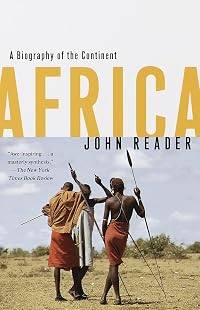
Africa: A Biography of the Continent
by John Reader, Michael Lewis (Photographer)
On This Page
Description
A history of Africa, following the development of the continent from its earliest manifestations to the late twentieth century; identifying the physical processes which have determined the course of progress; and, where relevant, defining the ecological context in which those processes occurred.Tags
Recommendations














Member Reviews
Review of: Africa: A Biography of the Continent, by John Reader
by Stan Prager (4-17-21)
Africa. My youth largely knew of it only through the distorted lens of racist cartoons peopled with bone-in-their-nose cannibals, B-grade movies showcasing explorers in pith helmets who somehow always managed to stumble into quicksand, and of course Tarzan. It was still even then sometimes referred to as the “Dark Continent,” something that was supposed to mean dangerous and mysterious but also translated, for most of us, into the kind of blackness that was synonymous with race and skin color.
My interest in Africa came via the somewhat circuitous route of my study of the Civil War. The central cause of that conflict was, of course, human show more chattel slavery, and nearly all the enslaved were descendants of lives stolen from Africa. So, for me, a closer scrutiny of the continent was the logical next step. One of the benefits of a fine personal library is that there are hundreds of volumes sitting on shelves waiting for me to find the moment to find them. Such was the case for Africa: A Biography of the Continent, by John Reader, which sat unattended but beckoning for some two decades until a random evening found a finger on the spine and then the cover was open and the book was in my lap. I did not turn back.
With a literary flourish rarely present in nonfiction combined with the ambitious sweep of something like a novel of James Michener, Reader attempts nothing less than the epic as he boldly surveys the history of Africa from the tectonic activities that billions of years ago shaped the continent, to the evolution of the single human species that now populates the globe, to the rise and fall of empires, to colonialism and independence, and finally to the twin witness of the glorious and the horrific in the peaceful dismantling of South African apartheid and the Rwandan genocide. In nearly seven hundred pages of dense but highly readable text, the author succeeds magnificently, identifying the myriad differences in peoples and lifeways and environments while not neglecting the shared themes that then and now much of the continent holds in common.
Africa is the world’s second largest continent, and it hosts by far the largest number of sovereign nations: with the addition of South Sudan in 2011—twelve years after Reader’s book was published—there are now fifty-four, as well as a couple of disputed territories. But nearly all of these states are artificial constructs that are relics of European colonialism, lines on maps once penciled in by elite overlords in distant drawing rooms in places like London, Paris, Berlin, and Brussels, and those maps were heavily influenced by earlier incursions by the Spanish, Portuguese, and Dutch. Much of the poverty, instability, and often dreadful standards of living in Africa are the vestiges of these artificial borders that mostly ignored prior states, tribes, clans, languages, religions, identities, lifeways. When their colonial masters, who had long raped the land for its resources and the people for their self-esteem, withdrew in the whirlwind decolonization era of 1956-1976—some at the strike of the pen, others at the point of the sword—the exploiters left little of value for nation-building to the exploited beyond the mockery of those boundaries. That of the ancestral that had been lost in the process, had been irrevocably lost. That is one of Reader’s themes. But there is so much more.
The focus is, as it should be, on sub-Saharan Africa; the continent’s northern portion is an extension of the Mediterranean world, marked by the storied legacies of ancient Greeks, Carthaginians, Romans, and the later Arab conquest. And Egypt, then and now, belongs more properly to the Middle East. But most of Africa’s vast geography stretches south of that, along the coasts and deep into the interior. Reader delivers “Big History” at its best, and the sub-Saharan offers up an immense arena for the drama that entails—from the fossil beds that begat Homo habilis in Tanzania’s Olduvai Gorge, to the South African diamond mines that spawned enormous wealth for a few on the backs of the suffering of a multitude, to today’s Maasai Mara game reserve in Kenya that we learn is not as we would suppose a remnant of some ancient pristine habitat, but rather a breeding ground for the deadly sleeping sickness carried by the tsetse fly that turned once productive land into a place unsuitable for human habitation.
Perhaps the most remarkable theme in Reader’s book is population sustainability and migration. While Africa is the second largest of earth’s continents, it remains vastly underpopulated relative to its size. Given the harsh environment, limited resources, and prevalence of devastating disease, there is strong evidence that it has likely always been this way. Slave-trading was, of course, an example of a kind forced migration, but more typically Africa’s history has long been characterized by a voluntary movement of peoples away from the continent, to the Middle East, to Europe, to all the rest of the world. Migration has always been—and remains today—subject to the dual factors of “push” and “pull,” but the push factor has dominated. That is perhaps the best explanation for what drove the migrations of archaic and anatomically modern humans out of Africa to populate the rest of the globe. The recently identified 210,000-year-old Homo sapiens skull in a cave in Greece reminds us that this has been going on a very long time. Homo erectus skulls found in Dmansi, Georgia that date to 1.8 million years old underscore just how long!
Slavery is, not unexpectedly, also a major theme for Reader, largely because of the impact of the Atlantic slave trade on Africa and how it forever transformed the lifeways of the people directly and indirectly affected by its pernicious hold—culturally, politically and economically. The slavery that was a fact of life on the continent before the arrival of European traders closely resembled its ancient roots; certainly race and skin color had nothing to do with it. As noted, I came to study Africa via the Civil War and antebellum slavery. To this day, a favored logical fallacy advanced by “Lost Cause” apologists for the Confederate slave republic asks rhetorically “But their own people sold them as slaves, didn’t they?” As if this contention—if it was indeed true—would somehow expiate or at least attenuate the sin of enslaving human beings. But is it true? Hardly. Captors of slaves taken in raids or in war by one tribe or one ethnicity would hardly consider them “their own people,” any more than the Vikings that for centuries took Slavs to feed the hungry slave markets of the Arab world have considered them “their own people.” This is a painful reminder that such notions endure in the mindset of the deeply entrenched racism that still defines modern America—a racism derived from African chattel slavery to begin with. It reflects how outsiders might view Africa, but not how Africans view themselves.
The Atlantic slave trade left a mark on every African who was touched by it as buyer, seller or unfortunate victim. The insatiable thirst for cheap labor to work sugar (and later cotton) plantations in the Americas overnight turned human beings into Africa’s most valuable export. Traditions were trampled. An ever-increasing demand put pressure on delivering supply at any cost. Since Europeans tended to perish in Africa’s hostile environment of climate and disease, a whole new class of “middle-men” came to prominence. Slavery, which dominated trade relations, corrupted all it encountered and left scars from its legacy upon the continent that have yet to fully heal.
This review barely scratches the surface of the range of material Reader covers in this impressive work. It’s a big book, but there is not a wasted page or paragraph, and it neither neglects the diversity nor what is held in common by the land and its peoples. Are there flaws? The included maps are terrible, but for that the publisher should be faulted rather than the author. To compensate, I hung a map of modern Africa on the door of my study and kept a historical atlas as companion to the narrative. Other than that quibble, the author’s achievement is superlative. Rarely have I read something of this size and scope and walked away so impressed, both with how much I learned as well as the learning process itself. If you have any interest in Africa, this book is an essential read. Don’t miss it.
Review of: Africa: A Biography of the Continent, by John Reader https://regarp.com/2021/04/17/review-of-africa-a-biography-of-the-continent-by-j...
Podcast: https://www.podbean.com/ew/pb-6gi9u-100f6e1 show less
by Stan Prager (4-17-21)
Africa. My youth largely knew of it only through the distorted lens of racist cartoons peopled with bone-in-their-nose cannibals, B-grade movies showcasing explorers in pith helmets who somehow always managed to stumble into quicksand, and of course Tarzan. It was still even then sometimes referred to as the “Dark Continent,” something that was supposed to mean dangerous and mysterious but also translated, for most of us, into the kind of blackness that was synonymous with race and skin color.
My interest in Africa came via the somewhat circuitous route of my study of the Civil War. The central cause of that conflict was, of course, human show more chattel slavery, and nearly all the enslaved were descendants of lives stolen from Africa. So, for me, a closer scrutiny of the continent was the logical next step. One of the benefits of a fine personal library is that there are hundreds of volumes sitting on shelves waiting for me to find the moment to find them. Such was the case for Africa: A Biography of the Continent, by John Reader, which sat unattended but beckoning for some two decades until a random evening found a finger on the spine and then the cover was open and the book was in my lap. I did not turn back.
With a literary flourish rarely present in nonfiction combined with the ambitious sweep of something like a novel of James Michener, Reader attempts nothing less than the epic as he boldly surveys the history of Africa from the tectonic activities that billions of years ago shaped the continent, to the evolution of the single human species that now populates the globe, to the rise and fall of empires, to colonialism and independence, and finally to the twin witness of the glorious and the horrific in the peaceful dismantling of South African apartheid and the Rwandan genocide. In nearly seven hundred pages of dense but highly readable text, the author succeeds magnificently, identifying the myriad differences in peoples and lifeways and environments while not neglecting the shared themes that then and now much of the continent holds in common.
Africa is the world’s second largest continent, and it hosts by far the largest number of sovereign nations: with the addition of South Sudan in 2011—twelve years after Reader’s book was published—there are now fifty-four, as well as a couple of disputed territories. But nearly all of these states are artificial constructs that are relics of European colonialism, lines on maps once penciled in by elite overlords in distant drawing rooms in places like London, Paris, Berlin, and Brussels, and those maps were heavily influenced by earlier incursions by the Spanish, Portuguese, and Dutch. Much of the poverty, instability, and often dreadful standards of living in Africa are the vestiges of these artificial borders that mostly ignored prior states, tribes, clans, languages, religions, identities, lifeways. When their colonial masters, who had long raped the land for its resources and the people for their self-esteem, withdrew in the whirlwind decolonization era of 1956-1976—some at the strike of the pen, others at the point of the sword—the exploiters left little of value for nation-building to the exploited beyond the mockery of those boundaries. That of the ancestral that had been lost in the process, had been irrevocably lost. That is one of Reader’s themes. But there is so much more.
The focus is, as it should be, on sub-Saharan Africa; the continent’s northern portion is an extension of the Mediterranean world, marked by the storied legacies of ancient Greeks, Carthaginians, Romans, and the later Arab conquest. And Egypt, then and now, belongs more properly to the Middle East. But most of Africa’s vast geography stretches south of that, along the coasts and deep into the interior. Reader delivers “Big History” at its best, and the sub-Saharan offers up an immense arena for the drama that entails—from the fossil beds that begat Homo habilis in Tanzania’s Olduvai Gorge, to the South African diamond mines that spawned enormous wealth for a few on the backs of the suffering of a multitude, to today’s Maasai Mara game reserve in Kenya that we learn is not as we would suppose a remnant of some ancient pristine habitat, but rather a breeding ground for the deadly sleeping sickness carried by the tsetse fly that turned once productive land into a place unsuitable for human habitation.
Perhaps the most remarkable theme in Reader’s book is population sustainability and migration. While Africa is the second largest of earth’s continents, it remains vastly underpopulated relative to its size. Given the harsh environment, limited resources, and prevalence of devastating disease, there is strong evidence that it has likely always been this way. Slave-trading was, of course, an example of a kind forced migration, but more typically Africa’s history has long been characterized by a voluntary movement of peoples away from the continent, to the Middle East, to Europe, to all the rest of the world. Migration has always been—and remains today—subject to the dual factors of “push” and “pull,” but the push factor has dominated. That is perhaps the best explanation for what drove the migrations of archaic and anatomically modern humans out of Africa to populate the rest of the globe. The recently identified 210,000-year-old Homo sapiens skull in a cave in Greece reminds us that this has been going on a very long time. Homo erectus skulls found in Dmansi, Georgia that date to 1.8 million years old underscore just how long!
Slavery is, not unexpectedly, also a major theme for Reader, largely because of the impact of the Atlantic slave trade on Africa and how it forever transformed the lifeways of the people directly and indirectly affected by its pernicious hold—culturally, politically and economically. The slavery that was a fact of life on the continent before the arrival of European traders closely resembled its ancient roots; certainly race and skin color had nothing to do with it. As noted, I came to study Africa via the Civil War and antebellum slavery. To this day, a favored logical fallacy advanced by “Lost Cause” apologists for the Confederate slave republic asks rhetorically “But their own people sold them as slaves, didn’t they?” As if this contention—if it was indeed true—would somehow expiate or at least attenuate the sin of enslaving human beings. But is it true? Hardly. Captors of slaves taken in raids or in war by one tribe or one ethnicity would hardly consider them “their own people,” any more than the Vikings that for centuries took Slavs to feed the hungry slave markets of the Arab world have considered them “their own people.” This is a painful reminder that such notions endure in the mindset of the deeply entrenched racism that still defines modern America—a racism derived from African chattel slavery to begin with. It reflects how outsiders might view Africa, but not how Africans view themselves.
The Atlantic slave trade left a mark on every African who was touched by it as buyer, seller or unfortunate victim. The insatiable thirst for cheap labor to work sugar (and later cotton) plantations in the Americas overnight turned human beings into Africa’s most valuable export. Traditions were trampled. An ever-increasing demand put pressure on delivering supply at any cost. Since Europeans tended to perish in Africa’s hostile environment of climate and disease, a whole new class of “middle-men” came to prominence. Slavery, which dominated trade relations, corrupted all it encountered and left scars from its legacy upon the continent that have yet to fully heal.
This review barely scratches the surface of the range of material Reader covers in this impressive work. It’s a big book, but there is not a wasted page or paragraph, and it neither neglects the diversity nor what is held in common by the land and its peoples. Are there flaws? The included maps are terrible, but for that the publisher should be faulted rather than the author. To compensate, I hung a map of modern Africa on the door of my study and kept a historical atlas as companion to the narrative. Other than that quibble, the author’s achievement is superlative. Rarely have I read something of this size and scope and walked away so impressed, both with how much I learned as well as the learning process itself. If you have any interest in Africa, this book is an essential read. Don’t miss it.
Review of: Africa: A Biography of the Continent, by John Reader https://regarp.com/2021/04/17/review-of-africa-a-biography-of-the-continent-by-j...
Podcast: https://www.podbean.com/ew/pb-6gi9u-100f6e1 show less
This is a big book with big aims: to tell, over the course of seven hundred pages, the story of sub-Saharan Africa from its geological formation through to the mid 1990s. Considering the magnitude of what he was attempting, Reader did well. It's obviously well-researched, cleanly written and accessible even for people like me, who know shamefully little about Africa. Yet I think the strain of compressing so much into such a small space began to tell on him after about the first two hundred and fifty pages or so—where they are strongly argued and well paced sections dealing with human evolution, and with the kinds of stresses and demands which led to the formation of Africa's distinct horizontally-organised socio-economic systems, the show more remaining four hundred or so pages become disjointed and choppy.
The earlier part of the book has the case studies serving to illustrate the thematic histories which he was constructing; in the latter half, however, the case studies become an end to themselves, and it's less easy for the reader to bring it together as a whole. A lot of the information which he presents about the awful impact which invasion and colonialism had on Africa was startling (if sadly not surprising), and what he had to say about the ways in which European intervention changed African culture very interesting, but I was left wishing that he'd had an editor ask him to step back a little and think about why he was saying what he was saying a little bit more, to recreate the structure of it. An interesting book, and probably a good starting point if you want to know more about Africa, but not without its flaws.
Lastly, there were one or two things which made me tilt my head. Reader has spent a lot of time in Africa, but as he acknowledges himself in the introduction, he is a white man and thus has to overcome a lot of internalised assumptions when talking about the continent. In many respects—at least to me—it seemed like he succeeded. But for instance, there were times when he referred to 'miscegenation' without problematising the term, showing how it's an ugly, ugly word, and that bothered me. show less
The earlier part of the book has the case studies serving to illustrate the thematic histories which he was constructing; in the latter half, however, the case studies become an end to themselves, and it's less easy for the reader to bring it together as a whole. A lot of the information which he presents about the awful impact which invasion and colonialism had on Africa was startling (if sadly not surprising), and what he had to say about the ways in which European intervention changed African culture very interesting, but I was left wishing that he'd had an editor ask him to step back a little and think about why he was saying what he was saying a little bit more, to recreate the structure of it. An interesting book, and probably a good starting point if you want to know more about Africa, but not without its flaws.
Lastly, there were one or two things which made me tilt my head. Reader has spent a lot of time in Africa, but as he acknowledges himself in the introduction, he is a white man and thus has to overcome a lot of internalised assumptions when talking about the continent. In many respects—at least to me—it seemed like he succeeded. But for instance, there were times when he referred to 'miscegenation' without problematising the term, showing how it's an ugly, ugly word, and that bothered me. show less
Reader's book is a gem. Subtitled "The Biography of a Continent", I was a bit skeptical that it would be so much of an overview as to be dull or repetitive. Instead "Africa" approaches the subject as an object. It is not a history of the people and cultures of the continent as much as it is the story of the land itself, as least for a good part of the book. The author delves into the geology of the continent, both in origin and the effect that it's unique mineral, landform and climate molded the cultures that evolved there. While this might sound a bit boring or scholarly, instead it makes for interesting reading.
A fascinating, and perhaps controversial section discusses the how the development of man's physiology was affected by show more Africa's climate and topography. This includes a discussion of the need for the cooling of the brain and how man's unique biped stance and movement were developed as a response to Africa's weather and flora. I found it pleasantly surprising to find that what I thought would be a simple history went so far afield yet stayed true to the subject.
He discusses the evolution of early man and the effect the land had on it. As man evolved and civilizations emerged, Reader shows how Africa's rainfall, soil and weather affected the way in which those civilizations developed. He describes the unique cultures of the different peoples, although he does not attempt to be comprehensive. Rather it is a sampling of some of the more interesting aspects.
The end of the book is a bit of a disappointment. With the beginning of the colonial era the style goes to more of an overview and while it is certainly appropriate for a single volume, it feels like a bit of a letdown compared to unusual and interesting approach Reader had taken in most of the book. Still, there's nothing bad or unreadable and for many readers it will be quite enough.
I strongly recommend this book to anyone with an interest in people and history, and especially those who enjoy finding those books that take chances and succeed. show less
A fascinating, and perhaps controversial section discusses the how the development of man's physiology was affected by show more Africa's climate and topography. This includes a discussion of the need for the cooling of the brain and how man's unique biped stance and movement were developed as a response to Africa's weather and flora. I found it pleasantly surprising to find that what I thought would be a simple history went so far afield yet stayed true to the subject.
He discusses the evolution of early man and the effect the land had on it. As man evolved and civilizations emerged, Reader shows how Africa's rainfall, soil and weather affected the way in which those civilizations developed. He describes the unique cultures of the different peoples, although he does not attempt to be comprehensive. Rather it is a sampling of some of the more interesting aspects.
The end of the book is a bit of a disappointment. With the beginning of the colonial era the style goes to more of an overview and while it is certainly appropriate for a single volume, it feels like a bit of a letdown compared to unusual and interesting approach Reader had taken in most of the book. Still, there's nothing bad or unreadable and for many readers it will be quite enough.
I strongly recommend this book to anyone with an interest in people and history, and especially those who enjoy finding those books that take chances and succeed. show less
This is a chonky book (about 800 pages for the paperback) that covers quite the range of topics in Africa. Not just the people or countries, we get a fair amount of geography and biology as the author goes into pre-hominid Africa... it's honestly fascinating... the title of this book is Africa: A Biography of the Continent, and boy howdy, it REALLY is a biography of the continent.
I learned about some cool ancient African civlizations I had not heard of before and some surprising parts of African history and how it was tied to other parts of the world and such. This is defiitely a book for the history buffs, the subjects and histories in here are extensive.
It's by no means a complete, 100 percent history, but as someone who reads a lot show more of history books, I can say i'm happy to have purchased this for my personal library. It's a good jumping board if you want to learn more about a specific area of African history, and there's a lot to choose from! Like, there's all these wonderful African kingdoms/tribes/civilizations that all merit their own books, but this is a great introduction.
This book was published in 1997 and I read this in early 2025. There's a lot that has happened politically and geographically in Africa since the publication of this book so it would be interesting for the author to make commentary on that. show less
I learned about some cool ancient African civlizations I had not heard of before and some surprising parts of African history and how it was tied to other parts of the world and such. This is defiitely a book for the history buffs, the subjects and histories in here are extensive.
It's by no means a complete, 100 percent history, but as someone who reads a lot show more of history books, I can say i'm happy to have purchased this for my personal library. It's a good jumping board if you want to learn more about a specific area of African history, and there's a lot to choose from! Like, there's all these wonderful African kingdoms/tribes/civilizations that all merit their own books, but this is a great introduction.
This book was published in 1997 and I read this in early 2025. There's a lot that has happened politically and geographically in Africa since the publication of this book so it would be interesting for the author to make commentary on that. show less
In a book as splendid in its wealth of information as it is breathtaking in scope,
British writer and photojournalist John Reader brings to light Africa's geology and evolution,
the majestic array of its landforms and environments, the rich diversity of its peoples and their ways of life,
the devastating legacies of slavery and colonialism as well as recent political troubles and triumphs.
Written in simple, elegant prose and illustrated with Reader's own photographs,
British writer and photojournalist John Reader brings to light Africa's geology and evolution,
the majestic array of its landforms and environments, the rich diversity of its peoples and their ways of life,
the devastating legacies of slavery and colonialism as well as recent political troubles and triumphs.
Written in simple, elegant prose and illustrated with Reader's own photographs,
http://nwhyte.livejournal.com/1172339.html
This came up in recommendations after I read Fage's History of Africa last year. It starts awfully well, with sections on African geology in the context of continental drift, and on the evolution of humanity in the context of climate change.
From then on I found it a bit patchy. Fage's book was good on the general ebb and flow of states and cultures; Reader prefers to take particular vignettes, and then is a bit frustrating in how he fits them into the general picture: lots of (very interesting!) material about Ethiopia, very little about Islam (for Reader, most of Africa's history seems to start with the Portuguese in the fifteenth century); a general focus on the southern part of the continent show more which means the Horn (apart from Ethiopia) and West Africa (apart from the prehistory of the inland Niger delta, and a later section on Nigeria) get rather neglected, and anything north of the Sahara isn't covered at all (apart from one early section on the prehistory of the Nile Valley).
There are two overarching themes which Reader does address well and eloquently: slavery and colonialism. Particularly on slavery - he makes a convincing case that the Atlantic slave trade was hugely damaging to Africa's development, in terms of lost population growth and social harm. On colonialism, he is (I guess rightly) excoriating of the Belgians, and damning also of the British and Germans, but the Portuguese (in the modern era) get off rather lightly and the French are mentioned only really in passing, which I found a little odd.
Anyway, all very interesting. show less
This came up in recommendations after I read Fage's History of Africa last year. It starts awfully well, with sections on African geology in the context of continental drift, and on the evolution of humanity in the context of climate change.
From then on I found it a bit patchy. Fage's book was good on the general ebb and flow of states and cultures; Reader prefers to take particular vignettes, and then is a bit frustrating in how he fits them into the general picture: lots of (very interesting!) material about Ethiopia, very little about Islam (for Reader, most of Africa's history seems to start with the Portuguese in the fifteenth century); a general focus on the southern part of the continent show more which means the Horn (apart from Ethiopia) and West Africa (apart from the prehistory of the inland Niger delta, and a later section on Nigeria) get rather neglected, and anything north of the Sahara isn't covered at all (apart from one early section on the prehistory of the Nile Valley).
There are two overarching themes which Reader does address well and eloquently: slavery and colonialism. Particularly on slavery - he makes a convincing case that the Atlantic slave trade was hugely damaging to Africa's development, in terms of lost population growth and social harm. On colonialism, he is (I guess rightly) excoriating of the Belgians, and damning also of the British and Germans, but the Portuguese (in the modern era) get off rather lightly and the French are mentioned only really in passing, which I found a little odd.
Anyway, all very interesting. show less
This is a scholarly, insightful piece of work, beautifully written. John Reader weaves together diverse disciplines like history, biology, physics, geology to produce a master thesis on the mother continent of humanity.
Members
- Recently Added By
Lists

Best African Books
126 works; 46 members
Author Information

9+ Works 2,081 Members
John Reader holds an Honorary Research Fellowship in the Department of Anthropology at University College London and is a fellow of the Royal Anthropological Institute and the Royal Geographic Society.

Some Editions
Awards and Honors
Awards
Series
Belongs to Publisher Series
Common Knowledge
- Canonical title
- Africa: A Biography of the Continent
- Original publication date
- 1997
- Important places
- Africa
- Original language*
- Inglese
*Some information comes from Common Knowledge in other languages. Click "Edit" for more information.
Classifications
Statistics
- Members
- 1,176
- Popularity
- 21,276
- Reviews
- 16
- Rating
- (4.26)
- Languages
- 5 — English, French, German, Italian, Portuguese
- Media
- Paper, Ebook
- ISBNs
- 17
- ASINs
- 3