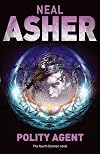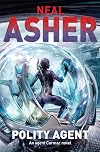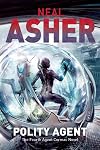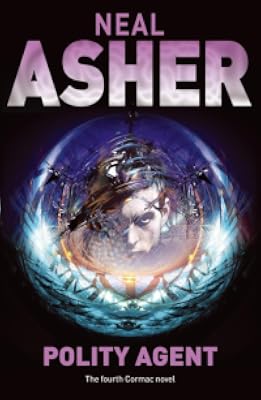
Polity Agent
by Neal Asher 
Polity: Ian Cormac (4), Polity Universe (Reading Order) (5.4), Polity Universe - Publication Order (7)
On This Page
Description
From 800 years in the future, a runcible gate is opened into the Polity and those coming through it have been sent specially to take the alien 'Maker' back to its home civilization in the Small Magellanic cloud. Once these refugees are safely through, the gate itself is rapidly shut down - because something alien is pursuing them. The gate is then dumped into a nearby sun. From those refugees who get through, agent Cormac learns that the Maker civilization has been destroyed by pernicious show more virus known as the Jain technology. This, of course, raised questions: why was Dragon, a massive biocontruct of the Makers, really sent to the Polity; why did a Jain node suddenly end up in the hands of someone who could do the most damage with it? Meanwhile an entity called the Legate is distributing pernicious Jain nodes . . . and a renegade attack ship, The King of Hearts, has encountered something very nasty outside the Polity itself. show lessTags
Recommendations















Member Reviews
Equally prolific, Asher’s new book on the other hand is a cracker. This is the fourth book featuring Ian Cormac, a future super-spy sort of type, working for the mighty Earth Central Artificial Intelligence that controls and shapes events in human space.
As with Stross, this is a future where humanity has spread through the stars, Artificial Intelligences benignly work with – and effectively administrate – humans throughout the Polity, the area of space colonised by humanity, and characters enjoy semi-immortality as they copy, edit and back-up their mental states. Unlike Stross though, Asher remembers that the ideas are only part of what gets people drawn into a book, and he thoughtfully includes a plot that bounds show more along, full of fairly major action sequences.
In previous books, Cormac has gone up against various threats to the Polity, including human terrorists trying to strike against the ruling class of the Polity, an enigmatic alien entity called Dragon and a rogue scientist with access to some particularly nasty alien nanotechnology, all while slowly seeing that the Earth Central AI, and its enigmatic chief agent, a seemingly immortal Japanese man called Horace Blegg who was a boy at Hiroshima, appears to have plans for him.
With this book, Asher starts to draw the elements from the three previous books closer together. From the opening chapter, where a group of human refugees from the future flee from a time where aggressive alien nanotech has wiped out entire alien civilisations, through the attack of the same nanotech on a Polity world, and on to the last third of the book, where a rogue Polity AI discovers something truly awful lurking beyond the line of Polity, Asher grabs you and keeps you reeled in. Plots from previous books are looped together, allegiances of old characters shift, and the true nature of the threat facing the Polity becomes apparent.
It’s a hell of a lot of fun. When Asher started this series, I was only vaguely convinced – he started off with Cormac as a very obvious 007 riff, and I wasn’t sure there was going to be anything more to him. Over the following books, he’s developed both the plot and the characters well enough that now I’m not only convinced, but I’m eagerly awaiting the next instalment.
Like Stross, Asher is not miserly with ideas, and while he puts his own spins on now-familiar hard SF tropes – benign all-controlling AIs with sardonic senses of humour, post-Singularity humans, unstable war drones, nanotech – he also puts forward plenty of his own ideas. There are some great throwaway ideas here – I loved the ecosystem Asher casually describes in passing about two thirds through the book, and his explanation of why the AIs haven’t truly reached a Singularity point is great.
The book is complete in itself, but it’s going to make a lot more sense if you’ve read the first three books before this one. If you have read and enjoyed those, I’ll be very surprised if you don’t love this one and – ending as it does with a very Empire Strikes Back like feel – end up keenly anticipating the inevitable fifth book in the sequence. show less
As with Stross, this is a future where humanity has spread through the stars, Artificial Intelligences benignly work with – and effectively administrate – humans throughout the Polity, the area of space colonised by humanity, and characters enjoy semi-immortality as they copy, edit and back-up their mental states. Unlike Stross though, Asher remembers that the ideas are only part of what gets people drawn into a book, and he thoughtfully includes a plot that bounds show more along, full of fairly major action sequences.
In previous books, Cormac has gone up against various threats to the Polity, including human terrorists trying to strike against the ruling class of the Polity, an enigmatic alien entity called Dragon and a rogue scientist with access to some particularly nasty alien nanotechnology, all while slowly seeing that the Earth Central AI, and its enigmatic chief agent, a seemingly immortal Japanese man called Horace Blegg who was a boy at Hiroshima, appears to have plans for him.
With this book, Asher starts to draw the elements from the three previous books closer together. From the opening chapter, where a group of human refugees from the future flee from a time where aggressive alien nanotech has wiped out entire alien civilisations, through the attack of the same nanotech on a Polity world, and on to the last third of the book, where a rogue Polity AI discovers something truly awful lurking beyond the line of Polity, Asher grabs you and keeps you reeled in. Plots from previous books are looped together, allegiances of old characters shift, and the true nature of the threat facing the Polity becomes apparent.
It’s a hell of a lot of fun. When Asher started this series, I was only vaguely convinced – he started off with Cormac as a very obvious 007 riff, and I wasn’t sure there was going to be anything more to him. Over the following books, he’s developed both the plot and the characters well enough that now I’m not only convinced, but I’m eagerly awaiting the next instalment.
Like Stross, Asher is not miserly with ideas, and while he puts his own spins on now-familiar hard SF tropes – benign all-controlling AIs with sardonic senses of humour, post-Singularity humans, unstable war drones, nanotech – he also puts forward plenty of his own ideas. There are some great throwaway ideas here – I loved the ecosystem Asher casually describes in passing about two thirds through the book, and his explanation of why the AIs haven’t truly reached a Singularity point is great.
The book is complete in itself, but it’s going to make a lot more sense if you’ve read the first three books before this one. If you have read and enjoyed those, I’ll be very surprised if you don’t love this one and – ending as it does with a very Empire Strikes Back like feel – end up keenly anticipating the inevitable fifth book in the sequence. show less
This kind of popcorn fiction requires a certain kind of mindset. A transhumanist mindset. One that keeps slipping between the lines of AI and Human and horrifying alien trap-technology.
Of course, since I'm half machine anyway, I'm perfectly at home with these shifting lines of self-definition. Screw sex-politics as a subset for SF idea exploration. Let's get right down to transforming the human race into something barely recognizable as human now, or if we can recognize it, it's constantly flying away from the norms. :)
This is the WILD future SF series. It's up there with Alastair Reynolds and Jack McDevitt and so many other Hard SF greatness. Never mind the heavy nanotech and alien technologies turning whole civilizations into slag show more through greed or the wonderful above-and-beyond enemies who are SERIOUS badasses.
These novels are genuine character-driven monstrosities. Unlike certain series, these heroes and baddies don't really die. They have backups and come back changed or crazy or on the side of the angels. Same thing is true for the good guys. :) It's like a flashy video game from the far future with all the tech in the world. AI ships and drones and even intelligent landmines... landminds. :)
In this novel really stood out for me with all the reveals about our incumbent wandering immortal, including snippets through all the Polity history. :) Pretty awesome, in fact. But the rest really steps up the game for the Jain trap.
While I can't call this the penultimate book of SF to end all SF, the tech, the aliens, the baddies and the reveals does something tingly to my insides. Like an extra jolt of electricity. Or nuclear fission. Total popcorn? Yeah, but of the So Much Better Than Pulp variety of popcorn. :)
What? I'm 6 or 7 books into the series? Yeah. And they all build on each other gloriously. Fortunately, the quality is consistent and fun. :) show less
Of course, since I'm half machine anyway, I'm perfectly at home with these shifting lines of self-definition. Screw sex-politics as a subset for SF idea exploration. Let's get right down to transforming the human race into something barely recognizable as human now, or if we can recognize it, it's constantly flying away from the norms. :)
This is the WILD future SF series. It's up there with Alastair Reynolds and Jack McDevitt and so many other Hard SF greatness. Never mind the heavy nanotech and alien technologies turning whole civilizations into slag show more through greed or the wonderful above-and-beyond enemies who are SERIOUS badasses.
These novels are genuine character-driven monstrosities. Unlike certain series, these heroes and baddies don't really die. They have backups and come back changed or crazy or on the side of the angels. Same thing is true for the good guys. :) It's like a flashy video game from the far future with all the tech in the world. AI ships and drones and even intelligent landmines... landminds. :)
In this novel really stood out for me with all the reveals about our incumbent wandering immortal, including snippets through all the Polity history. :) Pretty awesome, in fact. But the rest really steps up the game for the Jain trap.
While I can't call this the penultimate book of SF to end all SF, the tech, the aliens, the baddies and the reveals does something tingly to my insides. Like an extra jolt of electricity. Or nuclear fission. Total popcorn? Yeah, but of the So Much Better Than Pulp variety of popcorn. :)
What? I'm 6 or 7 books into the series? Yeah. And they all build on each other gloriously. Fortunately, the quality is consistent and fun. :) show less
This review is written with a GPL 4.0 license and the rights contained therein shall supersede all TOS by any and all websites in regards to copying and sharing without proper authorization and permissions. Crossposted at WordPress, Blogspot & Librarything by Bookstooge’s Exalted Permission
Title: Polity Agent
Series: Polity: Agent Cormac #4
Author: Neal Asher
Rating: 4 of 5 Stars
Genre: SF
Pages: 580
Format: Digital Edition
Synopsis:
Another jain node is experimented upon, this time by a haiman. But she's a bit smarter than Skellor and doesn't allow it access to her, thus putting off its growth and takeover.
At the same time, it turns out that the Maker civilization, which created the Dragon, was also using jain tech and planned on seeding show more the Polity with the nodes and thus allowing the Polity to destroy itself. Well, the Makers ended up destroying themselves first, but Cormac must track down the remaining nodes that they sent with the Dragon.
And if that wasn't enough, it appears that a rogue AI, that left the Polity after the Prador Wars, has succumbed to jain tech and is actively trying to destroy the Polity as well.
Bloody jain tech, it just wants to kill everything...
My Thoughts:
This was the first book in the Agent Cormac series where things weren't wrapped up by the end. The Haiman's [a human who is aug'ing themselves until they can handle AI level of data] storyline was the slowest and the least completed. In many ways her plot line almost felt unnecessary except for when she propelled the other plot lines forward. I can't remember enough about the next book to know if she plays a big part or not. I guess I'll just have to wait and find out.
Cormac tracking down the other nodes and the Rogue AI lines were pretty closely intertwined. The rogue AI, named Cerberus, kept laying traps for Polity ships and they kept falling for it. Not sure if that was deliberate or if the Polity AI's really were that stupid? Considering how long range Earth Central plans, I'm betting on “deliberate”.
I had forgotten how many people died. Almost everyone we've met so far, except for Cormac [of course!], the biologist Mika, the Dracoman Scar and AI's, die. Subsumed by jain tech, destroyed in battles, tortured and killed by bad guys, etc. Even the revelations about Horace Blegg means he is out of the picture, his usefulness at an end. By his own side too, ouch!
This is fun to read and I enjoy the violence and blazing guns and super weapons and smarty pants AI's. I don't feel that this book lost anything upon re-read. Things might not be as “new”, but it was just as exciting as before. If you're looking for some bloody good science fiction, try this sub-series of Asher's Polity Universe.
★★★★☆ show less
Title: Polity Agent
Series: Polity: Agent Cormac #4
Author: Neal Asher
Rating: 4 of 5 Stars
Genre: SF
Pages: 580
Format: Digital Edition
Synopsis:
Another jain node is experimented upon, this time by a haiman. But she's a bit smarter than Skellor and doesn't allow it access to her, thus putting off its growth and takeover.
At the same time, it turns out that the Maker civilization, which created the Dragon, was also using jain tech and planned on seeding show more the Polity with the nodes and thus allowing the Polity to destroy itself. Well, the Makers ended up destroying themselves first, but Cormac must track down the remaining nodes that they sent with the Dragon.
And if that wasn't enough, it appears that a rogue AI, that left the Polity after the Prador Wars, has succumbed to jain tech and is actively trying to destroy the Polity as well.
Bloody jain tech, it just wants to kill everything...
My Thoughts:
This was the first book in the Agent Cormac series where things weren't wrapped up by the end. The Haiman's [a human who is aug'ing themselves until they can handle AI level of data] storyline was the slowest and the least completed. In many ways her plot line almost felt unnecessary except for when she propelled the other plot lines forward. I can't remember enough about the next book to know if she plays a big part or not. I guess I'll just have to wait and find out.
Cormac tracking down the other nodes and the Rogue AI lines were pretty closely intertwined. The rogue AI, named Cerberus, kept laying traps for Polity ships and they kept falling for it. Not sure if that was deliberate or if the Polity AI's really were that stupid? Considering how long range Earth Central plans, I'm betting on “deliberate”.
I had forgotten how many people died. Almost everyone we've met so far, except for Cormac [of course!], the biologist Mika, the Dracoman Scar and AI's, die. Subsumed by jain tech, destroyed in battles, tortured and killed by bad guys, etc. Even the revelations about Horace Blegg means he is out of the picture, his usefulness at an end. By his own side too, ouch!
This is fun to read and I enjoy the violence and blazing guns and super weapons and smarty pants AI's. I don't feel that this book lost anything upon re-read. Things might not be as “new”, but it was just as exciting as before. If you're looking for some bloody good science fiction, try this sub-series of Asher's Polity Universe.
★★★★☆ show less
Awesome! The more we see of Jain tech, the worse things get! This is complex, multileveled and just plain cool. Character development is almost nil, but that is ok, but this is a plot driven series and man, does it drive you. Highly recommended.
Crash, bang, wallop. In space. Big ships and narrow escapes. I need a gridlink to Neil Asher's mind to have any chance of remembering the details of who all the characters and motivations are. But the ride was fun, if confusing and inconclusive. Leading man, Agent Ian Cormac, needs a life. But maybe he's not human after all....
Asher details all his sci-fi moves in a way such that they seem utterly plausible and add great depth to the story. Compelling and great fun.
Keeps getting better.
Enjoyed this book much more than the previous one, so I am now looking forward to getting into the next one in the series.
Full of fantastic monsters, weapons, plots and subplots. Would recommend this one to anyone but would suggest you read the previous ones in the series first.
Brilliant, keep them coming.
Enjoyed this book much more than the previous one, so I am now looking forward to getting into the next one in the series.
Full of fantastic monsters, weapons, plots and subplots. Would recommend this one to anyone but would suggest you read the previous ones in the series first.
Brilliant, keep them coming.
Members
- Recently Added By
Lists

Library Fantasy/Science Fiction
159 works; 2 members
Author Information

95+ Works 14,592 Members
Neal Asher is a LibraryThing Author, an author who lists their personal library on LibraryThing.
Some Editions
Awards and Honors
Distinctions
Series


Common Knowledge
- Canonical title
- Polity Agent
- Original publication date
- 2006-10
- People/Characters
- Ian Cormac; Horace Blegg; Celedon (AI); Arach; Jerusalem (AI); Earth Central (show all 25); Chaline Tazer Irand; Patran Thorn; Fethan; Orlandine; Jack Ketch; Scar; Lucifer (Maker); Asselis Mika; Coloron (AI); Thellant N'komo; The Legate; King of Hearts (AI); Coriolanus (AI); Haruspex (AI); Dragon (third sphere); Dragon (fourth sphere); Atheter (AI); Erebus; Brutus
- Important places
- Celedon (planet); Jerusalem (station); Not Entirely Jack; Osterland; Coloron (planet)
Classifications
Statistics
- Members
- 712
- Popularity
- 39,816
- Reviews
- 13
- Rating
- (4.04)
- Languages
- Czech, English, German, Romanian
- Media
- Paper, Audiobook, Ebook
- ISBNs
- 16
- ASINs
- 6