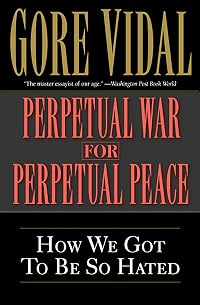
Perpetual War for Perpetual Peace
by Gore Vidal
On This Page
Description
The United States has been engaged in what the great historian Charles A. Beard called "perpetual war for perpetual peace." The Federation of American Scientists has cataloged nearly 200 military incursions since 1945 in which the United States has been the aggressor. In a series of penetrating and alarming essays, whose centerpiece is a commentary on the events of September 11, 2001 (deemed too controversial to publish in this country until now) Gore Vidal challenges the comforting show more consensus following September 11th and goes back and draws connections to Timothy McVeigh's bombing of the federal building in Oklahoma City. He asks were these simply the acts of "evil-doers?" "Gore Vidal is the master essayist of our age." — Washington Post "Our greatest living man of letters."—Boston Globe "Vidal's imagination of American politics is so powerful as to compel awe."—Harold Bloom, The New York Review of Books. show less
Tags
Recommendations




Member Reviews
Explains how the U.S. may well incite terror, which it so vehemently now fights. Full of wit, wisdom, and just that classic touch of Vidal satire.
"Interestingly, this book emphasizes something I had not considered that bears emphasis: although there were numerous intelligence failures in detail, Vidal suggests that the Director of Central Intelligence is correct when he claims that 9-11 was not (at root) an intelligence failure--but then leaves unsaid what Vidal says explicitly: it was a policy failure in that Bush-Cheney decided not to alarm the people and not to share the warning information, in part to avoid turbulence and in part because such an attack would be welcome--as Pearl Harbor was welcome--as a means to remilitarize foreign policy.
INTERESTING THAT GORE BELIEVES THAT ROOSEVELT KNEW THE JAPANESSE WERE GOING TO ATTACK-PLB
INTERESTING THAT GORE BELIEVES THAT ROOSEVELT KNEW THE JAPANESSE WERE GOING TO ATTACK-PLB
I found this book poorly written with errors and found that it jumped around too much and was repetitive. The list of wars was given but no background information at all which made its usefullness limited. I found that some of the phrases were intended for Americans who already knew the background of certain issues and some words used that may be familiar to Americans but not necessarily to others. It was a short read with little value though I do agree with many of the end remarks. I don't think it was effective in making a point that the government provoked McVeigh or Osama. It may have, had he included more information. It was in the end, disappointing in it's content.
a bit of a polemic.
United States Foreign Policy, United States 21st Century
What's there to say...? Its Gore Vidal!
“One of the problems of a society as tightly controlled as ours is that we get so little information about what those of our fellow citizens whom we will never know or see are actually thinking and feeling. This seems a paradox when most politics today involves minute-by-minute poll taking on what looks to be every conceivable subject, but, as politicians and pollsters know, it’s how the question is asked that determines the response.” (p. 59)
“’We can’t be so fixated on our desire to preserve the rights of ordinary Americans.’” - Bill Clinton, March 11, 1993 (p. 114)
“’We can’t be so fixated on our desire to preserve the rights of ordinary Americans.’” - Bill Clinton, March 11, 1993 (p. 114)
Members
- Recently Added By
Lists

LT picks: Blue Books
197 works; 44 members

Books Read in 2002
201 works; 8 members
Author Information

168+ Works 31,302 Members
Gore Vidal was born Eugene Luther Gore Vidal Jr. on October 3, 1925 at the U.S. Military Academy at West Point, New York. He did not go to college but attended St. Albans School in Washington and graduated from Phillips Exeter Academy in New Hampshire in 1943. He enlisted in the Army, where he became first mate on a freight supply ship in the show more Aleutian Islands. His first novel, Williwaw, was published in 1946 when he was twenty-one years old and working as an associate editor at the publishing company E. P. Dutton. The City and the Pillar was about a handsome, athletic young Virginia man who gradually discovers that he is homosexual, which caused controversy in the publishing world. The New York Times refused to advertise the novel and gave a negative review of it and future novels. He had such trouble getting subsequent novels reviewed that he turned to writing mysteries under the pseudonym Edgar Box and then gave up novel-writing altogether for a time. Once he moved to Hollywood, he wrote television dramas, screenplays, and plays. His films included I Accuse, Suddenly Last Summer with Tennessee Williams, Is Paris Burning? with Francis Ford Coppola, and Ben-Hur. His most successful play was The Best Man, which he also adapted into a film. He started writing novels again in the 1960's including Julian, Washington, D.C., Myra Breckenridge, Burr, Myron, 1876, Lincoln, Hollywood, Live From Golgotha: The Gospel According to Gore Vidal, and The Golden Age. He also published two collections of essays entitled The Second American Revolution, which won the National Book Critics Circle Award for criticism in 1982 and United States: Essays 1952-1992. In 2009, he received the National Book Awards lifetime achievement award. He died from complications of pneumonia on July 31, 2012 at the age of 86. (Bowker Author Biography) show less
Common Knowledge
- Canonical title
- Perpetual War for Perpetual Peace
- Original title
- Perpetual War for Perpetual Peace: How We Got To Be So Hated
- Original publication date
- 2002
- First words
- It is a law of physics (still on the books when last I looked) that in nature there is no action without reaction.
- Last words
- (Click to show. Warning: May contain spoilers.)Preserve, protect and defend what is left of our liberties, not to mention our heavily mortgaged fortune.
Classifications
- Genre
- Nonfiction
- DDC/MDS
- 814.54 — Literature & rhetoric American literature in English American essays in English 20th Century 1945-1999
- LCC
- HV6432 .V53 — Social sciences Social pathology. Social and public welfare. Criminology Social pathology. Social and public welfare. Criminology Crimes and offenses
- BISAC
Statistics
- Members
- 762
- Popularity
- 36,961
- Reviews
- 9
- Rating
- (3.72)
- Languages
- 5 — Dutch, English, German, Norwegian (Bokmål), Swedish
- Media
- Paper, Audiobook, Ebook
- ISBNs
- 9
- ASINs
- 3