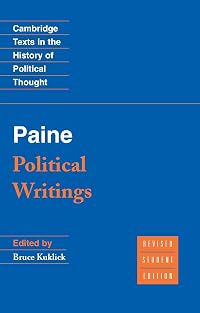
Paine: Political Writings
by Thomas Paine
151 Members (4.50)
On This Page
Description
Thomas Paine was arguably the single most influential political writer in the English-speaking world during the great upheavals of the American and French Revolutions. His writings here reappear in the acclaimed Cambridge Texts series. For this revised and updated edition the distinguished intellectual historian Bruce Kuklick brings together an expanded collection of the classic Paine texts - Common Sense, Rights of Man, and The Age of Reason - as well as the first of Paine's papers on The show more Crisis of 1776. A brief chronology, updated notes for further reading, and a succinct and lucid introduction to the principal themes of each text offer further support to the student reader. This selection will appeal to students in a variety of disciplines from political theory to American history, and enable further generations to engage at first hand with one of the most gifted and popular expositors of radical ideas ever to generate mass support. show lessTags
Recommendations







Member Reviews
Members
- Recently Added By
Author Information

208+ Works 17,405 Members
Born to parents with Quaker leanings, Thomas Paine grew up amid modest circumstances in the rural environs of Thetford, England. As the recipient of what he termed "a good moral education and a tolerable stock of useful learning," little in Paine's early years seemed to suggest that he would one day rise to a stunning defense of American show more independence in such passionate and compelling works as Common Sense (1776) and The American Crisis essays (1776-83). Paine's early years were characterized by a constant struggle to remain financially solvent while pursuing a number of nonintellectual activities. Nevertheless, the young Paine read such Enlightenment theorists as Isaac Newton and John Locke and remained dedicated to the idea that education was a lifelong commitment. From 1753 to 1759, Paine worked alternately as a sailor, a staymaker, and a customs officer. Between 1759 and 1772, he married twice. His first wife died within a year of their marriage, and Paine separated amicably from his second wife after a shop they operated together went bankrupt. While these circumstances seemed gloomy, Paine fortuitously made the acquaintance of Benjamin Franklin in London in 1773. Impressed by Paine's self-education, Franklin encouraged the young man to venture to America where he might prosper. Arriving in Philadelphia in 1774, Paine quickly found himself energized by the volatile nature of Revolutionary politics. Working as an editor of Pennsylvania Magazine, Paine found a forum for his passionate radical views. In the years that followed, Paine became increasingly committed to American independence, and to his conviction that the elitist and corrupt government that had ruled over him in England had little business extending its corrosive colonial power to the States. Moved by these beliefs, Paine published Common Sense (1776), a test that proved invaluable in unifying American sentiment against British rule. Later, after joining the fray as a soldier, Paine penned the familiar lines in "The American Crisis": "These are the times that try men's souls." Fifteen years later, Paine wrote his other famous work, Rights of Man (1791). Drawing on his eclectic experiences as a laborer, an international radical politician, and a revolutionary soldier, Paine asserted his Lockeian belief that since God created humans in "one degree only," then rights should be equal for every individual. (Bowker Author Biography) show less
Some Editions
Series
Belongs to Publisher Series
Common Knowledge
- Canonical title
- Paine: Political Writings
Classifications
- Genres
- Nonfiction, Philosophy, Politics and Government, General Nonfiction, History
- DDC/MDS
- 320.51 — Society, government, & culture Political science Types of Government Political ideologies Liberalism
- LCC
- JC177 .A3 — Political Science Political theory Political theory. The state. Theories of the state Modern state Thomas Paine
- BISAC
Statistics
- Members
- 151
- Popularity
- 216,037
- Rating
- (4.50)
- Languages
- English
- Media
- Paper, Ebook
- ISBNs
- 5
- ASINs
- 6