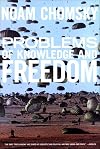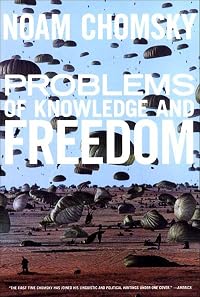
Problems of Knowledge and Freedom: The Russell Lectures
by Noam Chomsky
On This Page
Description
Originally delivered in 1971 as the first Cambridge lectures in memory of Bertrand Russell, Problems of Knowledge and Freedom is a masterful and cogent synthesis of Noam Chomsky's moral philosophy, linguistic analysis, and emergent political critique of America's war in Vietnam. In the first half of this wide-ranging work, Chomsky takes up Russell's lifelong search for the empirical principles of human understanding, in a philosophical overview referencing Hume, Wittgenstein, von Humboldt, show more and others. In the following half, aptly titled "On Changing the World," Chomsky applies these concepts to the issues that would remain the focus of his increasingly political work of the period--his criticisms of the war in Indochina and the Cold War ideology that supported it, of the centralization of U.S. decision-making in the Pentagon and the growing influence of multinational corporations in those circles, and of the politicization of American universities in the post-World War II years, as well as his analyses of the Cuban Missile Crisis and Nixon's foreign policies. show lessTags
Recommendations




















Member Reviews
QUOTES OF INTEREST:
"Those whose lives are fruitful to themselves, to their friends, or to the world are inspired by hope and sustained by joy: they see in imagination the things that might be and the way in which they are to be brought into existence. In their private relations they are not pre-occupied with anxiety lest they should lose such affection and respect as they receive: they are engaged in giving affection and respect freely, and the reward comes of itself without their seeking. In their work they are not haunted by jealousy of competitors, but concerned with the actual matter that has to be done. In politics, they do not spend time and passion defending unjust privileges of their class or nation, but they aim at making the show more world as a whole happier, less cruel, less full of conflict between rival greeds, and more full of human beings whose growth has not been dwarfed and stunted by oppression." (Russell, Proposed Roads to Freedom, 186-187).
“The world that we must seek is a world in which the creative spirit is alive, in which life is an adventure full of joy and hope, based rather upon the impulse to construct than upon the desire to retain what we possess or to seize what is possessed by others. It must be a world in which affection has free play, in which love is purged of the instinct for domination, in which cruelty and envy have been dispelled by happiness and the unfettered development of all the instincts that build up life and fill it with mental delights. Such a world is possible; it waits only for men to wish to create it. Meantime, the world in which we exist has other aims. But it will pass away, burned up in the fire of its own hot passions; and from its ashes will spring a new and younger world, full of fresh hope, with the light of morning in its eyes.” (Russell, Proposed Roads to Freedom, 212). show less
"Those whose lives are fruitful to themselves, to their friends, or to the world are inspired by hope and sustained by joy: they see in imagination the things that might be and the way in which they are to be brought into existence. In their private relations they are not pre-occupied with anxiety lest they should lose such affection and respect as they receive: they are engaged in giving affection and respect freely, and the reward comes of itself without their seeking. In their work they are not haunted by jealousy of competitors, but concerned with the actual matter that has to be done. In politics, they do not spend time and passion defending unjust privileges of their class or nation, but they aim at making the show more world as a whole happier, less cruel, less full of conflict between rival greeds, and more full of human beings whose growth has not been dwarfed and stunted by oppression." (Russell, Proposed Roads to Freedom, 186-187).
“The world that we must seek is a world in which the creative spirit is alive, in which life is an adventure full of joy and hope, based rather upon the impulse to construct than upon the desire to retain what we possess or to seize what is possessed by others. It must be a world in which affection has free play, in which love is purged of the instinct for domination, in which cruelty and envy have been dispelled by happiness and the unfettered development of all the instincts that build up life and fill it with mental delights. Such a world is possible; it waits only for men to wish to create it. Meantime, the world in which we exist has other aims. But it will pass away, burned up in the fire of its own hot passions; and from its ashes will spring a new and younger world, full of fresh hope, with the light of morning in its eyes.” (Russell, Proposed Roads to Freedom, 212). show less
Problmes of knouledge and freedom
Sep 7, 2009Portuguese (Brazil)
Ratings
Members
- Recently Added By
Author Information

585+ Works 47,705 Members
Noam Chomsky was born in Philadelphia, Pennsylvania on December 7, 1928. Son of a Russian emigrant who was a Hebrew scholar, Chomsky was exposed at a young age to the study of language and principles of grammar. During the 1940s, he began developing socialist political leanings through his encounters with the New York Jewish intellectual show more community. Chomsky received his Ph.D. from the University of Pennsylvania, where he studied linguistics, mathematics, and philosophy. He conducted much of his research at Harvard University. In 1955, he began teaching at MIT, eventually holding the Ferrari P. Ward Chair of Modern Language and Linguistics. Today Chomsky is highly regarded as both one of America's most prominent linguists and most notorious social critics and political activists. His academic reputation began with the publication of Syntactic Structures in 1957. Within a decade, he became known as an outspoken intellectual opponent of the Vietnam War. Chomsky has written many books on the links between language, human creativity, and intelligence, including Language and Mind (1967) and Knowledge of Language: Its Nature, Origin, and Use (1985). He also has written dozens of political analyses, including Manufacturing Consent: The Political Economy of the Mass Media (1988), Chronicles of Dissent (1992), and The Prosperous Few and the Restless Many (1993). (Bowker Author Biography) show less
Series
Belongs to Publisher Series
Common Knowledge
- Original publication date
- 1972
Classifications
- Genres
- Philosophy, Nonfiction, General Nonfiction, Politics and Government
- DDC/MDS
- 121 — Philosophy & psychology Epistemology (how do you know what you know?) Epistemology (Theory of knowledge)
- LCC
- P106 .C53 — Language and Literature Philology. Linguistics Language. Linguistic theory. Comparative grammar
- BISAC
Statistics
- Members
- 345
- Popularity
- 92,079
- Reviews
- 2
- Rating
- (4.21)
- Languages
- 10 — Dutch, English, Finnish, French, German, Italian, Portuguese (Portugal), Spanish, Swedish, Turkish
- Media
- Paper, Audiobook, Ebook
- ISBNs
- 20
- ASINs
- 13