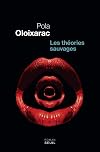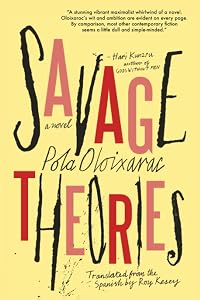
Savage Theories
by Pola Oloixarac
On This Page
Description
"A student at the Buenos Aires School of Philosophy attempts to put her life (academically and romantically) in the service of a professor whose nearly forgotten theories of violence she plans to popularize and radicalize--against his wishes. Meanwhile, a young couple--a documentary filmmaker and a blogger--engage in a series of cerebral and sexual misadventures. In a novel crammed with philosophy, group sex, revolutionary politics, and a fighting fish named Yorick, Oloixarac leads her show more characters and the reader through dazzling and digressive intellectual byways to an Internet hack that confronts us with a catalog of historical violence, devastation, and atrocity throughout the centuries. Spellbinding, strange, groundbreaking, and already translated into several languages, Savage Theories is the debut of a major new voice on the world stage"-- show lessTags
Recommendations














Member Reviews
Writing a brief description of the plot of Savage Theories is to miss most of what goes on in this odd book that spends most of its time going off on tangents and assuming the reader is a lot more knowledgeable than this particular reader is. Basically, there are two stories; a young woman stalks her professor while justifying it in all sorts of philosophical ways, which hides the creepiness somewhat and; two teenage friends, who believe themselves to be physically repulsive, negotiate their social world with an angry sense of inferiority, even as they engage in orgies with beautiful people.
This is one weird book. It revels in a sort of intellectual ping pong, where the reader is assumed to be not only aware of a broad swath of show more philosophy, sociology and Argentinian history, but that they are also able to keep up with Pola Oloixarac's frenetic jumping around between topics and references. This is the aspect of the book I liked - after a lot of looking up of things, I eventually just relaxed into enjoying the ride. It's a wild and fun one, even as I missed most of the references and asides.
I did have a problem with the author's cavalier attitude toward sexual violence, which is often played for laughs, including a gang rape in a nightclub bathroom which is played for laughs and also no big deal. There's more to feel uneasy about here, and much that was interesting, but in the end this was a book I'm not happy to have read. show less
This is one weird book. It revels in a sort of intellectual ping pong, where the reader is assumed to be not only aware of a broad swath of show more philosophy, sociology and Argentinian history, but that they are also able to keep up with Pola Oloixarac's frenetic jumping around between topics and references. This is the aspect of the book I liked - after a lot of looking up of things, I eventually just relaxed into enjoying the ride. It's a wild and fun one, even as I missed most of the references and asides.
I did have a problem with the author's cavalier attitude toward sexual violence, which is often played for laughs, including a gang rape in a nightclub bathroom which is played for laughs and also no big deal. There's more to feel uneasy about here, and much that was interesting, but in the end this was a book I'm not happy to have read. show less
When You Feel You're Too Old for a Book
"Savage Theories" is inventive and sharp, but I feel a certain distance from its headlong fascination with philosophy and political theory. About halfway through the book I began to realize my judgment was a matter of age.
But it's a tricky subject. If someone says they read contemporary fiction, that implies they don't read primarily children's books or YA fiction. But there's no category for fiction aimed at people between, say, 20 and 40. "Savage Theories" made me think there should be such a category. The problem would be how to define it.
In this novel, at least, it would have to do with the ways that the narrator and the implied author tend to get swept away by "theories," which tends to mean show more political theory, with some psychoanalysis and existentialism added in. I'm not allergic to novels with literary references (like Vila Matas), but to something about the way those references are presented. It also has to do, in "Savage Theories," with the way we're told about sex.
1. Sex
Sex obliterates narrative, as everyone knows, but in novels by what I'm calling young writers, sex can be a flood that washes through the room several times per chapter. It's as if the world is continuously immersed in streams of warm sea water. Sex is everywhere. People swim in it and even breathe for entire chapters underwater.
On the other hand talk about sex is descriptive and insouciant about combinations of lovers and ideals of beauty. (One of the heroines here is supposedly fat and ugly, and one of the people she has sex with -- in a group of four -- praises only her feet.) Even the character in Eimear McBride's "Lesser Bohemians" has more distance on sex than "Savage Theories."
2. Theories
Theories also captivate the characters in this "Savage Theories." It's full of the sort of breathless allusions that I remember from my undergraduate years. "I must say," a man says in a seduction scene, "I'm very impressed that you caught that hidden reference to Marx's 'The German Ideology.'" And then on the next page the narrator gets swept up in her theorizing:
"I took advantage of the fact that he was chewing, and added that ever since the Knowledge Industry decided to proclaim itself critical (i.e., since the dernier cri of its blusterings is to fancy itself a critic), humanism has been reduced to a republican version of intellectual purity; in the end, product differentiation is as important for (and within) the academy as it is for the capitalist corporations that academics love to hate." (p. 135)
This isn't ironic, except as a mandatory veneer of self-awareness on the narrator's part. It's heartfelt and entranced by the possibilities the novel grants it.
3. Mixing sex and theories
Both sex and theory are hypnotic, and tend to ruin the narrator's ability to focus on other things. They are only mixed in afew passages. Here is one: the narrator (a woman) has successfully stopped a man from kissing her by asking for a song. It's a triumph, but she dislikes him for acceeding. The thought leads her on to some political theory:
"Behind my eyes I confirm the presence of a feeling so powerful I want to bite him: his very being exudes a vulnerability so unpleasant that it makes me dizzy, rivalsthe strength of my patience without rising to the level of my disgust. But enough. Let us return to the scene. I have no desire to distort a rigorous political theory such as has been established in this book just to make of it a practice drill for some monstrous sort of love." (p. 164)
Again, the political theory is seen ironically, but just a little: the narrator, and the implied author, believe in a lot of it. And the only way works with the sex is not to work.
*
I feel too old for this. Some decades have passed since I was in college, and both sex and theories have become more entangled and less breathless. Dylan's "My Back Pages" says this well:
"A self-ordained professor's tongue too serious to fool
Spouted out that liberty is just equality in school
Equality, I spoke the word as if a wedding vow
Ah, but I was so much older then, I'm younger than that now."
And even that stanza flies its flags a bit too stridently. show less
"Savage Theories" is inventive and sharp, but I feel a certain distance from its headlong fascination with philosophy and political theory. About halfway through the book I began to realize my judgment was a matter of age.
But it's a tricky subject. If someone says they read contemporary fiction, that implies they don't read primarily children's books or YA fiction. But there's no category for fiction aimed at people between, say, 20 and 40. "Savage Theories" made me think there should be such a category. The problem would be how to define it.
In this novel, at least, it would have to do with the ways that the narrator and the implied author tend to get swept away by "theories," which tends to mean show more political theory, with some psychoanalysis and existentialism added in. I'm not allergic to novels with literary references (like Vila Matas), but to something about the way those references are presented. It also has to do, in "Savage Theories," with the way we're told about sex.
1. Sex
Sex obliterates narrative, as everyone knows, but in novels by what I'm calling young writers, sex can be a flood that washes through the room several times per chapter. It's as if the world is continuously immersed in streams of warm sea water. Sex is everywhere. People swim in it and even breathe for entire chapters underwater.
On the other hand talk about sex is descriptive and insouciant about combinations of lovers and ideals of beauty. (One of the heroines here is supposedly fat and ugly, and one of the people she has sex with -- in a group of four -- praises only her feet.) Even the character in Eimear McBride's "Lesser Bohemians" has more distance on sex than "Savage Theories."
2. Theories
Theories also captivate the characters in this "Savage Theories." It's full of the sort of breathless allusions that I remember from my undergraduate years. "I must say," a man says in a seduction scene, "I'm very impressed that you caught that hidden reference to Marx's 'The German Ideology.'" And then on the next page the narrator gets swept up in her theorizing:
"I took advantage of the fact that he was chewing, and added that ever since the Knowledge Industry decided to proclaim itself critical (i.e., since the dernier cri of its blusterings is to fancy itself a critic), humanism has been reduced to a republican version of intellectual purity; in the end, product differentiation is as important for (and within) the academy as it is for the capitalist corporations that academics love to hate." (p. 135)
This isn't ironic, except as a mandatory veneer of self-awareness on the narrator's part. It's heartfelt and entranced by the possibilities the novel grants it.
3. Mixing sex and theories
Both sex and theory are hypnotic, and tend to ruin the narrator's ability to focus on other things. They are only mixed in afew passages. Here is one: the narrator (a woman) has successfully stopped a man from kissing her by asking for a song. It's a triumph, but she dislikes him for acceeding. The thought leads her on to some political theory:
"Behind my eyes I confirm the presence of a feeling so powerful I want to bite him: his very being exudes a vulnerability so unpleasant that it makes me dizzy, rivalsthe strength of my patience without rising to the level of my disgust. But enough. Let us return to the scene. I have no desire to distort a rigorous political theory such as has been established in this book just to make of it a practice drill for some monstrous sort of love." (p. 164)
Again, the political theory is seen ironically, but just a little: the narrator, and the implied author, believe in a lot of it. And the only way works with the sex is not to work.
*
I feel too old for this. Some decades have passed since I was in college, and both sex and theories have become more entangled and less breathless. Dylan's "My Back Pages" says this well:
"A self-ordained professor's tongue too serious to fool
Spouted out that liberty is just equality in school
Equality, I spoke the word as if a wedding vow
Ah, but I was so much older then, I'm younger than that now."
And even that stanza flies its flags a bit too stridently. show less
Note: I stopped with this book around 1/3 of the way through. I hardly ever abandon a book.
The translator does a good job saying that things might be lost in translation here, possibly the author included four meanings in a sentence, and then the translator could only impart two of those meanings. As possibly a not-intelligent-enough reader, or not having the cultural context for this, I possibly wasn't getting any of the meanings which is why this book sadly might be impossible to decipher. This is a complicated book. So I think it is the fault on all levels: of the author's ambitiousness, the translator (at least he admits he didn't get it completely right), and me as a reader. I tried with this one. I really did. I never like to give show more up on books but I was just struggling with this one. Some of the sentences were GREAT. Sadly, it was taking me too much time to dig out those gems. show less
The translator does a good job saying that things might be lost in translation here, possibly the author included four meanings in a sentence, and then the translator could only impart two of those meanings. As possibly a not-intelligent-enough reader, or not having the cultural context for this, I possibly wasn't getting any of the meanings which is why this book sadly might be impossible to decipher. This is a complicated book. So I think it is the fault on all levels: of the author's ambitiousness, the translator (at least he admits he didn't get it completely right), and me as a reader. I tried with this one. I really did. I never like to give show more up on books but I was just struggling with this one. Some of the sentences were GREAT. Sadly, it was taking me too much time to dig out those gems. show less
De vez em quando a crítica define um livro pretensioso e desinteressante como uma grande crítica social de um autor desconhecido - A Elegância do Ouriço vem a mente.
Acho que foi exatamente o que aconteceu com esse livro. Ainda mais depois que surgiu a polêmica de uns imbecis que diziam que a autora era bonita demais para ter escrito um romance.
Acho que foi exatamente o que aconteceu com esse livro. Ainda mais depois que surgiu a polêmica de uns imbecis que diziam que a autora era bonita demais para ter escrito um romance.
En realidad no lo terminé. Abrumada por este libro en el que se nos está lanzando continuamente los conocimientos filosóficos de la autora a la cara. Demasiada sintaxis, poca estructura literaria y un poquito facha. No me apetece seguir.
This book has defeated me. I'm not interested in the subject matter, and it is incredibly difficult for me to make myself read it when An American Marriage is sitting right next to me begging to be picked up. So. I'm sorry, Pola Oloixarac. I tried.
overly complicated, no plot, chaotic. What is this book about?
Members
- Recently Added By
Lists

2018 Tournament of Books
18 works; 12 members

Kirkus Starred Fiction Reviews of Books Published in 2017
412 works; 7 members

contemporary literary fiction list to check out
47 works; 1 member
Author Information

5+ Works 541 Members
Some Editions
Awards and Honors
Common Knowledge
- Canonical title*
- Het hoorcollege
- Original title
- Las teorías salvajes
- Original publication date
- 2008
- People/Characters*
- Rosa Ostreech
- Important places*
- Buenos Aires, Argentinië
- Blurbers
- Kunzru, Hari; Piglia, Ricardo; Calvo, Javier
- Original language
- Spanish
*Some information comes from Common Knowledge in other languages. Click "Edit" for more information.
Classifications
- Genres
- Fiction and Literature, General Fiction
- DDC/MDS
- 863.7 — Literature & rhetoric Spanish Literature Spanish fiction 21st Century
- LCC
- PQ7798.425 .L65 .T4613 — Language and Literature French, Italian, Spanish and Portuguese literatures Spanish literature Provincial, local, colonial, etc. Spanish America
- BISAC
Statistics
- Members
- 188
- Popularity
- 174,574
- Reviews
- 10
- Rating
- (2.73)
- Languages
- 8 — Dutch, English, Finnish, French, German, Italian, Portuguese, Spanish
- Media
- Paper, Audiobook, Ebook
- ISBNs
- 17
- ASINs
- 4