On This Page
Description
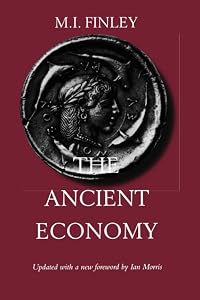
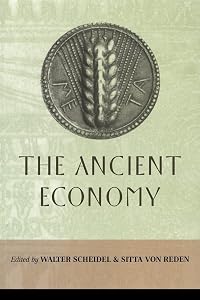
Technical progress, economic growth, productivity, even efficiency have not been significant goals since the beginning of time, declares M. I. Finley in his classic work. The states of the ancient Mediterranean world had no recognizable real-property market, never fought a commercially inspired war, witnessed no drive to capital formation, and assigned the management of many substantial enterprises to slaves and ex-slaves. In short, to study the economies of the ancient world, one must begin show more by discarding many premises that seemed self-evident before Finley showed that they were useless or misleading. Available again, with a new foreword by Ian Morris, these sagacious, fertile, and occasionally combative essays are just as electrifying today as when Finley first wrote them. show lessTags
Recommendations



















Member Recommendations

Member Reviews
A fascinating book. Some of the per-se economics is wrong, or at least out of date. But, like everything Finley wrote, it's briliant, forcing intellectual daring and rigor on a discipline--at best--too accustomed to lazy, unreflective "common sense" reasoning.
This book was immensely influential in its day. I use "in its day" to point to the out-of-date approach of Finley and his subsequent eclipse. He states that there is essentially no "ancient economy" and that we can't use economic yardsticks to measure what was essentially a status, non-market based economy. He states on page 23: "There was no business cycles in antiquity; no cities whose growth can be ascribed, even by us, to the establishment of manufacture..." I think modern archaeology would disagree with his statement. His method of analysis is textual literary analysis and he even uses remarks uttered by Trimalchio to support his conclusions! Things have come along way. Perhaps better is "The Archaeology of the Roman Economy" by show more Green. In any case, it's amazing how much classical studies have changed in 35 years. show less
The essential work in the “primitivist” interpretation of the ancient Mediterranean economy. In short, Finley argues that the ancient economy cannot be properly analyzed through the prism of modern economics. He argues for an agricultural, hand-to-mouth economy with little economy of scale, mass markets, or per capita growth.
While this is an important read, Finley relies almost exclusively on literary evidence where archeology, a field where the evidence continues to mount, tends to support a more “modernist” view of the ancient economy.
While this is an important read, Finley relies almost exclusively on literary evidence where archeology, a field where the evidence continues to mount, tends to support a more “modernist” view of the ancient economy.
A sensible book on economic life in ancient Greece and Rome. As always with Finley, he carefully emphasizes how limited the historical evidence is on these topics, how limited the reach of historians' conclusions consequently should be and how modern concepts like "economics" easily become anachronistic when applied to the ancient world. Such lessons are in my opinion an important part of understanding ancient history.
A surprisingly interesting book, given its title. The main argument is that modern theories of economics don't aways apply. The author keeps the social and world view of the ancients themselves firmly in the forefront, discussing topics such as agriculture, trade, provincial administration, etc. Deals mainly with the Greek and Roman worlds particularly Classical Greece and Imperial Rome.
The subject matter is fascinating but Finley's writing is inaccessible. For an academic, that's praise. For me, it means that I still haven't managed to wade through it.
Ratings
Members
- Recently Added By
Lists

Tim's Analytical History List
11 works; 1 member
Author Information

48+ Works 5,097 Members
M. I. Finley, FBA, (1912-1986), was a major scholar of classics and ancient history. He taught at Columbia University and the City College of New York, where he was influenced by exiled members of the Frankfurt School, before taking a position at Rutgers University. Finley moved to England in 1955, taught classics at Cambridge, and became a master show more at Darwin College. His numerous works include the classic texts Aspects of Antiquity and The Ancient Economy. Finley was knighted by the queen for his contributions to scholarship in 1979. show less
Awards and Honors
Awards
Series

Common Knowledge
- Canonical title
- The Ancient Economy
- Original publication date
- 1973
- Important places
- Antiquity
Classifications
Statistics
- Members
- 405
- Popularity
- 76,754
- Reviews
- 6
- Rating
- (3.90)
- Languages
- 7 — Danish, English, French, German, Italian, Spanish, Turkish
- Media
- Paper, Ebook
- ISBNs
- 20
- UPCs
- 1
- ASINs
- 5