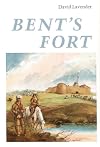
Bent's Fort
by David Lavender
On This Page
Description
Bent's Fort was a landmark of the American frontier, a huge private fort on the upper Arkansas River in present southeastern Colorado. Established by the adventurers Charles and William Bent, it stood until 1849 as the center of the Indian trade of the central plains. David Lavender's chronicle of these men and their part in the opening of the West has been conceded a place beside the works of Parkman and Prescott.Tags
Recommendations





















Member Reviews
Just about every famous name from the early West showed up at Bent’s Fort at sometime or another – James Beckwourth, Kit Carson, Stephen Kearny, Lucien Maxwell, Jedediah Smith, Ceran St. Vrain, Uncle Dick Wooton. And of course, the Bents – Charles and William and their brothers and children. The Bent’s private fort on the American side of the Arkansas River was central to the Santa Fe trade. (There’s not that much about the titular fort; the book was written before the archaeological digs and reconstruction of the 1970s). David Lavender’s book is simultaneously a history of the fur, buffalo robe, and Santa Fe trades, and a biography of the Bent family.
For a book written in 1954, Bent’s Fort is surprisingly just in its show more treatment of Native Americans – this was, after all, at time when John Chivington was still a heroic Indian fighter rather the perpetrator of a massacre. Although Lavender sometimes calls the Plains tribes “savages”, he also notes they were treated extremely poorly by the US government and by most traders. The Bents were also uncharacteristically fair in their treatment of natives – for the time. The Bent brothers built their fort in Cheyenne territory, and William married the Cheyenne chief White Thunder’s daughter Owl Woman, and after her death, her sister Yellow Woman; the Bents always tried to look after the interests of the Cheyenne.
Charles Bent, alas, was apparently overconfident of his reputation among the natives of New Mexico. He was appointed Governor after the military conquest, as being the American with the greatest knowledge of the region. In December 1846 he went from Santa Fe to his residence Taos for the holidays, where he was killed and scalped in front of his wife and children during the Taos revolt.
His brother William carried on the family business but seems to have lost heart with the deaths of Charles and Owl Woman (1847); he blew up Bent’s Fort in 1849, for no reason anyone has ever explained. His sons by Owl Woman (Robert and George) and Yellow Woman (Charles) all adopted Cheyenne ways; George and Charles were in Black Kettles camp at Sand Creek when Colonel John Chivington attacked it in 1863 – Robert had been captured and was forced to guide Chivington to the camp, and George, Charles, and their sister Julie were inside it. All survived, but Charles Bent – now the Cheyenne Pekiree – fought the whites as a Dog Soldier until he died of malaria in 1868 (there are Web sites claiming that Charles Bent/Pekiree instead died at the Battle of Summit Springs in 1869).
An engaging read. Maps in the front. Lavender’s research is meticulous; he notes the difficulty of separating “tall tales” from facts but his copious endnotes justify his interpretations. As noted above, at the time Lavender was writing there were only faint traces of Bent’s Fort; it’s now been reconstructed and is a National Historical Site under the Park Service. show less
For a book written in 1954, Bent’s Fort is surprisingly just in its show more treatment of Native Americans – this was, after all, at time when John Chivington was still a heroic Indian fighter rather the perpetrator of a massacre. Although Lavender sometimes calls the Plains tribes “savages”, he also notes they were treated extremely poorly by the US government and by most traders. The Bents were also uncharacteristically fair in their treatment of natives – for the time. The Bent brothers built their fort in Cheyenne territory, and William married the Cheyenne chief White Thunder’s daughter Owl Woman, and after her death, her sister Yellow Woman; the Bents always tried to look after the interests of the Cheyenne.
Charles Bent, alas, was apparently overconfident of his reputation among the natives of New Mexico. He was appointed Governor after the military conquest, as being the American with the greatest knowledge of the region. In December 1846 he went from Santa Fe to his residence Taos for the holidays, where he was killed and scalped in front of his wife and children during the Taos revolt.
His brother William carried on the family business but seems to have lost heart with the deaths of Charles and Owl Woman (1847); he blew up Bent’s Fort in 1849, for no reason anyone has ever explained. His sons by Owl Woman (Robert and George) and Yellow Woman (Charles) all adopted Cheyenne ways; George and Charles were in Black Kettles camp at Sand Creek when Colonel John Chivington attacked it in 1863 – Robert had been captured and was forced to guide Chivington to the camp, and George, Charles, and their sister Julie were inside it. All survived, but Charles Bent – now the Cheyenne Pekiree – fought the whites as a Dog Soldier until he died of malaria in 1868 (there are Web sites claiming that Charles Bent/Pekiree instead died at the Battle of Summit Springs in 1869).
An engaging read. Maps in the front. Lavender’s research is meticulous; he notes the difficulty of separating “tall tales” from facts but his copious endnotes justify his interpretations. As noted above, at the time Lavender was writing there were only faint traces of Bent’s Fort; it’s now been reconstructed and is a National Historical Site under the Park Service. show less
Charles and William Bent were early fur traders. They were involved in the beaver fur trade, the Santa Fe trail and the buffalo robe trade. The Bent's were honest friends of the native people, especially the Cheyenne. The silk hat saved the beavers from extermination but the Bent's best efforts couldn't save the Plains Indians. Charles Bent was the first territorial governor of New Mexico. The Bent's trading post, Bent's Fort, was visited by everybody. Kit Carson, Fremont, Jim Bridger and everybody else who was in the west between 1820 and 1850. A sad but honest report of things that really happened. Some school boards might not like this book, it tells an unpleasant truth. While Charles and William tired to do what was best for the show more Indians of the Plains too many others just wanted to cheat them and steal their lands. In the end the others prevailed. show less
Bent's Fort was a landmark of the American frontier, a huge private fort on the upper Arkansas River in present southeastern Colorado. Established by the adventurers Charles and William Bent, it stood until 1849 as the center of the Indian trade of the central plains. David Lavender's chronicle of these men and their part in the opening of the West has been conceded a place beside the works of Parkman and Prescott.
"When formal trade was about to open, the camp crier stalked through the village and in stentorian bellows announced what everyone knew: the name of the trader and the sort of merchandise he brought.
"
Bent’s Fort was a polestar for Indian trade in the plains of Colorado until 1849. This highly reputed historian portrays not just this important landmark, but greater still, the culture of the old Santa Fe Trail and its persons. Other Colorado topics published by this historian include the Colorado River, Telluride, and Spanish exploration.
Bent’s Fort was a polestar for Indian trade in the plains of Colorado until 1849. This highly reputed historian portrays not just this important landmark, but greater still, the culture of the old Santa Fe Trail and its persons. Other Colorado topics published by this historian include the Colorado River, Telluride, and Spanish exploration.
Ratings
Members
- Recently Added By
Author Information

48+ Works 2,140 Members
David Lavender's publications include One Man's West, Bent's Fort, The First in the Wilderness, and California: Land of New Beginnings
Awards and Honors
Awards
Work Relationships
Is contained in
Common Knowledge
- Original title
- Bent's Fort
- Original publication date
- 1954
- People/Characters
- Charles Bent; William Bent
- Important places
- Santa Fe Trail; Bent's Fort, Colorado, USA
- First words
- The Place Called Purgatory - Northeast from the Spanish Peaks of Colorado a small creek flows toward the Arkansas River.
- Last words
- (Click to show. Warning: May contain spoilers.)Concerning the other things he had left to the plains and the mountains, things that had made such cities and newspapers possible, the account had little to say.
- Original language
- English
Classifications
Statistics
- Members
- 222
- Popularity
- 147,561
- Reviews
- 4
- Rating
- (4.25)
- Languages
- English
- Media
- Paper, Ebook
- ISBNs
- 3
- ASINs
- 13