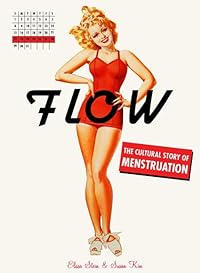
Flow: The Cultural Story of Menstruation
by Elissa Stein, Susan Kim
On This Page
Description
In this hip, hilarious and truly eye-opening cultural history, menstruation is talked about as never before. Flow spans its fascinating, occasionally wacky and sometimes downright scary story: from mikvahs (ritual cleansing baths) to menopause, hysteria to hysterectomies - not to mention the Pill, cramps, the history of underwear, and the movie about puberty they showed you in 5th grade. Flow answers such questions as: What's the point of getting a period? What did women do before pads and show more tampons? What about new drugs that promise to end periods - a hot idea or not? Sex during your period: gross or a turn-on? And what's normal, anyway? With color reproductions of (campy) historical ads and early (excruciating) femcare devices, it also provides a fascinating (and mind-boggling) gallery of this complex, personal and uniquely female process. show lessTags
Recommendations






Member Recommendations

Member Reviews
This was a fun book, jazzed up with lots of vintage ads. The authors' bias is clearly feminist and anti-big-pharma, so I was in their court from page one. If I have a complaint about this book, it's that it skews pretty young. There's one breezy chapter covering perimenopause and beyond- and that's it. So the target audience is considerably younger than your intrepid reviewer, who admits to more than a passing interest in hot flashes and scary clots the size of Rhode Island. Not that this kept me from being fascinated by the rubber aprons of yesteryear, or being furious about the medicalization of perfectly ordinary reproductive processes.
Well worth reading for the historical perspective alone, but as a bonus, guaranteed to make steam show more come out of your ears when you read about the drug companies scheming to make women feel dirty and sick and inadequate. show less
Well worth reading for the historical perspective alone, but as a bonus, guaranteed to make steam show more come out of your ears when you read about the drug companies scheming to make women feel dirty and sick and inadequate. show less
This book was such a brilliant idea, and the authors did a great job. I read another bloggers review about Flow and they were just had such a strong reaction to it, not positive or negative really just strong, that I thought it was definitely worth reading. Flow tells the cultural history of the period and how woman's status and health care have changed over time. It's written in a friendly, personable style. While many reviewers feel like this means the book was geared at the younger set, I think what the authors were really going for was making the book readable, and to try and make a topic that makes many people uncomfortable a little bit friendlier. The book isn't couched in a bunch of scientific jargon that most of us will never show more understand. Everything is in language that is respectful and completely understandable.
Some of the information in this book is definitely scary. It is absolutely terrifying to see how woman's bodies have been mistreated over the years due to lack of scientific study and information. While there is a lot of good explanation in this book regarding fertility and how a woman's cycle really works, the most important thing I think a woman can take away from this book is too make sure that you are well informed about exactly what it is you are doing to your body when you use medications or how you handle your period. show less
Some of the information in this book is definitely scary. It is absolutely terrifying to see how woman's bodies have been mistreated over the years due to lack of scientific study and information. While there is a lot of good explanation in this book regarding fertility and how a woman's cycle really works, the most important thing I think a woman can take away from this book is too make sure that you are well informed about exactly what it is you are doing to your body when you use medications or how you handle your period. show less
This book is thoroughly research, thoughtfully organized, fun, informative, and IMPORTANT! Stein and Kim have seized on an opportunity to reshape the way we talk about and think about menstruation, and if we can succeed in doing that, then the sky is the limit. I loved every minute I spent with Flow. I laughed, I cringed, I nodded in agreement, and I underlined like crazy. I learned all kinds of things I didn’t know before, and I revisited formative lessons from my women’s studies education. I reveled in the fun of reading this book in public and telling perfect strangers that yes, my book WAS about periods, and no, it wasn’t boring!
Flow is a gift of a book (and I’ll be giving it as a gift to just about everyone I know), and I show more can’t recommend it highly enough. To everyone. Because you shouldn’t have to be progressive, liberal, feminist, or even female to see the value in understanding something that essentially affects all of us.
Read my full review at The Book Lady's Blog. show less
Flow is a gift of a book (and I’ll be giving it as a gift to just about everyone I know), and I show more can’t recommend it highly enough. To everyone. Because you shouldn’t have to be progressive, liberal, feminist, or even female to see the value in understanding something that essentially affects all of us.
Read my full review at The Book Lady's Blog. show less
Flow is a thoroughly fascinating, humorous and often shocking look at the subject of menstruation throughout history. The authors use an entertaining, conversational tone to discuss a topic that is typically thought too personal or taboo to be mentioned at all. The book ranges from topics such as menarche and menopause to the development and advances of feminine care products. Adding to the visual appeal and readability are numerous personal accounts and vintage ads. Always the underlying theme is open discussion and acceptance for this natural part of every woman’s life. Though informative and thought provoking for any reader, it will be especially empowering for women.
First, I want to point out that I like the idea of this book. The argument that women have always been period-hating victims of men and the femcare industry's judgement and marketing is cool with me; I hate the femcare industry and like yelling about misogynism as much as the next lady. The many vintage advertisements and illustrations are nice, and realizing that "water cure" meant "water-stimulated orgasm to relieve hysteria" was pretty cool.
However.
Several things about the book rubbed me the wrong way. The greatest of these was the mini-section on alternatives to big femcare products (tampons and disposable pads). Menstrual cups (my personal torch) rated just one, mostly positive, page, although any convincing of reluctant readers is show more undermined by the writers suggesting that removal will cause you to be covered in "bloody goo." For two women who want us to view our periods more holistically and without the shame industry has assigned them, that seemed like a strange choice of words. Even more strange, though, is the section on cloth pads (which have a pretty long history to back them up). The strange part, though, was a side-quote from one of the authors, who writes that she "delved into the world of reusable pads" (241) in the spirit of conservation and book-research. Well, congratulations to you. Unfortunately, she admits that she was squicked out by seeing blood on her happy little flannel robots and that pads are hot in August. (Personal-torch-rant: TRY A CUP! THAT WOULD ACTUALLY BE RESEARCH AND THEN YOU MIGHT BE FREE FROM THE DISPOSABLES COMPANIES!) I'm a little surprised that authors of a book that is so damning of the femcare industry and all that they market to us come off as so personally unadventurous toward reusable products. Why else have you been spending five chapters telling us about TSS and deoderized tampons and landfills and et cetera et cetera et cetera?
Anyway.
Other minor gripes include the occasionally off-putting conversational/breezy tone of the writing, the relatively thin coverage of menopause and menarche, and the overall focus on white, middle-class American women throughout history. (Yes, I know the book is about America and that advertising for 200 years has tended to target the middle- and upper-classes, but STILL. Token mentions of the working poor and minorities do not constitute coverage.)
All in all, I enjoyed my trip down bio-feminism lane, or whatever you want to call it. I've been embracing my period (and menstrual cup) for five years now, though, so the choir was feeling a little superior to the preachers' revelations about alternatives to big femcare. show less
However.
Several things about the book rubbed me the wrong way. The greatest of these was the mini-section on alternatives to big femcare products (tampons and disposable pads). Menstrual cups (my personal torch) rated just one, mostly positive, page, although any convincing of reluctant readers is show more undermined by the writers suggesting that removal will cause you to be covered in "bloody goo." For two women who want us to view our periods more holistically and without the shame industry has assigned them, that seemed like a strange choice of words. Even more strange, though, is the section on cloth pads (which have a pretty long history to back them up). The strange part, though, was a side-quote from one of the authors, who writes that she "delved into the world of reusable pads" (241) in the spirit of conservation and book-research. Well, congratulations to you. Unfortunately, she admits that she was squicked out by seeing blood on her happy little flannel robots and that pads are hot in August. (Personal-torch-rant: TRY A CUP! THAT WOULD ACTUALLY BE RESEARCH AND THEN YOU MIGHT BE FREE FROM THE DISPOSABLES COMPANIES!) I'm a little surprised that authors of a book that is so damning of the femcare industry and all that they market to us come off as so personally unadventurous toward reusable products. Why else have you been spending five chapters telling us about TSS and deoderized tampons and landfills and et cetera et cetera et cetera?
Anyway.
Other minor gripes include the occasionally off-putting conversational/breezy tone of the writing, the relatively thin coverage of menopause and menarche, and the overall focus on white, middle-class American women throughout history. (Yes, I know the book is about America and that advertising for 200 years has tended to target the middle- and upper-classes, but STILL. Token mentions of the working poor and minorities do not constitute coverage.)
All in all, I enjoyed my trip down bio-feminism lane, or whatever you want to call it. I've been embracing my period (and menstrual cup) for five years now, though, so the choir was feeling a little superior to the preachers' revelations about alternatives to big femcare. show less
I love the premise of this book -- a social history of menstruation, although mostly USA and mostly late-1800s+. It explores menarche and menopause; PMS and hysteria; religion and society; products and advertising … each topic a mix of fun, nostalgia and shocking practices. I especially like the book’s design -- a larger hardcover whose smooth, heavy pages are filled with reproductions of easily a hundred vintage ads for femcare products.
But I’m disappointed with its superficiality -- more an exploratory collage than definitive information (despite teasers on the back cover); its lack of notes or documentation lends a chatty, hearsay quality. And I tired of its immature (“OMG!!!” in spirit if not in print), snarky tone that show more devolved multi-factored concerns into rants against the femcare industry.
There’s a good bibliography, and the Hysteria chapter's mention of the “rest cure” and Charlotte Perkins Gilman’s 1892 short (horror) story prompted me to reread The Yellow Wallpaper.
I’m keeping Flow for the ads. It's fabulous to browse through, less satisfying to read through; still I do recommend it to most anyone interested in a light treatment of the topic. show less
But I’m disappointed with its superficiality -- more an exploratory collage than definitive information (despite teasers on the back cover); its lack of notes or documentation lends a chatty, hearsay quality. And I tired of its immature (“OMG!!!” in spirit if not in print), snarky tone that show more devolved multi-factored concerns into rants against the femcare industry.
There’s a good bibliography, and the Hysteria chapter's mention of the “rest cure” and Charlotte Perkins Gilman’s 1892 short (horror) story prompted me to reread The Yellow Wallpaper.
I’m keeping Flow for the ads. It's fabulous to browse through, less satisfying to read through; still I do recommend it to most anyone interested in a light treatment of the topic. show less
This book certainly gave me a lot to think about, and this type of book needs to be written. However, I found the voice somewhat grating and even hectoring in places, and some chapters tried to skim over all possible viewpoints but felt disjointed and thin. Also, the excessive use of adverbs such as "clearly", "obviously" and "evidently" undermined some of the arguments a bit; it made them feel more like opinion than fact, as though stating that things were clear, obvious or evident meant that the opposite was true. I would not dissuade anyone from reading it, but would suggest exploring the bibliography as well to get some more perspectives on this issue.
Members
- Recently Added By
Author Information

10 Works 383 Members

8+ Works 869 Members
Awards and Honors
Distinctions
Notable Lists
Common Knowledge
- Original publication date
- 2009
- Dedication
- To Jon and Heather, whose endless patience and support made all the difference.
And to Izzy and Jack, who callenge and inspire me every day.
—Elissa Stein
To Lar, who always understands; to Ollie, who alway... (show all)s listens; and to Evelyn, Melody, and Katie, who occasionally let me win.
—Susan Kim - First words
- Introduction
Females make up more than half of the world's population.
For years, feminist scholars complained bitterly that menstruation was a taboo subject in the United States. - Last words
- (Click to show. Warning: May contain spoilers.)Just go with the flow.
Classifications
Statistics
- Members
- 284
- Popularity
- 113,039
- Reviews
- 19
- Rating
- (3.83)
- Languages
- English
- Media
- Paper, Ebook
- ISBNs
- 3
- ASINs
- 2