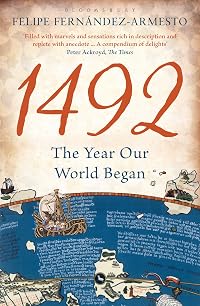
1492: The Year the World Began
by Felipe Fernández-Armesto
On This Page
Description
1492: The Year the World Began is a look at one of the most fascinating years in world history, the year when many believe the modern world was born. Historian Felipe Fernandez-Armesto, author of Millennium, covers such iconic figures as Christopher Columbus and Alexander Borgia and explores cultures as diverse as that of Spain, China, and Africa to tell the story of 1492, a momentous year whose lessons are still relevant today.Tags
Recommendations




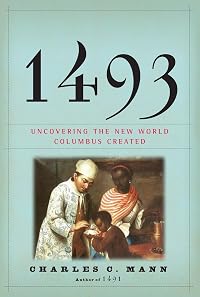

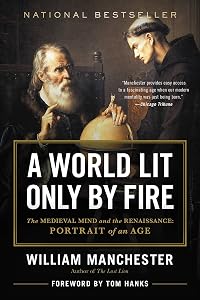
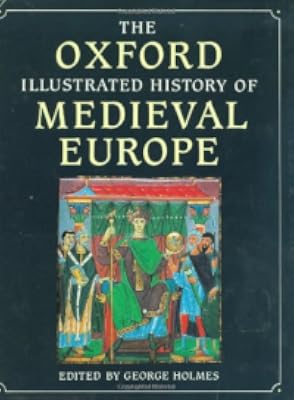
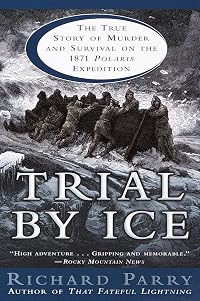













Member Recommendations
Member Reviews
An engrossing, highly readable survey of the state of the world in 1492, when Columbus's (or his overlooked lookout's) discovery of the Americas dramatically changed the global status quo. Fernandez-Armesto, a Professorial Fellow of Queen Mary, University of London, writes with clarity and intellectual rigor (not always an easily managed combination), examining the international situation with the enthusiasm of an ideal explorer.
At 321 pages, this book is deceptively lightweight, and minimally footnoted, but the author manages to pack an impressive amount of content between its covers.
Over the course of ten chapters, subjects covered include, among others, the fortunes of Islam in Africa, the reign of Ivan III and his massive expansion show more of Russia, and the complex tensions between Confucian mandarins and the Buddhist-sympathizing Ming dynasty.
Some of Fernandez-Armesto's most striking observations are only briefly treated in the text, but provide much room for further thought: for example, his speculation that a decline in the fortunes of the great empire of Mali, during the fifteenth century, may have directly influenced the concurrent decline in the status of black people, evinced in contemporary map illustrations, thus strengthening the justifications for the slave trade (itself already well underway) and constituting a dramatic turning-point in the history of race relations.
Occasionally, the author's attempts to provide contemporary pop-culture parallels for historic reference points can feel slightly jarring, but this is rarely an issue and in any case is also a reflection of the book's appealing chattiness and immense enthusiasm for and engagement with its subject.
Notwithstanding its light touch, however, this study provides a cogent and intensive analysis of why other parts of the world, for one reason or another, did not take over the Americas -- thus giving the lie to the inevitability of the "rise of the West" -- and what this take-over, five hundred odd years ago, means for the world today. show less
At 321 pages, this book is deceptively lightweight, and minimally footnoted, but the author manages to pack an impressive amount of content between its covers.
Over the course of ten chapters, subjects covered include, among others, the fortunes of Islam in Africa, the reign of Ivan III and his massive expansion show more of Russia, and the complex tensions between Confucian mandarins and the Buddhist-sympathizing Ming dynasty.
Some of Fernandez-Armesto's most striking observations are only briefly treated in the text, but provide much room for further thought: for example, his speculation that a decline in the fortunes of the great empire of Mali, during the fifteenth century, may have directly influenced the concurrent decline in the status of black people, evinced in contemporary map illustrations, thus strengthening the justifications for the slave trade (itself already well underway) and constituting a dramatic turning-point in the history of race relations.
Occasionally, the author's attempts to provide contemporary pop-culture parallels for historic reference points can feel slightly jarring, but this is rarely an issue and in any case is also a reflection of the book's appealing chattiness and immense enthusiasm for and engagement with its subject.
Notwithstanding its light touch, however, this study provides a cogent and intensive analysis of why other parts of the world, for one reason or another, did not take over the Americas -- thus giving the lie to the inevitability of the "rise of the West" -- and what this take-over, five hundred odd years ago, means for the world today. show less
I plodded through the first few chapters, then skimmed through a few chapters, finally giving up entirely.
Obviously, there are exceptions to every rule, but I've struggled with multiple books written by academics recently, while thoroughly enjoying well-researched books written by journalists. I'm definitely an English major with an interest in history, with my first priority being readability.
1492 suffered from the same issues as many other professor-written titles: concentration on including every little detail, rather than building a captivating overall narrative. While I was interested in some of the information in this book, I got bogged down with name after name thrown at me, and with the clumsy use of block quotes. It was too show more reminiscent of research papers I wrote in college, "SAT words" and all. show less
Obviously, there are exceptions to every rule, but I've struggled with multiple books written by academics recently, while thoroughly enjoying well-researched books written by journalists. I'm definitely an English major with an interest in history, with my first priority being readability.
1492 suffered from the same issues as many other professor-written titles: concentration on including every little detail, rather than building a captivating overall narrative. While I was interested in some of the information in this book, I got bogged down with name after name thrown at me, and with the clumsy use of block quotes. It was too show more reminiscent of research papers I wrote in college, "SAT words" and all. show less
Dr. F-A has a curious program in this book. He seeks to give us a picture, a snap-shot of a very fluid system, to wit, our understanding of the past, as we have drawn it from written, and archaeological evidence, but reveals in his Epilogue that he believes that history has no course. But the point of such a snap-shot approach is to draw parallels, especially as his chapter on the community of the Indian ocean. I found this information very valuable when relating it to the scale of European-Mediterranean commerce. He seems to have found patterns in his denial that such patterns can be found. We are also treated to a close study of the state of the mind, and of the technology of Christopher Columbus, and some information relating to the show more lapse in exploration by non-European societies in the generation preceding Columbus. The book, promising a unity of vision, seems disjoined, but has some interesting essays dealing with the effects of the Expulsion of the Jews from Spain, a quick look at exploration of North Eastern Africa in the fifteenth century, and a rare look at the Russian expansion of the period. A book for reading and then examining in the light of more detailed study in the areas covered. The prose is lively. I would prefer readers of this book to also read Charles Mann's two books "1491" and 1492". I reread this work in June 2021. show less
1492 was an easy and informative read in which the author looks at the civilizations of the world in the years just prior to the voyage made by Columbus. He thinks that that world was a different one from the world that we live in today and he attempts to explain how we got from there to here. The only section where I got bogged down a bit was the one that explained 15th century Italy and that was probably me and not the book. The sections on Africa and the formation of Russia were particularly good and told me a great deal that I never knew about the history of those areas. Also interesting was the way Christianity and Islam established themselves in some parts of the world but not others.
I liked the book well enough that I ordered the show more author's book Pathfinders from the library before even finishing this one. show less
I liked the book well enough that I ordered the show more author's book Pathfinders from the library before even finishing this one. show less
This is not my first book by this author and so I expected it to be a little dense and sometimes very academic. It was all of those things. But like the other book of his that I read, it was well constructed and loaded with information that I had not encountered before in my history reading (and I have read quite a lot). I am going to read Charles Mann's book "1493" soon so I think this will be a good prep for it.
Overview of the various exploratory and colonialistic movements happening around the world in the period when Columbus was sailing to the New World (though that was neither his intention nor his assumption). While I learned an awful lot from this book, I found it frankly rather disappointing. Part of it was the author's sytax; the book is peppered with sentences and phrases that often struck me as odd and sometimes incomprehensible.
Das Jahr 1492 ist wohl für viele mit dem Namen Kolumbus verknüpft - Felipe Fernandez-Armesto spannt den Bogen aber sehr viel größer, indem er die Zeit um den Wechsel aus dem 15. in das 16. Jahrhundert global betrachtet. Die Machtverhältnisse in Europa und in Nordafrika kommen zur Sprache, die Verbreitung von Islam und Christentum und die geographischen und maritimen Voraussetzungen für die erfolgreiche Fahrt von Kolumbus nach Amerika - und zurück.
Es wird aber auch hinterfragt, warum ausgerechnet die Europäer zu den großen Entdeckern wurden, nicht aber die Inder oder Chinesen.
Und Felipe Fernandez-Armesto zeigt immer wieder auf, dass nicht nur in Europa dieser Jahrhundertwechsel als Zeitenwende angesehen werden kann.
Teilweises show more etwas langatmig, in der Summe aber ein Geschichtsbuch, dass auch die außereuropäische Geschichte in den Blick nimmt. show less
Es wird aber auch hinterfragt, warum ausgerechnet die Europäer zu den großen Entdeckern wurden, nicht aber die Inder oder Chinesen.
Und Felipe Fernandez-Armesto zeigt immer wieder auf, dass nicht nur in Europa dieser Jahrhundertwechsel als Zeitenwende angesehen werden kann.
Teilweises show more etwas langatmig, in der Summe aber ein Geschichtsbuch, dass auch die außereuropäische Geschichte in den Blick nimmt. show less
Feb 12, 2017German
Members
- Recently Added By
Lists

Books Read in 2015
3,299 works; 129 members

The Joe Rogan Experience Library
254 works; 3 members

What A Year: Books titled with a particular year
147 works; 2 members
Author Information

65+ Works 6,179 Members
Felipe Fernandez-Armesto, a world-renowed scholar and author, is the Principe de Asturias Professor of Spanish Culture and Civilization at Tufts University
Common Knowledge
- Canonical title*
- 1492 : The Year Our World Began
- Original title
- 1492 : The Year Our World Began
- Original publication date
- 2009
- People/Characters
- Christopher Columbus; Ferdinand II of Aragon; Isabella I, Queen of Castile and León; Ivan III of Russia
- Important places
- Granada, Andalusia, Spain; Florence, Tuscany, Italy; Russia (Muscovite); Grand Duchy of Moscow; Mali
- First words
- In 1491, a prophet appeared in Rome in rags, flourishing, as his greatest possession, a wooden cross.
- Last words
- (Click to show. Warning: May contain spoilers.)The world the prophets knew vanished, and a new world, the world we are in, began to take shape.
*Some information comes from Common Knowledge in other languages. Click "Edit" for more information.
Classifications
Statistics
- Members
- 501
- Popularity
- 60,422
- Reviews
- 8
- Rating
- (3.70)
- Languages
- English, Italian, Portuguese (Portugal), Spanish
- Media
- Paper, Ebook
- ISBNs
- 15
- ASINs
- 8