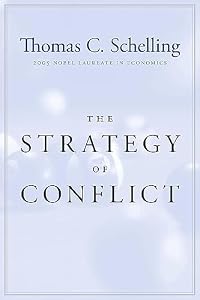
The Strategy of Conflict
by Thomas C. Schelling
On This Page
Description
A series of closely interrelated essays on game theory, this book deals with an area in which progress has been least satisfactory--the situations where there is a common interest as well as conflict between adversaries: negotiations, war and threats of war, criminal deterrence, extortion, tacit bargaining. It proposes enlightening similarities between, for instance, maneuvering in limited war and in a traffic jam; deterring the Russians and one's own children; the modern strategy of terror show more and the ancient institution of hostages. show lessTags
Recommendations






Member Reviews
Sometimes when you read a classic, it doesn’t offer much because its insights have been the building blocks for what came after. So too here—if you know any game theory, then very little here will be new (and there’s a lot of math) but that doesn’t mean it wasn’t vital. Also notable: we’ve come around again to deterring (or not) the Russians.
This is one of the most important books on Game Theory, and also, thankfully, one of the more accessible (certainly much more so than von Neumann's and Morgenstern's book).
His main theses are that not all games are zero-sum. That is, they are 'variable-sum', or dependent upon the strategies used. Not all actors are apparently rational, and some may act on seemingly irrational behavior in order to alter their opponent's responses. On the individual level, this could be the abusive lover threatening to kill themselves in order to keep you obedient to them. On the international level, this could be the North Koreans lobbing more missiles into the ocean to get more food. Decisions are interdependent upon the other's decisions.
Perceptions show more are also a vital component of decision making. Limiting information available to the opponent, or restricting their choices by other means, is a way to appropriately modify your own action. Strategy is not only a way of dealing with force, but also potential force.
In cooperative games, coordination is necessary. If communication is possible, then it would be best to aim for some point that you know that the other target might think of as being a valuable and important meeting point. These are now referred to as 'focal points', or, more recently, 'Schelling points'.
The idea of 'deterrence' has to have two necessary components: a conflict, and a common interest. Bargaining is a means by which both actors can find ways to benefit, but this becomes more difficult in areas of more open conflict, as the means of communication may become impeded. Therefore, a tacit communication or tacit bargaining - a scale of responses with which one communicates, up to and including armed force.
Some of these points may seem obvious now, fifty years later, but they seem even more important only because of how often they are overlooked. Schelling is important not entirely because of his mathematical analysis, but because how he also encompasses the human element in decision-making. The Cuban Missile Crisis, the ultimate 'game' of brinksmanship, coordination, and negotiation, only occurred two years after this book was published. Valuable reading for economists, politicians, and anybody who wants more than a passing knowledge of these games we play. show less
His main theses are that not all games are zero-sum. That is, they are 'variable-sum', or dependent upon the strategies used. Not all actors are apparently rational, and some may act on seemingly irrational behavior in order to alter their opponent's responses. On the individual level, this could be the abusive lover threatening to kill themselves in order to keep you obedient to them. On the international level, this could be the North Koreans lobbing more missiles into the ocean to get more food. Decisions are interdependent upon the other's decisions.
Perceptions show more are also a vital component of decision making. Limiting information available to the opponent, or restricting their choices by other means, is a way to appropriately modify your own action. Strategy is not only a way of dealing with force, but also potential force.
In cooperative games, coordination is necessary. If communication is possible, then it would be best to aim for some point that you know that the other target might think of as being a valuable and important meeting point. These are now referred to as 'focal points', or, more recently, 'Schelling points'.
The idea of 'deterrence' has to have two necessary components: a conflict, and a common interest. Bargaining is a means by which both actors can find ways to benefit, but this becomes more difficult in areas of more open conflict, as the means of communication may become impeded. Therefore, a tacit communication or tacit bargaining - a scale of responses with which one communicates, up to and including armed force.
Some of these points may seem obvious now, fifty years later, but they seem even more important only because of how often they are overlooked. Schelling is important not entirely because of his mathematical analysis, but because how he also encompasses the human element in decision-making. The Cuban Missile Crisis, the ultimate 'game' of brinksmanship, coordination, and negotiation, only occurred two years after this book was published. Valuable reading for economists, politicians, and anybody who wants more than a passing knowledge of these games we play. show less
Ratings
Members
- Recently Added By
Author Information

14+ Works 1,699 Members
Thomas Crombie Schelling was born in Oakland, California on April 14, 1921. He received a bachelor's degree in economics from the University of California, Berkeley in 1944. After working as an analyst for the federal Bureau of the Budget, he attended Harvard University. He spent two years in Denmark and France as an economist for the Economic show more Cooperation Administration. In 1950, he joined the White House staff of the foreign policy adviser to President Harry S. Truman. In 1951, he received his doctorate from Harvard and published his first book, National Income Behavior: An Introduction to Algebraic Analysis. He taught economics at Yale University, Harvard University, and the University of Maryland's Department of Economics and School of Public Policy before retiring in 2003. He wrote several books during his lifetime including International Economics, The Strategy of Conflict, Strategy and Arms Control written with Morton H. Halperin, Arms and Influence, Micromotives and Macrobehavior, Choice and Consequence, and Strategies of Commitment. In 2005, he and Robert J. Aumann received the Nobel Prize in economic science for "having enhanced our understanding of conflict and cooperation through game-theory analysis." He died on December 13, 2016 at the age of 95. (Bowker Author Biography) show less
Awards and Honors
Common Knowledge
- Original publication date
- 1960; 1980 (new preface) (new preface)
- First words
- Among diverse theories of conflict -- corresponding to the diverse meetings of the word "conflict" -- a main dividing line is between those that treat conflict as a pathological state and seek its causes and treatment, and th... (show all)ose that take conflict for granted and study the behavior associated with it.
Classifications
Statistics
- Members
- 560
- Popularity
- 52,575
- Reviews
- 2
- Rating
- (3.89)
- Languages
- English, French, Italian, Spanish
- Media
- Paper, Audiobook, Ebook
- ISBNs
- 12
- ASINs
- 7