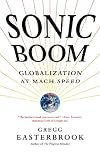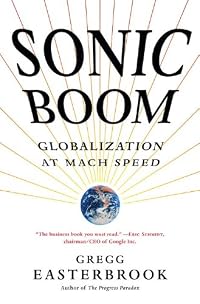
Sonic Boom: Globalization at Mach Speed
by Gregg Easterbrook
On This Page
Description
Writing with the lively wit and contrarian insight that are his trademarks, Easterbrook argues that the West is about to enter the most powerful economic boom in history that will bring with it unprecedented levels of anxiety.Tags
Recommendations










Member Reviews
Thoughtful, dynamic book that leads one to think about the future in new ways, and defies conventional wisdom. First of all, Easterbrook is optimistic about the future, and points out the many ways in which, even with the current economic recession, life is better for many people than ever before in history. He thinks things will continue to improve, though he does some interesting speculation on what life will be like with global warming - Siberia may become the world's most desirable climate and open up to new resources, while currently hot climates may become unlivable.
Easterbrook is a believer in the free market. He paints a picture in which no one is in charge of the economy, and where attempts to control it hold back innovation show more and positive change. He admits the job disruptions caused thereby, and that the world economy, while producing increasing wealth with better-paying, safer jobs is, however, a world where jobs are not stable, that employees can expect to change jobs several times over their careers. He does deal somewhat with the implications. He thinks education through college and health care should both be universal and affordable in a world where employees need mental flexibility to learn new jobs and must be free of the fear that losing their jobs means losing their health care.
He sees a world in which innovation is key, so the more educated minds working on problems the better. Flexibility is important....manufacturers who can more easily gear up to make new products will win out over older fixed assembly plants that take too much time and money to refigure.
It is a fascinating book that offers a fascinating future. There are points it is easy to disagree with him about. He seems to think there is little that governments can do to affect change, yet praises Germany for subsidizing solar energy, for example, which seems inconsistent.
Easterbrook writes well, and the excitement of the world he depicts is enticing. He does give practical examples of what he is talking about. The book is partly arranged geographically, with chapters devoted to cities that exemplify the kinds of changes Easterbrook is talking about. He also is quick to admit problems, but sees answers in the long term. I'm not sure he offers any solutions for jobless people in the short term, however, and that's the biggest problem with this picture of the future.
Overall an interesting, energetic book that provides a viewpoint that needs to be heard. show less
Easterbrook is a believer in the free market. He paints a picture in which no one is in charge of the economy, and where attempts to control it hold back innovation show more and positive change. He admits the job disruptions caused thereby, and that the world economy, while producing increasing wealth with better-paying, safer jobs is, however, a world where jobs are not stable, that employees can expect to change jobs several times over their careers. He does deal somewhat with the implications. He thinks education through college and health care should both be universal and affordable in a world where employees need mental flexibility to learn new jobs and must be free of the fear that losing their jobs means losing their health care.
He sees a world in which innovation is key, so the more educated minds working on problems the better. Flexibility is important....manufacturers who can more easily gear up to make new products will win out over older fixed assembly plants that take too much time and money to refigure.
It is a fascinating book that offers a fascinating future. There are points it is easy to disagree with him about. He seems to think there is little that governments can do to affect change, yet praises Germany for subsidizing solar energy, for example, which seems inconsistent.
Easterbrook writes well, and the excitement of the world he depicts is enticing. He does give practical examples of what he is talking about. The book is partly arranged geographically, with chapters devoted to cities that exemplify the kinds of changes Easterbrook is talking about. He also is quick to admit problems, but sees answers in the long term. I'm not sure he offers any solutions for jobless people in the short term, however, and that's the biggest problem with this picture of the future.
Overall an interesting, energetic book that provides a viewpoint that needs to be heard. show less
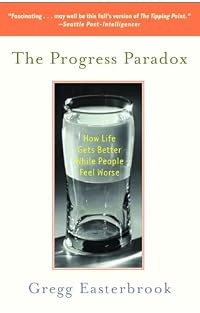
You may know Gregg Easterbrook from his previous book The Progress Paradox (one of his six books) or his articles in The Atlantic. I know him mostly from his hobby: writing the Tuesday Morning Quarterback column on ESPN.com.
Sonic Boom tries to look beyond the current recession. Easterbrook looks ahead to what to expect after we make our way out. He sees the continued growth of globalization, interconnectedness and technology improvements. That should lead to greater prosperity, knowledge growth, instability and financial distress.
Easterbrook starts off Sonic Boom by using the Chinese city of Shenzhen, with its population of 9 million. But thirty years ago, the city did not exist. In 2007, it sent out 21 million containers, making it the show more fourth largest port in the world.
His next example grabbed me because it revolves around Waltham, Massachusetts, just down the street from me. He even calls my alma mater, Brandeis University "an outstanding institution". He uses Waltham as a example because it was the home of the first modern factory in the US. (I wrote about this is an article for Wired: GeekDad Visits the Charles River Museum of Industry & Innovation.) Waltham went through some tough times as it went from being a center of manufacturing to center for high tech and venture capital.
The book continues by focusing on a city and the how globalization has affected each. There is disruption, innovation, loss, growth, distress, and gain.
All of the turmoil in the job markets makes employer-sponsored health-care a bad fit. "It's ridiculous that our cell phones work wherever we go but our health-care coverage does not."
Yes, globalization is displacing manufacturing jobs from the United States. But you also need to look at the advances in efficiency and technology that reduce manufacturing jobs. The US made 106 million tons of steel in 2007 with 159,000 workers. That is more than the 91 million tons of steel made in 1977 with 531,000 workers.
Globalization is also bringing peace. A few decades ago the world's two most important countries had horns locked trying to destroy each other. The US and USSR had nuclear missiles aimed and fingers on the button. We would not even send athletes to the other's hosting of the Olympic Games. Now the two most important countries are the US and China. We are locked "cooperative competition" of trade and finance.
Sure, China has a long way to go towards democracy and human rights. But the country is much better than it was 30 years ago.
If you have read Tuesday Morning Quarterback, you will encounter some familiar stories. You will also find the writing familiar as he weaves tales of economics into his football column.
Is Easterbrook right? Do I agree with everything he writes? Well, even Kurt Warner throws a few incomplete passes.
If you like football, then you should also read his Tuesday Morning Quaterback column on ESPN.com. I enjoyed reading Sonic Boom and recommend that you read it. With only one meaningful football game left this season, you'll need something to read in the off-season. show less
Sonic Boom tries to look beyond the current recession. Easterbrook looks ahead to what to expect after we make our way out. He sees the continued growth of globalization, interconnectedness and technology improvements. That should lead to greater prosperity, knowledge growth, instability and financial distress.
Easterbrook starts off Sonic Boom by using the Chinese city of Shenzhen, with its population of 9 million. But thirty years ago, the city did not exist. In 2007, it sent out 21 million containers, making it the show more fourth largest port in the world.
His next example grabbed me because it revolves around Waltham, Massachusetts, just down the street from me. He even calls my alma mater, Brandeis University "an outstanding institution". He uses Waltham as a example because it was the home of the first modern factory in the US. (I wrote about this is an article for Wired: GeekDad Visits the Charles River Museum of Industry & Innovation.) Waltham went through some tough times as it went from being a center of manufacturing to center for high tech and venture capital.
The book continues by focusing on a city and the how globalization has affected each. There is disruption, innovation, loss, growth, distress, and gain.
All of the turmoil in the job markets makes employer-sponsored health-care a bad fit. "It's ridiculous that our cell phones work wherever we go but our health-care coverage does not."
Yes, globalization is displacing manufacturing jobs from the United States. But you also need to look at the advances in efficiency and technology that reduce manufacturing jobs. The US made 106 million tons of steel in 2007 with 159,000 workers. That is more than the 91 million tons of steel made in 1977 with 531,000 workers.
Globalization is also bringing peace. A few decades ago the world's two most important countries had horns locked trying to destroy each other. The US and USSR had nuclear missiles aimed and fingers on the button. We would not even send athletes to the other's hosting of the Olympic Games. Now the two most important countries are the US and China. We are locked "cooperative competition" of trade and finance.
Sure, China has a long way to go towards democracy and human rights. But the country is much better than it was 30 years ago.
If you have read Tuesday Morning Quarterback, you will encounter some familiar stories. You will also find the writing familiar as he weaves tales of economics into his football column.
Is Easterbrook right? Do I agree with everything he writes? Well, even Kurt Warner throws a few incomplete passes.
If you like football, then you should also read his Tuesday Morning Quaterback column on ESPN.com. I enjoyed reading Sonic Boom and recommend that you read it. With only one meaningful football game left this season, you'll need something to read in the off-season. show less
Ratings
Members
- Recently Added By
Author Information

15+ Works 910 Members
Gregg Easterbrook's "Tuesday Morning Quarterback" is "the best and most compelling football column anywhere" (Chuck Todd, MSNBC), "excellent" (Wired magazine), "a legend in the world of sports journalism" (Yale Daily News), "popular" (The New Yorker), "the thinking-person's John Madden" (Washingtonian magazine), "excellent" (The Christian Science show more Monitor), "influential" (The Guardian), "a must-read for American football fans" (Reuters), "always interesting" (Cincinnati Enquirer), "phenomenalfunny, articulate, insightful, and thorough" (University of Virginia Cavalier Daily), "prescient, thoughtful, engaging" (Spirit magazine), and "deserves a game ball" (The New York Times). show less
Classifications
Statistics
- Members
- 50
- Popularity
- 591,841
- Reviews
- 2
- Rating
- (4.10)
- Languages
- English
- Media
- Paper, Ebook
- ISBNs
- 3
- ASINs
- 2