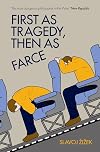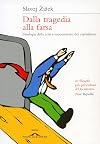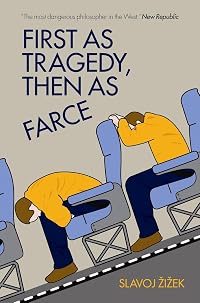
First as Tragedy, Then as Farce
by Slavoj Žižek
On This Page
Description
"In this take-no-prisoners analysis, [the author] frames the moral failures of the modern world in terms of the epoch-making events of the first decade of this century. What he finds is the old one-two punch of history: the jab of tragedy, the righthook of farce. In the attacks of 9/11 and the global credit crunch, liberalism died twice: as a political doctrine and as an economic theory"--P. [4] of cover.Tags
Recommendations









Member Reviews
This book has very little to do with its description on the back cover. Its more of a bucket of musings than a straightforward argument. I gather that this is typical of Žižek's stuff. None of this is meant as negative criticism. This text would not have the power it does with a more conventional form. Though I occasionally got lost somewhere between psychoanalysis and Various Capitalized Words And Phrases That Do Not Mean What You Think, the core argument of the book was made powerfully, through an accretion of examples and analysis. That argument is a provocative one: that Left wing politics must not be afraid to hold on to the communist idea, and must act accordingly. A corollary to this is that it is the liberal idea of eternal show more capitalist democracy that is utopian and not inevitable.
These words mean what you think they do: Read This Book show less
These words mean what you think they do: Read This Book show less
This book renewed my interest in political philosophy, although saying that, it is probably better appreciated by someone with a renewed interest than with a new interest. The reason I say this is that there are a lot of references to writers and use of terminology which many will not know, I found myself turning to dictionaries of philosophy more than once.
The book attacks contemporary capitalist society from a communist perspective, but not the communism of Marxism-Leninism but a contemporary communist thought rooted in the classics of Kant and Hegel, but strongly influenced by psychoanalysis and phenomenology.
'all the features we today identify with freedom and liberal democracy (trade unions, the universal vote, free universal show more education, freedom of the press, etc.) were won through a long and difficult struggle on the part of the lower classes throughout the ninetenth and twentieth centuries - in other words they were anything but the "natural" consequences of capitalist relations' (p.38). He points out that many of the demands of The Communist Manifesto have been won and are widely accepted.
Some of his comments on contemporary oppositions are frighteningly perceptive: 'such a Left fears for its own comfortable position as a critical voice fully integrated into the system, ready to risk nothing' (p.75) how many in the Labour Party and trades unions must feel this at the moment? And if you do feel it can you afford to take the risks?
And you think you've heard all the criticisms of capitalism? Well no, I was amazed to read that 'help' from the International Monetary Fund makes people ill, and this is no wild claim, it is based on research by a respected University, showing how IMF inspired cuts in public health budgets of many countries has led to increased ill-health in those countries (p.81).
Some might be surprised that Zizek states that the future conflicts will between socialism and communism, that is a 'corporate' socialism of state and big-business that actually rules/owns most everything at the moment, the individual entrepreneur (so beloved of the neo-liberals) is extremely rare and ineffectual.
There is so much more I could say about Zizek's arguments, often they are excellent, but not always convincing, he is like a boxer that wins on points and not on knock-out blows. Also, however good criticism of the existing order might be, the question will always arise 'how would you do otherwise?' and Zizek is rather short on advice in this department. show less
The book attacks contemporary capitalist society from a communist perspective, but not the communism of Marxism-Leninism but a contemporary communist thought rooted in the classics of Kant and Hegel, but strongly influenced by psychoanalysis and phenomenology.
'all the features we today identify with freedom and liberal democracy (trade unions, the universal vote, free universal show more education, freedom of the press, etc.) were won through a long and difficult struggle on the part of the lower classes throughout the ninetenth and twentieth centuries - in other words they were anything but the "natural" consequences of capitalist relations' (p.38). He points out that many of the demands of The Communist Manifesto have been won and are widely accepted.
Some of his comments on contemporary oppositions are frighteningly perceptive: 'such a Left fears for its own comfortable position as a critical voice fully integrated into the system, ready to risk nothing' (p.75) how many in the Labour Party and trades unions must feel this at the moment? And if you do feel it can you afford to take the risks?
And you think you've heard all the criticisms of capitalism? Well no, I was amazed to read that 'help' from the International Monetary Fund makes people ill, and this is no wild claim, it is based on research by a respected University, showing how IMF inspired cuts in public health budgets of many countries has led to increased ill-health in those countries (p.81).
Some might be surprised that Zizek states that the future conflicts will between socialism and communism, that is a 'corporate' socialism of state and big-business that actually rules/owns most everything at the moment, the individual entrepreneur (so beloved of the neo-liberals) is extremely rare and ineffectual.
There is so much more I could say about Zizek's arguments, often they are excellent, but not always convincing, he is like a boxer that wins on points and not on knock-out blows. Also, however good criticism of the existing order might be, the question will always arise 'how would you do otherwise?' and Zizek is rather short on advice in this department. show less
We are forced to live as if we were free. -- John Gray
First as Tragedy, Then as Farce is my favorite work yet by Žižek. Despite its many passages being recycled in later works, there is a clarity here which moved me. The specific grasp was Žižek's viewing the newly inaugurated President Obama. Certainly the philosopher fears a hegemon with a human face, he rightly critiques the vaunted 2009 speech in Cairo. The philosopher then betrays himself as a sentimentalist by comparing the 2008 Obama victory with the 1791-1804 Haitian Revolution. Hegel and the rest of the Enlightenment were all about the concept of liberation from slavery, except where actual slaves were involved. That simply didn't enter the equation. Thus when French show more peacekeepers arrived to find natives singing La Marseillaise , there was a historic realization: these black people might be more French than we are. Such is the drenched weight of ideology. show less
First as Tragedy, Then as Farce is my favorite work yet by Žižek. Despite its many passages being recycled in later works, there is a clarity here which moved me. The specific grasp was Žižek's viewing the newly inaugurated President Obama. Certainly the philosopher fears a hegemon with a human face, he rightly critiques the vaunted 2009 speech in Cairo. The philosopher then betrays himself as a sentimentalist by comparing the 2008 Obama victory with the 1791-1804 Haitian Revolution. Hegel and the rest of the Enlightenment were all about the concept of liberation from slavery, except where actual slaves were involved. That simply didn't enter the equation. Thus when French show more peacekeepers arrived to find natives singing La Marseillaise , there was a historic realization: these black people might be more French than we are. Such is the drenched weight of ideology. show less
It is always commendable when an author makes it clear right from the start what he/she stands for. In the case of Slavoj Zizek, of course, his reputation precedes him, but that does not prevent him from immediately propagating his communist convictions. This book was published in 2009, ie during the severe financial crisis that shook the entire globalized economy to its foundations. Zizek's analysis of the direct causes of that crisis - the too far-reaching liberalization of the financial world in particular - certainly remains valid, more than 10 years later. But he connects this with the older anti-capitalist discourse, and sees in that crisis a sweet-tasting revenge for the debacle of 1989-1990: “The moral of the story: the time show more for liberal-democratic moralistic blackmail is over. Our side no longer has to go on apologizing; while the other side had better start soon.” Our side obviously is that of the radical left. Not just any left, of course, in typical Leninist tradition Zizek knocks at least as hard on the socialists and social democrats as the hypocritical liberal democracies themselves.
There are, of course, a number of points where Zizek's polemical views make sense. He rightly emphasizes, for example, the power of ideologies, both positive and negative, and that any economy or state building always is the result of political choices, although on this he seems to follow Jacques Lacan rather than Michel Foucault. And he also rightfully points to the creative capacity of capitalism to constantly adapt to changing circumstances, although he sees this more as a perversion (a tragedy turned farce) than as an opportunity. Finally, there’s no question that the core drive of pure capitalism, namely maximizing profits, has a number of structurally destructive consequences, both for on the individual, the collective and the ecological level.
Zizek is a polemicist and both his points of analysis and his outbursts follow each other in rapid succession. Sometimes he shoots in all directions, and sometimes he goes sideways in an almost inscrutable jargon reminiscent of the best days of Marxism. It is also typical that he does not seem to be selling any real alternative to all of this, at most an ecologically reformed form of the familiar communism. The self-assured and sometimes downright arrogant tone seems to me to be an extra argument for taking this writer off his pedestal. And for those who need one more, this quote seems sufficient enough: “communism is to be opposed to socialism, which, in place of the egalitarian collective, offers an organic community (Nazism was national socialism, not national communism). In other words, while there may be a socialist anti-Semitism, there cannot be a communist form. (If it appears otherwise, as in Stalin's last years, it is only as an indicator of a lack of fidelity to the revolutionary event).” For me, this statement was enough to definitely slam the door. show less
There are, of course, a number of points where Zizek's polemical views make sense. He rightly emphasizes, for example, the power of ideologies, both positive and negative, and that any economy or state building always is the result of political choices, although on this he seems to follow Jacques Lacan rather than Michel Foucault. And he also rightfully points to the creative capacity of capitalism to constantly adapt to changing circumstances, although he sees this more as a perversion (a tragedy turned farce) than as an opportunity. Finally, there’s no question that the core drive of pure capitalism, namely maximizing profits, has a number of structurally destructive consequences, both for on the individual, the collective and the ecological level.
Zizek is a polemicist and both his points of analysis and his outbursts follow each other in rapid succession. Sometimes he shoots in all directions, and sometimes he goes sideways in an almost inscrutable jargon reminiscent of the best days of Marxism. It is also typical that he does not seem to be selling any real alternative to all of this, at most an ecologically reformed form of the familiar communism. The self-assured and sometimes downright arrogant tone seems to me to be an extra argument for taking this writer off his pedestal. And for those who need one more, this quote seems sufficient enough: “communism is to be opposed to socialism, which, in place of the egalitarian collective, offers an organic community (Nazism was national socialism, not national communism). In other words, while there may be a socialist anti-Semitism, there cannot be a communist form. (If it appears otherwise, as in Stalin's last years, it is only as an indicator of a lack of fidelity to the revolutionary event).” For me, this statement was enough to definitely slam the door. show less
Slavoj, you will be unsurprised to learn, is against the citizen's wage because it degrades us and makes us dependent on capitalist-creative wealth producers and their charity, enervating a genuine socialist politics and giving them a new way to parasite on us (viz. the recent/current financial crisis). But this is just the reform/revolution argument redux, right? And call me a dirty ameliorist, but I'm pretty comfortable calling Zizek's argument reprehensible here. Because we work to imagine/envision a society in which poverty can't exist, we shouldn't work to keep "the poor" alive? the two are mutually exclusive? If that's the case we should quit with the protests, dismantle our social services, and elect, like, rapacious space show more lizards to brutalize us until we REALLY want change.
The IS line was always "talk about socialism; work for socialism; struggle toward an understanding of what it might in practice mean/be; but in the meantime, vote NDP", right? Still strikes me as reasonable.
I'll quit in the interests of pre-empting a rant, although there's of course plenty more to say here--I haaate the way he conflates the welfare state with "charity", e.g., and I think the thing about European guilt/need culture and "third-world" aspiration/pride culture, while absuuuurdly reductive of course, does get to a grain of truth, and the privileging of citizens in relation to non-citizens is a big topic. But yeah, "rent enabling dignified survival to all citizens" sounds like something worth supporting. I'm for a citizen's wage covering needs, I'm for a maximum wage, I'm for taxes conceived as an active tool of redistribution, I'm for the collective ownership of property-in-the-marxist sense, I see the central questions as "how to implement these policies in a capitalist regime without causing the flight of wealth" and "how to achieve a social consensus around them" (the flip side of the envy and pride issues Zhizh raises--to me, thinking that we can work through all those bad human impulses that he knows all about "as a psychoanalyst" just amounts to saying "from each according to their ability, to each according to their need"). And I'm comfortable with the idea that the reduction in human misery that I hope all of this would effect may complicate the development of a sustainable post-wage economy.
And a citizen's wage lets us all create, if we want to, artistically, without worrying about getting paid--and the alpha dawg shitbag that wants to be a big man in a big house still can, and earn more than his neighbours--just less than now. show less
The IS line was always "talk about socialism; work for socialism; struggle toward an understanding of what it might in practice mean/be; but in the meantime, vote NDP", right? Still strikes me as reasonable.
I'll quit in the interests of pre-empting a rant, although there's of course plenty more to say here--I haaate the way he conflates the welfare state with "charity", e.g., and I think the thing about European guilt/need culture and "third-world" aspiration/pride culture, while absuuuurdly reductive of course, does get to a grain of truth, and the privileging of citizens in relation to non-citizens is a big topic. But yeah, "rent enabling dignified survival to all citizens" sounds like something worth supporting. I'm for a citizen's wage covering needs, I'm for a maximum wage, I'm for taxes conceived as an active tool of redistribution, I'm for the collective ownership of property-in-the-marxist sense, I see the central questions as "how to implement these policies in a capitalist regime without causing the flight of wealth" and "how to achieve a social consensus around them" (the flip side of the envy and pride issues Zhizh raises--to me, thinking that we can work through all those bad human impulses that he knows all about "as a psychoanalyst" just amounts to saying "from each according to their ability, to each according to their need"). And I'm comfortable with the idea that the reduction in human misery that I hope all of this would effect may complicate the development of a sustainable post-wage economy.
And a citizen's wage lets us all create, if we want to, artistically, without worrying about getting paid--and the alpha dawg shitbag that wants to be a big man in a big house still can, and earn more than his neighbours--just less than now. show less
This is Žižek at his polemical best. If you want to know what Žižek is about this is the book. It sets out in a clear and concise way his take on current politics. Get ready for his Communist Hypothesis, which does not take any prisoners and does not blink in the face of 'political correctness',
"the point is simply that the British colonization of India created the conditions for the double liberation of India: from the constraints of its own tradition as well as from colonization itself" (116).
This book is informative and philosophically rewarding. I highly highly recommend it. Oh, if you just received your MBA from Stanford, you might want to pour yourself a stiff drink first, because the truth will hit you hard.
"the point is simply that the British colonization of India created the conditions for the double liberation of India: from the constraints of its own tradition as well as from colonization itself" (116).
This book is informative and philosophically rewarding. I highly highly recommend it. Oh, if you just received your MBA from Stanford, you might want to pour yourself a stiff drink first, because the truth will hit you hard.
The write-up on the back cover sounded compelling. The tragedy referred to in the title was the events of 9/11. The farce was the economic collapse of 2008. Taken together, these events signal the political and economic death of Western-style liberalism.
I was expecting an analysis of these events (with liberal doses of Hegel and Lacan, as always). I quickly learned that the writer of the back cover must have only read the introduction! Žižek quickly left these events behind to mount his defense of Socialism in the face of failed Capitalism.
Capitalism with a warm and fuzzy face is still capitalism, and no amount of charity from the capitalists will change that. In fact, just as kind slave-owners exacerbated the problem by masking the show more evil, charitable capitalists cloud the real issue: what is needed is the sort of deep socioeconomic reordering of society that would render charity superfluous.
I evidently don't have enough of a background in political theory to follow all the details of his argument (that, or I didn't read slowly enough). Much of the book seemed disjointed and needlessly dense.
Žižek is incredibly intelligent and funny. I just wish he could write a little more intelligibly for the masses. show less
I was expecting an analysis of these events (with liberal doses of Hegel and Lacan, as always). I quickly learned that the writer of the back cover must have only read the introduction! Žižek quickly left these events behind to mount his defense of Socialism in the face of failed Capitalism.
Capitalism with a warm and fuzzy face is still capitalism, and no amount of charity from the capitalists will change that. In fact, just as kind slave-owners exacerbated the problem by masking the show more evil, charitable capitalists cloud the real issue: what is needed is the sort of deep socioeconomic reordering of society that would render charity superfluous.
I evidently don't have enough of a background in political theory to follow all the details of his argument (that, or I didn't read slowly enough). Much of the book seemed disjointed and needlessly dense.
Žižek is incredibly intelligent and funny. I just wish he could write a little more intelligibly for the masses. show less
Members
- Recently Added By
Author Information

327+ Works 18,087 Members
Slavoj Zizek is a Hegelian philosopher, Lacanian psychoanalyst, and political activist. He is international director of the Birkbeck Institute for the Humanities, and Global Distinguished Professor of German at New York University. He is the author of numerous books on dialectical materialism, as well as critique of ideology and art, including show more Event, and Trouble in Paradise, both published by Melville House. show less
Some Editions
Awards and Honors
Distinctions
Series
Belongs to Publisher Series
Common Knowledge
- Canonical title
- First as Tragedy, Then as Farce
Classifications
Statistics
- Members
- 912
- Popularity
- 29,584
- Reviews
- 18
- Rating
- (3.67)
- Languages
- 10 — Czech, Dutch, English, French, Italian, Polish, Portuguese, Croatian, Spanish, Swedish
- Media
- Paper, Ebook
- ISBNs
- 16
- ASINs
- 3