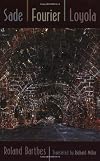
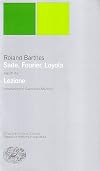
Sade, Fourier, Loyola
by Roland Barthes
On This Page
Description
In Sade/Fourier/Loyola, eminent literary theorist Roland Barthes offers a fascinating treatise on the nature of philosophical creation. Barthes examines the parallel impulses of Loyola, the Jesuit saint, Sade, the renowned and sometimes pornographic libertine philosopher, and Fourier, the utopian theorist. All three, he makes clear, have been founders of languages--Loyola, the language of divine address; Sade, the language of erotic freedom; and Fourier, the language of social perfection and show more happiness. Each language is an all-enveloping system, a "secondary language" that isolates the adherent from the conventional world. The object of this book, Barthes makes clear, is not to decipher the content of these respective works, but to consider Sade, Fourier, and Loyola as creators of text. "Here they are all three brought together, the evil writer, the great utopian, and the Jesuit saint. There is not intentional provocation in this assembling (were there provocation, it would rather consist in treating Sade, Fourier, and Loyola as though they had not had faith: in God, the Future, Nature), no transcendence (the sadist, the contestator, and the mystic are not redeemed by sadism, revolution, religion), and, I add of these studies, although first published (in part) seperately, was from the first conceived to join the others in one book: the book of Logothetes, founders of language."-- from the Preface show lessTags
Recommendations

























Member Reviews
Sade Fourier Loyola explores the works of three major innovators of language: the French philosopher, pornographer and atheist Donatien Alphonse François, Marquis de Sade (2 June 1740 – 2 December 1814); the French utopian socialist François Marie Charles Fourier (7 April 1772 – 10 October 1837); and Basque Spanish theologian and founder of the Society of Jesus (the Jesuits) Ignacio López de Loyola (Saint Ignatius of Loyola) (1491 – July 31, 1556). Barthes goes on to illustrate how each writer in this superficially blasphemous trio transformed language. How the three writers reflect off each other displays Barthes’s unique take on the subject, transcending the standard academic category of “comparative show more literature.”
Everybody has heard of DAF Sade, yet very few have read his works. In the opening sections of Sade Fourier Loyola, Barthes reflects on the contradictory accusations leveled against Sade: His works are boring and his works are shocking. How can one be both? Mythologies dissected pop cultural artifacts while Sade Fourier Loyola examined well-known works in a different way. The comparative literary criticism Barthes achieves is reminiscent of the ad slogan, “Think different.”
He examines Sade’s work, seeing it in mathematical terms, with each carnal atrocity building upon each other until they reach a séance, a kind of Enlightenment clockwork made of frenzied bodies. Sade’s writing exemplifies what Barthes terms “a contamination of discourses,” with extended speeches championing reason and rationality suddenly broken by curse-laced shouts and blasphemies involving orgies, murder, and torture. One of many things bedeviling critics is the inability to place Sade within a neat framework of periodicity. Sade is simultaneously a Gothic writer, embracing the darker strains of Romanticism, an Enlightenment philosopher, and a literary satirist. Furthermore, his work continually champions crime over law and power over morality. Those who are more powerful are thus because of Nature.
The theme of subservience is picked up in his analysis of Loyola, whose Spiritual Exercises bears resemblances to Sade’s 120 Days of Sodom. Each work appears like a glorified outline. While both writers come from completely different backgrounds, Barthes brings our attention to the meticulousness and concentration involved in writing these books. Loyola even has a section where the success or failure of the spiritual retreat’s practitioner can be measured on a graph. Loyola and Sade also have their practitioners in severe isolation and endure physical hardships.
Fourier, the utopian socialist, uses language that combines aspects of both Sade and Loyola. His utopia is spiritual in nature, but man’s perfection is attained by the release of bodily passions that have been repressed by civilization. Barthes also explores the playfulness of Fourier’s brand of utopia, especially regarding his notorious phrase about turning the sea into lemonade. The treatment of Fourier as a literary figure to be celebrated shows how Barthes has evolved from an orthodox Marxist to a non-ideological literary critic. Marxists shy away from Fourier because of his wild eccentricities and the non-scientific basis for his utopian vision. Barthes embraces him as he does Sade and Loyola.
http://driftlessareareview.com/2012/04/14/the-art-of-reviewing-roland-barthes/ show less
Everybody has heard of DAF Sade, yet very few have read his works. In the opening sections of Sade Fourier Loyola, Barthes reflects on the contradictory accusations leveled against Sade: His works are boring and his works are shocking. How can one be both? Mythologies dissected pop cultural artifacts while Sade Fourier Loyola examined well-known works in a different way. The comparative literary criticism Barthes achieves is reminiscent of the ad slogan, “Think different.”
He examines Sade’s work, seeing it in mathematical terms, with each carnal atrocity building upon each other until they reach a séance, a kind of Enlightenment clockwork made of frenzied bodies. Sade’s writing exemplifies what Barthes terms “a contamination of discourses,” with extended speeches championing reason and rationality suddenly broken by curse-laced shouts and blasphemies involving orgies, murder, and torture. One of many things bedeviling critics is the inability to place Sade within a neat framework of periodicity. Sade is simultaneously a Gothic writer, embracing the darker strains of Romanticism, an Enlightenment philosopher, and a literary satirist. Furthermore, his work continually champions crime over law and power over morality. Those who are more powerful are thus because of Nature.
The theme of subservience is picked up in his analysis of Loyola, whose Spiritual Exercises bears resemblances to Sade’s 120 Days of Sodom. Each work appears like a glorified outline. While both writers come from completely different backgrounds, Barthes brings our attention to the meticulousness and concentration involved in writing these books. Loyola even has a section where the success or failure of the spiritual retreat’s practitioner can be measured on a graph. Loyola and Sade also have their practitioners in severe isolation and endure physical hardships.
Fourier, the utopian socialist, uses language that combines aspects of both Sade and Loyola. His utopia is spiritual in nature, but man’s perfection is attained by the release of bodily passions that have been repressed by civilization. Barthes also explores the playfulness of Fourier’s brand of utopia, especially regarding his notorious phrase about turning the sea into lemonade. The treatment of Fourier as a literary figure to be celebrated shows how Barthes has evolved from an orthodox Marxist to a non-ideological literary critic. Marxists shy away from Fourier because of his wild eccentricities and the non-scientific basis for his utopian vision. Barthes embraces him as he does Sade and Loyola.
http://driftlessareareview.com/2012/04/14/the-art-of-reviewing-roland-barthes/ show less
Sade, Fourier e Ignacio de Loyola fueron clasificadores y fundadores de lenguas: la lengua del placer erótico, la lengua del bienestar social y la lengua de la interpelación divina; cada uno puso en la construcción de esta segunda lengua toda la energía de una pasión. Sin embargo, inventar signos es entrar paradójicamente en ese terreno ya conocido por el sentido que es el significante: en una palabra, es practicar la escritura.
Aug 14, 2011Spanish
Ratings
Members
- Recently Added By
Author Information

196+ Works 22,406 Members
Roland Barthes (1915-1980), a French critic and intellectual, was a seminal figure in late twentieth-century literary criticism. Barthes's primary theory is that language is not simply words, but a series of indicators of a given society's assumptions. He derived his critical method from structuralism, which studies the rules behind language, and show more semiotics, which analyzes culture through signs and holds that meaning results from social conventions. Barthes believed that such techniques permit the reader to participate in the work of art under study, rather than merely react to it. Barthes's first books, Writing Degree Zero (1953), and Mythologies (1957), introduced his ideas to a European audience. During the 1960s his work began to appear in the United States in translation and became a strong influence on a generation of American literary critics and theorists. Other important works by Barthes are Elements of Semiology (1968), Critical Essays (1972), The Pleasure of the Text (1973), and The Empire of Signs (1982). The Barthes Reader (1983), edited by Susan Sontag, contains a wide selection of the critic's work in English translation. (Bowker Author Biography) show less
Some Editions
Common Knowledge
- Original publication date
- 1971
- People/Characters
- Joseph Fourier; Ignatius of Loyola; Donatien Alphonse-François, Marquis de Sade
Classifications
- Genres
- Nonfiction, Literature Studies and Criticism, Philosophy, Fiction and Literature
- DDC/MDS
- 808 — Literature & rhetoric Literature, rhetoric & criticism Rhetoric and collections of literary texts from more than two literatures
- LCC
- PQ2063 .S3 .B313 — Language and Literature French, Italian, Spanish and Portuguese literatures French literature Modern literature 18th century
- BISAC
Statistics
- Members
- 313
- Popularity
- 102,669
- Reviews
- 2
- Rating
- (4.02)
- Languages
- 10 — Czech, Dutch, English, French, German, Greek, Italian, Polish, Portuguese, Spanish
- Media
- Paper, Ebook
- ISBNs
- 24
- ASINs
- 7