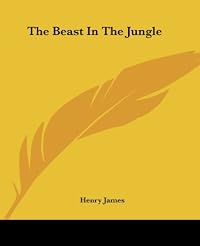
The Beast in the Jungle
by Henry James
On This Page
Description
Regarded as one of Henry James' finest works, the short story The Beast in the Jungle centers around protagonist John Marcher and his seemingly bizarre phobia—a pervasive sense of doom that prevents him from living his life to the fullest and precludes the possibility of him ever finding true love. This fascinating read highlights the psychological complexity that has earned James' fiction so much critical acclaim..
Tags
Recommendations























Member Reviews
James is my second favorite writer, after Proust, of course. The Beast in the Jungle is probably his most masterful tale—novella or short story, you decide—and it's one that I've read at least ten times. While many of my readings have been colored by Eve Kosofsky Sedgwick's now canonical essay "The Beast in the Closet," this time around I read James's tale from an entirely new perspective.
And to me that's the most marvelous thing about writers like James: one never encounters the same text; one always finds new entry points, threads, and cadences that were lost on the first (or tenth) reading. James's work is always lucid and at the same time ambiguous, tapping into the ebb and flow of our psychological mindsets; I suppose it's no show more wonder that our own psychological states while reading would blind us to the many other complex ideas and structures with which James is working with such laudable skill.
The Beast in the Jungle is the tale of John Marcher, a narrative that pits existential and phenomenological questions of being against the ineluctable nature of language, speech, and what is unnameable. While Marcher is sure that something monstrous is going to happen to him, thus remaining hypervigilant through his entire life in wait for what he calls the beast, James is quick to show how the underlying narcissism that pervades our suffering—and which can blind us to the suffering of others—still courts a desire to be understood, acknowledged, and ultimately known. The analytic relationship between Marcher and May Bartram is one of the most beguiling and yet touching of these sorts of relationships in James's fiction, perhaps because the sense of intimacy and the threat of the beast are interwoven in a way that causes the textual rhythm to literally pulsate at times (e.g., see the famous ending lines).
If you are a writer and you've never read this, I honestly have no idea what sort of company you've been keeping. Not only is The Beast in the Jungle one of the very best examples of the short story, but it is also an investigation into the same representational inquiries with which we all deal when trying to nail down words for things that are simply unnameable. And if you're a reader who has never read this: what on earth are you waiting for? show less
And to me that's the most marvelous thing about writers like James: one never encounters the same text; one always finds new entry points, threads, and cadences that were lost on the first (or tenth) reading. James's work is always lucid and at the same time ambiguous, tapping into the ebb and flow of our psychological mindsets; I suppose it's no show more wonder that our own psychological states while reading would blind us to the many other complex ideas and structures with which James is working with such laudable skill.
The Beast in the Jungle is the tale of John Marcher, a narrative that pits existential and phenomenological questions of being against the ineluctable nature of language, speech, and what is unnameable. While Marcher is sure that something monstrous is going to happen to him, thus remaining hypervigilant through his entire life in wait for what he calls the beast, James is quick to show how the underlying narcissism that pervades our suffering—and which can blind us to the suffering of others—still courts a desire to be understood, acknowledged, and ultimately known. The analytic relationship between Marcher and May Bartram is one of the most beguiling and yet touching of these sorts of relationships in James's fiction, perhaps because the sense of intimacy and the threat of the beast are interwoven in a way that causes the textual rhythm to literally pulsate at times (e.g., see the famous ending lines).
If you are a writer and you've never read this, I honestly have no idea what sort of company you've been keeping. Not only is The Beast in the Jungle one of the very best examples of the short story, but it is also an investigation into the same representational inquiries with which we all deal when trying to nail down words for things that are simply unnameable. And if you're a reader who has never read this: what on earth are you waiting for? show less
“It wouldn’t have been failure to be bankrupt, dishonoured, pilloried, hanged; it was failure not to be anything. ”
At a party John Marcher meets May Bartram whom he had met many years before. May recalls a strange confession he made on that occasion and so they begin a long, but uncommitted relationship. Marcher is convinced that will he have a great unknown thrust upon him so he is unwilling to commit himself as awaits it. It is only after May's death that he comes to realise what 'the beast in the jungle' really is.
In this novella Henry James tries to portray the predicament of all the people who forfeit their allotted share of experience, because of their excessive pride and rationality. Marcher suffers chiefly by not show more responding to May’s affection. This is not a thrill a minute roller-coaster rather it is a plodding, mature look at wasted lives and as such despite its brevity has hidden depths. show less
At a party John Marcher meets May Bartram whom he had met many years before. May recalls a strange confession he made on that occasion and so they begin a long, but uncommitted relationship. Marcher is convinced that will he have a great unknown thrust upon him so he is unwilling to commit himself as awaits it. It is only after May's death that he comes to realise what 'the beast in the jungle' really is.
In this novella Henry James tries to portray the predicament of all the people who forfeit their allotted share of experience, because of their excessive pride and rationality. Marcher suffers chiefly by not show more responding to May’s affection. This is not a thrill a minute roller-coaster rather it is a plodding, mature look at wasted lives and as such despite its brevity has hidden depths. show less
The Beast in the Jungle is a gemlike encapsulation of everything James does so well. Told in a brisk seventy-five pages, the story offers an amount of psychological depth, observation, and insight which most full-length novels don't even approach. Most notable in my opinion, however, is how the story portrays the difficulty of perceiving things rightly (perceiving others, perceiving oneself, and perceiving value) – which is, according to James, precisely the task with which the readers and the writer of his fictions are faced as well. The Beast in the Jungle is perhaps the easiest way in to this distinctive literary vision – short enough to read through in a day, but complex enough to consume a lifetime.
A man is convinced that some event of significance lurks ahead in his future; he has the sense that a purpose awaits him which is yet to be revealed. He makes the acquaintance of a woman his age with whom he shares his secret, who awaits it with him. Much of the story is their conversations about what it might be, and hints emerge that she has predicted its identity.
We're missing the source for his certainty that he should anticipate some event, the instigation that led to his identifying this as the core truth of his self-identity. It doesn't harm the story not to have it, but it would have provided a more complete arc. The theme is regret about things not done, opportunities not taken; how one wrong axiom about life can throw the show more opportunity to make the most of it off kilter. Someone once looked at me just so, and I reacted the same way. It happens that quickly and there is no returning to the moment. show less
We're missing the source for his certainty that he should anticipate some event, the instigation that led to his identifying this as the core truth of his self-identity. It doesn't harm the story not to have it, but it would have provided a more complete arc. The theme is regret about things not done, opportunities not taken; how one wrong axiom about life can throw the show more opportunity to make the most of it off kilter. Someone once looked at me just so, and I reacted the same way. It happens that quickly and there is no returning to the moment. show less
"It was the truth, vivid and monstrous, that all the while he had waited the wait was itself his portion"
"When the possibilities themselves had accordingly turned stale, when the secret of the gods had grown faint, had perhaps even quite evaporated, that, and that only, was failure. It wouldn't have been failure to be bankrupt, dishonoured, pilloried, hanged; it was failure not to be anything"
"When the possibilities themselves had accordingly turned stale, when the secret of the gods had grown faint, had perhaps even quite evaporated, that, and that only, was failure. It wouldn't have been failure to be bankrupt, dishonoured, pilloried, hanged; it was failure not to be anything"
A powerful parable about the paralysis of fear, this is one of the best things I have read in quite awhile.
I read some Henry James when I was a teenager, and I thought then that Edith Wharton was better, and that neither was quite my style. This novella has not changed my mind. It's too laboured and obvious. It bored me.
Members
- Recently Added By
Lists

2024. Nuestro año literario (Faustino Sánchez)
20 works; 1 member
Author Information

1,061+ Works 87,953 Members
Series
Belongs to Publisher Series
Work Relationships
Is contained in
Has the adaptation
Has as a student's study guide
Common Knowledge
- Canonical title
- The Beast in the Jungle
- Original title
- The beast in the jungle
- Original publication date
- 1903
- Important places
- London, England, UK
- First words
- What determined the speech that startled him in the course of their encounter scarcely matters, being probably but some words spoken by himself quite without intention - spoken as they lingered and slowly moved together after... (show all) their renewal of acquaintance.
- Last words
- (Click to show. Warning: May contain spoilers.)His eyes darkened - it was close; and, instinctively turning, in his hallucination, to avoid it, he flung himself, on his face, on the tomb.
- Original language
- English
Classifications
Statistics
- Members
- 409
- Popularity
- 75,535
- Reviews
- 8
- Rating
- (3.69)
- Languages
- 9 — Catalan, Dutch, English, French, German, Greek, Italian, Portuguese (Portugal), Spanish
- Media
- Paper, Audiobook, Ebook
- ISBNs
- 100
- ASINs
- 22