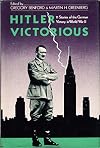
Hitler Victorious
by Gregory Benford
On This Page
Description
Why does the memory of Adolf Hitler refuse to be exorcised? Why, forty years after his death and the end of World War II, do we have Hitler Victorious, an anthology of eleven stories set in various alternative worlds in which the, uh, Iron Dream of Nazi Germany did not end in the rubble of the Fuhrerbunker in Berlin?" Norman Spinrad raises these important questions in the introduction to this highly readable anthology-and then answers them in an illuminating and provocative essay that show more explains why "people with no historical perception of or connection to the culture or theories of the Third Reich, including even Jews, are still drawn to the Nazi symbol system, are still fascinated by its late high priest, Adolf Hitler." The stories in this anthology are gathered from science-fiction publication now accessible only in well-stocked or specialized libraries. Several works were commissioned exclusively for inclusion in this volume: David Brin's "Thor Meets Captain America," Howard Goldsmith's "Do Ye Hear the Children Weeping?," Sheila Finch's "Reichs-Peace," and Tom Shippey's "Enemy Transmissions." Brad Linaweaver's "Moon of Ice" was substantially revised and rewritten for this collection. The settings of the stories range from the environs of prewar Los Alamos Laboratory in New Mexico to the futuristic SS state of Burgundy, a popular tourist attraction outside the jurisdiction of German law. show lessTags
Recommendations
































Member Reviews
The weakest stories in this anthology think they can just evoke that modern totem of evil, the twisted cross of the swastika, mix it with some vengeance and moral retribution insufficiently provided by our universe, and have an affecting story. Sometimes, in an ostensible collection of alternate histories, the actual historical speculation is pretty sparse..
The worst of the lot is from the normally reliable Greg Bear. His "Through No Road Whither" has SS officers from an alternate 1985 Germany get their just deserts after crossing the path of a Gypsy woman. There is almost no explanation for this alternate timeline, no exploration of its details. The ghosts of fetuses experimented on by a death camp doctor come back to wreck justice in show more Howard Goldsmith's "Do Ye Hear the Children Weeping?", but it's not as moving as it wants to be and we learn little about this world except that Nazi genocide proceeded apace and, somehow, America fell under Nazi rule. Editor Gregory Benford at least provides something of an interesting alternative in "Valhalla" which has the Third Reich only surviving till 1947 -- but that's long enough to complete its plans of racial extermination. But the inhabitants of another timeline asserting their jurisdiction over Hitler and his pending judgement are little more than empty wish fufillment.
Long before the Nazi-occult was established in pop culture -- if less firmly in history -- Hilary Bailey's 1964 story, "The Fall of French Steiner", featured sort of a prophecying Nazi Vestal Virgin. That, of course, puts a different spin on the title. Shelia Finch's "Reichs-Peace" provides a somewhat detailed alternate history and some realistic technological jargon before veering off on a plot involving Romany pre-disposition to telepathy. The story also suffers from an implausibly influential Eva Braun and that peculiar 1980s fear that America was headed towards theocracy. (Here America is ruled by an isolationist Protestant government that forbids science fiction!)
The flavor of fantasy is strongest in David Brin's peculiar "Thor Meets Captain America". This melange of military adventure, the Norse gods, high tech, alternate history, magic, comic books, and slapstick really shouldn't work. But it does and quite well. It's definitely one of the high points of the book.
Several of the stories postulate sort of an alternate Cold War with the Nazis filling in for the USSR. (Of course, all the stories in the book were written during the Cold War.) That flavor is strongest in the oldest story here, Algis Budrys' "Never Meet Again" from 1957. Budrys is the only author here to have actually seen, as a small Lithuanian boy, Hitler in person. The USSR, which occuppied Budrys' homeland, also chills the soul of his protagonist who flees a prosperous Germany -- and a regime which indirectly killed his wife when she was in a concentration camp -- for a better world. Unfortunately, what he gets is a Russian occuppied East Berlin.
The nuclear apocalypse so much in the public mind during the Cold War features in C. M. Kornbluth's 1958 story "Two Dooms". The dooms in question aren't the Japan and Germany that have occuppied an alternate America but the hero's choice -- a world of nuclear weapons or a world of fascist tyranny. It was also interesting to see a characteristic Kornbluth theme, overpopulation, show up here too.
Another sort of Cold War also features in Tom Shippey's "Enemy Transmissions" which even reflects, in its discussions of space weapons built by the Germans and Americans as each vies, client states in tow, for world supremacy, similar discussions in our version of 1985. Shippey's basic plot centers around the science of prophetic dreams, the discipline which lead Hitler to make wiser decisions about technological development than he did in our world. But literary critic Shippey, in his first piece of fiction, does what the best stories in this anthology do: not give us easy stories of Nazis being punished but, rather, show us the culture and mindset and politics of worlds where Nazis thrive.
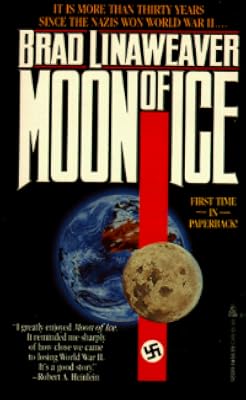
Besides Brin's and Shippey's tales, the strongest stories here are Brad Linaweaver's "Moon of Ice", an early run of his excellent novel of the same name, and Keith Roberts' "Weihnachtsabend". Told through Joseph Goebbels' diaries, "Moon of Ice" gives us a Hitler reflectiive on his deathbed, Nazi cinema and pseudo-science, intrigue, a Dr. Mabuse-like figure, and SS men so fanatical they regard Goebbels as a traitor. It's also a family drama with two of his children choosing very different paths from him. Roberts give us a characteristically English story of a Nazi England returning to its thinly veiled pagan roots. Among the wonderful description of land and storm, Roberts gives us one of his tales of futile, despondent rebellion. I don't think it's a coincidence that the anthology's best stories, with the exception of Brin, feature protagonists who are, themselves, part of the Nazi machine.
The allure of that machine and, especially, its symbols and fantasies, is explored in Norman Spinrad's introduction. Hack sword-and-sorcery author Adolf Hitler intuitively grasps these concepts in Spinrad's alternate history The Iron Dream.
Benford's preface gives a good overview of the "Hitler Wins" sub-genre of alternate history -- at least in the English language.
There are some weak stories here, but there are enough good stories, and four really good stories, to make this anthology worth the time. show less
The worst of the lot is from the normally reliable Greg Bear. His "Through No Road Whither" has SS officers from an alternate 1985 Germany get their just deserts after crossing the path of a Gypsy woman. There is almost no explanation for this alternate timeline, no exploration of its details. The ghosts of fetuses experimented on by a death camp doctor come back to wreck justice in show more Howard Goldsmith's "Do Ye Hear the Children Weeping?", but it's not as moving as it wants to be and we learn little about this world except that Nazi genocide proceeded apace and, somehow, America fell under Nazi rule. Editor Gregory Benford at least provides something of an interesting alternative in "Valhalla" which has the Third Reich only surviving till 1947 -- but that's long enough to complete its plans of racial extermination. But the inhabitants of another timeline asserting their jurisdiction over Hitler and his pending judgement are little more than empty wish fufillment.
Long before the Nazi-occult was established in pop culture -- if less firmly in history -- Hilary Bailey's 1964 story, "The Fall of French Steiner", featured sort of a prophecying Nazi Vestal Virgin. That, of course, puts a different spin on the title. Shelia Finch's "Reichs-Peace" provides a somewhat detailed alternate history and some realistic technological jargon before veering off on a plot involving Romany pre-disposition to telepathy. The story also suffers from an implausibly influential Eva Braun and that peculiar 1980s fear that America was headed towards theocracy. (Here America is ruled by an isolationist Protestant government that forbids science fiction!)
The flavor of fantasy is strongest in David Brin's peculiar "Thor Meets Captain America". This melange of military adventure, the Norse gods, high tech, alternate history, magic, comic books, and slapstick really shouldn't work. But it does and quite well. It's definitely one of the high points of the book.
Several of the stories postulate sort of an alternate Cold War with the Nazis filling in for the USSR. (Of course, all the stories in the book were written during the Cold War.) That flavor is strongest in the oldest story here, Algis Budrys' "Never Meet Again" from 1957. Budrys is the only author here to have actually seen, as a small Lithuanian boy, Hitler in person. The USSR, which occuppied Budrys' homeland, also chills the soul of his protagonist who flees a prosperous Germany -- and a regime which indirectly killed his wife when she was in a concentration camp -- for a better world. Unfortunately, what he gets is a Russian occuppied East Berlin.
The nuclear apocalypse so much in the public mind during the Cold War features in C. M. Kornbluth's 1958 story "Two Dooms". The dooms in question aren't the Japan and Germany that have occuppied an alternate America but the hero's choice -- a world of nuclear weapons or a world of fascist tyranny. It was also interesting to see a characteristic Kornbluth theme, overpopulation, show up here too.
Another sort of Cold War also features in Tom Shippey's "Enemy Transmissions" which even reflects, in its discussions of space weapons built by the Germans and Americans as each vies, client states in tow, for world supremacy, similar discussions in our version of 1985. Shippey's basic plot centers around the science of prophetic dreams, the discipline which lead Hitler to make wiser decisions about technological development than he did in our world. But literary critic Shippey, in his first piece of fiction, does what the best stories in this anthology do: not give us easy stories of Nazis being punished but, rather, show us the culture and mindset and politics of worlds where Nazis thrive.
Besides Brin's and Shippey's tales, the strongest stories here are Brad Linaweaver's "Moon of Ice", an early run of his excellent novel of the same name, and Keith Roberts' "Weihnachtsabend". Told through Joseph Goebbels' diaries, "Moon of Ice" gives us a Hitler reflectiive on his deathbed, Nazi cinema and pseudo-science, intrigue, a Dr. Mabuse-like figure, and SS men so fanatical they regard Goebbels as a traitor. It's also a family drama with two of his children choosing very different paths from him. Roberts give us a characteristically English story of a Nazi England returning to its thinly veiled pagan roots. Among the wonderful description of land and storm, Roberts gives us one of his tales of futile, despondent rebellion. I don't think it's a coincidence that the anthology's best stories, with the exception of Brin, feature protagonists who are, themselves, part of the Nazi machine.
The allure of that machine and, especially, its symbols and fantasies, is explored in Norman Spinrad's introduction. Hack sword-and-sorcery author Adolf Hitler intuitively grasps these concepts in Spinrad's alternate history The Iron Dream.
Benford's preface gives a good overview of the "Hitler Wins" sub-genre of alternate history -- at least in the English language.
There are some weak stories here, but there are enough good stories, and four really good stories, to make this anthology worth the time. show less
These stories were a mixed bag. There are some easy targets in doing alternate World War II stories. One is who got the bomb first. Another is Nazi mysticism. Both of these got beaten to death by the end of the anthology, though two of the mysticism ones were my favorites: "The Fall of Frenchy Steiner" and "Thor Meets Captain America". Another thing that made the reading uneven was that the Nazis are among our culture's baddest mythic bad guys. The authors who took up this theme seemed to be aiming at sitting ducks. The authors who gave a more nuanced approach, while creating more interesting worlds, often were unable to write an end to the story that satisfied my idea of justice. Still, a set of interesting ideas of what might have show more happened if a few events had gone differently.
I've also reviewed each story individually. show less
I've also reviewed each story individually. show less
I found the book to be overall enjoyable and interesting. There was one story that did drag a bit (the one an official shooting his boss for causing his girlfriend's disappearance. Can't recall the title). I liked the one about Goebbels' diary. Overall, a good speculative fiction anthology.
I really like short stories, but this was not a book of great short stories, more just stories around a theme. I was hoping for better.
Still, out of the 11 stories, there were some good ones, which I'll summarize here:
Two Dooms by C.M. Kornbluth - about the guy involved in the Manhattan project who discovers the critical information necessary to fast track the bomb, and has second thoughts.
Reichs-Peace by Shiela Finch - about how Hitler's widow tries to keep the peace
Never Meet Again by Algis Budrys - in a world where Hitler won, a German engineer wants to change the past because of what the state did to him
Enemy Transmissions by Tom Shippey - about the state's dream study program
Valhalla by Gregory Benford - about how Hitler has to pay show more in the end
So, half were above average, maybe one more about average. Glad I read it. It did link up well with the other WWII books I have read recently (The Rise and Fall of the Third Reich) and The Book Thief). That reminds me, one of the books mentioned in one of the stories was Shirer's The Rise of the Third Reich! show less
Still, out of the 11 stories, there were some good ones, which I'll summarize here:
Two Dooms by C.M. Kornbluth - about the guy involved in the Manhattan project who discovers the critical information necessary to fast track the bomb, and has second thoughts.
Reichs-Peace by Shiela Finch - about how Hitler's widow tries to keep the peace
Never Meet Again by Algis Budrys - in a world where Hitler won, a German engineer wants to change the past because of what the state did to him
Enemy Transmissions by Tom Shippey - about the state's dream study program
Valhalla by Gregory Benford - about how Hitler has to pay show more in the end
So, half were above average, maybe one more about average. Glad I read it. It did link up well with the other WWII books I have read recently (The Rise and Fall of the Third Reich) and The Book Thief). That reminds me, one of the books mentioned in one of the stories was Shirer's The Rise of the Third Reich! show less
A series of short stories, the matter being obvious from the title. Turtledove does this better, as these are obvious and not very deep.
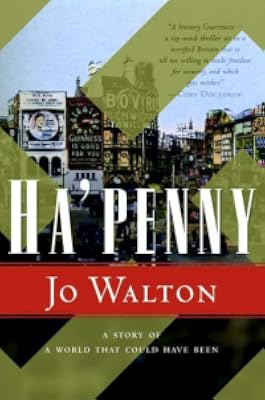
(Amy) I've read a dozen or so Martin and Greenberg anthologies, and am usually quite satisfied with them - rarely blown away by the astounding wonderfulness, but rarely disappointed, either. This one was disappointing. I think it was the subject matter, however - I'm really quite remarkably picky when it comes to alternate history, and I've never had what I think I would describe as a Nazi fetish (despite these two things, I absolutely adore Jo Walton's Farthing et. al., mostly-victorious Nazis and all). So the odds of any of these stories overcoming my natural distaste for the Third Reich and fitting my criteria for alternate history were not good. I did enjoy a couple of the stories, but not overwhelmingly. My general summation of my show more opinion of this book is: Enh.
( http://weblog.siliconcerebrate.com/zenos-library/2008/11/hitler_victorious_grego... ) show less
( http://weblog.siliconcerebrate.com/zenos-library/2008/11/hitler_victorious_grego... ) show less
Mental masturbation at its height! What was I thinking when I bought this thing?
Members
- Recently Added By
Author Information

239+ Works 22,548 Members
Gregory Benford, was born on January 30, 1941 in Mobile, Alabama. He is a physicist and science fiction writer who earned his Ph.D. from the University of California, San Diego, in 1967. He is a Woodrow Wilson Fellow and a consultant for NASA. Benford's first novel "Deeper than the Darkness" (1970), which was revised as "The Stars in Shroud" show more (1978), gave him notice as a serious Science Fiction writer. His most popular work is "Timescape" (1980), which was the winner of the Nebula and John W. Campbell Memorial Awards; it presented a hard physics approach to limited time travel. "In the Ocean of Night" (1977), "Across the Sea of Suns" (1984), "Great Sky River" (1987), "Tides of Light" (1989) and "Furious Gulf" (1994) were all a part of the Galactic Cluster Series. He has also written the juvenile novel "Jupiter Project" (1975), "Against Infinity" (1983) and the thriller "Artifact" (1985). He has been nominated for 12 Nebula Awards (winning for "Timescape" and for the novelette, "If the Stars are Gods"). Benford, writing alternately with Bruce Sterling, produces science fact articles for the Magazine of Fantasy and Science Fiction. They took over after the death of regular columnist Isaac Asimov. He has also co-edited theme anthologies with Martin H. Greenburg, which include "Hitler Victorious" (1986), "Nuclear War" (1988), "What Might Have Been, Volume 1: Alternate Empires" (1988), "Volume 2: Alternate Heroes" (1989) and "Volume 3: Alternate Wars." (Bowker Author Biography) show less
Work Relationships
Contains
Common Knowledge
- Canonical title
- Hitler Victorious
- Alternate titles
- Hitler Victorious
- Original publication date
- 1986
- People/Characters
- Adolf Hitler
- Important places
- Berlin, Germany
- Important events
- World War II
- Dedication
- To all who suffered under the Third Reich
- First words
- What does it mean to think of our world as arising from a vast series of past possibilities? (Preface: Imagining the Abyss, Gregory Benford)
Why does the memory of Adolf Hitler refuse to be exorcised? (Introduction: Hitler Victorious, Norman Spinrad)
Classifications
- Genres
- Fiction and Literature, Science Fiction
- DDC/MDS
- 813.087608358 — Literature & rhetoric American literature in English American fiction in English By type Genre fiction Adventure fiction Speculative fiction Collections
- LCC
- PS648 .F3 .H57 — Language and Literature American literature American literature Collections of American literature Prose (General)
Statistics
- Members
- 233
- Popularity
- 140,100
- Reviews
- 10
- Rating
- (3.09)
- Languages
- English, Spanish
- Media
- Paper
- ISBNs
- 4
- ASINs
- 7