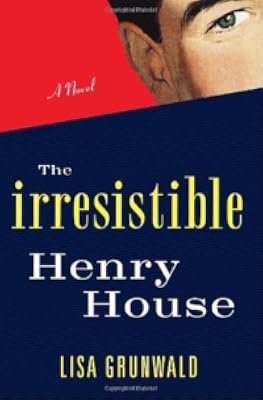
The Irresistible Henry House: A Novel
by Lisa Grunwald 
On This Page
Description
In the mid-twentieth century in a home economics program at a prominent university, real babies are being used to teach mothering skills to young women. For a young man raised in these unlikely circumstances, finding real love and learning to trust will prove to be the work of a lifetime. From his earliest days as a "practice baby" through his adult adventures in 1960s New York City, Disney's Burbank studios, and the delirious world of the Beatles' London, Henry House remains handsome, show more charming, universally adored--and never entirely accessible to the many women he conquers but can never entirely trust. show lessTags
Recommendations

















Member Recommendations

Member Reviews
Another book with a really promising start and a disappointing ending. I loved the first chapters, even if they did make me want another baby, but I started disliking Henry more and more the older he got, and by the end I was getting awfully tired of him bedding every woman within a ten-mile radius. And I was totally put off by the way he treated poor Martha. Yes, I get it, she lied to you. She also showered love on you for years and did her absolute best to raise you properly. So now that she's dying of cancer, you could maybe get over yourself a little bit, Henry. The fact that I am still ticked off at a fictional character two days after finishing the book is probably a tribute to Lisa Grunwald's skill as a writer. But I think I show more disliked him more than she really intended me to, and it's difficult for me to imagine he would ever make a good life partner. Run, Mary Jane! Run like the wind! show less
Another book with a really promising start and a disappointing ending. I loved the first chapters, even if they did make me want another baby, but I started disliking Henry more and more the older he got, and by the end I was getting awfully tired of him bedding every woman within a ten-mile radius. And I was totally put off by the way he treated poor Martha. Yes, I get it, she lied to you. She also showered love on you for years and did her absolute best to raise you properly. So now that she's dying of cancer, you could maybe get over yourself a little bit, Henry. The fact that I am still ticked off at a fictional character two days after finishing the book is probably a tribute to Lisa Grunwald's skill as a writer. But I think I show more disliked him more than she really intended me to, and it's difficult for me to imagine he would ever make a good life partner. Run, Mary Jane! Run like the wind! show less
Irresistible Henry House, Lisa Grunwald
★ ★
Apparently in 1919 Cornell University began a trend in Home Economics called "Practice Babies" who all came from a local orphanage & were later adopted out... Young college women would take Home Economics to study & practice, chemistry, physics, mechanics, cooking, cleaning, & baby raising. The program went on until 1969.
So this book is about Henry, who was the child of the Dean's daughter by a man other than her husband and was eventually given over to the Practice House Mother to raise as her own.
It would have been nice to like Henry, but lets face it, he hated his adoptive mother, he hated his mother, & he used women... he was a sexually promiscuous misogynist. The author tries to make show more her readers sympathetic/empathetic towards Henry, but I for one would have like to slap him silly.
In a fit of defiance, Henry decides to become mute... so he is sent to the "Custodial Asylum for Unteachable Idiots" a.k.a. "Humphrey Asylum for the Feeble Minded" a.k.a. "Humphrey School for Mental Defectives"... which had me wondering what kind of person names a school that aims to help those in need such assholic titles?
So Henry, hates his adopted mother for never telling him the whole truth, hates his mother for disposing of him, & uses women sexually & emotionally by plying them with his charms & charisma...
So Henry starts out in Pennsylvania, then to the asylum in Connecticut as he has (purposely) become "mute" yet excels at art, then to N.Y. where his birth mother is working for the Times & living w/ one of his practice mothers, then to CA to work for Walt Disney on Mary Poppins, then to London to work for the Beatles on Yellow Submarine, to Paris to face off his birth mother one last time, & back to N.Y. to his "one true love".
Somehow everywhere he goes he finds a connection & seduces women.... and we are to fawn over Henry...
The book was too long for me, the characters particularly bent, odious, & unrealistic. As I stated, I'd like to have been able to beat the holy crap out of Henry, such a narcissistic p.o.s.
I will tell you this, it was a compelling read & I finished it in one day.... I wanted Henry to redeem himself (because of all the many, many opportunities he had to do so), but in my opinion: as a human being, Henry was as an unrepentant narcissistic failure. show less
★ ★
Apparently in 1919 Cornell University began a trend in Home Economics called "Practice Babies" who all came from a local orphanage & were later adopted out... Young college women would take Home Economics to study & practice, chemistry, physics, mechanics, cooking, cleaning, & baby raising. The program went on until 1969.
So this book is about Henry, who was the child of the Dean's daughter by a man other than her husband and was eventually given over to the Practice House Mother to raise as her own.
It would have been nice to like Henry, but lets face it, he hated his adoptive mother, he hated his mother, & he used women... he was a sexually promiscuous misogynist. The author tries to make show more her readers sympathetic/empathetic towards Henry, but I for one would have like to slap him silly.
In a fit of defiance, Henry decides to become mute... so he is sent to the "Custodial Asylum for Unteachable Idiots" a.k.a. "Humphrey Asylum for the Feeble Minded" a.k.a. "Humphrey School for Mental Defectives"... which had me wondering what kind of person names a school that aims to help those in need such assholic titles?
So Henry, hates his adopted mother for never telling him the whole truth, hates his mother for disposing of him, & uses women sexually & emotionally by plying them with his charms & charisma...
So Henry starts out in Pennsylvania, then to the asylum in Connecticut as he has (purposely) become "mute" yet excels at art, then to N.Y. where his birth mother is working for the Times & living w/ one of his practice mothers, then to CA to work for Walt Disney on Mary Poppins, then to London to work for the Beatles on Yellow Submarine, to Paris to face off his birth mother one last time, & back to N.Y. to his "one true love".
Somehow everywhere he goes he finds a connection & seduces women.... and we are to fawn over Henry...
The book was too long for me, the characters particularly bent, odious, & unrealistic. As I stated, I'd like to have been able to beat the holy crap out of Henry, such a narcissistic p.o.s.
I will tell you this, it was a compelling read & I finished it in one day.... I wanted Henry to redeem himself (because of all the many, many opportunities he had to do so), but in my opinion: as a human being, Henry was as an unrepentant narcissistic failure. show less
I can say with a good deal of certainty that the premise of this book is one of the strangest that I’ve seen in a long time. And? It’s not about aliens, or magic, or preposterous conspiracies. It’s about a phenomenon called “practice babies”. And? It’s based on fact.
From 1919 to 1959 at Cornell University (and other institutions across the country) home economics programs used babies “on loan” from orphanages to help teach women how to be mothers. These “practice babies” lived away from the orphanage for months to years – having many “practice mothers” during that time. This book came about when the author saw a picture of one of these babies on the Cornell University website and read about the history of the show more program. Which then, of course, leads one to wonder what happened next…and Grunwald does a compelling job of answering that question.
The book follows the life of Henry House (all of the babies in this program are given the last name House – for “practice house”). He arrives in the practice house a bit younger in age than most of the babies, and in a complete turnaround from the other babies, ends up staying. Martha, the director, ends up keeping Henry after his seven practice mothers are finished with the program. And then the reader is allowed to follow his life, the life of a child who had many partial mothers, but no mother all his own.
Martha, the woman who decides to keep him, is a very interesting mix of cold logic and fact, and tightly controlled grief. “Martha saw herself in the mirror at the top of the stairs and readjusted her scarf, forcing the memory out of her mind. Once a day. She allowed herself to think about that only once a day.”
And the feelings that Henry has…about himself, his place in the world, families and women in general, are fascinating. To grow up in such an environment, when many women are pretending to be your mother and yet none of them are in any sort of traditional sense, is such a bizarre idea that were I writing the story, might come up with hundreds of different possibilities. One similarity might be this, though:
“He wondered what other secrets she’d kept, what other lies she had told him. He assumed that there had been many of both. Trust was not a muscle he had learned how to use.”
Henry develops a fierce need to be wanted, to be loved…that competes with his lack of an ability to then form an attachment. He becomes used to people coming into his life that shower attention on him…but these people leave. That is the pattern of his younger life, one that he continues into his young adult relationships.
“He wondered if they missed him. They had not even tried to call him. He wondered if he missed them. They were receding into the horizon of his mental landscape, smaller and smaller as the city’s buildings, and the city’s people, rose. He wondered if he had ever truly missed anyone, or ever would.”
The more I read, the more I wondered what might have happened to these children. Some of Henry’s choices and emotions (or lack thereof) made me wonder if some of them might have turned out to be sociopaths. As babies, they received a great deal of attention, but no actual love, and then even that was snatched away when they were returned to the orphanage. How would these children have learned to care about others or themselves? How would they understand true feelings, what kind of grasp on reality or human relationships would they have?
“He endured their various reactions of hurt, rage, disappointment, and blame with utterly feigned remorse. He wanted to have no one. If he had no one, he figured, he would have no one to lose.”
But Henry’s life does not follow such a dark path. Though he certainly has (and creates himself) a number of problems, he seeks out a new world for himself, an animated world where he feels more at home than in the real world. “It was a world in which it seemed that the real purpose of all things was to be transformed into other things.”
And here, Henry is transformed. Once surrounded by unreal things and people who create them, he is able to start separating truth from fiction, and starts learning more about himself…and as an extension of that, other people.
I found the premise of this book fascinating, and I think that Grunwald fully fleshes out the character of Henry. While the start of his life seems incomprehensible, the results of that start are compelling and very believable. show less
From 1919 to 1959 at Cornell University (and other institutions across the country) home economics programs used babies “on loan” from orphanages to help teach women how to be mothers. These “practice babies” lived away from the orphanage for months to years – having many “practice mothers” during that time. This book came about when the author saw a picture of one of these babies on the Cornell University website and read about the history of the show more program. Which then, of course, leads one to wonder what happened next…and Grunwald does a compelling job of answering that question.
The book follows the life of Henry House (all of the babies in this program are given the last name House – for “practice house”). He arrives in the practice house a bit younger in age than most of the babies, and in a complete turnaround from the other babies, ends up staying. Martha, the director, ends up keeping Henry after his seven practice mothers are finished with the program. And then the reader is allowed to follow his life, the life of a child who had many partial mothers, but no mother all his own.
Martha, the woman who decides to keep him, is a very interesting mix of cold logic and fact, and tightly controlled grief. “Martha saw herself in the mirror at the top of the stairs and readjusted her scarf, forcing the memory out of her mind. Once a day. She allowed herself to think about that only once a day.”
And the feelings that Henry has…about himself, his place in the world, families and women in general, are fascinating. To grow up in such an environment, when many women are pretending to be your mother and yet none of them are in any sort of traditional sense, is such a bizarre idea that were I writing the story, might come up with hundreds of different possibilities. One similarity might be this, though:
“He wondered what other secrets she’d kept, what other lies she had told him. He assumed that there had been many of both. Trust was not a muscle he had learned how to use.”
Henry develops a fierce need to be wanted, to be loved…that competes with his lack of an ability to then form an attachment. He becomes used to people coming into his life that shower attention on him…but these people leave. That is the pattern of his younger life, one that he continues into his young adult relationships.
“He wondered if they missed him. They had not even tried to call him. He wondered if he missed them. They were receding into the horizon of his mental landscape, smaller and smaller as the city’s buildings, and the city’s people, rose. He wondered if he had ever truly missed anyone, or ever would.”
The more I read, the more I wondered what might have happened to these children. Some of Henry’s choices and emotions (or lack thereof) made me wonder if some of them might have turned out to be sociopaths. As babies, they received a great deal of attention, but no actual love, and then even that was snatched away when they were returned to the orphanage. How would these children have learned to care about others or themselves? How would they understand true feelings, what kind of grasp on reality or human relationships would they have?
“He endured their various reactions of hurt, rage, disappointment, and blame with utterly feigned remorse. He wanted to have no one. If he had no one, he figured, he would have no one to lose.”
But Henry’s life does not follow such a dark path. Though he certainly has (and creates himself) a number of problems, he seeks out a new world for himself, an animated world where he feels more at home than in the real world. “It was a world in which it seemed that the real purpose of all things was to be transformed into other things.”
And here, Henry is transformed. Once surrounded by unreal things and people who create them, he is able to start separating truth from fiction, and starts learning more about himself…and as an extension of that, other people.
I found the premise of this book fascinating, and I think that Grunwald fully fleshes out the character of Henry. While the start of his life seems incomprehensible, the results of that start are compelling and very believable. show less
The Irresistible Henry House is, indeed, an irresistible read. Funny, poignant, clever and light. In many ways the writing reminded me of John Irving--tracing the central feature of the central character through many unique twists and turns. In this case, the central character, Henry House, starts life as a practice baby with many different "mothers"--and his quest is to repair that early fractured beginning with a permanent, committed relationship. Note: Grunwald is no John Irving, clearly....while the writing is excellent, the early cleverness of the practice baby idea fizzles into a pretty mundane ending. But perhaps that is the point (no spoilers here!)
Final note: Grunwald's coverage of the different eras involved in the book, show more particularly juxtaposing the utopian, clean-cut Disney philosophy with the debauchery of the 60s--is superb. show less
Final note: Grunwald's coverage of the different eras involved in the book, show more particularly juxtaposing the utopian, clean-cut Disney philosophy with the debauchery of the 60s--is superb. show less
 This review was written for LibraryThing Early Reviewers.
This is a strange one, a book that is chocked full of interesting plot points, but that lacks any likable characters. Henry House is a practice baby provided by a local orphanage for a small Pennsylvania women’s college in the 1940s. This is something that really happened from 1919 to 1969; orphans were used in home economic courses to help teach young women how to care for babies.
Martha runs the practice house where Henry lives and eventually becomes his mother. We also find out who his real mother is and we see Henry live a Goldilocks-style life, with one mother too old to understand him and the other too young to care for him properly. Henry spends his whole life watching anyone he loves eventually leave him. Because of this show more he’s unable to form any real connections with people.
At one point Martha compares Henry’s upbringing to that of the rhesus monkeys that were experimented on. They were given wire “mothers” that dispensed milk and cloth “mothers.” The monkeys preferred the cloth surrogate mothers, but in the end they all went mad because they had no real mother, no real caregiver. It’s a dark and disturbing thought coming from the woman who is supposed to be his “mother.”
We follow Henry throughout his childhood and early adulthood, watching the world change around him in dramatic ways. The book is almost reminiscent of Forrest Gump in the fact that we see dozens of major events and famous people cross paths with Henry in one way or another. There’s a mini history lesson on each page and that was by far my favorite aspect of the novel.
BOTTOM LINE: Worth reading if you’re curious about the history of using practice babies or about Disney animators. The writing style reminds me a lot of John Irving – even when you don't like the characters the story is still quirky and compulsively readable, but it leaves me feeling dissatisfied. I think I would have preferred a nonfiction book on the subject to this.
“If he had no one, he figured, he would have no one to lose.” show less
Martha runs the practice house where Henry lives and eventually becomes his mother. We also find out who his real mother is and we see Henry live a Goldilocks-style life, with one mother too old to understand him and the other too young to care for him properly. Henry spends his whole life watching anyone he loves eventually leave him. Because of this show more he’s unable to form any real connections with people.
At one point Martha compares Henry’s upbringing to that of the rhesus monkeys that were experimented on. They were given wire “mothers” that dispensed milk and cloth “mothers.” The monkeys preferred the cloth surrogate mothers, but in the end they all went mad because they had no real mother, no real caregiver. It’s a dark and disturbing thought coming from the woman who is supposed to be his “mother.”
We follow Henry throughout his childhood and early adulthood, watching the world change around him in dramatic ways. The book is almost reminiscent of Forrest Gump in the fact that we see dozens of major events and famous people cross paths with Henry in one way or another. There’s a mini history lesson on each page and that was by far my favorite aspect of the novel.
BOTTOM LINE: Worth reading if you’re curious about the history of using practice babies or about Disney animators. The writing style reminds me a lot of John Irving – even when you don't like the characters the story is still quirky and compulsively readable, but it leaves me feeling dissatisfied. I think I would have preferred a nonfiction book on the subject to this.
“If he had no one, he figured, he would have no one to lose.” show less
The late 1040's and 1950's evoke proper housewifely images like Barbara Billingsley as June Cleaver, vaccuuming in heels and pearls. Although this was a Hollywood constructed image, achieving a near likeness to it was certainly the plan of the day. And doing so did not come easy. Quite a few colleges across the US offered young women home economics courses to teach them to be good wives and mothers through hands-on experience. The invented midwestern Wilton College in Grunwald's novel is one of those. Main character Henry House, borrowed from a local orphanage, was a "practice baby," intended to be lent to the program for two years of raising by a group of young, enthusiastic women learning to be mothers.
Martha Gaines, the house show more matron, ran a tight ship and subscribed to the very strict methods of child rearing about to be eclipsed by Dr. Sears' more gentle and loving approach. But Henry, at 6 weeks old, comes to a practice house at a time when babies are still tightly scheduled and cared for but not lavished with love. There is, as the title suggests, something irrestible about this baby and even the bitter, widowed matron comes to love Henry, craving his love in return, eventually lobbying to be allowed to keep Henry and raise him in the practice house as her own son.
As sought after as Henry is (and will continue to be for his entire life), he is emotionally stunted, marked by an inability to make connections with others, and incapable of not only fulfilling the needs of others but also of even wanting another person until or unless she is emotionally inaccessible to him. Being raised by so many mothers who must, of necessity, graduate and move on in their own lives, taught Henry that everything in life is transitory, fleeting. The desperate love of his "mother," matron Martha Gaines, comes too late and too threaded through with untruths about his beginnings for its depth and permanence to have an impact on Henry's emotional life. Being a "practice baby" completely defined Henry.
As he moves from childhood to adulthood, his search to belong somewhere continues through his efforts with his birth mother, his work as an animator at Disney, his move to 1960's London to be a part of The Beatles' The Yellow Submarine, and his eventual homecoming to the States. As he moves through each of these times in his life, he continually reenacts the heady infatuation, easy conquest, and abandonment of his infancy and early childhood. But instead of being the object of this, he inflicts this destructive cycle on the women in his life. And yet, he remains a sympathetic character, if not quite the irresistible one of the title.
The times and places of Henry's life are rendered in vivid and accurate detail. The secondary characters who swirl around him are fully realized, or as fully realized as they ever are to Henry, and human. If some of the plot threads are unfinished and abandonned, it is because that is how Henry, in his emotionally stunted development, leaves them. The story reinforces the idea that early childhood is vital in character formation, acknowledges that nature and nurture both play important roles, and highlights the damage that can be done, even inadvertantly, without love. With a unique and fascinating premise, I thoroughly enjoyed this well written novel. show less
Martha Gaines, the house show more matron, ran a tight ship and subscribed to the very strict methods of child rearing about to be eclipsed by Dr. Sears' more gentle and loving approach. But Henry, at 6 weeks old, comes to a practice house at a time when babies are still tightly scheduled and cared for but not lavished with love. There is, as the title suggests, something irrestible about this baby and even the bitter, widowed matron comes to love Henry, craving his love in return, eventually lobbying to be allowed to keep Henry and raise him in the practice house as her own son.
As sought after as Henry is (and will continue to be for his entire life), he is emotionally stunted, marked by an inability to make connections with others, and incapable of not only fulfilling the needs of others but also of even wanting another person until or unless she is emotionally inaccessible to him. Being raised by so many mothers who must, of necessity, graduate and move on in their own lives, taught Henry that everything in life is transitory, fleeting. The desperate love of his "mother," matron Martha Gaines, comes too late and too threaded through with untruths about his beginnings for its depth and permanence to have an impact on Henry's emotional life. Being a "practice baby" completely defined Henry.
As he moves from childhood to adulthood, his search to belong somewhere continues through his efforts with his birth mother, his work as an animator at Disney, his move to 1960's London to be a part of The Beatles' The Yellow Submarine, and his eventual homecoming to the States. As he moves through each of these times in his life, he continually reenacts the heady infatuation, easy conquest, and abandonment of his infancy and early childhood. But instead of being the object of this, he inflicts this destructive cycle on the women in his life. And yet, he remains a sympathetic character, if not quite the irresistible one of the title.
The times and places of Henry's life are rendered in vivid and accurate detail. The secondary characters who swirl around him are fully realized, or as fully realized as they ever are to Henry, and human. If some of the plot threads are unfinished and abandonned, it is because that is how Henry, in his emotionally stunted development, leaves them. The story reinforces the idea that early childhood is vital in character formation, acknowledges that nature and nurture both play important roles, and highlights the damage that can be done, even inadvertantly, without love. With a unique and fascinating premise, I thoroughly enjoyed this well written novel. show less
Members
- Recently Added By
Published Reviews
ThingScore 100
To the ranks of iconic mid-century modern men Gump and Garp, add The Irresistible Henry House. As imagined by Lisa Grunwald, inspired by the peculiar beginnings of a real baby, Henry's life unspools with more realism and intention than Gump's, with less a sense of dread than Garp's. But Henry and his story have the same almost-magic magnetism. . . . The multidimensional generations of women in show more his life make a fascinating microcosm of the cultural revolution that redefined the expectations of all American women in the latter half of the 20th century. But it's Henry's struggle to define the desires of his own heart that propels this story, culminating in a scene as transcendent as Carver's Cathedral. show less
added by lisagrunwald
Starred review, Pick of the Week. Like T.S. Garp, Forrest Gump or Benjamin Button, Henry House, the hero of Grunwald’s imaginative take on a little known aspect of American academic life, has an unusual upbringing...With cameos by Dr. Benjamin Spock, Walt Disney and John Lennon, and locations ranging from a peaceful college campus to swinging 1960s London, Grunwald nails the era just as she show more ingeniously uses Henry and the women in his life to illuminate the heady rush of sexual freedom (and confusion) that signified mid-century life. show less
added by lisagrunwald
Lists

Books Read in 2012
59 works; 1 member
Author Information

11 Works 2,071 Members
Lisa Grunwald is a LibraryThing Author, an author who lists their personal library on LibraryThing.
Common Knowledge
- Canonical title
- The Irresistible Henry House: A Novel
- Original publication date
- 2010-03-16
- People/Characters
- Henry House; Martha Gaines; Betty Gardner; Dr. Gardner; Mary Jane; Peace (show all 8); Walt Disney; Haley
- Important places
- London, England, UK; Los Angeles, California, USA
- Important events
- Assassination of John F. Kennedy (1963-11-22)
- Dedication
- For my son, Jonathan Grunwald Adler, with love and wonder
- First words
- By the time Henry House was four months old, a copy of his picture was being carried in the pocketbooks of seven different women, each of whom called him her son.
- Last words
- (Click to show. Warning: May contain spoilers.)Henry drew the third line -- parallel to the beautiful ground -- and in an instant those lines completed a rectangle sitting in an open field, and with windows, a door, and perhaps a chimney, they could become a house.
- Blurbers
- Redel, Victoria; Smith, Liz; Fairstein, Linda; Metz, Julie; Schutt, Christine
Classifications
Statistics
- Members
- 628
- Popularity
- 46,546
- Reviews
- 64
- Rating
- (3.47)
- Languages
- Danish, English
- Media
- Paper, Audiobook, Ebook
- ISBNs
- 5
- ASINs
- 7